Category Archives: Physics

Doppler Effect

Image
Image
Image
Image

1. Introduction to the Doppler Effect

The Doppler effect is one of the most important and widely observed phenomena related to waves. It describes the change in frequency or wavelength of a wave when there is relative motion between the source of the wave and the observer. This effect is commonly experienced in everyday life, especially with sound waves.

A familiar example occurs when an ambulance or police siren passes by. As the vehicle approaches, the sound appears higher in pitch, and as it moves away, the sound becomes lower in pitch. This change in pitch is caused by the Doppler effect.

The Doppler effect was first described in 1842 by the Austrian physicist Christian Doppler, who proposed that the observed frequency of waves depends on the relative motion between the source and the observer. Although his original explanation focused on sound waves, the Doppler effect applies to all types of waves, including light waves, water waves, and electromagnetic waves.

The Doppler effect plays a significant role in many scientific and technological fields such as astronomy, meteorology, medical imaging, radar technology, and navigation systems. By analyzing changes in frequency or wavelength, scientists can determine the motion of distant objects, measure speeds, and study the structure of the universe.


2. Definition of the Doppler Effect

The Doppler effect can be defined as:

The Doppler effect is the apparent change in frequency, wavelength, or pitch of a wave due to the relative motion between the source of the wave and the observer.

When the source and observer move toward each other:

  • Observed frequency increases
  • Observed wavelength decreases

When the source and observer move away from each other:

  • Observed frequency decreases
  • Observed wavelength increases

This phenomenon occurs because the motion changes the spacing between successive wavefronts reaching the observer.


3. Basic Principle of the Doppler Effect

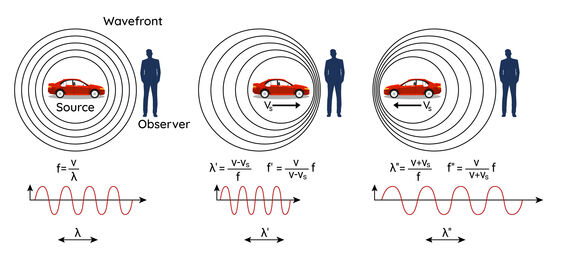
The Doppler effect occurs because of the compression or stretching of wavefronts.

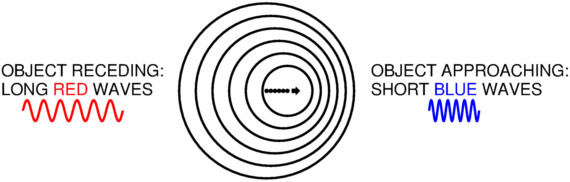
When a wave source moves relative to an observer, the waves in front of the source become compressed, while the waves behind the source become stretched.

When the Source Moves Toward the Observer

  • Wavefronts are compressed
  • Wavelength becomes shorter
  • Frequency increases
  • Sound pitch becomes higher

When the Source Moves Away from the Observer

  • Wavefronts are stretched
  • Wavelength becomes longer
  • Frequency decreases
  • Sound pitch becomes lower

The observer perceives these changes as variations in sound or light.


4. Doppler Effect in Sound Waves

Image
Image
Image
Image

Sound waves provide the most familiar example of the Doppler effect.

When a sound source moves through air, it produces wavefronts that travel outward in all directions.

If the source is stationary, the wavefronts are evenly spaced.

However, if the source moves:

  • Wavefronts in front of the source are closer together.
  • Wavefronts behind the source are farther apart.

This change in spacing causes the frequency heard by the observer to change.

Example: Ambulance Siren

When an ambulance approaches a listener:

  • Sound waves are compressed
  • Frequency increases
  • Pitch becomes higher

When the ambulance moves away:

  • Sound waves stretch
  • Frequency decreases
  • Pitch becomes lower

This change in pitch occurs instantly as the ambulance passes the observer.


5. Mathematical Expression of the Doppler Effect

The Doppler effect can be described mathematically.

For sound waves, the observed frequency is given by:

f′ = f (v ± v₀) / (v ∓ vₛ)

Where:

f′ = observed frequency
f = actual frequency of the source
v = speed of sound in the medium
v₀ = velocity of the observer
vₛ = velocity of the source

Signs depend on the direction of motion.

Source Approaching Observer

f′ = f (v / (v − vₛ))

Observed frequency increases.

Source Moving Away

f′ = f (v / (v + vₛ))

Observed frequency decreases.

These formulas allow scientists to calculate the change in frequency due to motion.


6. Doppler Effect When Observer Moves

The Doppler effect can also occur when the observer moves instead of the source.

Observer Moving Toward Source

Observed frequency increases.

The observer encounters wavefronts more frequently.

Observer Moving Away from Source

Observed frequency decreases.

Wavefronts reach the observer less frequently.

This situation is common when a person moves toward or away from a sound source.


7. Doppler Effect When Both Source and Observer Move

When both the source and the observer move simultaneously, the Doppler effect depends on their relative motion.

If they move toward each other:

Frequency increases.

If they move away from each other:

Frequency decreases.

The mathematical formula accounts for both velocities.


8. Doppler Effect in Light Waves

Image
Image
Image
Image

The Doppler effect also occurs in light waves and other electromagnetic radiation.

In astronomy, this effect is extremely important because it helps scientists determine whether stars and galaxies are moving toward or away from Earth.

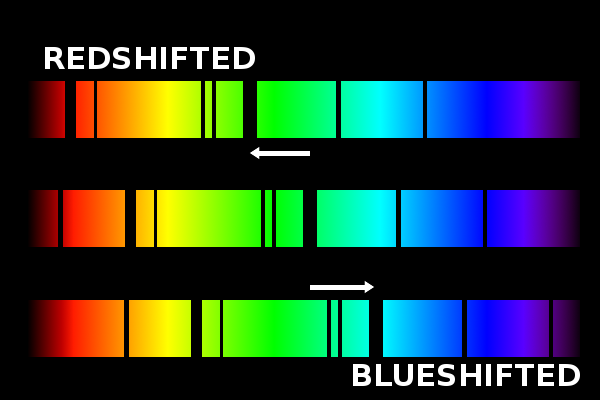
Redshift

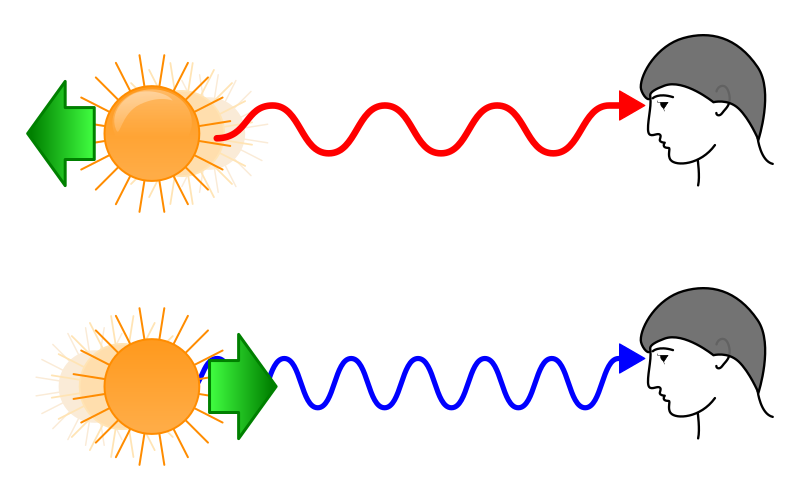
When a light source moves away from the observer:

  • Wavelength increases
  • Light shifts toward the red end of the spectrum

This is called redshift.

Redshift indicates that the object is moving away.


Blueshift

When a light source moves toward the observer:

  • Wavelength decreases
  • Light shifts toward the blue end of the spectrum

This is called blueshift.

Blueshift indicates that the object is moving closer.

Astronomers analyze these shifts in spectral lines to determine the velocity of distant stars and galaxies.


9. Applications of the Doppler Effect

The Doppler effect has many practical applications.

Radar Technology

Radar systems use the Doppler effect to measure the speed of vehicles.

Police radar guns detect the frequency shift of reflected radio waves to determine vehicle speed.


Medical Imaging

Ultrasound machines use the Doppler effect to measure blood flow.

Doctors can observe the movement of blood through arteries and veins.

This technique is known as Doppler ultrasound.


Astronomy

Astronomers use Doppler shifts to study the motion of stars and galaxies.

This helps determine:

  • Star rotation
  • Galaxy movement
  • Expansion of the universe

Weather Forecasting

Weather radars use Doppler shifts to detect the movement of storm clouds and wind patterns.

This helps meteorologists predict severe weather conditions.


10. Doppler Effect in Everyday Life

The Doppler effect can be observed in many everyday situations.

Examples include:

  • Passing ambulance siren
  • Train horn approaching and leaving
  • Racing car engine sound
  • Airplane flying overhead

In each case, the pitch of the sound changes as the source moves relative to the observer.


11. Doppler Effect in Astronomy

The Doppler effect revolutionized modern astronomy.

By studying spectral shifts, scientists can determine:

  • Speed of galaxies
  • Rotation of stars
  • Presence of exoplanets

One of the most important discoveries based on the Doppler effect is that most galaxies show redshift, indicating that the universe is expanding.

This observation led to the development of the Big Bang theory.


12. Limitations of the Doppler Effect

Although the Doppler effect is very useful, it has certain limitations.

  • It depends on relative motion between source and observer.
  • Measurements can be affected by environmental conditions.
  • Accurate results require precise instruments.

Despite these limitations, it remains one of the most powerful tools in wave physics.


13. Importance of the Doppler Effect

The Doppler effect is important for several reasons.

It helps scientists:

  • Measure velocities of distant objects
  • Understand wave propagation
  • Develop medical imaging technologies
  • Study weather systems
  • Analyze astronomical phenomena

The Doppler effect also demonstrates how wave properties change when the source or observer moves.


Conclusion

The Doppler effect is a fundamental phenomenon in wave physics that describes the change in frequency or wavelength of a wave due to the relative motion between the source and the observer. It occurs in all types of waves, including sound waves, water waves, and electromagnetic waves.

When a wave source moves toward an observer, the frequency appears higher and the wavelength becomes shorter. When the source moves away, the frequency decreases and the wavelength increases. This effect explains the changing pitch of passing sirens and provides valuable information about motion in various physical systems.

The Doppler effect has important applications in fields such as radar technology, medical imaging, astronomy, and weather forecasting. It has enabled scientists to measure the motion of distant galaxies and understand the expansion of the universe.

Because of its wide range of applications and its fundamental role in wave physics, the Doppler effect remains one of the most significant concepts in modern science and technology.


Tags:
Beats in Sound Waves

Image
Image
Image
Image

1. Introduction to Beats

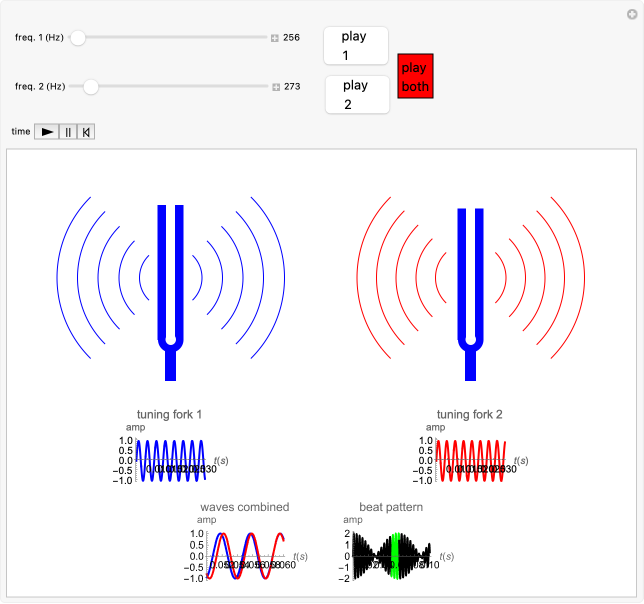
The phenomenon of beats is one of the most interesting effects observed in sound waves and wave interference. Beats occur when two sound waves of slightly different frequencies travel through the same medium and interfere with each other. The result of this interference is a periodic variation in the loudness or intensity of the sound.

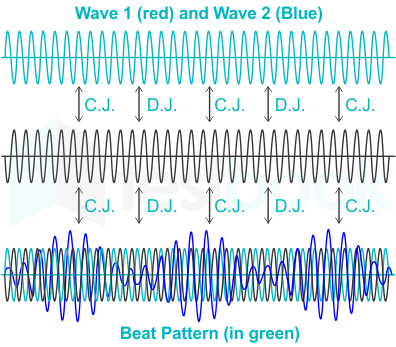
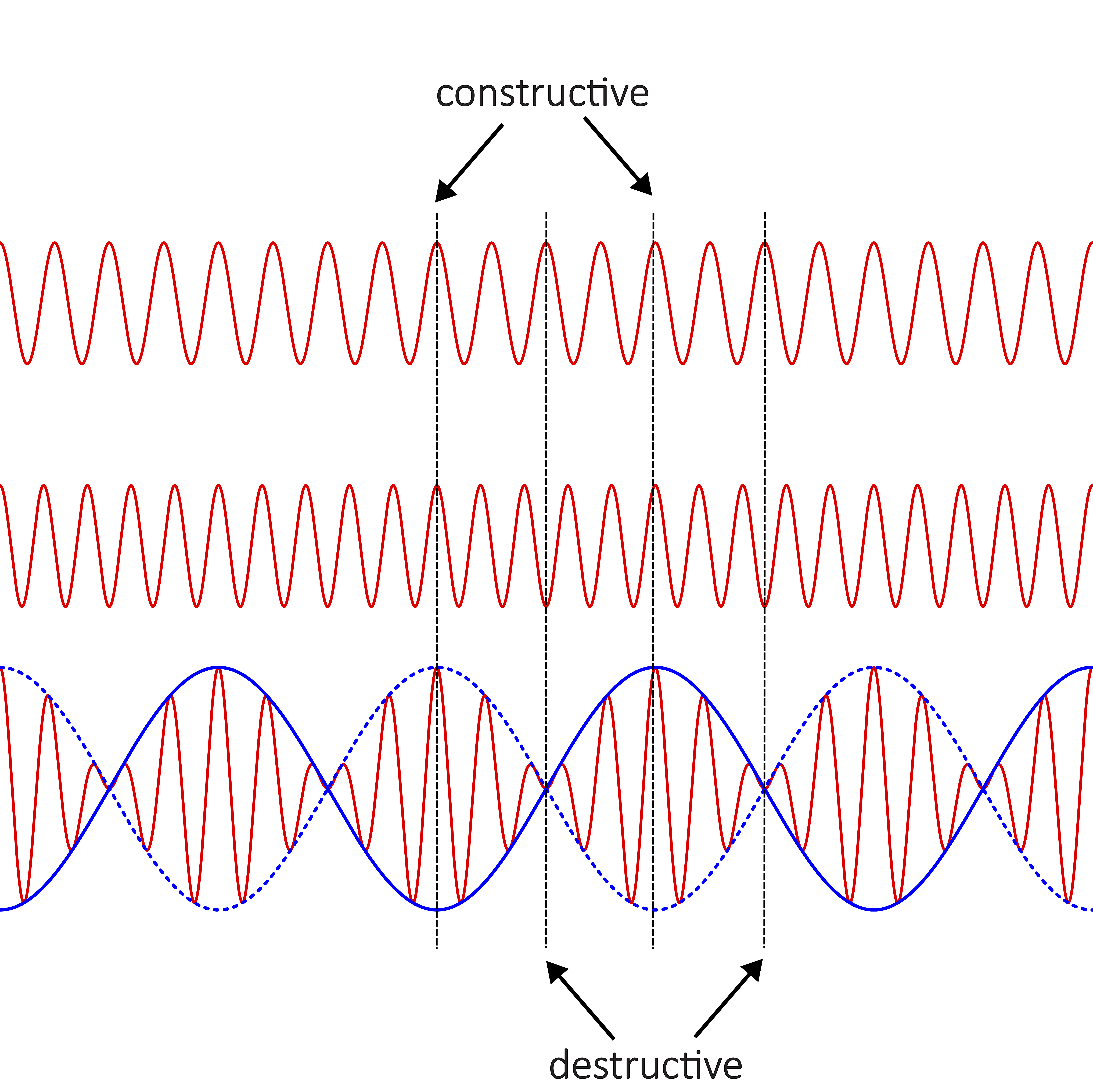
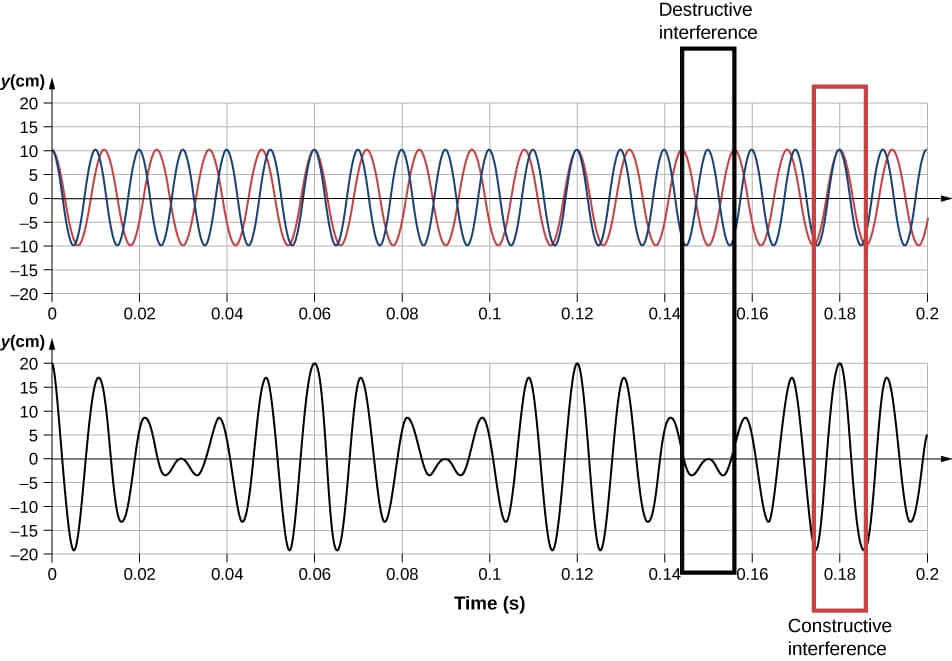
When these two waves overlap, they alternately reinforce and cancel each other due to constructive and destructive interference. This produces a rhythmic pattern of loud and soft sounds that can be heard by the human ear. The periodic rise and fall in sound intensity is known as beats.

Beats are commonly experienced in music, especially when tuning musical instruments. For example, when two musical instruments are slightly out of tune, the sound they produce creates a pulsating effect due to beats. Musicians often listen carefully to these beats to adjust the tuning of their instruments.

The study of beats is important in acoustics, music theory, and physics because it provides insight into wave interference, sound frequency analysis, and harmonic vibrations.


2. Definition of Beats

Beats can be defined as:

Beats are periodic variations in the intensity or loudness of sound produced when two sound waves of slightly different frequencies interfere with each other.

In this phenomenon:

  • The waves alternately reinforce and cancel each other.
  • This produces alternating loud and soft sounds.
  • The loudness variation occurs at a frequency called the beat frequency.

The human ear perceives beats when the difference between the frequencies of the two waves is small.


3. Formation of Beats

Image
Image
Image
Image

Beats occur due to the principle of superposition of waves.

Consider two sound waves traveling in the same direction.

Wave 1:

y₁ = A sin(2πf₁t)

Wave 2:

y₂ = A sin(2πf₂t)

Where:

A = amplitude
f₁ = frequency of first wave
f₂ = frequency of second wave

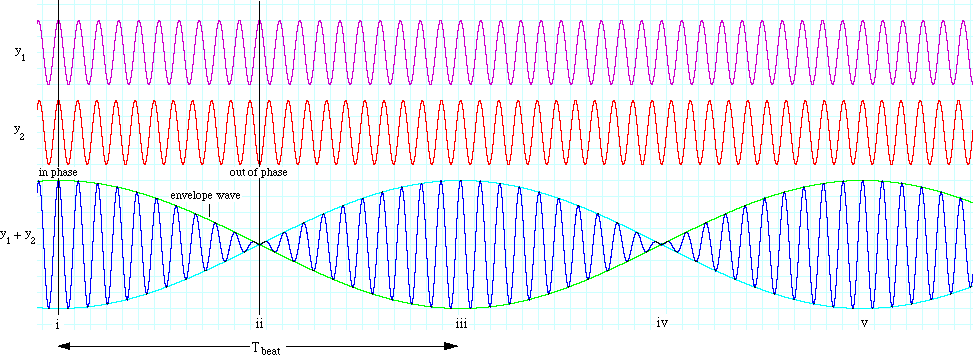
When these waves combine, they produce a resultant wave whose amplitude varies periodically.

This variation in amplitude produces the characteristic pulsating sound known as beats.

Constructive Interference

When the waves are in phase:

  • Amplitudes add together
  • Sound becomes louder

Destructive Interference

When the waves are out of phase:

  • Amplitudes cancel each other
  • Sound becomes weaker or silent

These alternating conditions create the beat effect.


4. Beat Frequency

The number of beats heard per second is called the beat frequency.

Beat frequency formula:

f_beat = | f₁ − f₂ |

Where:

f₁ = frequency of first sound wave
f₂ = frequency of second sound wave

The beat frequency equals the absolute difference between the two frequencies.

Example

If two tuning forks produce frequencies:

f₁ = 256 Hz
f₂ = 260 Hz

Then:

f_beat = |260 − 256|

f_beat = 4 Hz

This means four beats are heard every second.


5. Mathematical Explanation of Beats

The resultant displacement of two waves can be derived mathematically.

Consider two waves:

y₁ = A sin(2πf₁t)

y₂ = A sin(2πf₂t)

Using trigonometric identities:

y = 2A cos[π(f₁ − f₂)t] sin[π(f₁ + f₂)t]

This equation shows that the amplitude varies with time according to the cosine term.

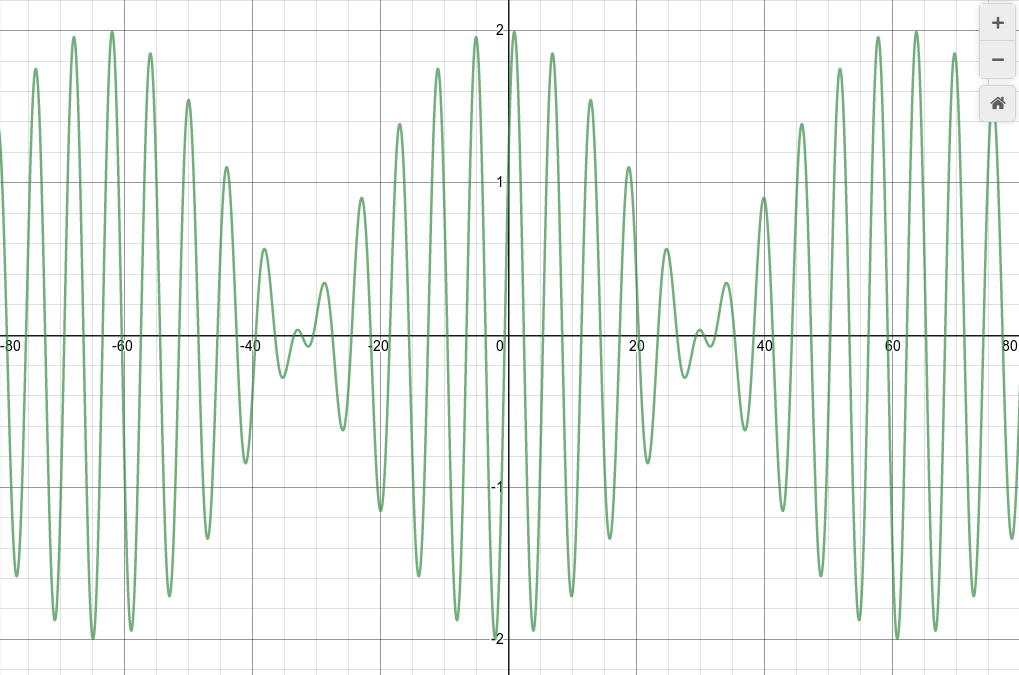
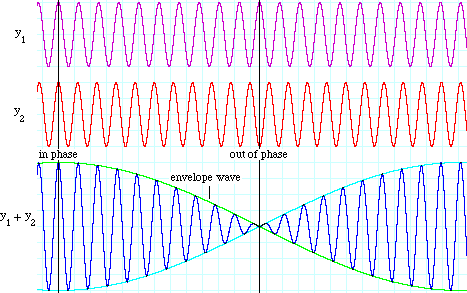
This varying amplitude produces the envelope of the wave, which corresponds to the beats heard.


6. Beat Envelope

Image
Image
Image
Image

The beat phenomenon produces a wave whose amplitude changes periodically.

The outer curve of this changing amplitude is called the beat envelope.

Characteristics of the beat envelope:

  • It represents the variation in sound intensity.
  • Peaks correspond to loud sounds.
  • Valleys correspond to soft sounds.

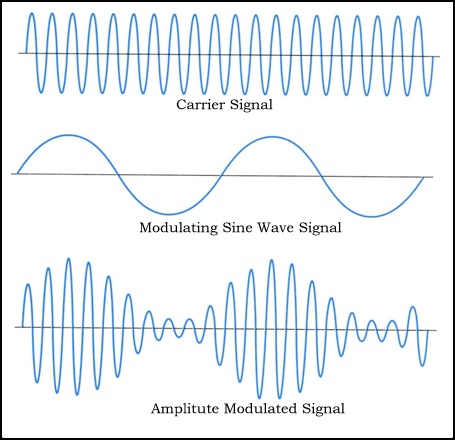
This pattern is similar to amplitude modulation used in radio communication.


7. Conditions for Beats

Certain conditions must be satisfied for beats to occur.

Small Frequency Difference

The frequencies of the two waves must differ slightly.

If the difference is too large, separate tones are heard instead of beats.

Same Amplitude

The waves should have similar amplitudes for clear beat formation.

Same Medium

The waves must travel through the same medium.

Similar Direction

The waves should propagate in approximately the same direction.


8. Beats in Musical Instruments

Image
Image
Image
Image

Beats are widely used in music for tuning instruments.

Instrument Tuning

When two instruments produce slightly different frequencies, beats are heard.

Musicians adjust the tuning until the beats disappear.

When beats stop:

  • The frequencies become equal
  • The instruments are properly tuned

Example

Two tuning forks may produce frequencies close to each other.

If beats are heard, the frequencies differ.

By adjusting one fork until beats vanish, the correct frequency is achieved.


9. Applications of Beats

The phenomenon of beats has many practical applications.

Musical Tuning

Musicians rely on beats to tune instruments accurately.

Determining Unknown Frequency

Beats help determine the frequency of a sound source.

By comparing it with a known frequency, the unknown frequency can be calculated.

Acoustics Research

Beats help analyze sound wave properties and interference patterns.

Signal Processing

Beat patterns are used in certain electronic signal processing techniques.


10. Beats in Electronics and Communication

The concept of beats also appears in electronics and radio technology.

Heterodyning

Heterodyning is a process where two frequencies mix to produce a beat frequency.

This technique is used in:

  • Radio receivers
  • Radar systems
  • Signal modulation

The resulting beat frequency can be easier to detect and analyze.


11. Difference Between Beats and Interference

Although beats result from interference, they are not exactly the same phenomenon.

Interference refers to the general superposition of waves.

Beats are a specific type of interference where the frequencies differ slightly and produce a rhythmic variation in amplitude.

In interference patterns such as double-slit experiments, the pattern is spatial.

In beats, the variation occurs with time.


12. Human Perception of Beats

The human ear can detect beats only when the frequency difference is small.

If the difference is less than about 10 Hz, beats are clearly heard.

If the difference becomes larger:

  • Beats become too rapid
  • The ear perceives two separate tones instead.

This limitation depends on the sensitivity of human hearing.


13. Beats in Nature

Beats can occur naturally when multiple sound sources interact.

Examples include:

  • Musical instruments playing together
  • Vibrations of nearby machinery
  • Sound waves produced by wind instruments

In large spaces like concert halls, multiple reflections can also create beat-like patterns.


14. Importance of Beats in Physics

Beats provide important insights into wave behavior.

They demonstrate:

  • Wave interference
  • Superposition principle
  • Sound frequency analysis
  • Amplitude modulation

Beats also help physicists measure frequencies with high precision.

Because of this, beats are an important concept in acoustics and wave physics.


15. Experimental Demonstration of Beats

Beats can be easily demonstrated using simple experiments.

Tuning Fork Experiment

  1. Strike two tuning forks with slightly different frequencies.
  2. Hold them close together.
  3. A periodic increase and decrease in sound intensity is heard.

Signal Generator Experiment

Two signal generators can produce sound waves with close frequencies.

When played together through speakers, beats are observed.


Conclusion

Beats are a fascinating phenomenon that arises when two sound waves of slightly different frequencies interfere with each other. This interference produces a periodic variation in sound intensity, resulting in alternating loud and soft sounds that can be heard as beats.

The number of beats per second is determined by the difference between the frequencies of the two waves. This property allows beats to be used for measuring frequencies and tuning musical instruments.

The phenomenon of beats illustrates the principle of superposition and demonstrates how waves interact with one another. Beats are important not only in acoustics and music but also in electronics, communication technology, and signal processing.

Understanding beats provides valuable insight into the behavior of waves and the nature of sound. It also highlights how wave interference can produce complex patterns and effects that play an important role in both science and everyday life.


Tags:

Interference of Waves

Image
Image
Image
Image

1. Introduction to Interference of Waves

Interference of waves is one of the most fascinating phenomena in physics. It occurs when two or more waves overlap in space and combine to produce a new wave pattern. This process results in regions where waves reinforce each other and regions where they cancel each other out. The resulting pattern is called an interference pattern.

Wave interference demonstrates the fundamental principle known as the superposition principle, which states that when multiple waves occupy the same region of space, the resultant displacement at any point is equal to the algebraic sum of the displacements caused by each individual wave.

Interference is observed in many different types of waves including sound waves, water waves, light waves, radio waves, and even matter waves in quantum mechanics. It plays a crucial role in many scientific and technological applications such as optics, acoustics, signal processing, and communication systems.

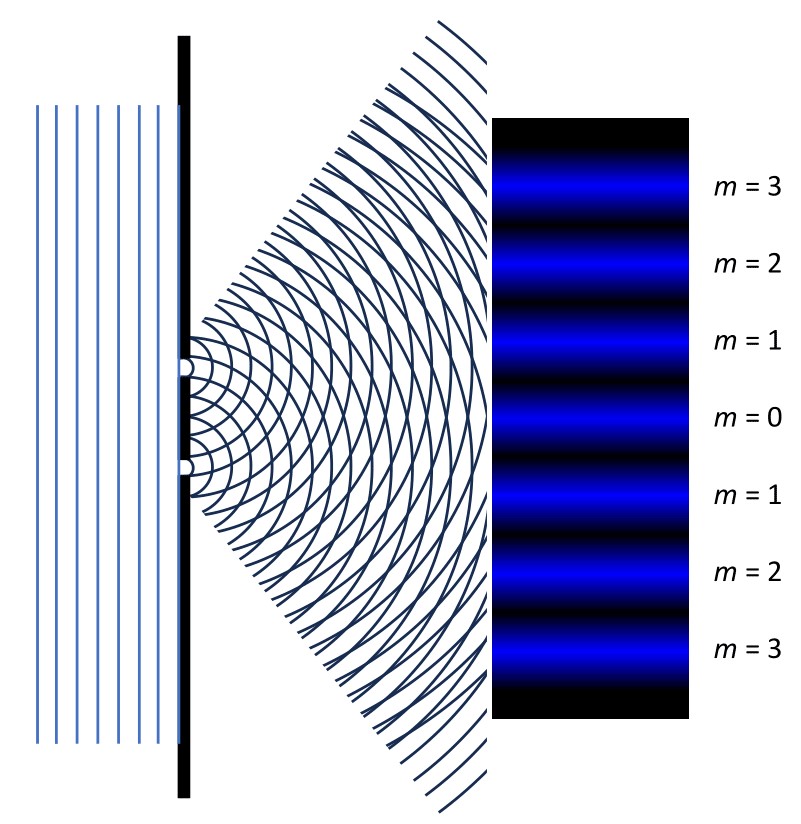
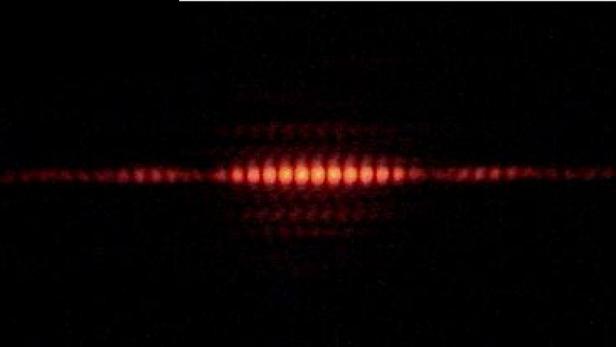
One of the most famous demonstrations of wave interference is the double-slit experiment, which showed that light behaves like a wave by producing alternating bright and dark fringes on a screen.

Understanding interference helps scientists analyze wave behavior, determine wavelengths, design optical devices, and develop technologies like holography, interferometers, and noise-canceling headphones.


2. Principle of Superposition

The principle of superposition is the foundation of wave interference.

Principle of Superposition:

When two or more waves overlap in a medium, the resultant displacement at any point is equal to the sum of the displacements produced by each wave individually.

Mathematically:

y = y₁ + y₂

Where:

y = resultant displacement
y₁ = displacement due to first wave
y₂ = displacement due to second wave

This means that waves do not permanently alter each other when they meet. They simply combine temporarily and then continue traveling as if they had never interacted.

This property distinguishes waves from particles.


3. Conditions for Interference

For interference to occur clearly and produce a stable pattern, certain conditions must be satisfied.

Coherent Sources

The waves must originate from coherent sources.

Coherent sources have:

  • Same frequency
  • Constant phase difference

Without coherence, the interference pattern becomes unstable and disappears.

Same Wavelength

The interfering waves must have the same wavelength.

Comparable Amplitudes

If one wave has much larger amplitude than the other, the interference pattern becomes less noticeable.

Overlapping Waves

The waves must meet at the same point in space.

When these conditions are satisfied, a stable interference pattern can be observed.


4. Types of Interference

Image
Image
Image
Image

There are two main types of interference.

Constructive Interference

Constructive interference occurs when two waves combine in such a way that their displacements reinforce each other.

This happens when:

  • Crest meets crest
  • Trough meets trough

In this case, the resultant wave has larger amplitude.

Condition for constructive interference:

Path difference = nλ

Where:

n = 0,1,2,3…

λ = wavelength

Constructive interference produces bright fringes in light waves or louder sounds in sound waves.


Destructive Interference

Destructive interference occurs when waves combine in such a way that their displacements cancel each other.

This happens when:

  • Crest meets trough

In this case, the resultant amplitude decreases or becomes zero.

Condition for destructive interference:

Path difference = (2n + 1) λ / 2

Destructive interference produces dark fringes in light interference patterns.


5. Interference in Water Waves

Image
Image
Image
Image

Water waves provide a simple way to observe interference.

When two wave sources generate waves in water, the waves spread outward and overlap.

This creates a pattern consisting of:

  • Regions of large waves
  • Regions of small or zero waves

These regions form lines called:

Antinodal lines – constructive interference
Nodal lines – destructive interference

Ripple tanks are commonly used in laboratories to demonstrate water wave interference.


6. Interference of Sound Waves

Sound waves also exhibit interference.

When two sound waves overlap, they combine according to the superposition principle.

This can produce areas of:

  • Loud sound (constructive interference)
  • Quiet sound (destructive interference)

Example: Noise-Canceling Headphones

Noise-canceling headphones use destructive interference.

They generate sound waves that are opposite in phase to incoming noise.

When the two waves combine, they cancel each other.

This reduces unwanted noise.

Example: Beats

When two sound waves of slightly different frequencies interfere, they produce beats.

The sound intensity alternates between loud and soft.

Beat frequency:

fbeat = |f₁ − f₂|


7. Interference of Light Waves

Image
Image
Image
Image

Light interference is one of the most important phenomena in optics.

Because light behaves as a wave, it can produce interference patterns when two coherent light sources overlap.

Young’s Double-Slit Experiment

In this famous experiment:

  1. Light passes through two narrow slits.
  2. Each slit acts as a coherent source.
  3. The waves overlap on a screen.
  4. Alternating bright and dark fringes appear.

Bright fringes occur due to constructive interference.

Dark fringes occur due to destructive interference.

This experiment provided strong evidence for the wave nature of light.


8. Mathematical Description of Interference

Consider two waves with equal amplitude.

Wave equations:

y₁ = A sin(ωt)

y₂ = A sin(ωt + φ)

Resultant wave:

y = 2A cos(φ/2) sin(ωt + φ/2)

Where:

φ = phase difference

Resultant amplitude:

A_resultant = 2A cos(φ/2)

Special cases:

φ = 0 → maximum amplitude (constructive interference)

φ = π → zero amplitude (destructive interference)

This mathematical treatment helps predict interference patterns.


9. Path Difference and Phase Difference

Two waves may reach a point with different distances traveled.

This difference is called path difference.

Path difference determines whether interference is constructive or destructive.

Constructive Interference

Path difference = nλ

Destructive Interference

Path difference = (2n + 1) λ / 2

Phase difference is related to path difference by:

Phase difference = 2π × (path difference / λ)

Understanding this relationship helps analyze wave interactions.


10. Standing Waves

Standing waves are formed by interference of two waves traveling in opposite directions.

This produces a pattern with fixed points called nodes and antinodes.

Nodes: points of zero displacement
Antinodes: points of maximum displacement

Standing waves occur in:

  • Guitar strings
  • Organ pipes
  • Microwave cavities

Standing waves are important in musical instruments and resonant systems.


11. Applications of Wave Interference

Interference has many practical applications in science and technology.

Optical Interferometers

Interferometers measure extremely small distances using light interference.

Examples:

Michelson interferometer
Fabry–Perot interferometer


Holography

Holography uses interference patterns to record three-dimensional images.


Noise Control

Destructive interference is used in noise reduction technologies.


Astronomy

Interference techniques help astronomers measure star distances and detect exoplanets.


Thin Film Technology

Interference of light in thin films produces colorful patterns seen in soap bubbles and oil films.


12. Interference in Nature

Interference appears in many natural phenomena.

Examples include:

  • Colors of soap bubbles
  • Patterns in butterfly wings
  • Ocean wave patterns
  • Sound interference in large halls

These natural examples demonstrate how wave interactions shape our environment.


13. Importance of Interference in Physics

Interference is extremely important because it provides evidence of the wave nature of phenomena.

It helps scientists understand:

  • Wave propagation
  • Optical phenomena
  • Quantum mechanics
  • Signal processing
  • Acoustic engineering

In quantum mechanics, even particles such as electrons can produce interference patterns, demonstrating their wave-like behavior.


Conclusion

Interference of waves is a fundamental phenomenon that occurs when two or more waves overlap and combine. The principle of superposition explains how wave displacements add together to produce constructive and destructive interference patterns.

Constructive interference occurs when waves reinforce each other, producing larger amplitudes, while destructive interference occurs when waves cancel each other out. These interactions create complex patterns that can be observed in water waves, sound waves, and light waves.

Wave interference has important applications in many scientific fields including optics, acoustics, astronomy, and engineering. Technologies such as interferometers, holography, noise-canceling devices, and optical coatings rely on interference principles.

The study of interference has also played a crucial role in demonstrating the wave nature of light and matter, making it one of the most significant concepts in modern physics. Understanding interference helps scientists explore wave behavior and develop technologies that harness wave interactions for practical use.


Tags:
Sound Waves

Image
Image
Image
Image

1. Introduction to Sound Waves

Sound waves are a fundamental form of wave motion that plays an essential role in communication, music, technology, and many natural processes. Sound is produced whenever an object vibrates, creating disturbances that travel through a medium such as air, water, or solids. These disturbances propagate as waves and can be detected by the human ear or specialized instruments.

Unlike light waves, sound waves require a material medium to travel through. They cannot propagate through empty space because they rely on the vibrations of particles within a medium to transfer energy. When a sound is produced, the particles of the medium vibrate back and forth around their equilibrium positions, passing energy from one particle to the next.

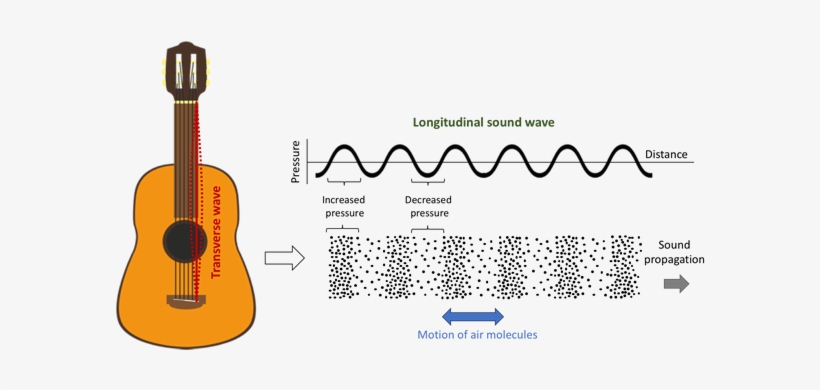
Sound waves are an example of mechanical longitudinal waves, meaning that the oscillations of the particles occur in the same direction as the wave propagation. As the wave travels, regions of compression and rarefaction form within the medium. These alternating regions create the pressure variations that our ears interpret as sound.

The study of sound waves is known as acoustics, which is a branch of physics that examines sound production, transmission, and perception. Acoustics has applications in many fields, including engineering, architecture, music, medicine, and environmental science.

Understanding sound waves helps explain phenomena such as echoes, musical tones, noise pollution, sonar systems, and ultrasound imaging.


2. Definition of Sound Waves

A sound wave can be defined as:

A mechanical longitudinal wave that propagates through a medium due to vibrations of particles and transfers energy in the form of pressure variations.

Sound waves consist of alternating regions of high pressure and low pressure within the medium.

These regions are known as:

  • Compression
  • Rarefaction

As the wave moves through the medium, particles vibrate parallel to the direction of wave propagation.

Key characteristics of sound waves include:

  • They require a medium.
  • They involve particle vibrations.
  • They carry energy.
  • They travel with a specific speed depending on the medium.

3. Production of Sound

Image
Image
Image
Image

Sound is produced whenever an object vibrates.

These vibrations disturb the surrounding medium, creating waves that travel outward.

Example: Tuning Fork

When a tuning fork is struck:

  1. The prongs vibrate.
  2. Air molecules around the fork are compressed.
  3. These compressions move outward through the air.
  4. Rarefactions follow the compressions.
  5. The alternating pattern travels as a sound wave.

Example: Human Voice

Human speech is produced by vibrations of the vocal cords in the larynx.

Air passing through the vocal cords causes them to vibrate.

These vibrations create sound waves that travel through the air.

Example: Musical Instruments

Musical instruments produce sound through vibrations of strings, membranes, or air columns.

Examples:

  • Guitar strings vibrate to produce musical tones.
  • Drums produce sound through vibrating membranes.
  • Flutes produce sound through vibrating air columns.

4. Structure of Sound Waves

Image
Image
Image
Image

Sound waves consist of two main regions.

Compression

Compression occurs when particles of the medium are pushed together.

This creates a region of high pressure and high density.

Rarefaction

Rarefaction occurs when particles move apart.

This creates a region of low pressure and low density.

These compressions and rarefactions move through the medium as the sound wave travels.

Although the wave moves forward, the particles only oscillate back and forth around their equilibrium positions.


5. Properties of Sound Waves

Sound waves have several measurable properties.

Wavelength

Wavelength is the distance between two consecutive compressions or rarefactions.

Symbol: λ

Unit: meter


Frequency

Frequency is the number of sound wave cycles passing a point per second.

Symbol: f

Unit: Hertz (Hz)

Higher frequency produces higher pitch.


Amplitude

Amplitude measures the maximum pressure variation in the wave.

Greater amplitude corresponds to louder sound.


Wave Speed

Wave speed is the rate at which sound waves travel through a medium.

The speed depends on the properties of the medium.

Formula:

v = fλ

Where:

v = velocity
f = frequency
λ = wavelength


6. Speed of Sound

The speed of sound varies depending on the medium through which it travels.

Typical speeds include:

Air (at 20°C): 343 m/s
Water: 1480 m/s
Steel: about 5000 m/s

Sound travels faster in solids than in liquids and faster in liquids than in gases.

This is because particles in solids are more closely packed and can transfer vibrations more quickly.

Factors Affecting Speed

Several factors influence sound speed:

  • Density of the medium
  • Elastic properties of the medium
  • Temperature
  • Humidity

For example, sound travels faster in warm air than in cold air because higher temperature increases molecular motion.


7. Characteristics of Sound

Image
Image
Image
Image

Sound is perceived by humans through three main characteristics.

Pitch

Pitch is determined by frequency.

High-frequency sounds produce high pitch.

Low-frequency sounds produce low pitch.

Examples:

  • Whistle: high pitch
  • Drum: low pitch

Loudness

Loudness depends on amplitude.

Larger amplitude means louder sound.

Sound intensity is measured in decibels (dB).


Quality (Timbre)

Quality distinguishes sounds produced by different instruments even when they have the same pitch and loudness.

This occurs because different instruments produce different waveforms.

For example:

A violin and piano playing the same note sound different because of their timbre.


8. Types of Sound Waves

Sound waves can be classified based on frequency.

Infrasonic Waves

Frequency less than 20 Hz.

These waves cannot be heard by humans.

Examples:

  • Earthquake vibrations
  • Elephant communication

Audible Sound

Frequency range between 20 Hz and 20,000 Hz.

This is the range detectable by the human ear.


Ultrasonic Waves

Frequency greater than 20,000 Hz.

Used in medical imaging, sonar, and industrial applications.

Animals such as bats and dolphins use ultrasonic waves for navigation.


9. Reflection of Sound

Reflection occurs when sound waves bounce off surfaces.

Example:

Echo.

An echo is heard when sound reflects from a distant object and returns to the listener.

Conditions for hearing an echo:

  • The reflecting surface must be at least 17 meters away.
  • The reflected sound must return after about 0.1 seconds.

Reflection of sound is used in designing auditoriums and concert halls.


10. Refraction of Sound

Refraction occurs when sound waves change direction due to changes in medium properties.

For example:

Sound may travel faster in warm air than in cold air.

This can cause bending of sound waves in the atmosphere.

Refraction explains why distant sounds are sometimes heard more clearly at night.


11. Diffraction of Sound

Diffraction refers to the bending of sound waves around obstacles or openings.

Because sound wavelengths are relatively large, sound diffracts easily.

This is why we can hear sounds around corners even if we cannot see the source.


12. Interference of Sound

When two sound waves meet, they combine according to the superposition principle.

This produces interference patterns.

Types:

Constructive interference – sound becomes louder
Destructive interference – sound becomes weaker

Interference is used in noise-canceling headphones.


13. Applications of Sound Waves

Sound waves have numerous applications in science and technology.

Communication

Speech and hearing rely on sound waves.

Music

Musical instruments create sound through vibrations.

Medical Imaging

Ultrasound uses high-frequency sound waves to produce images of internal organs.

SONAR

SONAR systems use sound waves to detect underwater objects.

Industrial Testing

Ultrasonic waves detect cracks in materials.


14. Sound Waves in Nature

Sound waves play important roles in the natural world.

Examples include:

  • Animal communication
  • Whale and dolphin sonar
  • Earthquake seismic waves
  • Thunder from lightning

Many animals rely on sound waves for navigation and survival.


15. Importance of Sound Waves

Sound waves are essential for many aspects of human life.

They allow:

  • Communication through speech
  • Enjoyment of music
  • Medical diagnosis using ultrasound
  • Underwater exploration
  • Scientific research in acoustics

The study of sound waves has led to many technological innovations that improve communication, healthcare, and engineering.


Conclusion

Sound waves are mechanical longitudinal waves produced by vibrating objects and transmitted through a medium. They consist of alternating compressions and rarefactions that travel through materials such as air, water, and solids.

The properties of sound waves include wavelength, frequency, amplitude, and speed. These properties determine how sound behaves and how it is perceived by the human ear in terms of pitch, loudness, and quality.

Sound waves exhibit several wave behaviors including reflection, refraction, diffraction, and interference. These behaviors explain many natural and technological phenomena such as echoes, acoustic design, sonar systems, and noise control.

The study of sound waves forms the foundation of acoustics and has applications in music, communication, medicine, engineering, and environmental science. Understanding sound waves allows scientists and engineers to analyze how sound is produced, transmitted, and detected, enabling the development of technologies that enhance our ability to communicate and explore the world around us.


Wave Properties: Frequency, Wavelength, and Amplitude

Image
Image
Image
Image

1. Introduction to Wave Properties

Wave motion is one of the most important phenomena in physics because it explains how energy and information travel through space and through different media. Waves occur in many forms, including sound waves, water waves, electromagnetic waves, and even matter waves in quantum mechanics. Although these waves may differ in their physical nature, they share several fundamental characteristics that describe how they behave and propagate.

Among the most important properties of waves are frequency, wavelength, and amplitude. These properties determine the energy carried by a wave, the speed at which it travels, and how it interacts with matter. By understanding these wave properties, scientists and engineers can analyze wave behavior in various fields such as acoustics, optics, oceanography, telecommunications, and seismology.

Every wave can be described using measurable quantities. Frequency indicates how often the wave oscillates, wavelength describes the spatial distance between repeating points in the wave, and amplitude represents the strength or intensity of the oscillation. Together, these parameters define the overall characteristics of a wave and determine how it affects its environment.

Understanding wave properties is essential for interpreting many natural phenomena. For example, the pitch of a musical note depends on frequency, the color of visible light depends on wavelength, and the loudness of a sound depends on amplitude. Similarly, ocean waves, radio signals, and seismic vibrations can all be analyzed using these same fundamental properties.

In physics, waves are often represented graphically as sinusoidal patterns. These graphical representations make it easier to visualize the relationships between frequency, wavelength, amplitude, and wave velocity.


2. Basic Structure of a Wave

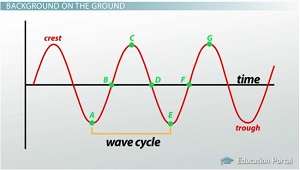
To understand wave properties, it is helpful to examine the structure of a wave. In a typical transverse wave, the wave pattern consists of alternating crests and troughs.

Crest

A crest is the highest point of a wave above the equilibrium position.

Trough

A trough is the lowest point of a wave below the equilibrium position.

Equilibrium Position

The equilibrium position is the rest position of the particles in the medium when no wave is present.

Wave Cycle

One complete wave cycle consists of one crest and one trough or the distance between two identical points such as crest to crest.

These structural features form the basis for defining important wave properties such as wavelength and amplitude.


3. Wavelength

Image
Image
Image
Image

Definition

Wavelength is the distance between two consecutive points in the same phase of a wave.

These points can include:

  • Crest to crest
  • Trough to trough
  • Compression to compression
  • Rarefaction to rarefaction

Wavelength is usually represented by the Greek letter λ (lambda).

Unit of Wavelength

The SI unit of wavelength is meter (m).

However, depending on the type of wave, wavelength may be expressed in different units such as:

  • centimeters
  • millimeters
  • nanometers
  • kilometers

For example:

  • Radio waves may have wavelengths of several kilometers.
  • Visible light wavelengths are measured in nanometers.

Examples of Wavelength

Visible light wavelengths range approximately from:

400 nm (violet light) to 700 nm (red light)

Radio waves can have wavelengths longer than 1 kilometer.

Water waves may have wavelengths ranging from a few centimeters to several meters.

Relationship with Wave Speed

Wavelength is related to wave speed and frequency through the wave equation:

v = fλ

Where:

v = wave velocity
f = frequency
λ = wavelength

If wave speed remains constant, increasing frequency results in a shorter wavelength.


4. Frequency

Image
Image
Image
Image

Definition

Frequency is the number of wave cycles passing a given point in one second.

It indicates how rapidly the wave oscillates.

Frequency is represented by the symbol f.

Unit of Frequency

The SI unit of frequency is Hertz (Hz).

1 Hz means one cycle per second.

Other commonly used units include:

  • kilohertz (kHz)
  • megahertz (MHz)
  • gigahertz (GHz)

These units are commonly used in radio communication and electronics.

Time Period

Frequency is closely related to time period.

Time period is the time required to complete one full cycle.

Relationship:

T = 1 / f

Where:

T = time period
f = frequency

Examples of Frequency

Different types of waves have different frequency ranges.

Human hearing range:

20 Hz to 20,000 Hz

Radio waves:

Thousands to billions of Hz

Visible light:

Around 4 × 10¹⁴ Hz to 7.5 × 10¹⁴ Hz

Effect of Frequency

Frequency determines many important properties.

For sound waves:

Frequency determines pitch.

Higher frequency produces higher pitch.

For electromagnetic waves:

Frequency determines energy and color.

Higher frequency waves have greater energy.


5. Amplitude

Image
Image
Image
Image

Definition

Amplitude is the maximum displacement of a particle from its equilibrium position.

It represents the height of the wave crest or the depth of the trough relative to the equilibrium line.

Amplitude is usually represented by the symbol A.

Unit of Amplitude

The unit of amplitude depends on the type of wave.

For mechanical waves:

meters

For sound waves:

pressure variations

For electromagnetic waves:

electric field intensity

Energy and Amplitude

Wave energy is strongly related to amplitude.

Energy carried by a wave is proportional to the square of the amplitude.

This means:

Doubling amplitude increases energy four times.

Examples

Sound waves:

Large amplitude → loud sound

Small amplitude → soft sound

Water waves:

Large amplitude → powerful waves

Small amplitude → gentle ripples

Light waves:

Higher amplitude → brighter light


6. Relationship Between Frequency, Wavelength, and Wave Speed

One of the most important equations in wave physics connects frequency, wavelength, and velocity.

Wave equation:

v = fλ

Where:

v = wave speed
f = frequency
λ = wavelength

This equation applies to all types of waves.

Example

If a wave has:

Frequency = 10 Hz
Wavelength = 2 m

Then:

v = 10 × 2

v = 20 m/s

Interpretation

If frequency increases while wave speed remains constant, wavelength decreases.

If wavelength increases while speed remains constant, frequency decreases.

This relationship explains many phenomena such as sound pitch changes and light color variations.


7. Wave Properties in Different Types of Waves

Sound Waves

Sound waves are longitudinal waves.

Frequency determines pitch.

Amplitude determines loudness.

Wavelength affects how sound propagates in different environments.


Light Waves

Light waves are electromagnetic waves.

Frequency determines color.

Amplitude determines brightness.

Wavelength determines position in the electromagnetic spectrum.


Water Waves

Water waves involve both transverse and longitudinal motion.

Amplitude determines wave height.

Wavelength determines distance between crests.

Frequency determines how rapidly waves arrive at the shore.


8. Graphical Representation of Wave Properties

Waves are often represented graphically to visualize their properties.

Common graphs include:

Displacement vs Distance

This graph shows the shape of the wave and helps measure wavelength.

Displacement vs Time

This graph shows how particles move over time and helps determine frequency.

Amplitude Representation

The height of the wave from equilibrium shows amplitude.

These graphical methods are widely used in physics and engineering.


9. Applications of Wave Properties

Understanding wave properties is essential in many practical applications.

Music and Acoustics

Musical instruments produce sound waves.

Frequency determines musical pitch.

Amplitude determines loudness.


Communication Technology

Radio waves carry information using frequency modulation.

Television and mobile networks rely on electromagnetic waves.


Medical Imaging

Ultrasound imaging uses high-frequency sound waves to produce images of internal organs.


Oceanography

Wave height and wavelength are studied to understand ocean currents and coastal erosion.


Astronomy

Astronomers analyze electromagnetic waves from stars and galaxies to study the universe.


10. Wave Properties in Nature

Wave properties influence many natural phenomena.

Examples include:

  • Ocean waves
  • Sound propagation in atmosphere
  • Light from the Sun
  • Seismic waves during earthquakes
  • Vibrations of atoms in solids

Understanding these properties allows scientists to analyze and predict natural processes.


11. Energy Transport by Waves

Waves transport energy without transporting matter.

Energy transfer occurs through oscillations of particles.

The amount of energy depends mainly on amplitude.

Higher amplitude waves carry more energy and can cause stronger physical effects.

For example:

Large ocean waves can damage ships and coastlines because of their high energy.

Similarly, powerful seismic waves during earthquakes cause destruction due to their large amplitude.


12. Importance of Wave Properties in Physics

Wave properties are essential for understanding many physical systems.

They help explain:

  • Sound transmission
  • Light propagation
  • Electromagnetic radiation
  • Quantum mechanical waves
  • Vibrations in mechanical systems

Many modern technologies depend on controlling wave properties.

Examples include:

  • Laser technology
  • Fiber optic communication
  • Radar systems
  • Medical imaging equipment

Thus, wave properties play a fundamental role in science and engineering.


Conclusion

Wave properties such as frequency, wavelength, and amplitude are fundamental concepts in physics that describe how waves behave and propagate through different environments. These properties determine how waves carry energy, interact with matter, and transmit information.

Wavelength describes the spatial distance between repeating points in a wave, frequency indicates how often the wave oscillates, and amplitude represents the strength or intensity of the wave. Together, these properties are related through the fundamental wave equation that connects wave speed, frequency, and wavelength.

Understanding wave properties allows scientists and engineers to analyze sound, light, ocean waves, seismic vibrations, and electromagnetic radiation. These principles are essential for modern technologies including communication systems, medical imaging devices, and scientific instruments.

The study of wave properties therefore provides a powerful framework for understanding many natural phenomena and technological applications. By analyzing frequency, wavelength, and amplitude, researchers can predict wave behavior and harness wave energy for practical purposes across many fields of science and engineering.


Tags:

Wave Motion

Image
Image
Image
Image

1. Introduction to Wave Motion

Wave motion is one of the most fundamental phenomena in physics and plays an essential role in understanding how energy and disturbances travel through space or through a medium. Waves are responsible for many natural events and technological applications such as sound transmission, ocean waves, light propagation, radio communication, and seismic vibrations.

In physics, wave motion refers to the propagation of disturbances from one place to another without the permanent displacement of the particles of the medium. Instead of the particles themselves traveling across large distances, they oscillate about their equilibrium positions while transferring energy to neighboring particles. This chain of oscillations results in the movement of energy through the medium in the form of waves.

Wave motion occurs in many forms throughout nature. The ripples on the surface of water, vibrations of a guitar string, sound traveling through air, and electromagnetic radiation such as light are all examples of wave motion.

Understanding wave motion is important because it connects many areas of physics including mechanics, acoustics, optics, electromagnetism, and quantum physics. Waves help explain how information and energy travel through different environments.


2. Definition of Wave Motion

Wave motion can be defined as:

Wave motion is the propagation of energy and disturbances through a medium or space without the net movement of matter.

In wave motion:

  • Particles oscillate around their equilibrium positions.
  • Energy is transferred from one particle to another.
  • The wave travels through the medium while particles remain near their original positions.

For example, when a stone is dropped into water, circular ripples spread outward. The water molecules do not travel across the surface; instead, they oscillate up and down while the wave energy moves outward.

This principle applies to most types of waves.


3. Characteristics of Wave Motion

Wave motion has several defining characteristics that help describe how waves behave and propagate.

Energy Transfer

The most important feature of wave motion is the transfer of energy. Energy moves from one point to another through oscillations of particles.

Oscillation of Particles

Particles of the medium oscillate about their equilibrium position. These oscillations allow energy to pass from particle to particle.

No Permanent Displacement

Although particles move back and forth, they return to their original positions after the wave passes.

Propagation

Waves travel through space or a medium with a certain velocity known as wave speed.

Periodicity

Most waves repeat their motion regularly and are therefore periodic in nature.


4. Types of Wave Motion

Wave motion can be classified into different types depending on how particles move and how the wave propagates.

Mechanical Waves

Mechanical waves require a medium to travel through. The medium may be solid, liquid, or gas.

Examples include:

  • Sound waves
  • Water waves
  • Waves in strings
  • Seismic waves

Mechanical waves cannot travel in a vacuum because they require particles to transmit energy.


Electromagnetic Waves

Electromagnetic waves do not require a medium. They can travel through empty space.

Examples include:

  • Visible light
  • Radio waves
  • X-rays
  • Gamma rays
  • Microwaves

These waves consist of oscillating electric and magnetic fields.


Matter Waves

Matter waves are associated with moving particles such as electrons.

According to quantum mechanics, particles exhibit wave-like properties.

This concept was introduced by Louis de Broglie and forms the basis of quantum theory.


5. Transverse and Longitudinal Waves

Image
Image
Image
Image

Transverse Waves

In transverse waves, the particles of the medium oscillate perpendicular to the direction of wave propagation.

Examples include:

  • Waves on a string
  • Water surface waves
  • Light waves

Important parts of transverse waves include:

  • Crest (highest point)
  • Trough (lowest point)
  • Wavelength (distance between crests)

Longitudinal Waves

In longitudinal waves, particles oscillate parallel to the direction of wave propagation.

Examples include:

  • Sound waves
  • Compression waves in springs

Key features:

  • Compression: particles close together
  • Rarefaction: particles spread apart

Sound waves travel through air as longitudinal waves.


6. Wave Parameters

To describe wave motion quantitatively, several physical parameters are used.

Wavelength

Wavelength (λ) is the distance between two consecutive points in the same phase of the wave.

Examples:

  • Distance between two crests
  • Distance between two compressions

Unit: meter


Frequency

Frequency (f) is the number of wave cycles passing a point in one second.

Unit: Hertz (Hz)

Higher frequency means more oscillations per second.


Time Period

Time period (T) is the time taken for one complete wave cycle.

Relation between frequency and time period:

T = 1 / f


Wave Speed

Wave speed describes how fast the wave travels.

Wave speed formula:

v = fλ

Where:

v = wave velocity
f = frequency
λ = wavelength

This equation is fundamental in wave physics.


Amplitude

Amplitude is the maximum displacement of particles from equilibrium.

Greater amplitude corresponds to higher energy in the wave.

In sound waves, amplitude determines loudness.


7. Wave Energy

Image
Image
Image
Image

Waves carry energy from one location to another.

Energy in waves depends mainly on amplitude.

Key points:

  • Energy is proportional to amplitude squared.
  • Higher amplitude waves carry more energy.
  • Energy is transferred without transporting matter.

For example:

Ocean waves carry enormous energy capable of moving ships and eroding coastlines.

Similarly, sound waves carry energy that allows us to hear vibrations.


8. Wave Behavior

Waves exhibit several important behaviors when they encounter obstacles or boundaries.

Reflection

Reflection occurs when a wave bounces back after hitting a surface.

Examples:

  • Echo of sound
  • Reflection of light from mirrors

Refraction

Refraction occurs when waves change direction while entering a different medium.

This happens because wave speed changes.

Example:

Light bending when entering water.


Diffraction

Diffraction is the bending of waves around obstacles or openings.

Example:

Sound waves spreading around corners.


Interference

Interference occurs when two waves overlap and combine.

Types of interference:

  • Constructive interference: waves reinforce each other
  • Destructive interference: waves cancel each other

Interference patterns are seen in water waves and light waves.


9. Superposition Principle

The superposition principle states that when two or more waves overlap, the resultant displacement is the sum of individual displacements.

This principle explains:

  • Interference patterns
  • Standing waves
  • Beat formation

Superposition is a fundamental concept in wave physics.


10. Standing Waves

Standing waves are formed when two waves of equal frequency travel in opposite directions.

This produces fixed points called nodes and antinodes.

Nodes: points of zero displacement
Antinodes: points of maximum displacement

Standing waves occur in:

  • Guitar strings
  • Organ pipes
  • Microwave cavities

11. Sound Waves

Sound waves are mechanical longitudinal waves that travel through air, liquids, and solids.

Characteristics of sound waves include:

Pitch – determined by frequency
Loudness – determined by amplitude
Quality – determined by waveform

Sound travels at different speeds depending on the medium.

Typical speed in air:

343 m/s

Sound cannot travel in a vacuum.


12. Water Waves

Water waves are surface waves that involve both transverse and longitudinal motion.

Particles move in circular paths as waves pass.

Examples include:

  • Ocean waves
  • Ripples in ponds
  • Tidal waves

Water waves play an important role in oceanography and coastal processes.


13. Electromagnetic Waves

Electromagnetic waves consist of oscillating electric and magnetic fields.

They travel at the speed of light:

c = 3 × 10⁸ m/s

Types include:

  • Radio waves
  • Microwaves
  • Infrared
  • Visible light
  • Ultraviolet
  • X-rays
  • Gamma rays

Electromagnetic waves are essential for communication technologies.


14. Applications of Wave Motion

Wave motion has numerous applications in science and technology.

Communication

Radio, television, and mobile networks use electromagnetic waves.

Medical Imaging

Ultrasound uses sound waves to visualize internal organs.

Ocean Engineering

Wave energy can be converted into electricity.

Earthquake Detection

Seismic waves help scientists study earthquakes.

Musical Instruments

Sound waves produced by vibrating strings and air columns create music.


15. Wave Motion in Nature

Wave motion occurs everywhere in nature.

Examples include:

  • Ocean tides
  • Light from the Sun
  • Sound waves from animals
  • Seismic waves from earthquakes
  • Vibrations of atoms in solids

Even at microscopic levels, waves play an important role in quantum mechanics and atomic structure.


16. Importance of Wave Motion

Wave motion is crucial for understanding many physical processes.

Its importance includes:

  • Explaining sound and light
  • Understanding earthquakes
  • Designing communication systems
  • Studying atomic and quantum systems
  • Developing medical technologies

Because waves transport energy and information across distances, they form the basis of many modern technologies.


Conclusion

Wave motion is a fundamental phenomenon in physics that describes how energy and disturbances propagate through space or through a medium. In wave motion, particles oscillate around their equilibrium positions while energy moves from one location to another.

Waves exist in many forms including mechanical waves, electromagnetic waves, and matter waves. Their properties such as wavelength, frequency, amplitude, and velocity help describe their behavior and interactions.

Wave motion explains many natural and technological phenomena including sound, light, ocean waves, radio communication, and medical imaging. The study of waves connects different branches of physics and plays an essential role in modern science and engineering.

Understanding wave motion helps us analyze and control energy transfer, design advanced technologies, and explore the fundamental nature of the universe.


Tags:

Simple Harmonic Motion (SHM)

Image
Image
Image
Image

1. Introduction to Simple Harmonic Motion

Simple Harmonic Motion (SHM) is one of the most important concepts in classical physics and plays a central role in understanding oscillatory systems. It describes a special type of periodic motion where an object moves back and forth about an equilibrium position under the influence of a restoring force that is directly proportional to its displacement from that position.

Many natural phenomena exhibit SHM or approximate it under certain conditions. The vibration of a guitar string, oscillation of a mass attached to a spring, swinging of a pendulum, and even the motion of atoms in solids can often be modeled using simple harmonic motion.

SHM is particularly significant because it provides a mathematical model that is both simple and extremely powerful. Many complex systems can be approximated as simple harmonic oscillators when the displacement from equilibrium is small.

Understanding SHM is essential for studying waves, acoustics, electronics, mechanical vibrations, and even quantum mechanics.


2. Definition of Simple Harmonic Motion

Simple harmonic motion can be defined as:

A type of periodic motion in which the restoring force acting on a particle is directly proportional to its displacement from the equilibrium position and always directed toward that equilibrium position.

Mathematically:

F = −kx

Where:

F = restoring force
k = force constant (spring constant)
x = displacement from equilibrium

The negative sign indicates that the force acts in the direction opposite to displacement.

Since force causes acceleration according to Newton’s second law:

F = ma

Therefore:

ma = −kx

or

a = −(k/m)x

This equation shows that acceleration is proportional to displacement and directed toward the equilibrium position.

This characteristic property defines simple harmonic motion.


3. Basic Concepts of SHM

1. Equilibrium Position

The equilibrium position is the point where the net force acting on the particle is zero.

At this point:

  • Acceleration = 0
  • Restoring force = 0
  • Potential energy is minimum
  • Velocity is maximum

The oscillating body continuously passes through this position during motion.


2. Displacement

Displacement is the distance of the particle from the equilibrium position.

In SHM, displacement varies periodically with time and follows a sinusoidal pattern.

If x represents displacement, then:

x = A sin(ωt + φ)

Where:

A = amplitude
ω = angular frequency
t = time
φ = phase constant


3. Amplitude

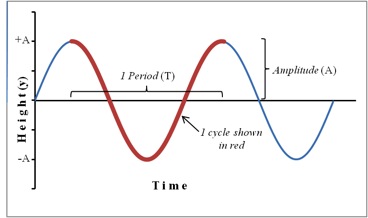
Amplitude is the maximum displacement from the equilibrium position.

It represents the maximum extent of oscillation.

Example:

If a mass attached to a spring moves 5 cm on either side of equilibrium, then the amplitude is 5 cm.

Amplitude determines the energy of the oscillating system.


4. Time Period

The time period (T) is the time taken to complete one full oscillation.

One oscillation means the particle returns to its original position with the same velocity direction.

Unit: seconds


5. Frequency

Frequency (f) is the number of oscillations completed in one second.

f = 1 / T

Unit: Hertz (Hz)

Example:

If the time period is 0.5 seconds:

f = 1 / 0.5 = 2 Hz

This means the system completes two oscillations per second.


6. Angular Frequency

Angular frequency (ω) represents the rate of oscillation in radians.

ω = 2πf
ω = 2π / T

Unit: radians per second

Angular frequency is commonly used in mathematical descriptions of SHM.


4. Mathematical Description of SHM

The motion of a particle undergoing SHM can be described mathematically using sinusoidal functions.

Displacement Equation

x = A sin(ωt + φ)

or

x = A cos(ωt + φ)

Where:

x = displacement
A = amplitude
ω = angular frequency
t = time
φ = phase constant

This equation represents how displacement changes with time.


Velocity Equation

Velocity is the rate of change of displacement.

v = dx/dt

If

x = A sin(ωt)

Then

v = Aω cos(ωt)

Maximum velocity occurs at the equilibrium position.

v_max = Aω


Acceleration Equation

Acceleration is the rate of change of velocity.

a = dv/dt

For SHM:

a = −ω²x

This equation confirms that acceleration is proportional to displacement and opposite in direction.

Maximum acceleration occurs at maximum displacement.

a_max = ω²A


5. Graphical Representation of SHM

Image
Image
Image
Image

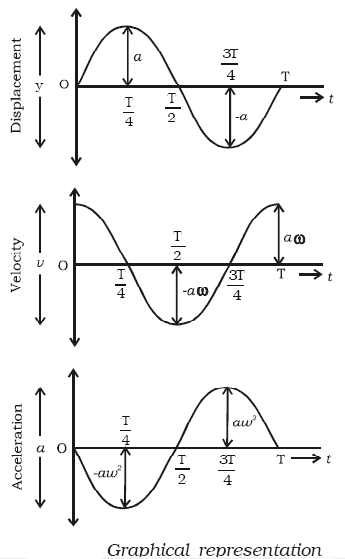
Graphical analysis helps visualize simple harmonic motion clearly.

Displacement vs Time Graph

The displacement-time graph is a sine or cosine curve.

It shows how the particle moves between maximum positive and negative displacements.

Characteristics:

  • Periodic pattern
  • Smooth oscillation
  • Maximum displacement equals amplitude

Velocity vs Time Graph

The velocity graph is also sinusoidal but shifted by 90° in phase relative to displacement.

Velocity is maximum when displacement is zero.

Velocity becomes zero at extreme positions.


Acceleration vs Time Graph

Acceleration graph is also sinusoidal.

However, it is opposite in phase with displacement.

When displacement is maximum, acceleration is maximum but in the opposite direction.


6. Energy in Simple Harmonic Motion

Energy continuously transforms during SHM.

The total mechanical energy remains constant if there is no energy loss.

Potential Energy

Potential energy is stored when the particle is displaced.

PE = ½ kx²

Maximum potential energy occurs at maximum displacement.


Kinetic Energy

Kinetic energy is due to motion.

KE = ½ mv²

Maximum kinetic energy occurs at the equilibrium position.


Total Energy

Total energy remains constant.

E = KE + PE

In SHM:

E = ½ kA²

Energy continuously shifts between kinetic and potential forms.

At equilibrium:

  • KE = maximum
  • PE = minimum

At extreme positions:

  • KE = zero
  • PE = maximum

7. Examples of Simple Harmonic Motion

Mass-Spring System

Image
Image
Image
Image

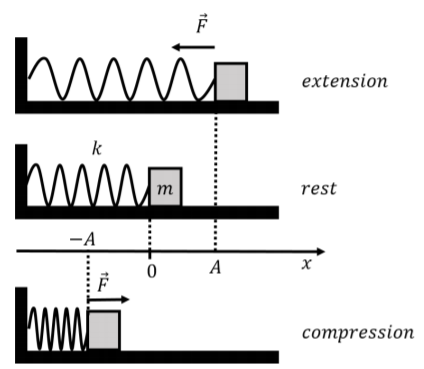
A mass attached to a spring is the classic example of SHM.

When the spring is stretched or compressed, a restoring force acts on the mass.

According to Hooke’s law:

F = −kx

Time period of oscillation:

T = 2π √(m/k)

Where:

m = mass
k = spring constant

Heavier mass increases the time period, while a stiffer spring decreases it.


Simple Pendulum

Image
Image
Image
Image

A pendulum consists of a small mass suspended from a string.

When displaced slightly and released, it oscillates.

For small angles, pendulum motion approximates SHM.

Time period:

T = 2π √(L/g)

Where:

L = length of pendulum
g = acceleration due to gravity

Interestingly, the time period does not depend on mass.


8. Phase and Phase Difference

Phase describes the stage of oscillation at any instant.

It is represented by:

ωt + φ

Where φ is the phase constant.

Two oscillations may have:

  • Same phase
  • Different phases

Phase difference describes how much one oscillation leads or lags another.

It is measured in radians or degrees.

Example:

Two waves separated by π radians are completely opposite.


9. Damped Harmonic Motion

In real systems, oscillations gradually decrease due to energy loss.

This is called damping.

Causes include:

  • Air resistance
  • Friction
  • Internal energy losses

Examples:

  • Pendulum eventually stopping
  • Vibrating tuning fork losing sound
  • Car suspension systems

Damping reduces amplitude over time.


10. Forced Oscillations and Resonance

When an external periodic force acts on a system, it produces forced oscillations.

If the frequency of the applied force equals the natural frequency, resonance occurs.

Resonance produces large amplitudes.

Examples:

  • Musical instruments
  • Radio tuning circuits
  • Vibrations in bridges

Resonance is useful but can also cause structural damage if uncontrolled.


11. Applications of SHM

SHM is used in many technologies.

Timekeeping

Pendulum clocks use SHM to measure time accurately.

Sound and Music

Musical instruments rely on oscillations.

Electronics

Oscillators produce periodic signals used in communication devices.

Earthquake Engineering

Buildings are designed considering vibrational motion.

Medical Devices

Ultrasound imaging uses oscillatory waves.

Quantum Mechanics

Atoms and molecules often behave like harmonic oscillators.


12. SHM in Nature

Many natural processes involve oscillations.

Examples include:

  • Heartbeat rhythm
  • Breathing cycles
  • Vibrations of atoms in solids
  • Ocean waves
  • Alternating electrical currents

Even microscopic particles in molecules vibrate in patterns similar to SHM.


13. SHM and Circular Motion

SHM can be understood as the projection of uniform circular motion onto a straight line.

If a particle moves in a circle with constant speed and its motion is projected onto a diameter, the resulting motion is simple harmonic motion.

This relationship explains the sinusoidal nature of SHM equations.

It also helps visualize phase relationships.


14. Importance of SHM in Physics

SHM is extremely important because it provides a simple model for many complex physical systems.

Reasons for its importance:

  • Many systems behave like harmonic oscillators.
  • Mathematical analysis is simple.
  • Helps explain wave motion.
  • Fundamental to quantum mechanics.
  • Important in electronics and signal processing.

Because of these reasons, SHM is considered one of the most fundamental topics in physics.


Conclusion

Simple harmonic motion is a fundamental form of periodic motion where the restoring force is proportional to displacement and directed toward equilibrium. It is characterized by sinusoidal motion, constant time period, and continuous energy transformation between kinetic and potential forms.

SHM appears in countless natural and technological systems, from vibrating strings and pendulums to electrical circuits and molecular vibrations. The mathematical simplicity and universal applicability of SHM make it one of the most powerful models in physics.

By understanding SHM, scientists and engineers gain insights into oscillations, waves, vibrations, and resonance. This knowledge is essential for designing mechanical systems, electronic devices, musical instruments, and scientific instruments.

Thus, simple harmonic motion serves as a cornerstone for understanding a wide range of physical phenomena across classical and modern physics.


Tags:

Periodic Motion

Image
Image
Image
Image

1. Introduction to Periodic Motion

Periodic motion is one of the most fundamental concepts in physics. It describes any motion that repeats itself after equal intervals of time. Many natural and man-made systems exhibit periodic motion, ranging from the oscillation of a pendulum and vibration of molecules to the rotation of planets around the Sun and alternating electric currents.

In simple terms, periodic motion occurs whenever an object moves in a pattern that repeats regularly over time. The time taken to complete one full cycle of motion is called the period, and this repeating behavior allows scientists and engineers to predict and analyze the motion with mathematical precision.

Periodic motion is closely connected with oscillations, waves, vibrations, and rotational motion. Because of its predictable nature, it is widely studied in physics, engineering, astronomy, acoustics, electronics, and many other scientific fields.

For example:

  • The swinging of a pendulum repeats again and again.
  • The vibration of a guitar string produces musical notes.
  • The Earth rotates about its axis every 24 hours.
  • The motion of electrons in alternating current circuits repeats regularly.

All of these are examples of periodic motion.

Understanding periodic motion allows scientists to describe complex systems using mathematical models and helps engineers design devices such as clocks, sensors, oscillators, and communication systems.


2. Definition of Periodic Motion

Periodic motion can be defined as:

Periodic motion is a type of motion that repeats itself at equal intervals of time.

The time taken for one complete repetition of motion is called the time period.

Mathematically,

T = Time taken for one complete cycle.

If a motion repeats every T seconds, then it is periodic.

Examples include:

  • Motion of a simple pendulum
  • Vibrations of a spring-mass system
  • Rotation of Earth around the Sun
  • Oscillations of atoms in a crystal lattice
  • Alternating current in electrical circuits

These motions repeat after a fixed interval of time and therefore qualify as periodic motion.


3. Characteristics of Periodic Motion

Periodic motion has several important characteristics that distinguish it from other types of motion.

1. Repetition

The most important feature of periodic motion is repetition. The motion repeats itself exactly after a certain time interval.

2. Time Period

Every periodic motion has a constant time period.

Time period (T) is the time taken to complete one full cycle.

Example:
If a pendulum completes one oscillation in 2 seconds, then its time period is:

T = 2 s

3. Frequency

Frequency describes how many cycles occur in one second.

Frequency is the reciprocal of time period.

f = 1 / T

Where:

  • f = frequency (Hertz)
  • T = time period (seconds)

Example:

If a motion repeats every 0.5 seconds:

f = 1 / 0.5 = 2 Hz

This means two cycles occur every second.

4. Amplitude

Amplitude is the maximum displacement of the particle from its equilibrium position.

In oscillatory motion, amplitude represents how far the object moves from the center position.

For example:

  • In a pendulum, amplitude is the maximum angle of swing.
  • In a spring system, amplitude is the maximum stretch or compression.

5. Equilibrium Position

The equilibrium position is the position where the net force acting on the system is zero.

In periodic motion, the object repeatedly moves around this equilibrium position.


4. Types of Periodic Motion

Periodic motion can occur in several forms depending on how the motion repeats.

1. Oscillatory Motion

Oscillatory motion is a special type of periodic motion where an object moves back and forth around an equilibrium position.

Examples include:

  • Pendulum motion
  • Vibrations of a spring
  • Motion of a tuning fork

Oscillatory motion always involves restoring forces that bring the object back to its equilibrium position.

2. Circular Motion

Circular motion can also be periodic if the object moves around a circular path repeatedly.

Examples:

  • Earth revolving around the Sun
  • A stone tied to a string and rotated
  • Rotating fan blades

In circular motion, the object returns to its starting position after each revolution.

3. Wave Motion

Waves represent periodic disturbances that travel through space or a medium.

Examples:

  • Water waves
  • Sound waves
  • Light waves

The particles of the medium move in periodic motion while the wave propagates.

4. Vibrational Motion

Vibrational motion refers to rapid periodic movements of particles.

Examples:

  • Vibrations of molecules in solids
  • Vibrations of a guitar string
  • Vibrations of atoms in a crystal lattice

5. Time Period and Frequency

Image
Image
Image
Image

Time Period

The time period (T) is the time taken by a body to complete one full cycle of motion.

Units:

seconds (s)

Example:

If a pendulum completes 5 oscillations in 10 seconds:

T = Total time / Number of oscillations

T = 10 / 5 = 2 s

Frequency

Frequency (f) represents how many cycles occur in one second.

Unit:

Hertz (Hz)

Formula:

f = 1 / T

Example:

If T = 2 seconds

f = 1 / 2 = 0.5 Hz

This means the system completes half a cycle every second.

Angular Frequency

Angular frequency describes how rapidly the motion repeats in angular terms.

Formula:

ω = 2πf
ω = 2π / T

Where:

ω = angular frequency

Unit: radians per second.

Angular frequency is widely used in oscillatory systems and wave equations.


6. Examples of Periodic Motion

Periodic motion appears everywhere in nature and technology.

Pendulum Motion

A simple pendulum swings back and forth in a periodic manner.

The time period depends on:

  • Length of the string
  • Acceleration due to gravity

Formula:

T = 2π √(L / g)

Where:

L = length of pendulum
g = acceleration due to gravity

Spring-Mass System

A mass attached to a spring oscillates periodically.

The restoring force follows Hooke’s law:

F = −kx

Where:

k = spring constant

Time period of oscillation:

T = 2π √(m / k)

Where:

m = mass of the object

Planetary Motion

The revolution of planets around the Sun is periodic.

For example:

Earth takes 365 days to complete one revolution.

Thus the orbital motion is periodic.

Vibrations of Strings

Musical instruments like guitars and violins produce sound through periodic vibration of strings.

The frequency of vibration determines the pitch of the sound.


7. Simple Harmonic Motion (SHM)

Image
Image
Image
Image

Simple Harmonic Motion is the most important form of periodic motion.

Definition

Simple harmonic motion is a type of periodic motion where the restoring force is directly proportional to displacement and acts toward the equilibrium position.

Mathematically:

F = −kx

or

a = −ω²x

Where:

F = restoring force
x = displacement
ω = angular frequency

The negative sign indicates that the force acts opposite to the displacement.

Characteristics of SHM

  1. Motion repeats periodically
  2. Acceleration is proportional to displacement
  3. Force acts toward equilibrium position
  4. Motion follows a sinusoidal pattern

Displacement Equation

x = A sin(ωt + φ)

Where:

A = amplitude
ω = angular frequency
t = time
φ = phase constant

This equation describes how displacement varies with time.


8. Energy in Periodic Motion

In periodic motion, energy continuously transforms between different forms.

Kinetic Energy

When the object moves fastest at the equilibrium position, kinetic energy is maximum.

KE = ½ mv²

Potential Energy

At maximum displacement, potential energy is maximum.

PE = ½ kx²

Total Energy

Total mechanical energy remains constant.

Total Energy = KE + PE

In SHM:

E = ½ kA²

Energy continuously shifts between kinetic and potential forms during motion.


9. Phase and Phase Difference

Phase describes the position of a particle in its periodic cycle.

Example:

Two waves may be:

  • In phase
  • Out of phase

If two motions have the same displacement and direction at the same time, they are in phase.

If they differ, they have a phase difference.

Phase difference is measured in radians or degrees.


10. Applications of Periodic Motion

Periodic motion has numerous applications across science and engineering.

Clocks and Time Measurement

Pendulum clocks and quartz clocks rely on periodic motion to measure time accurately.

Electronics

Oscillators produce periodic electrical signals used in radios, televisions, and communication systems.

Sound Production

Musical instruments create sound through periodic vibration.

Astronomy

Planetary motion is periodic, allowing astronomers to predict celestial events.

Mechanical Systems

Machines use rotating components that undergo periodic motion.


11. Periodic Motion in Nature

Nature is full of periodic motions.

Examples include:

  • Rotation of Earth (day and night cycle)
  • Revolution of Earth (seasons)
  • Ocean tides
  • Heartbeat
  • Breathing cycles
  • Vibrations of atoms

Even microscopic systems such as molecules exhibit periodic vibrations.


12. Graphical Representation of Periodic Motion

Periodic motion is often represented graphically.

Common graphs include:

Displacement vs Time

This graph shows sinusoidal curves for SHM.

Velocity vs Time

Velocity is also periodic but shifted in phase.

Acceleration vs Time

Acceleration graph is opposite in phase with displacement.

These graphs help visualize periodic behavior clearly.


13. Damped Periodic Motion

In real systems, periodic motion often decreases with time due to energy loss.

This is called damped motion.

Causes include:

  • Friction
  • Air resistance
  • Internal energy loss

Examples:

  • Pendulum gradually stopping
  • Vibrating string losing energy
  • Shock absorbers in vehicles

14. Forced Oscillations and Resonance

When an external force drives a system periodically, it undergoes forced oscillations.

If the driving frequency equals the natural frequency, resonance occurs.

Resonance produces very large amplitudes.

Examples:

  • Musical instruments
  • Bridges vibrating due to wind
  • Radio tuning circuits

Resonance is useful but can also cause structural failures.


15. Importance of Periodic Motion in Physics

Periodic motion plays a central role in physics.

It helps in:

  • Understanding waves and vibrations
  • Studying quantum mechanics
  • Describing electromagnetic waves
  • Modeling planetary motion
  • Designing engineering systems

Many advanced physical theories rely on oscillatory and periodic behavior.

Because periodic systems are predictable and mathematically manageable, they serve as models for more complex systems.


Conclusion

Periodic motion is a fundamental concept that describes repeating motion in physical systems. From pendulums and springs to planetary orbits and sound waves, periodic motion is present in nearly every aspect of the natural world.

Key concepts such as time period, frequency, amplitude, phase, and energy transformations help describe and analyze periodic systems. Among the many forms of periodic motion, simple harmonic motion stands out as the most important due to its mathematical simplicity and widespread occurrence.

The study of periodic motion has enormous practical applications in science, engineering, electronics, astronomy, and everyday technology. Understanding it allows scientists and engineers to design systems that rely on predictable repeating motion, from clocks and musical instruments to communication systems and mechanical devices.

Periodic motion therefore represents not only a fundamental physical phenomenon but also a powerful tool for understanding and controlling the dynamic behavior of the universe.


Collisions in Physics

Image
Image
Image
Image

Introduction

A collision in physics refers to an event in which two or more objects interact with each other for a short period of time and exert forces on each other. During a collision, the objects may change their velocity, direction, shape, or energy depending on the nature of the interaction.

Collisions occur everywhere in the physical world. Examples include cars crashing into each other, billiard balls striking one another on a pool table, particles colliding inside particle accelerators, and molecules colliding in gases. Even when a person kicks a football or a bat hits a cricket ball, a collision takes place.

Collisions are important in physics because they involve the transfer of momentum and energy between objects. One of the key principles governing collisions is the law of conservation of momentum, which states that the total momentum of an isolated system remains constant if no external forces act on it.

Understanding collisions allows scientists and engineers to analyze real-world phenomena such as vehicle accidents, sports mechanics, chemical reactions, and space interactions. Collisions also play a significant role in modern technologies such as crash safety systems, particle accelerators, and industrial machinery.


Basic Concepts of Collisions

To understand collisions, it is important to first understand some basic concepts such as momentum, impulse, and force.


Momentum

Momentum is the quantity of motion possessed by an object.

[
p = mv
]

Where:

(p) = momentum
(m) = mass
(v) = velocity

Momentum is a vector quantity and depends on both mass and velocity.


Impulse

Impulse is the product of force and the time interval over which the force acts.

[
J = F \Delta t
]

Impulse causes a change in momentum.

[
J = \Delta p
]

During collisions, large forces act for very short time intervals, resulting in significant changes in momentum.


Characteristics of Collisions

Collisions generally have several important characteristics.

  1. Collisions occur over very short time intervals.
  2. Forces involved are often very large.
  3. Momentum is conserved in isolated systems.
  4. Energy may or may not be conserved depending on the type of collision.

These characteristics help physicists analyze collision events effectively.


Types of Collisions

Collisions can be classified into different categories depending on how momentum and energy behave.


Elastic Collisions

Image
Image
Image
Image

Definition

An elastic collision is a collision in which both momentum and kinetic energy are conserved.

This means the total kinetic energy of the system before and after the collision remains the same.


Mathematical Representation

Momentum conservation:

[
m_1u_1 + m_2u_2 = m_1v_1 + m_2v_2
]

Kinetic energy conservation:

[
\frac{1}{2}m_1u_1^2 + \frac{1}{2}m_2u_2^2 =
\frac{1}{2}m_1v_1^2 + \frac{1}{2}m_2v_2^2
]

Where:

(u_1, u_2) = initial velocities
(v_1, v_2) = final velocities


Examples of Elastic Collisions

Examples include:

Billiard balls colliding
Atomic particle interactions
Gas molecule collisions

In these cases, objects bounce off each other without losing kinetic energy.


Inelastic Collisions

Image
Image
Image
Image

Definition

An inelastic collision is a collision in which momentum is conserved but kinetic energy is not conserved.

Some kinetic energy is converted into other forms such as:

Heat
Sound
Deformation energy


Examples

Examples of inelastic collisions include:

Car accidents
Collisions involving soft materials
Clay balls sticking together
Meteor impacts


Perfectly Inelastic Collision

In a perfectly inelastic collision, the colliding objects stick together after the collision and move as a single object.

The final velocity can be calculated using momentum conservation:

[
m_1u_1 + m_2u_2 = (m_1 + m_2)v
]

Where (v) is the common velocity after collision.


Head-On and Oblique Collisions

Collisions can also be categorized based on the direction of motion.


Head-On Collision

A head-on collision occurs when two objects move along the same straight line and collide directly.

Examples include:

Two cars colliding on a straight road
Two carts moving along a track

Head-on collisions are easier to analyze because motion occurs along one dimension.


Oblique Collision

An oblique collision occurs when objects collide at an angle.

These collisions involve motion in two dimensions.

Examples include:

Billiard balls striking at an angle
Two vehicles colliding at an intersection

In oblique collisions, momentum must be conserved in both horizontal and vertical directions.


Coefficient of Restitution

The coefficient of restitution measures how elastic a collision is.

It is defined as the ratio of relative velocity after collision to relative velocity before collision.

[
e = \frac{v_2 – v_1}{u_1 – u_2}
]

Where:

(e) = coefficient of restitution

Values of (e):

(e = 1) → perfectly elastic collision

(0 < e < 1) → partially inelastic collision

(e = 0) → perfectly inelastic collision


Conservation of Momentum in Collisions

Image
Image
Image
Image

The law of conservation of momentum states:

The total momentum of an isolated system remains constant before and after a collision.

Mathematically:

[
p_{initial} = p_{final}
]

or

[
\sum m_i u_i = \sum m_i v_i
]

This principle applies to all types of collisions.


Energy Considerations in Collisions

In collisions, kinetic energy may change depending on the type of collision.

Elastic collisions conserve kinetic energy.

Inelastic collisions convert some kinetic energy into:

Heat
Sound
Internal energy
Deformation

Even though kinetic energy may change, total energy remains conserved according to the law of conservation of energy.


Collisions in Everyday Life

Collisions occur in many everyday situations.

Transportation

Vehicle collisions involve large momentum changes.

Sports

Bat hitting ball in cricket
Football collisions between players
Tennis ball hitting racket

Industrial Machinery

Machine parts interacting during operation.

Space Science

Asteroids colliding with planets.


Safety Applications of Collision Physics

Understanding collisions helps improve safety in many technologies.

Seat Belts

Seat belts reduce injury by increasing stopping time.

Airbags

Airbags reduce impact force during collisions.

Crash Barriers

Barriers absorb energy and reduce vehicle damage.

Helmets

Helmets protect the head by absorbing impact energy.

These safety systems rely on impulse and momentum principles.


Collisions in Particle Physics

In modern physics, collisions between subatomic particles are studied using particle accelerators.

These collisions help scientists discover fundamental particles and understand the structure of matter.

Examples include experiments conducted in large particle accelerators.


Applications in Engineering

Engineers use collision analysis to design safer vehicles, buildings, and machines.

Applications include:

Automobile crash testing
Design of protective equipment
Robotics interactions
Structural engineering

Understanding collision forces helps prevent damage and improve safety.


Importance of Studying Collisions

Collisions are essential in understanding how objects interact.

They help scientists analyze:

Energy transfer
Momentum conservation
Mechanical systems
Impact forces

Studying collisions allows engineers to design safer systems and understand natural processes.


Summary

A collision is an interaction between two or more objects in which they exert forces on each other for a short time interval. Collisions result in changes in velocity, momentum, and sometimes energy.

The law of conservation of momentum governs all collisions in isolated systems. Collisions can be elastic, inelastic, or perfectly inelastic depending on how kinetic energy behaves.

Understanding collisions is important for analyzing vehicle accidents, sports mechanics, industrial machinery, and particle physics experiments. The study of collisions provides valuable insights into the transfer of energy and momentum during interactions between objects.


Tags

Momentum and Impulse

Image
Image
Image
Image

Introduction

In physics, momentum and impulse are fundamental concepts that describe how objects move and interact with forces. These concepts are central to the study of mechanics and help explain many everyday phenomena, such as collisions between vehicles, the motion of rockets, the recoil of guns, and the behavior of sports equipment.

Momentum describes the quantity of motion possessed by an object. It depends on both the mass of the object and its velocity. Objects with greater mass or higher velocity possess greater momentum.

Impulse, on the other hand, describes the effect of a force applied over a period of time. It represents the change in momentum produced by that force. Impulse is especially important in analyzing situations involving collisions or sudden changes in motion.

The study of momentum and impulse allows physicists to analyze systems where forces act over short time intervals, such as when a bat strikes a ball or when two cars collide. These concepts also lead to the important principle known as the law of conservation of momentum, which states that the total momentum of an isolated system remains constant.

Momentum and impulse are widely used in fields such as mechanical engineering, aerospace engineering, robotics, sports science, and transportation safety.


Linear Momentum

Definition of Momentum

Momentum is defined as the product of the mass of an object and its velocity.

Mathematically, momentum is expressed as:

[
p = mv
]

Where:

(p) = momentum
(m) = mass
(v) = velocity

Momentum is a vector quantity, meaning it has both magnitude and direction.

The direction of momentum is the same as the direction of velocity.


Unit of Momentum

The SI unit of momentum is:

[
kg \cdot m/s
]

Momentum may also be expressed as:

[
N \cdot s
]

since Newton multiplied by seconds gives the same unit.


Characteristics of Momentum

Momentum has several important properties:

  1. It depends on both mass and velocity.
  2. It is a vector quantity.
  3. Its direction is the same as velocity.
  4. It increases with mass and speed.
  5. It plays a key role in collisions and motion analysis.

For example, a truck moving at moderate speed may have greater momentum than a small car moving at high speed due to its larger mass.


Examples of Momentum

Examples of momentum appear frequently in everyday life.

Moving Vehicle

A heavy truck moving at 50 km/h has large momentum.

Sports

A fast-moving football possesses momentum when kicked.

Flowing Water

Water flowing in a river has momentum.

Rocket Motion

Rockets gain momentum when gases are expelled at high velocity.


Newton’s Second Law and Momentum

Newton’s second law can be expressed in terms of momentum.

The law states that:

The rate of change of momentum of an object is proportional to the applied force and occurs in the direction of the force.

Mathematically:

[
F = \frac{dp}{dt}
]

Where:

(F) = force
(p) = momentum
(t) = time

If mass remains constant, this equation reduces to:

[
F = ma
]

Thus Newton’s second law links force and momentum.


Impulse

Image
Image
Image
Image

Definition of Impulse

Impulse is defined as the product of force and the time interval during which the force acts.

[
J = F \Delta t
]

Where:

(J) = impulse
(F) = force
(\Delta t) = time interval

Impulse is a vector quantity.


Unit of Impulse

The SI unit of impulse is:

[
N \cdot s
]

This is equivalent to the unit of momentum.


Impulse-Momentum Theorem

The impulse-momentum theorem states:

Impulse applied to an object equals the change in its momentum.

Mathematically:

[
J = \Delta p
]

or

[
F \Delta t = mv_f – mv_i
]

Where:

(v_i) = initial velocity
(v_f) = final velocity

This relationship explains how forces change motion.


Practical Interpretation

A small force applied over a long time can produce the same impulse as a large force applied over a short time.

Example:

Catching a ball with soft hands increases the time interval and reduces the force experienced.


Impulse in Graphical Form

Impulse can also be represented using a force–time graph.

The impulse equals the area under the force–time curve.

This graphical method is useful in analyzing collisions and impacts.


Applications of Impulse

Impulse is widely used in many practical situations.

Sports

Athletes increase contact time to reduce impact forces.

Safety Equipment

Airbags and seat belts increase stopping time during collisions.

Packaging

Soft packaging materials increase impact time to protect fragile items.

Hammering

A hammer applies large force for a short time interval.


Conservation of Momentum

Image
Image
Image
Image

Law of Conservation of Momentum

The law of conservation of momentum states:

In an isolated system with no external forces, the total momentum remains constant.

Mathematically:

[
p_{initial} = p_{final}
]

or

[
m_1v_1 + m_2v_2 = m_1v_1′ + m_2v_2′
]

Where:

(v_1) and (v_2) are initial velocities.

(v_1′) and (v_2′) are final velocities.


Collisions

A collision occurs when two or more objects interact for a short time and exert forces on each other.

Collisions are classified into different types.


Elastic Collision

In elastic collisions:

Momentum is conserved.

Kinetic energy is also conserved.

Examples include collisions between billiard balls and gas molecules.


Inelastic Collision

In inelastic collisions:

Momentum is conserved.

Kinetic energy is not conserved.

Some energy converts into heat, sound, or deformation.

Example:

Car accidents.


Perfectly Inelastic Collision

In perfectly inelastic collisions, objects stick together after collision.

Example:

Two lumps of clay colliding and sticking together.


Momentum in Rocket Propulsion

Rocket propulsion works based on the conservation of momentum.

When a rocket expels gases backward at high velocity, the rocket moves forward with equal momentum in the opposite direction.

This principle allows rockets to move in space where there is no air.


Momentum in Sports

Momentum plays a major role in sports.

Examples include:

Cricket bat striking ball

Football kicking

Boxing punches

Golf swings

Athletes often increase momentum to achieve greater impact.


Momentum and Safety

Momentum concepts are important in designing safety systems.

Airbags

Increase collision time and reduce force.

Seat Belts

Prevent passengers from moving forward suddenly.

Crash Barriers

Absorb momentum during vehicle collisions.

These systems reduce injuries by controlling impulse and force.


Importance of Momentum and Impulse

Momentum and impulse are essential concepts in physics because they help analyze interactions between objects, especially during collisions.

They are widely used in:

Mechanical engineering

Transportation safety

Sports science

Aerospace engineering

Robotics

Understanding these principles allows engineers to design safer vehicles, better sports equipment, and efficient propulsion systems.


Summary

Momentum is the quantity of motion possessed by an object and is defined as the product of mass and velocity. It is a vector quantity that depends on both the mass and speed of an object.

Impulse is the product of force and the time interval over which the force acts. The impulse-momentum theorem states that impulse equals the change in momentum of an object.

The law of conservation of momentum states that the total momentum of an isolated system remains constant. This principle is crucial for understanding collisions, rocket propulsion, and many mechanical processes.

Momentum and impulse are fundamental tools in physics and engineering that help explain how forces affect motion and how objects interact with each other.


Tags