

1. Introduction to Sets and Relations
Sets and relations are fundamental concepts in mathematics that form the foundation for many advanced topics in algebra, logic, computer science, and data analysis. Set theory provides a systematic way to organize and analyze collections of objects, while relations describe connections between elements of sets.
The concept of sets was introduced by the German mathematician Georg Cantor in the late 19th century. Since then, set theory has become one of the most important frameworks in modern mathematics.
Sets allow mathematicians to represent collections of objects such as numbers, symbols, or even other sets. Relations extend this concept by describing how elements from one set are connected to elements in another set.
These ideas are widely used in fields such as:
- Mathematics
- Computer science
- Database systems
- Artificial intelligence
- Logic
- Statistics
- Engineering
Understanding sets and relations helps in organizing information, solving mathematical problems, and modeling relationships in real-world systems.
2. Definition of a Set
A set is a well-defined collection of distinct objects.
The objects in a set are called elements or members.
Example:
A = {1, 2, 3, 4}
Here:
1, 2, 3, and 4 are elements of set A.
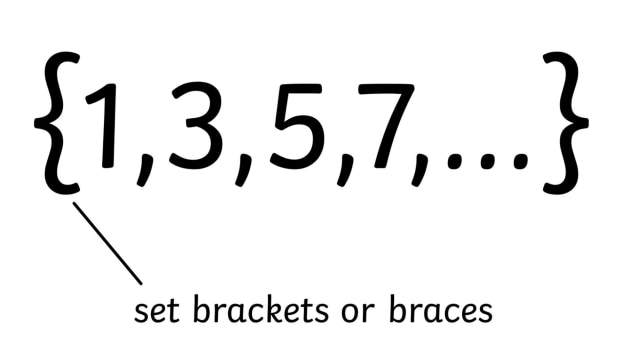
Sets are usually represented using curly braces.
3. Representation of Sets
There are two common ways to represent sets.
Roster Method
Elements are listed explicitly.
Example:
A = {2, 4, 6, 8}
Set Builder Method
Elements are described using a rule.
Example:
A = {x | x is an even number less than 10}
This means the set of even numbers less than 10.
4. Types of Sets
Different types of sets exist depending on their properties.
Empty Set
A set with no elements.
Symbol:
∅
Example:
A = {x | x < 0 and x is natural number}
This set has no elements.
Singleton Set
A set containing only one element.
Example:
{5}
Finite Set
A set with a limited number of elements.
Example:
{1, 2, 3, 4}
Infinite Set
A set with unlimited elements.
Example:
Natural numbers:
{1, 2, 3, …}
Equal Sets
Two sets are equal if they contain the same elements.
Example:
A = {1, 2, 3}
B = {3, 2, 1}
A = B
Equivalent Sets
Sets with the same number of elements.
Example:
A = {1,2,3}
B = {a,b,c}
Universal Set
The universal set contains all elements under consideration.
Symbol:
U
Example:
If studying numbers 1–10:
U = {1,2,3,4,5,6,7,8,9,10}
5. Subsets
A subset is a set whose elements are all contained within another set.
Symbol:
⊆
Example:
A = {1,2,3}
B = {1,2}
B ⊆ A
Proper Subset
A subset that is not equal to the original set.
Symbol:
⊂
Example:
{1,2} ⊂ {1,2,3}
6. Power Set
The power set of a set is the set of all subsets of that set.
If set A has n elements:
Power set contains:
2ⁿ subsets.
Example:
A = {1,2}
Power set:
{ ∅, {1}, {2}, {1,2} }
7. Operations on Sets
Set operations combine sets in various ways.
Union
The union of two sets includes all elements in either set.
Symbol:
A ∪ B
Example:
A = {1,2,3}
B = {3,4,5}
A ∪ B = {1,2,3,4,5}
Intersection
Intersection includes elements common to both sets.
Symbol:
A ∩ B
Example:
A ∩ B = {3}
Difference
Difference includes elements in one set but not the other.
Symbol:
A − B
Example:
A − B = {1,2}
Complement
Complement includes elements not in the set.
Symbol:
A’
Example:
If universal set:
U = {1,2,3,4,5}
A = {1,2}
A’ = {3,4,5}
8. Venn Diagrams
Venn diagrams visually represent sets and their relationships.
They use circles to represent sets and show intersections, unions, and differences.
Venn diagrams are widely used in probability, statistics, and logic.
9. Cartesian Product
The Cartesian product combines two sets to form ordered pairs.
Symbol:
A × B
Example:
A = {1,2}
B = {a,b}
A × B =
{(1,a), (1,b), (2,a), (2,b)}
10. Relations
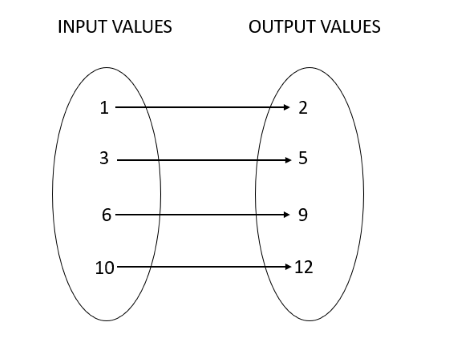
A relation is a connection between elements of two sets.
A relation from set A to set B is a subset of the Cartesian product A × B.
Example:
A = {1,2}
B = {a,b}
Relation:
R = {(1,a), (2,b)}
11. Domain and Range
For a relation:
Domain = set of first elements.
Range = set of second elements.
Example:
R = {(1,a),(2,b)}
Domain = {1,2}
Range = {a,b}
12. Types of Relations
Relations have different properties.
Reflexive Relation
Every element relates to itself.
Example:
R = {(1,1),(2,2),(3,3)}
Symmetric Relation
If (a,b) is in relation, then (b,a) is also.
Example:
Friendship relation.
Transitive Relation
If (a,b) and (b,c) exist, then (a,c) exists.
Example:
Ancestor relationships.
13. Equivalence Relations
A relation is an equivalence relation if it is:
- Reflexive
- Symmetric
- Transitive
Example:
Equality relation.
14. Equivalence Classes
Equivalence relations divide sets into groups called equivalence classes.
Example:
Integers grouped by remainder when divided by 3.
15. Functions as Special Relations
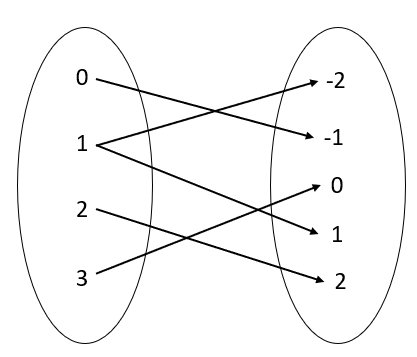
A function is a special type of relation.
Each element of the domain maps to exactly one element of the range.
Example:
f(x) = x²
16. Relations in Graph Theory
Relations can be represented using graphs.
Nodes represent elements.
Edges represent relationships.
Used in social networks and communication systems.
17. Applications of Sets
Set theory is used in:
- probability theory
- database design
- computer algorithms
- artificial intelligence
- data classification
18. Applications of Relations
Relations help model real-world connections.
Examples include:
- social networks
- family trees
- database relationships
- network communication
19. Sets and Relations in Computer Science
Computer science uses sets for:
- data structures
- database queries
- programming logic
- algorithm design
Relations are used in:
- relational databases
- graph theory
- network modeling
20. Importance of Sets and Relations
Sets and relations provide powerful mathematical tools for organizing and analyzing data.
They help describe relationships between objects and simplify complex systems.
Without these concepts, many fields such as computer science, artificial intelligence, and database management would not exist.
Conclusion
Sets and relations form the backbone of modern mathematics and provide essential tools for organizing information and describing relationships between objects. Sets allow mathematicians to define collections of elements and perform operations such as union, intersection, and complement. Relations extend this concept by establishing connections between elements of different sets, enabling the study of structures such as functions, equivalence relations, and mappings.
These concepts are widely applied in many disciplines including mathematics, computer science, data analysis, and engineering. From database systems and network models to probability theory and logic, sets and relations play a crucial role in representing and analyzing complex systems.
Understanding sets and relations is essential for anyone studying mathematics, computer science, or data science because they form the foundation for many advanced topics such as functions, graph theory, and formal logic.