


Introduction
Circular motion is a type of motion in which an object moves along a circular path around a fixed point or axis. It is one of the most important types of motion studied in classical mechanics. Unlike motion in a straight line, circular motion involves continuous change in direction, even if the speed of the object remains constant.
Many natural and artificial systems exhibit circular motion. Examples include the motion of planets around the Sun, electrons moving around atomic nuclei, cars moving around circular tracks, rotating wheels, satellites orbiting Earth, and amusement park rides such as merry-go-rounds.
Circular motion is significant because it introduces the concept of centripetal acceleration and centripetal force, which are necessary to keep an object moving along a curved path. Without these forces, objects would move in straight lines according to Newton’s first law of motion.
In circular motion, several important quantities are studied, including angular displacement, angular velocity, angular acceleration, centripetal force, and tangential velocity. Understanding these quantities allows physicists and engineers to analyze rotating systems and orbital motion.
Circular motion plays a crucial role in many fields such as physics, astronomy, engineering, robotics, and transportation systems.
Basic Concepts of Circular Motion
Definition of Circular Motion
Circular motion is defined as the motion of an object along the circumference of a circle or a circular path.
The center of the circle is called the axis of rotation, and the distance between the center and the object is called the radius of the circular path.
In circular motion, even if the speed remains constant, the direction of motion changes continuously. This change in direction results in acceleration.
Examples of Circular Motion
Examples of circular motion appear frequently in everyday life and nature.
Examples include:
- A stone tied to a string and rotated in a circle
- Blades of a rotating fan
- Motion of satellites around Earth
- Wheels of a moving vehicle
- Motion of planets around the Sun
- Rotating turbines in power plants
All of these systems involve objects moving along circular paths.
Types of Circular Motion
Circular motion can be classified into two main types.
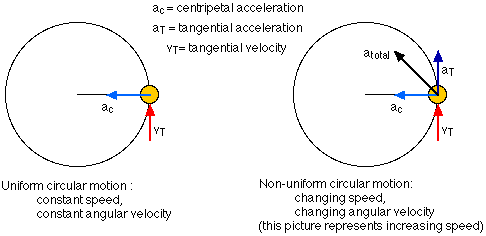
Uniform Circular Motion
Uniform circular motion occurs when an object moves along a circular path with constant speed.
Although the speed remains constant, the direction of velocity changes continuously. Therefore, acceleration is present.
Examples include:
- Earth orbiting the Sun
- A car moving at constant speed around a circular track
- A rotating fan blade
Non-Uniform Circular Motion
Non-uniform circular motion occurs when the speed of the object changes while moving in a circular path.
In this case, acceleration occurs due to:
- Change in speed
- Change in direction
Examples include:
- A car accelerating around a circular track
- A rotating disk that speeds up or slows down
Angular Quantities in Circular Motion
In circular motion, angular quantities are often used to describe rotation.
Angular Displacement
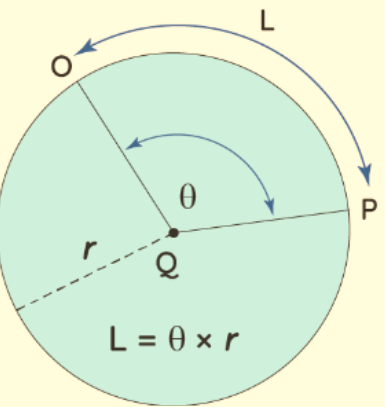
Angular displacement represents the angle through which an object rotates.
It is measured in radians.
[
\theta = \frac{s}{r}
]
Where:
(s) = arc length
(r) = radius of circle
Angular Velocity
Angular velocity describes the rate of change of angular displacement.
[
\omega = \frac{\theta}{t}
]
Where:
(\omega) = angular velocity
(\theta) = angular displacement
(t) = time
Unit of angular velocity:
[
rad/s
]
Angular Acceleration
Angular acceleration represents the rate of change of angular velocity.
[
\alpha = \frac{d\omega}{dt}
]
Unit:
[
rad/s^2
]
Relationship Between Linear and Angular Motion
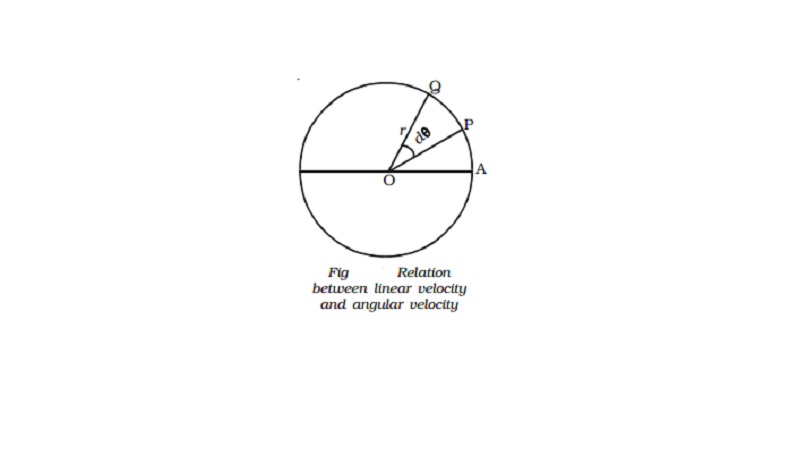

Linear and angular quantities are related.
Linear Velocity
The linear velocity of an object moving in a circle is given by:
[
v = r\omega
]
Where:
(v) = linear velocity
(r) = radius
(\omega) = angular velocity
Linear velocity acts tangentially to the circular path.
Centripetal Acceleration
Even when an object moves at constant speed in a circle, it experiences acceleration because its direction changes continuously.
This acceleration is called centripetal acceleration.
The centripetal acceleration always points toward the center of the circle.
[
a_c = \frac{v^2}{r}
]
Where:
(v) = velocity
(r) = radius
Another expression is:
[
a_c = r\omega^2
]
Centripetal Force

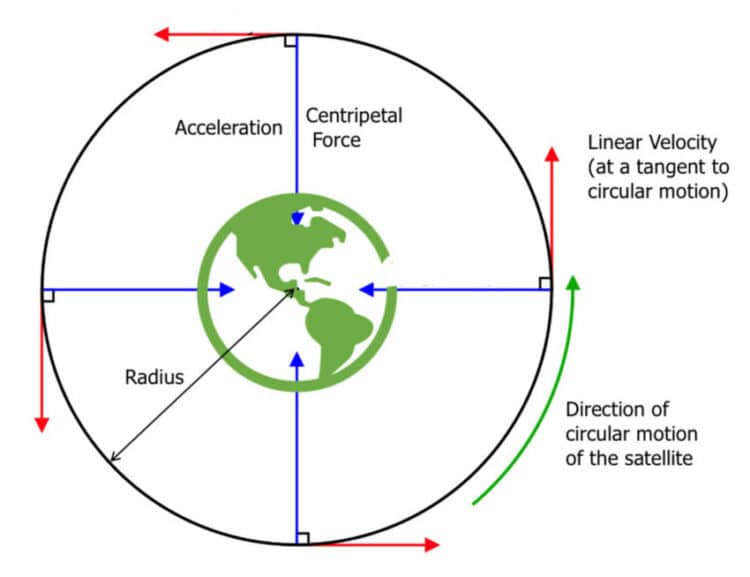
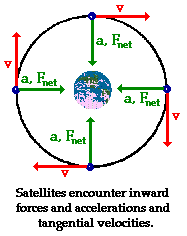
Centripetal force is the force required to keep an object moving in a circular path.
Without centripetal force, the object would move in a straight line according to Newton’s first law.
The formula for centripetal force is:
[
F_c = \frac{mv^2}{r}
]
Where:
(m) = mass
(v) = velocity
(r) = radius
Alternatively:
[
F_c = mr\omega^2
]
Sources of Centripetal Force
Different forces can provide centripetal force in different situations.
Examples include:
Gravitational force → planetary motion
Tension force → stone tied to string
Frictional force → car moving on curved road
Normal force → roller coaster motion
Centrifugal Force
Centrifugal force is an apparent force observed in a rotating reference frame.
It appears to push objects away from the center of the circular path.
Examples include:
Passengers pushed outward in a turning car.
Clothes sticking to the walls of a spinning washing machine.
Centrifugal force is considered a pseudo force because it appears due to the rotating frame of reference.
Period and Frequency
Two important quantities related to circular motion are period and frequency.
Period
The period is the time required for one complete revolution.
[
T = \frac{1}{f}
]
Unit: seconds
Frequency
Frequency is the number of revolutions per second.
[
f = \frac{1}{T}
]
Unit: Hertz (Hz)
Angular Velocity Relation
Angular velocity is related to period and frequency.
[
\omega = \frac{2\pi}{T}
]
or
[
\omega = 2\pi f
]
Applications of Circular Motion
Circular motion has many practical applications.
Planetary Motion
Planets revolve around the Sun due to gravitational centripetal force.
Satellites
Artificial satellites orbit Earth using gravitational force.
Transportation
Vehicles turning on curved roads experience circular motion.
Engineering
Rotating machinery such as turbines and engines use circular motion.
Sports
Hammer throw and discus events involve circular motion.
Amusement Parks
Rides such as roller coasters and merry-go-rounds use circular motion principles.
Banking of Roads
When vehicles move along curved roads, they require centripetal force.
To provide this force safely, roads are often banked.
Banking tilts the road surface so that the normal force helps provide centripetal force.
This reduces dependence on friction and prevents skidding.
Vertical Circular Motion
Vertical circular motion occurs when an object moves in a circular path in a vertical plane.
Examples include:
- Roller coaster loops
- Swinging bucket of water
- Pendulum motion
In vertical circular motion, the speed changes due to gravity.
At the top of the circle, the object must have sufficient velocity to maintain the circular path.
Importance of Circular Motion
Circular motion is fundamental in physics because many natural phenomena involve rotational movement.
Important fields using circular motion include:
Astrophysics
Mechanical engineering
Electrical engineering
Robotics
Transportation engineering
Understanding circular motion allows scientists to design stable orbits, efficient engines, and safe transportation systems.
Summary
Circular motion is the motion of an object along a circular path around a central point. It involves constant change in direction, which leads to centripetal acceleration even when speed remains constant.
Key concepts in circular motion include angular displacement, angular velocity, centripetal force, and centripetal acceleration. These concepts help explain how objects remain in circular paths.
Circular motion is observed in many systems such as planetary orbits, rotating machines, vehicles on curved roads, and amusement park rides. By understanding circular motion, scientists and engineers can design technologies and explain many natural phenomena.
Circular motion remains one of the most important topics in mechanics and plays a vital role in understanding rotational dynamics and orbital mechanics.