Tag Archives: amplitude

Wave Properties: Frequency, Wavelength, and Amplitude

Image
Image
Image
Image

1. Introduction to Wave Properties

Wave motion is one of the most important phenomena in physics because it explains how energy and information travel through space and through different media. Waves occur in many forms, including sound waves, water waves, electromagnetic waves, and even matter waves in quantum mechanics. Although these waves may differ in their physical nature, they share several fundamental characteristics that describe how they behave and propagate.

Among the most important properties of waves are frequency, wavelength, and amplitude. These properties determine the energy carried by a wave, the speed at which it travels, and how it interacts with matter. By understanding these wave properties, scientists and engineers can analyze wave behavior in various fields such as acoustics, optics, oceanography, telecommunications, and seismology.

Every wave can be described using measurable quantities. Frequency indicates how often the wave oscillates, wavelength describes the spatial distance between repeating points in the wave, and amplitude represents the strength or intensity of the oscillation. Together, these parameters define the overall characteristics of a wave and determine how it affects its environment.

Understanding wave properties is essential for interpreting many natural phenomena. For example, the pitch of a musical note depends on frequency, the color of visible light depends on wavelength, and the loudness of a sound depends on amplitude. Similarly, ocean waves, radio signals, and seismic vibrations can all be analyzed using these same fundamental properties.

In physics, waves are often represented graphically as sinusoidal patterns. These graphical representations make it easier to visualize the relationships between frequency, wavelength, amplitude, and wave velocity.


2. Basic Structure of a Wave

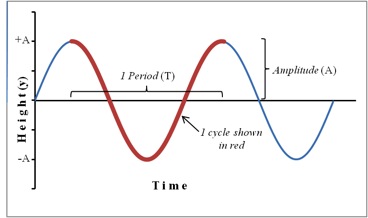
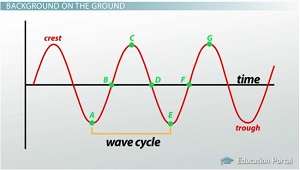
To understand wave properties, it is helpful to examine the structure of a wave. In a typical transverse wave, the wave pattern consists of alternating crests and troughs.

Crest

A crest is the highest point of a wave above the equilibrium position.

Trough

A trough is the lowest point of a wave below the equilibrium position.

Equilibrium Position

The equilibrium position is the rest position of the particles in the medium when no wave is present.

Wave Cycle

One complete wave cycle consists of one crest and one trough or the distance between two identical points such as crest to crest.

These structural features form the basis for defining important wave properties such as wavelength and amplitude.


3. Wavelength

Image
Image
Image
Image

Definition

Wavelength is the distance between two consecutive points in the same phase of a wave.

These points can include:

  • Crest to crest
  • Trough to trough
  • Compression to compression
  • Rarefaction to rarefaction

Wavelength is usually represented by the Greek letter λ (lambda).

Unit of Wavelength

The SI unit of wavelength is meter (m).

However, depending on the type of wave, wavelength may be expressed in different units such as:

  • centimeters
  • millimeters
  • nanometers
  • kilometers

For example:

  • Radio waves may have wavelengths of several kilometers.
  • Visible light wavelengths are measured in nanometers.

Examples of Wavelength

Visible light wavelengths range approximately from:

400 nm (violet light) to 700 nm (red light)

Radio waves can have wavelengths longer than 1 kilometer.

Water waves may have wavelengths ranging from a few centimeters to several meters.

Relationship with Wave Speed

Wavelength is related to wave speed and frequency through the wave equation:

v = fλ

Where:

v = wave velocity
f = frequency
λ = wavelength

If wave speed remains constant, increasing frequency results in a shorter wavelength.


4. Frequency
Image
Image
Image
Image

Definition

Frequency is the number of wave cycles passing a given point in one second.

It indicates how rapidly the wave oscillates.

Frequency is represented by the symbol f.

Unit of Frequency

The SI unit of frequency is Hertz (Hz).

1 Hz means one cycle per second.

Other commonly used units include:

  • kilohertz (kHz)
  • megahertz (MHz)
  • gigahertz (GHz)

These units are commonly used in radio communication and electronics.

Time Period

Frequency is closely related to time period.

Time period is the time required to complete one full cycle.

Relationship:

T = 1 / f

Where:

T = time period
f = frequency

Examples of Frequency

Different types of waves have different frequency ranges.

Human hearing range:

20 Hz to 20,000 Hz

Radio waves:

Thousands to billions of Hz

Visible light:

Around 4 × 10¹⁴ Hz to 7.5 × 10¹⁴ Hz

Effect of Frequency

Frequency determines many important properties.

For sound waves:

Frequency determines pitch.

Higher frequency produces higher pitch.

For electromagnetic waves:

Frequency determines energy and color.

Higher frequency waves have greater energy.


5. Amplitude

Image
Image
Image
Image

Definition

Amplitude is the maximum displacement of a particle from its equilibrium position.

It represents the height of the wave crest or the depth of the trough relative to the equilibrium line.

Amplitude is usually represented by the symbol A.

Unit of Amplitude

The unit of amplitude depends on the type of wave.

For mechanical waves:

meters

For sound waves:

pressure variations

For electromagnetic waves:

electric field intensity

Energy and Amplitude

Wave energy is strongly related to amplitude.

Energy carried by a wave is proportional to the square of the amplitude.

This means:

Doubling amplitude increases energy four times.

Examples

Sound waves:

Large amplitude → loud sound

Small amplitude → soft sound

Water waves:

Large amplitude → powerful waves

Small amplitude → gentle ripples

Light waves:

Higher amplitude → brighter light


6. Relationship Between Frequency, Wavelength, and Wave Speed

One of the most important equations in wave physics connects frequency, wavelength, and velocity.

Wave equation:

v = fλ

Where:

v = wave speed
f = frequency
λ = wavelength

This equation applies to all types of waves.

Example

If a wave has:

Frequency = 10 Hz
Wavelength = 2 m

Then:

v = 10 × 2

v = 20 m/s

Interpretation

If frequency increases while wave speed remains constant, wavelength decreases.

If wavelength increases while speed remains constant, frequency decreases.

This relationship explains many phenomena such as sound pitch changes and light color variations.


7. Wave Properties in Different Types of Waves

Sound Waves

Sound waves are longitudinal waves.

Frequency determines pitch.

Amplitude determines loudness.

Wavelength affects how sound propagates in different environments.


Light Waves

Light waves are electromagnetic waves.

Frequency determines color.

Amplitude determines brightness.

Wavelength determines position in the electromagnetic spectrum.


Water Waves

Water waves involve both transverse and longitudinal motion.

Amplitude determines wave height.

Wavelength determines distance between crests.

Frequency determines how rapidly waves arrive at the shore.


8. Graphical Representation of Wave Properties

Waves are often represented graphically to visualize their properties.

Common graphs include:

Displacement vs Distance

This graph shows the shape of the wave and helps measure wavelength.

Displacement vs Time

This graph shows how particles move over time and helps determine frequency.

Amplitude Representation

The height of the wave from equilibrium shows amplitude.

These graphical methods are widely used in physics and engineering.


9. Applications of Wave Properties

Understanding wave properties is essential in many practical applications.

Music and Acoustics

Musical instruments produce sound waves.

Frequency determines musical pitch.

Amplitude determines loudness.


Communication Technology

Radio waves carry information using frequency modulation.

Television and mobile networks rely on electromagnetic waves.


Medical Imaging

Ultrasound imaging uses high-frequency sound waves to produce images of internal organs.


Oceanography

Wave height and wavelength are studied to understand ocean currents and coastal erosion.


Astronomy

Astronomers analyze electromagnetic waves from stars and galaxies to study the universe.


10. Wave Properties in Nature

Wave properties influence many natural phenomena.

Examples include:

  • Ocean waves
  • Sound propagation in atmosphere
  • Light from the Sun
  • Seismic waves during earthquakes
  • Vibrations of atoms in solids

Understanding these properties allows scientists to analyze and predict natural processes.


11. Energy Transport by Waves

Waves transport energy without transporting matter.

Energy transfer occurs through oscillations of particles.

The amount of energy depends mainly on amplitude.

Higher amplitude waves carry more energy and can cause stronger physical effects.

For example:

Large ocean waves can damage ships and coastlines because of their high energy.

Similarly, powerful seismic waves during earthquakes cause destruction due to their large amplitude.


12. Importance of Wave Properties in Physics

Wave properties are essential for understanding many physical systems.

They help explain:

  • Sound transmission
  • Light propagation
  • Electromagnetic radiation
  • Quantum mechanical waves
  • Vibrations in mechanical systems

Many modern technologies depend on controlling wave properties.

Examples include:

  • Laser technology
  • Fiber optic communication
  • Radar systems
  • Medical imaging equipment

Thus, wave properties play a fundamental role in science and engineering.


Conclusion

Wave properties such as frequency, wavelength, and amplitude are fundamental concepts in physics that describe how waves behave and propagate through different environments. These properties determine how waves carry energy, interact with matter, and transmit information.

Wavelength describes the spatial distance between repeating points in a wave, frequency indicates how often the wave oscillates, and amplitude represents the strength or intensity of the wave. Together, these properties are related through the fundamental wave equation that connects wave speed, frequency, and wavelength.

Understanding wave properties allows scientists and engineers to analyze sound, light, ocean waves, seismic vibrations, and electromagnetic radiation. These principles are essential for modern technologies including communication systems, medical imaging devices, and scientific instruments.

The study of wave properties therefore provides a powerful framework for understanding many natural phenomena and technological applications. By analyzing frequency, wavelength, and amplitude, researchers can predict wave behavior and harness wave energy for practical purposes across many fields of science and engineering.


Tags:

Simple Harmonic Motion (SHM)

Image
Image
Image
Image

1. Introduction to Simple Harmonic Motion

Simple Harmonic Motion (SHM) is one of the most important concepts in classical physics and plays a central role in understanding oscillatory systems. It describes a special type of periodic motion where an object moves back and forth about an equilibrium position under the influence of a restoring force that is directly proportional to its displacement from that position.

Many natural phenomena exhibit SHM or approximate it under certain conditions. The vibration of a guitar string, oscillation of a mass attached to a spring, swinging of a pendulum, and even the motion of atoms in solids can often be modeled using simple harmonic motion.

SHM is particularly significant because it provides a mathematical model that is both simple and extremely powerful. Many complex systems can be approximated as simple harmonic oscillators when the displacement from equilibrium is small.

Understanding SHM is essential for studying waves, acoustics, electronics, mechanical vibrations, and even quantum mechanics.


2. Definition of Simple Harmonic Motion

Simple harmonic motion can be defined as:

A type of periodic motion in which the restoring force acting on a particle is directly proportional to its displacement from the equilibrium position and always directed toward that equilibrium position.

Mathematically:

F = −kx

Where:

F = restoring force
k = force constant (spring constant)
x = displacement from equilibrium

The negative sign indicates that the force acts in the direction opposite to displacement.

Since force causes acceleration according to Newton’s second law:

F = ma

Therefore:

ma = −kx

or

a = −(k/m)x

This equation shows that acceleration is proportional to displacement and directed toward the equilibrium position.

This characteristic property defines simple harmonic motion.


3. Basic Concepts of SHM

1. Equilibrium Position

The equilibrium position is the point where the net force acting on the particle is zero.

At this point:

  • Acceleration = 0
  • Restoring force = 0
  • Potential energy is minimum
  • Velocity is maximum

The oscillating body continuously passes through this position during motion.


2. Displacement

Displacement is the distance of the particle from the equilibrium position.

In SHM, displacement varies periodically with time and follows a sinusoidal pattern.

If x represents displacement, then:

x = A sin(ωt + φ)

Where:

A = amplitude
ω = angular frequency
t = time
φ = phase constant


3. Amplitude

Amplitude is the maximum displacement from the equilibrium position.

It represents the maximum extent of oscillation.

Example:

If a mass attached to a spring moves 5 cm on either side of equilibrium, then the amplitude is 5 cm.

Amplitude determines the energy of the oscillating system.


4. Time Period

The time period (T) is the time taken to complete one full oscillation.

One oscillation means the particle returns to its original position with the same velocity direction.

Unit: seconds


5. Frequency

Frequency (f) is the number of oscillations completed in one second.

f = 1 / T

Unit: Hertz (Hz)

Example:

If the time period is 0.5 seconds:

f = 1 / 0.5 = 2 Hz

This means the system completes two oscillations per second.


6. Angular Frequency

Angular frequency (ω) represents the rate of oscillation in radians.

ω = 2πf
ω = 2π / T

Unit: radians per second

Angular frequency is commonly used in mathematical descriptions of SHM.


4. Mathematical Description of SHM

The motion of a particle undergoing SHM can be described mathematically using sinusoidal functions.

Displacement Equation

x = A sin(ωt + φ)

or

x = A cos(ωt + φ)

Where:

x = displacement
A = amplitude
ω = angular frequency
t = time
φ = phase constant

This equation represents how displacement changes with time.


Velocity Equation

Velocity is the rate of change of displacement.

v = dx/dt

If

x = A sin(ωt)

Then

v = Aω cos(ωt)

Maximum velocity occurs at the equilibrium position.

v_max = Aω


Acceleration Equation

Acceleration is the rate of change of velocity.

a = dv/dt

For SHM:

a = −ω²x

This equation confirms that acceleration is proportional to displacement and opposite in direction.

Maximum acceleration occurs at maximum displacement.

a_max = ω²A


5. Graphical Representation of SHM

Image
Image
Image
Image

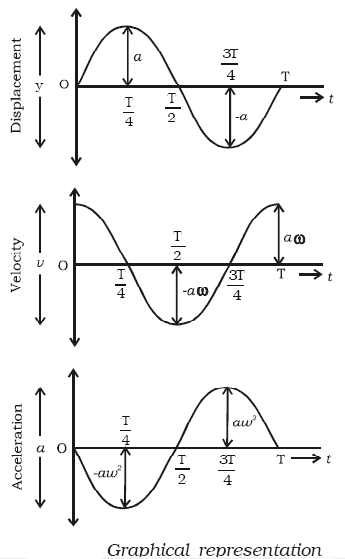
Graphical analysis helps visualize simple harmonic motion clearly.

Displacement vs Time Graph

The displacement-time graph is a sine or cosine curve.

It shows how the particle moves between maximum positive and negative displacements.

Characteristics:

  • Periodic pattern
  • Smooth oscillation
  • Maximum displacement equals amplitude

Velocity vs Time Graph

The velocity graph is also sinusoidal but shifted by 90° in phase relative to displacement.

Velocity is maximum when displacement is zero.

Velocity becomes zero at extreme positions.


Acceleration vs Time Graph

Acceleration graph is also sinusoidal.

However, it is opposite in phase with displacement.

When displacement is maximum, acceleration is maximum but in the opposite direction.


6. Energy in Simple Harmonic Motion

Energy continuously transforms during SHM.

The total mechanical energy remains constant if there is no energy loss.

Potential Energy

Potential energy is stored when the particle is displaced.

PE = ½ kx²

Maximum potential energy occurs at maximum displacement.


Kinetic Energy

Kinetic energy is due to motion.

KE = ½ mv²

Maximum kinetic energy occurs at the equilibrium position.


Total Energy

Total energy remains constant.

E = KE + PE

In SHM:

E = ½ kA²

Energy continuously shifts between kinetic and potential forms.

At equilibrium:

  • KE = maximum
  • PE = minimum

At extreme positions:

  • KE = zero
  • PE = maximum

7. Examples of Simple Harmonic Motion

Mass-Spring System

Image
Image
Image
Image

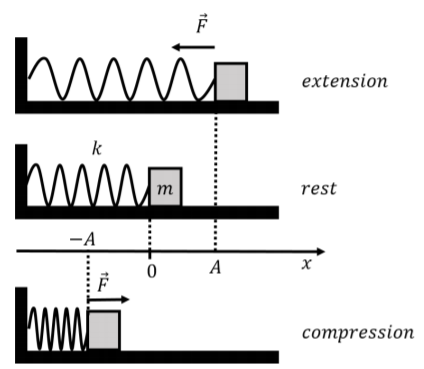
A mass attached to a spring is the classic example of SHM.

When the spring is stretched or compressed, a restoring force acts on the mass.

According to Hooke’s law:

F = −kx

Time period of oscillation:

T = 2π √(m/k)

Where:

m = mass
k = spring constant

Heavier mass increases the time period, while a stiffer spring decreases it.


Simple Pendulum

Image
Image
Image
Image

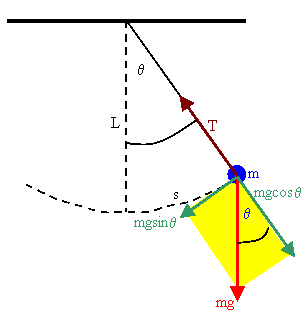
A pendulum consists of a small mass suspended from a string.

When displaced slightly and released, it oscillates.

For small angles, pendulum motion approximates SHM.

Time period:

T = 2π √(L/g)

Where:

L = length of pendulum
g = acceleration due to gravity

Interestingly, the time period does not depend on mass.


8. Phase and Phase Difference

Phase describes the stage of oscillation at any instant.

It is represented by:

ωt + φ

Where φ is the phase constant.

Two oscillations may have:

  • Same phase
  • Different phases

Phase difference describes how much one oscillation leads or lags another.

It is measured in radians or degrees.

Example:

Two waves separated by π radians are completely opposite.


9. Damped Harmonic Motion

In real systems, oscillations gradually decrease due to energy loss.

This is called damping.

Causes include:

  • Air resistance
  • Friction
  • Internal energy losses

Examples:

  • Pendulum eventually stopping
  • Vibrating tuning fork losing sound
  • Car suspension systems

Damping reduces amplitude over time.


10. Forced Oscillations and Resonance

When an external periodic force acts on a system, it produces forced oscillations.

If the frequency of the applied force equals the natural frequency, resonance occurs.

Resonance produces large amplitudes.

Examples:

  • Musical instruments
  • Radio tuning circuits
  • Vibrations in bridges

Resonance is useful but can also cause structural damage if uncontrolled.


11. Applications of SHM

SHM is used in many technologies.

Timekeeping

Pendulum clocks use SHM to measure time accurately.

Sound and Music

Musical instruments rely on oscillations.

Electronics

Oscillators produce periodic signals used in communication devices.

Earthquake Engineering

Buildings are designed considering vibrational motion.

Medical Devices

Ultrasound imaging uses oscillatory waves.

Quantum Mechanics

Atoms and molecules often behave like harmonic oscillators.


12. SHM in Nature

Many natural processes involve oscillations.

Examples include:

  • Heartbeat rhythm
  • Breathing cycles
  • Vibrations of atoms in solids
  • Ocean waves
  • Alternating electrical currents

Even microscopic particles in molecules vibrate in patterns similar to SHM.


13. SHM and Circular Motion

SHM can be understood as the projection of uniform circular motion onto a straight line.

If a particle moves in a circle with constant speed and its motion is projected onto a diameter, the resulting motion is simple harmonic motion.

This relationship explains the sinusoidal nature of SHM equations.

It also helps visualize phase relationships.


14. Importance of SHM in Physics

SHM is extremely important because it provides a simple model for many complex physical systems.

Reasons for its importance:

  • Many systems behave like harmonic oscillators.
  • Mathematical analysis is simple.
  • Helps explain wave motion.
  • Fundamental to quantum mechanics.
  • Important in electronics and signal processing.

Because of these reasons, SHM is considered one of the most fundamental topics in physics.


Conclusion

Simple harmonic motion is a fundamental form of periodic motion where the restoring force is proportional to displacement and directed toward equilibrium. It is characterized by sinusoidal motion, constant time period, and continuous energy transformation between kinetic and potential forms.

SHM appears in countless natural and technological systems, from vibrating strings and pendulums to electrical circuits and molecular vibrations. The mathematical simplicity and universal applicability of SHM make it one of the most powerful models in physics.

By understanding SHM, scientists and engineers gain insights into oscillations, waves, vibrations, and resonance. This knowledge is essential for designing mechanical systems, electronic devices, musical instruments, and scientific instruments.

Thus, simple harmonic motion serves as a cornerstone for understanding a wide range of physical phenomena across classical and modern physics.


Tags:

Periodic Motion

Image
Image
Image
Image

1. Introduction to Periodic Motion

Periodic motion is one of the most fundamental concepts in physics. It describes any motion that repeats itself after equal intervals of time. Many natural and man-made systems exhibit periodic motion, ranging from the oscillation of a pendulum and vibration of molecules to the rotation of planets around the Sun and alternating electric currents.

In simple terms, periodic motion occurs whenever an object moves in a pattern that repeats regularly over time. The time taken to complete one full cycle of motion is called the period, and this repeating behavior allows scientists and engineers to predict and analyze the motion with mathematical precision.

Periodic motion is closely connected with oscillations, waves, vibrations, and rotational motion. Because of its predictable nature, it is widely studied in physics, engineering, astronomy, acoustics, electronics, and many other scientific fields.

For example:

  • The swinging of a pendulum repeats again and again.
  • The vibration of a guitar string produces musical notes.
  • The Earth rotates about its axis every 24 hours.
  • The motion of electrons in alternating current circuits repeats regularly.

All of these are examples of periodic motion.

Understanding periodic motion allows scientists to describe complex systems using mathematical models and helps engineers design devices such as clocks, sensors, oscillators, and communication systems.


2. Definition of Periodic Motion

Periodic motion can be defined as:

Periodic motion is a type of motion that repeats itself at equal intervals of time.

The time taken for one complete repetition of motion is called the time period.

Mathematically,

T = Time taken for one complete cycle.

If a motion repeats every T seconds, then it is periodic.

Examples include:

  • Motion of a simple pendulum
  • Vibrations of a spring-mass system
  • Rotation of Earth around the Sun
  • Oscillations of atoms in a crystal lattice
  • Alternating current in electrical circuits

These motions repeat after a fixed interval of time and therefore qualify as periodic motion.


3. Characteristics of Periodic Motion

Periodic motion has several important characteristics that distinguish it from other types of motion.

1. Repetition

The most important feature of periodic motion is repetition. The motion repeats itself exactly after a certain time interval.

2. Time Period

Every periodic motion has a constant time period.

Time period (T) is the time taken to complete one full cycle.

Example:
If a pendulum completes one oscillation in 2 seconds, then its time period is:

T = 2 s

3. Frequency

Frequency describes how many cycles occur in one second.

Frequency is the reciprocal of time period.

f = 1 / T

Where:

  • f = frequency (Hertz)
  • T = time period (seconds)

Example:

If a motion repeats every 0.5 seconds:

f = 1 / 0.5 = 2 Hz

This means two cycles occur every second.

4. Amplitude

Amplitude is the maximum displacement of the particle from its equilibrium position.

In oscillatory motion, amplitude represents how far the object moves from the center position.

For example:

  • In a pendulum, amplitude is the maximum angle of swing.
  • In a spring system, amplitude is the maximum stretch or compression.

5. Equilibrium Position

The equilibrium position is the position where the net force acting on the system is zero.

In periodic motion, the object repeatedly moves around this equilibrium position.


4. Types of Periodic Motion

Periodic motion can occur in several forms depending on how the motion repeats.

1. Oscillatory Motion

Oscillatory motion is a special type of periodic motion where an object moves back and forth around an equilibrium position.

Examples include:

  • Pendulum motion
  • Vibrations of a spring
  • Motion of a tuning fork

Oscillatory motion always involves restoring forces that bring the object back to its equilibrium position.

2. Circular Motion

Circular motion can also be periodic if the object moves around a circular path repeatedly.

Examples:

  • Earth revolving around the Sun
  • A stone tied to a string and rotated
  • Rotating fan blades

In circular motion, the object returns to its starting position after each revolution.

3. Wave Motion

Waves represent periodic disturbances that travel through space or a medium.

Examples:

  • Water waves
  • Sound waves
  • Light waves

The particles of the medium move in periodic motion while the wave propagates.

4. Vibrational Motion

Vibrational motion refers to rapid periodic movements of particles.

Examples:

  • Vibrations of molecules in solids
  • Vibrations of a guitar string
  • Vibrations of atoms in a crystal lattice

5. Time Period and Frequency

Image
Image
Image
Image

Time Period

The time period (T) is the time taken by a body to complete one full cycle of motion.

Units:

seconds (s)

Example:

If a pendulum completes 5 oscillations in 10 seconds:

T = Total time / Number of oscillations

T = 10 / 5 = 2 s

Frequency

Frequency (f) represents how many cycles occur in one second.

Unit:

Hertz (Hz)

Formula:

f = 1 / T

Example:

If T = 2 seconds

f = 1 / 2 = 0.5 Hz

This means the system completes half a cycle every second.

Angular Frequency

Angular frequency describes how rapidly the motion repeats in angular terms.

Formula:

ω = 2πf
ω = 2π / T

Where:

ω = angular frequency

Unit: radians per second.

Angular frequency is widely used in oscillatory systems and wave equations.


6. Examples of Periodic Motion

Periodic motion appears everywhere in nature and technology.

Pendulum Motion

A simple pendulum swings back and forth in a periodic manner.

The time period depends on:

  • Length of the string
  • Acceleration due to gravity

Formula:

T = 2π √(L / g)

Where:

L = length of pendulum
g = acceleration due to gravity

Spring-Mass System

A mass attached to a spring oscillates periodically.

The restoring force follows Hooke’s law:

F = −kx

Where:

k = spring constant

Time period of oscillation:

T = 2π √(m / k)

Where:

m = mass of the object

Planetary Motion

The revolution of planets around the Sun is periodic.

For example:

Earth takes 365 days to complete one revolution.

Thus the orbital motion is periodic.

Vibrations of Strings

Musical instruments like guitars and violins produce sound through periodic vibration of strings.

The frequency of vibration determines the pitch of the sound.


7. Simple Harmonic Motion (SHM)

Image
Image
Image
Image

Simple Harmonic Motion is the most important form of periodic motion.

Definition

Simple harmonic motion is a type of periodic motion where the restoring force is directly proportional to displacement and acts toward the equilibrium position.

Mathematically:

F = −kx

or

a = −ω²x

Where:

F = restoring force
x = displacement
ω = angular frequency

The negative sign indicates that the force acts opposite to the displacement.

Characteristics of SHM

  1. Motion repeats periodically
  2. Acceleration is proportional to displacement
  3. Force acts toward equilibrium position
  4. Motion follows a sinusoidal pattern

Displacement Equation

x = A sin(ωt + φ)

Where:

A = amplitude
ω = angular frequency
t = time
φ = phase constant

This equation describes how displacement varies with time.


8. Energy in Periodic Motion

In periodic motion, energy continuously transforms between different forms.

Kinetic Energy

When the object moves fastest at the equilibrium position, kinetic energy is maximum.

KE = ½ mv²

Potential Energy

At maximum displacement, potential energy is maximum.

PE = ½ kx²

Total Energy

Total mechanical energy remains constant.

Total Energy = KE + PE

In SHM:

E = ½ kA²

Energy continuously shifts between kinetic and potential forms during motion.


9. Phase and Phase Difference

Phase describes the position of a particle in its periodic cycle.

Example:

Two waves may be:

  • In phase
  • Out of phase

If two motions have the same displacement and direction at the same time, they are in phase.

If they differ, they have a phase difference.

Phase difference is measured in radians or degrees.


10. Applications of Periodic Motion

Periodic motion has numerous applications across science and engineering.

Clocks and Time Measurement

Pendulum clocks and quartz clocks rely on periodic motion to measure time accurately.

Electronics

Oscillators produce periodic electrical signals used in radios, televisions, and communication systems.

Sound Production

Musical instruments create sound through periodic vibration.

Astronomy

Planetary motion is periodic, allowing astronomers to predict celestial events.

Mechanical Systems

Machines use rotating components that undergo periodic motion.


11. Periodic Motion in Nature

Nature is full of periodic motions.

Examples include:

  • Rotation of Earth (day and night cycle)
  • Revolution of Earth (seasons)
  • Ocean tides
  • Heartbeat
  • Breathing cycles
  • Vibrations of atoms

Even microscopic systems such as molecules exhibit periodic vibrations.


12. Graphical Representation of Periodic Motion

Periodic motion is often represented graphically.

Common graphs include:

Displacement vs Time

This graph shows sinusoidal curves for SHM.

Velocity vs Time

Velocity is also periodic but shifted in phase.

Acceleration vs Time

Acceleration graph is opposite in phase with displacement.

These graphs help visualize periodic behavior clearly.


13. Damped Periodic Motion

In real systems, periodic motion often decreases with time due to energy loss.

This is called damped motion.

Causes include:

  • Friction
  • Air resistance
  • Internal energy loss

Examples:

  • Pendulum gradually stopping
  • Vibrating string losing energy
  • Shock absorbers in vehicles

14. Forced Oscillations and Resonance

When an external force drives a system periodically, it undergoes forced oscillations.

If the driving frequency equals the natural frequency, resonance occurs.

Resonance produces very large amplitudes.

Examples:

  • Musical instruments
  • Bridges vibrating due to wind
  • Radio tuning circuits

Resonance is useful but can also cause structural failures.


15. Importance of Periodic Motion in Physics

Periodic motion plays a central role in physics.

It helps in:

  • Understanding waves and vibrations
  • Studying quantum mechanics
  • Describing electromagnetic waves
  • Modeling planetary motion
  • Designing engineering systems

Many advanced physical theories rely on oscillatory and periodic behavior.

Because periodic systems are predictable and mathematically manageable, they serve as models for more complex systems.


Conclusion

Periodic motion is a fundamental concept that describes repeating motion in physical systems. From pendulums and springs to planetary orbits and sound waves, periodic motion is present in nearly every aspect of the natural world.

Key concepts such as time period, frequency, amplitude, phase, and energy transformations help describe and analyze periodic systems. Among the many forms of periodic motion, simple harmonic motion stands out as the most important due to its mathematical simplicity and widespread occurrence.

The study of periodic motion has enormous practical applications in science, engineering, electronics, astronomy, and everyday technology. Understanding it allows scientists and engineers to design systems that rely on predictable repeating motion, from clocks and musical instruments to communication systems and mechanical devices.

Periodic motion therefore represents not only a fundamental physical phenomenon but also a powerful tool for understanding and controlling the dynamic behavior of the universe.