1. Introduction to Matter
Matter is one of the most fundamental concepts in chemistry and physical science. Everything that exists in the physical universe, from the smallest microscopic particles to enormous celestial bodies such as planets and stars, is composed of matter. Matter can be defined as anything that has mass and occupies space. This definition may appear simple, but it encompasses a vast range of materials and substances that make up our universe.
Matter exists in various forms and structures. It includes everyday objects like water, air, rocks, plants, animals, metals, plastics, and countless other materials. Even the human body is composed entirely of matter. Understanding matter and how it behaves is essential for studying chemistry because chemistry focuses on the composition, structure, properties, and transformations of matter.
In chemistry, matter is studied at different levels. Scientists investigate matter at the macroscopic level, which includes visible materials and substances we can observe directly. They also study matter at the microscopic level, which involves atoms, molecules, and subatomic particles that cannot be seen with the naked eye.
Matter exhibits different characteristics depending on its composition and the arrangement of its particles. Because of this diversity, scientists classify matter into various categories to better understand its properties and behavior.
The classification of matter helps scientists organize substances into groups based on similarities in their physical and chemical properties. This organization simplifies the study of matter and provides a framework for predicting how substances will behave under different conditions.
2. Properties of Matter
Matter possesses certain characteristics known as properties, which describe how a substance behaves and how it can be identified. These properties are broadly divided into two categories: physical properties and chemical properties.
Physical Properties
Physical properties are characteristics that can be observed or measured without changing the chemical identity of the substance. These properties describe the appearance and behavior of matter under various conditions.
Some common physical properties include:
Mass
Mass refers to the amount of matter present in an object. It is usually measured in kilograms or grams. Mass remains constant regardless of location.
Volume
Volume is the amount of space occupied by a substance. Liquids and gases take the shape of their containers, while solids usually have fixed shapes.
Density
Density is defined as the mass per unit volume of a substance. It indicates how tightly packed the particles of matter are within a given space.
Color and Appearance
Many substances can be identified by their color or physical appearance. For example, copper has a reddish color, while sulfur is yellow.
Melting Point
The melting point is the temperature at which a solid changes into a liquid.
Boiling Point
The boiling point is the temperature at which a liquid changes into a gas.
Solubility
Solubility describes the ability of a substance to dissolve in another substance.
Electrical Conductivity
Some materials, such as metals, can conduct electricity, while others cannot.
Physical properties are useful in identifying substances and determining their potential applications.
Chemical Properties
Chemical properties describe the ability of a substance to undergo chemical reactions and form new substances.
Examples of chemical properties include:
Reactivity
Reactivity describes how easily a substance reacts with other substances.
Flammability
Flammability refers to the ability of a substance to burn in the presence of oxygen.
Corrosion
Certain metals react with oxygen and moisture to form oxides, leading to corrosion.
Acidity and Basicity
These properties describe the chemical behavior of substances in aqueous solutions.
Chemical properties can only be observed when a chemical change occurs.
3. States of Matter


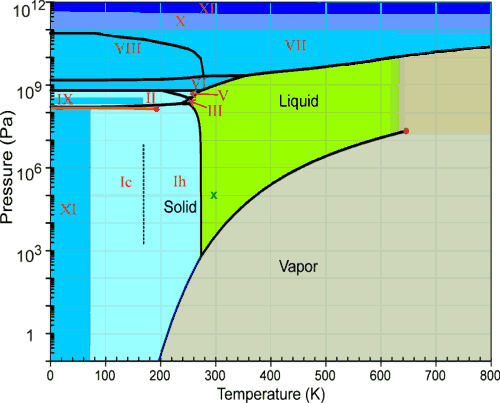
Matter exists in different physical states, depending on temperature and pressure conditions. The four primary states of matter are solid, liquid, gas, and plasma.
Solid
In solids, particles are tightly packed in a fixed arrangement. The strong intermolecular forces between particles keep them in place, allowing only small vibrations.
Characteristics of solids:
- Definite shape
- Definite volume
- High density
- Particles closely packed
- Very limited movement of particles
Examples of solids include:
- Ice
- Wood
- Metals
- Salt
- Rocks
Solids can be further classified into crystalline solids and amorphous solids.
Crystalline solids have an orderly repeating structure, while amorphous solids have irregular particle arrangements.
Liquid
Liquids have a definite volume but no fixed shape. They take the shape of the container that holds them.
Characteristics of liquids:
- Definite volume
- No fixed shape
- Moderate density
- Particles close together but able to move
- Ability to flow
Examples of liquids include:
- Water
- Oil
- Alcohol
- Mercury
Liquids exhibit properties such as viscosity, surface tension, and capillary action.
Gas
Gases have neither definite shape nor definite volume. They expand to fill the entire container.
Characteristics of gases:
- No fixed shape
- No fixed volume
- Very low density
- Particles move freely and rapidly
- Highly compressible
Examples of gases include:
- Oxygen
- Nitrogen
- Carbon dioxide
- Hydrogen
The behavior of gases is described by various gas laws.
Plasma
Plasma is considered the fourth state of matter. It consists of highly energized charged particles such as ions and electrons.
Plasma forms when gases are heated to extremely high temperatures or exposed to strong electromagnetic fields.
Examples include:
- Lightning
- The Sun and stars
- Neon lights
- Plasma televisions
- Auroras
Plasma conducts electricity and responds strongly to magnetic fields.
4. Classification of Matter


Matter can be classified into two major categories:
- Pure substances
- Mixtures
This classification is based on composition and uniformity.
5. Pure Substances
Pure substances are forms of matter that have a fixed chemical composition and consistent properties throughout the sample.
They cannot be separated into simpler substances by physical methods.
Pure substances are divided into two categories:
- Elements
- Compounds
Elements
An element is the simplest form of matter that cannot be broken down into simpler substances by chemical reactions.
Elements consist of only one type of atom.
Examples of elements include:
- Hydrogen
- Oxygen
- Carbon
- Iron
- Gold
- Silver
- Nitrogen
Each element has a unique atomic number that represents the number of protons in its nucleus.
More than 118 elements are known today.
Elements are organized in the periodic table based on their atomic number and chemical properties.
Elements can be classified into several groups:
Metals
Metals are elements that are typically shiny, conductive, and malleable.
Examples:
- Iron
- Copper
- Aluminum
- Gold
Nonmetals
Nonmetals generally lack metallic properties.
Examples:
- Oxygen
- Nitrogen
- Sulfur
- Carbon
Metalloids
Metalloids possess properties intermediate between metals and nonmetals.
Examples:
- Silicon
- Germanium
Compounds
Compounds are substances formed when two or more elements chemically combine in fixed proportions.
The atoms in a compound are held together by chemical bonds.
Examples include:
- Water (H₂O)
- Carbon dioxide (CO₂)
- Sodium chloride (NaCl)
- Methane (CH₄)
- Ammonia (NH₃)
Compounds have properties that differ from the elements that compose them.
For example:
Hydrogen and oxygen are gases, but when they combine chemically, they form water, which is a liquid.
Compounds can only be separated into their elements through chemical reactions, not physical processes.
6. Mixtures
A mixture is a combination of two or more substances that are physically combined rather than chemically bonded.
The components of a mixture retain their individual properties and can be separated using physical methods.
Examples of mixtures include:
- Air
- Saltwater
- Soil
- Sand and sugar mixture
- Alloys such as brass and steel
Mixtures are divided into two types:
- Homogeneous mixtures
- Heterogeneous mixtures
Homogeneous Mixtures
Homogeneous mixtures have a uniform composition throughout the entire mixture.
They appear as a single phase.
Examples include:
- Salt dissolved in water
- Sugar solution
- Air
- Vinegar
- Alcohol-water mixture
These mixtures are often referred to as solutions.
A solution contains:
- Solute (the substance dissolved)
- Solvent (the substance that dissolves the solute)
For example, in saltwater:
Salt = solute
Water = solvent
Heterogeneous Mixtures
Heterogeneous mixtures have non-uniform composition and contain visibly different components.
Examples include:
- Sand in water
- Oil and water
- Salad
- Soil
- Granite
The different components in heterogeneous mixtures can usually be seen with the naked eye.
7. Methods of Separating Mixtures


Because mixtures consist of physically combined substances, they can be separated using various physical methods.
Filtration
Filtration separates insoluble solids from liquids using a filter medium.
Example: separating sand from water.
Distillation
Distillation separates liquids based on differences in boiling points.
Example: separating alcohol from water.
Chromatography
Chromatography separates substances based on their movement through a medium.
Example: separating pigments in ink.
Centrifugation
Centrifugation uses rapid spinning to separate substances of different densities.
Example: separating blood components.
Evaporation
Evaporation separates dissolved solids from liquids.
Example: obtaining salt from seawater.
8. Changes in Matter
Matter can undergo two main types of changes.
Physical Changes
Physical changes affect the form or state of matter but do not alter its chemical composition.
Examples:
- Melting ice
- Freezing water
- Breaking glass
- Dissolving sugar
These changes are often reversible.
Chemical Changes
Chemical changes produce new substances with different chemical compositions.
Examples:
- Burning wood
- Rusting iron
- Cooking food
- Fermentation
Chemical changes usually involve energy changes and the formation of new chemical bonds.
9. Importance of Studying Matter and Its Classification
Understanding matter and its classification is fundamental to chemistry and other sciences.
It helps scientists:
- Understand the structure of substances
- Predict chemical behavior
- Develop new materials
- Improve industrial processes
- Design medicines and chemicals
- Study environmental changes
This classification also provides a foundation for more advanced topics such as thermodynamics, chemical bonding, quantum chemistry, and materials science.
10. Conclusion
Matter forms the basis of everything in the physical universe. By studying matter and its classification, scientists can better understand the nature of substances and how they interact with each other.
The classification of matter into pure substances and mixtures provides a structured way to study materials based on their composition and properties. Further division into elements, compounds, homogeneous mixtures, and heterogeneous mixtures allows scientists to organize and analyze substances efficiently.
Understanding matter is the first step toward exploring more complex concepts in chemistry such as atomic structure, chemical reactions, thermodynamics, and molecular interactions.
As science advances, the study of matter continues to play a vital role in developing new technologies, improving industrial processes, and addressing global challenges such as energy production, environmental sustainability, and human health.