


Introduction
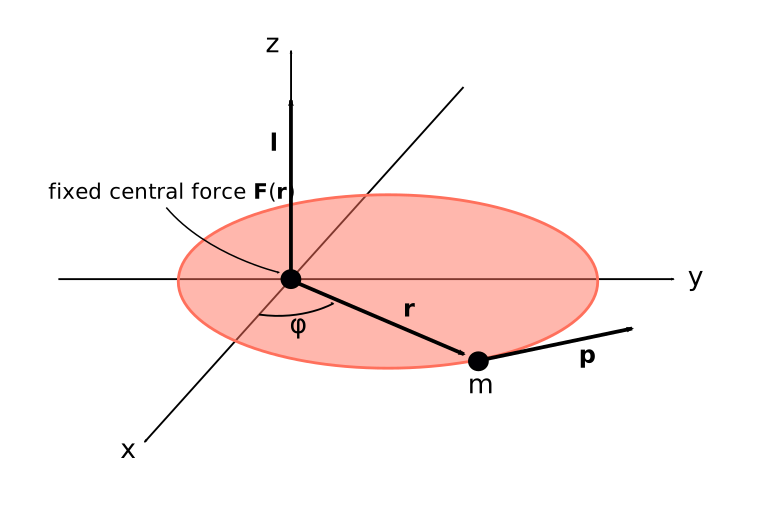
Central force motion is a fundamental concept in classical mechanics describing the motion of a particle under the influence of a force that always points toward or away from a fixed point called the center of force. This type of force depends only on the distance between the particle and the center, not on the direction of motion.
Central forces are extremely important in physics because they describe many natural phenomena such as:
- Planetary motion around stars
- Satellite motion around planets
- Motion of electrons in atoms (in simplified models)
- Gravitational interactions between celestial bodies
A central force always acts along the line connecting the particle to the center and is typically expressed as a function of the radial distance.
Mathematically, a central force can be written as:
[
\vec{F} = F(r)\hat{r}
]
Where:
- (F(r)) is a function of the radial distance (r)
- (\hat{r}) is the radial unit vector
Central force motion plays a major role in classical mechanics, celestial mechanics, and orbital mechanics.
Characteristics of Central Forces


A central force has several important properties.
Radial Direction
The force always acts along the line joining the particle and the center.
Distance Dependence
The magnitude of the force depends only on the distance from the center.
No Tangential Component
Central forces do not have components perpendicular to the radial direction.
Conservativeness
Most central forces are conservative forces, meaning the work done depends only on initial and final positions.
Examples of central forces include:
- Gravitational force
- Electrostatic force
- Elastic forces in certain systems
Examples of Central Forces


Several important forces in physics are central forces.
Gravitational Force
Newton’s law of gravitation:
[
F = -\frac{GMm}{r^2}
]
This force governs planetary motion.
Electrostatic Force
Coulomb’s law describes the interaction between electric charges:
[
F = \frac{kq_1 q_2}{r^2}
]
Elastic Central Force
Certain spring forces can behave like central forces.
These forces play major roles in atomic and astronomical systems.
Motion in Polar Coordinates

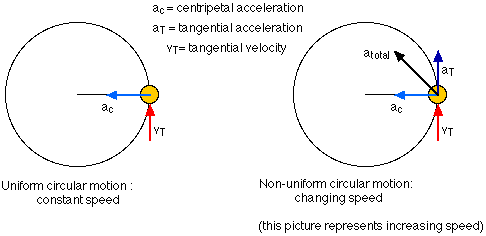

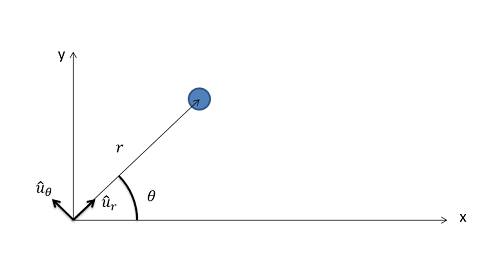
Central force motion is most easily analyzed using polar coordinates.
In polar coordinates, the position of a particle is described by:
- Radial distance (r)
- Angular position ( \theta )
The velocity and acceleration components can be expressed in terms of radial and angular components.
Radial Acceleration
[
a_r = \ddot{r} – r\dot{\theta}^2
]
Angular Acceleration
[
a_\theta = r\ddot{\theta} + 2\dot{r}\dot{\theta}
]
These equations are essential for analyzing central force motion.
Conservation of Angular Momentum


A key result of central force motion is the conservation of angular momentum.
Since the force acts along the radial direction, the torque about the center is zero.
[
\tau = \vec{r} \times \vec{F} = 0
]
Therefore:
[
L = m r^2 \dot{\theta} = constant
]
Where:
- (L) is angular momentum.
This leads to an important consequence: the particle sweeps equal areas in equal times.
This principle is equivalent to Kepler’s second law of planetary motion.
Effective Potential


Central force motion can be analyzed using the concept of effective potential.
The effective potential combines gravitational potential energy and rotational energy.
[
V_{eff}(r) = V(r) + \frac{L^2}{2mr^2}
]
Where:
- (V(r)) is the potential energy
- (L) is angular momentum
The effective potential helps determine whether orbits are:
- Stable
- Circular
- Elliptical
Circular Orbits


A circular orbit occurs when the centripetal force required for circular motion is provided by the central force.
Condition:
[
\frac{mv^2}{r} = F(r)
]
For gravitational forces:
[
v = \sqrt{\frac{GM}{r}}
]
Circular orbits are common in satellite motion.
Elliptical Orbits and Kepler’s Laws


Many central force systems produce elliptical orbits.
Kepler’s laws describe planetary motion.
First Law
Planets move in elliptical orbits with the Sun at one focus.
Second Law
A line joining the planet and the Sun sweeps equal areas in equal times.
Third Law
[
T^2 \propto a^3
]
Where:
- (T) = orbital period
- (a) = semi-major axis
These laws arise naturally from Newton’s gravitational force.
Stability of Orbits


Orbit stability depends on the shape of the effective potential.
Stable orbits occur when:
[
\frac{d^2 V_{eff}}{dr^2} > 0
]
This means the orbit corresponds to a minimum in the effective potential.
Small disturbances cause the particle to oscillate around the stable orbit.
Applications of Central Force Motion


Central force motion is important in many areas of physics.
Celestial Mechanics
Explains planetary and satellite motion.
Atomic Physics
Used in early models of atomic structure.
Space Engineering
Helps design satellite trajectories.
Astrophysics
Describes motion of stars and galaxies.
Understanding central forces is essential for studying gravitational systems.
Importance in Physics
Central force motion is one of the most important topics in classical mechanics.
It connects several key physical concepts:
- Conservation of energy
- Conservation of angular momentum
- Orbital motion
- Gravitational interactions
Many fundamental results in astronomy and space science arise from central force dynamics.
Conclusion
Central force motion describes the motion of particles under forces that act along the line connecting the particle to a fixed center. Such forces depend only on the distance between the particle and the center and include gravitational and electrostatic forces.
Using polar coordinates and conservation laws, the motion of particles under central forces can be analyzed in detail. These systems often produce circular or elliptical orbits, as described by Kepler’s laws.
Central force motion is fundamental to celestial mechanics, orbital dynamics, and many areas of theoretical physics. Its principles continue to play a vital role in understanding the motion of objects in the universe.