



1. Introduction to Topology
Topology is a branch of mathematics that studies the properties of spaces that remain unchanged under continuous transformations such as stretching, bending, or twisting, but not tearing or gluing. Because of this, topology is often described as “rubber-sheet geometry.”
Unlike classical geometry, which focuses on exact measurements such as angles and distances, topology focuses on qualitative properties such as connectedness, continuity, and the number of holes in a space.
Topology plays a crucial role in modern mathematics and has applications in many areas including:
- Physics
- Computer science
- Robotics
- Data analysis
- Cosmology
- Network theory
- Artificial intelligence
One famous example used to explain topology is that a coffee cup and a donut (torus) are considered topologically equivalent because each has one hole and can be continuously transformed into the other without cutting.
Topology provides a powerful framework for understanding spaces and shapes in a more abstract and general way.
2. Basic Concepts of Topology
Topology studies mathematical spaces and their properties.
Key concepts include:
- Topological spaces
- Open sets
- Closed sets
- Continuity
- Compactness
- Connectedness
These concepts allow mathematicians to analyze spaces in a generalized way.
3. Topological Spaces
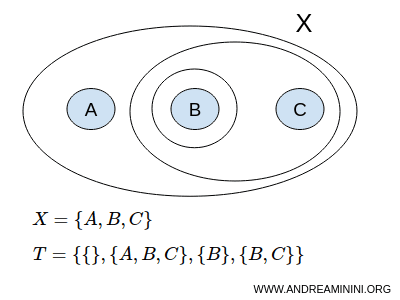
A topological space is a set together with a collection of subsets called open sets.
Formally, a topological space is defined as:
(X, τ)
Where:
X = set of points
τ = topology (collection of open sets)
The topology must satisfy three conditions:
- The empty set and the whole set X are open.
- Any union of open sets is open.
- Any finite intersection of open sets is open.
These rules define the structure of a topological space.
4. Open Sets
An open set is a fundamental concept in topology.
In simple terms, an open set contains none of its boundary points.
Example:
The interval (0,1) in real numbers is an open set.
Open sets help define continuity and convergence.
5. Closed Sets
A closed set contains all its boundary points.
Example:
The interval [0,1] is closed.
Closed sets are complements of open sets.
Properties:
- Intersection of closed sets is closed.
- Finite union of closed sets is closed.
6. Interior, Closure, and Boundary
Topology uses several concepts to describe subsets.
Interior
The interior of a set contains all points surrounded entirely by the set.
Example:
Interior of [0,1] is (0,1).
Closure
The closure includes all points of the set plus its boundary.
Example:
Closure of (0,1) is [0,1].
Boundary
Boundary points lie between the set and its complement.
Example:
Boundary of (0,1) is {0,1}.
7. Basis for a Topology
A basis is a collection of open sets used to generate a topology.
Example:
Open intervals form a basis for the topology on real numbers.
Using bases simplifies the description of topological spaces.
8. Subspace Topology
A subspace topology is created when a subset inherits the topology from a larger space.
Example:
Subset of real numbers with induced topology.
9. Continuous Functions
Continuity is a key concept in topology.
A function f is continuous if the preimage of every open set is open.
This definition generalizes continuity from calculus.
10. Homeomorphism
A homeomorphism is a continuous function with a continuous inverse.
Two spaces connected by a homeomorphism are considered topologically equivalent.
Example:
Coffee cup and torus.
11. Connected Spaces
A space is connected if it cannot be divided into two disjoint open sets.
Example:
A single line segment is connected.
Two separate circles form a disconnected space.
12. Path Connectedness
A space is path connected if any two points can be joined by a continuous path.
This concept is stronger than connectedness.
13. Compactness
A set is compact if every open cover has a finite subcover.
Compactness generalizes the idea of closed and bounded sets.
Example:
Closed interval [0,1] is compact.
Compact sets have many important mathematical properties.
14. Metric Spaces
A metric space is a set with a distance function.
Distance function:
d(x,y)
Metric spaces combine topology and geometry.
Example:
Real numbers with standard distance.
15. Topological Manifolds
A manifold is a space that locally resembles Euclidean space.
Examples:
- surfaces
- spheres
- torus
Manifolds are central in modern geometry and physics.
16. Algebraic Topology
Algebraic topology uses algebraic methods to study topological spaces.
Tools include:
- homology
- homotopy
- fundamental groups
These help classify spaces.
17. Fundamental Group
The fundamental group describes loops in a space.
Spaces with different numbers of holes have different fundamental groups.
Example:
Circle has nontrivial fundamental group.
18. Applications of Topology
Topology has many practical applications.
Physics
Used in quantum field theory and cosmology.
Robotics
Topology helps analyze motion planning.
Data Science
Topological data analysis studies patterns in data.
Computer Graphics
Used to model surfaces and shapes.
Network Theory
Topology helps analyze connectivity in networks.
19. Importance of Topology
Topology provides tools for studying spaces in a very general way.
It connects geometry, algebra, and analysis.
Many modern mathematical theories rely on topological ideas.
20. Modern Developments in Topology
Modern topology includes:
- differential topology
- algebraic topology
- geometric topology
These fields study complex structures in mathematics and physics.
Conclusion
Topology is a fascinating branch of mathematics that studies the properties of spaces that remain unchanged under continuous transformations. Unlike classical geometry, which focuses on measurements and distances, topology focuses on the qualitative structure of spaces and how they are connected.
Key concepts such as open sets, closed sets, continuity, compactness, and connectedness provide the foundation for understanding topological spaces. The concept of homeomorphism allows mathematicians to classify spaces based on their fundamental structure rather than their precise geometric shape.
Topology has deep connections with many other branches of mathematics, including algebra, geometry, and analysis. It also has important applications in physics, computer science, robotics, and data science.
As modern science continues to explore complex systems and high-dimensional structures, topology remains an essential tool for understanding the underlying structure of mathematical and physical spaces.