

1. Introduction to Complex Analysis
Complex analysis is a branch of mathematics that studies functions of complex numbers. It extends the ideas of calculus and real analysis into the complex number system. Complex analysis explores the behavior of functions whose variables and values are complex numbers.
Complex analysis is one of the most elegant and powerful areas of mathematics. It provides deep insights into the structure of functions, and many results in complex analysis are stronger and more elegant than their counterparts in real analysis.
The field plays an important role in mathematics, physics, engineering, and applied sciences. Complex analysis is widely used in:
- Electrical engineering
- Quantum mechanics
- Fluid dynamics
- Signal processing
- Control theory
- Electromagnetism
- Computer graphics
The central idea of complex analysis is studying functions defined on the complex plane, which combines the real and imaginary number systems.
2. Complex Numbers
Complex numbers extend the real numbers by including an imaginary component.
A complex number has the form:
z = a + bi
Where:
a = real part
b = imaginary part
i = imaginary unit
The imaginary unit is defined as:
i² = −1
Example complex numbers:
3 + 2i
−1 + 5i
4 − i
3. Real and Imaginary Parts
For a complex number:
z = a + bi
Real part:
Re(z) = a
Imaginary part:
Im(z) = b
Example:
z = 4 + 7i
Re(z) = 4
Im(z) = 7
4. Complex Plane (Argand Plane)
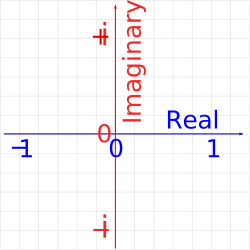
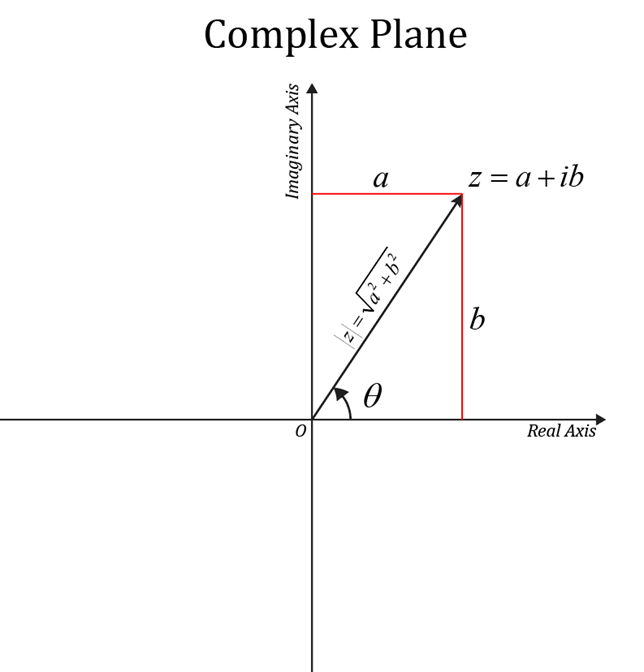
Complex numbers can be represented geometrically on the complex plane.
The horizontal axis represents the real numbers.
The vertical axis represents the imaginary numbers.
Example:
z = 3 + 4i
Point coordinates:
(3,4)
This representation allows complex numbers to be visualized as vectors.
5. Modulus of a Complex Number
The modulus represents the distance of a complex number from the origin.
Formula:
|z| = √(a² + b²)
Example:
z = 3 + 4i
|z| = √(3² + 4²)
|z| = 5
6. Argument of a Complex Number
The argument represents the angle between the positive real axis and the vector representing the complex number.
Notation:
arg(z)
Example:
z = a + bi
Angle:
θ = tan⁻¹(b/a)
7. Polar Form of Complex Numbers
Complex numbers can be written in polar form.
z = r(cosθ + i sinθ)
Where:
r = modulus
θ = argument
Polar form simplifies multiplication and division.
8. Euler’s Formula
One of the most famous formulas in mathematics:
e^(iθ) = cosθ + i sinθ
Using Euler’s formula, complex numbers can be written as:
z = re^(iθ)
This form is called the exponential form.
9. Operations on Complex Numbers
Complex numbers follow standard arithmetic rules.
Addition
(a + bi) + (c + di)
= (a + c) + (b + d)i
Subtraction
(a + bi) − (c + di)
= (a − c) + (b − d)i
Multiplication
(a + bi)(c + di)
= ac + adi + bci + bdi²
Since i² = −1:
= (ac − bd) + (ad + bc)i
Division
Division involves multiplying by the conjugate.
10. Complex Conjugate
The conjugate of a complex number reverses the sign of the imaginary part.
If:
z = a + bi
Then:
z̅ = a − bi
Example:
z = 3 + 4i
z̅ = 3 − 4i
Conjugates help simplify division.
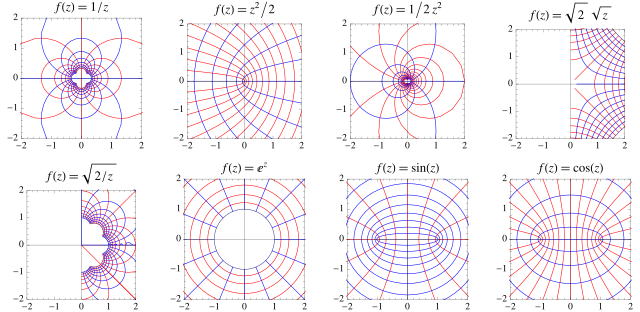
11. Functions of Complex Variables
A complex function maps complex numbers to complex numbers.
Example:
f(z) = z²
Where z is complex.
Functions in complex analysis often behave differently from real functions.
12. Limits in Complex Analysis
Limits are defined similarly to real analysis.
lim z→z₀ f(z)
However, in complex analysis the limit must be the same regardless of the direction of approach.
13. Continuity
A function is continuous if:
lim z→z₀ f(z) = f(z₀)
Most elementary complex functions are continuous.
14. Differentiability
A complex function is differentiable if:
f'(z) = lim h→0 [f(z + h) − f(z)] / h
Complex differentiability is stronger than real differentiability.
Functions that are differentiable are called analytic functions.
15. Cauchy-Riemann Equations
For a function:
f(z) = u(x,y) + iv(x,y)
The function is analytic if:
∂u/∂x = ∂v/∂y
∂u/∂y = −∂v/∂x
These equations are fundamental in complex analysis.
16. Analytic Functions
A function is analytic if it is differentiable at every point in a region.
Analytic functions have many remarkable properties.
Examples include:
- exponential functions
- trigonometric functions
- logarithmic functions
17. Complex Integration
Integration in complex analysis involves integrating along curves.
Example:
∮ f(z) dz
This is called contour integration.
18. Cauchy’s Integral Theorem
Cauchy’s theorem states that the integral of an analytic function over a closed contour is zero.
This theorem is one of the most important results in complex analysis.
19. Cauchy’s Integral Formula
Cauchy’s formula allows evaluation of analytic functions inside contours.
It is widely used in theoretical mathematics.
20. Residue Theory
Residue theory helps compute complex integrals using residues at poles.
Residues simplify many difficult integrals.
21. Singularities
Singularities are points where a function is not analytic.
Types include:
- removable singularities
- poles
- essential singularities
22. Applications of Complex Analysis
Complex analysis has many practical applications.
Electrical Engineering
Used in circuit analysis and signal processing.
Fluid Dynamics
Complex functions model fluid flow.
Quantum Mechanics
Complex wave functions describe particles.
Control Systems
Complex analysis helps analyze system stability.
Image Processing
Complex transformations help manipulate images.
23. Importance of Complex Analysis
Complex analysis simplifies many mathematical problems.
It provides elegant solutions and powerful techniques for solving integrals and differential equations.
Many real-world systems rely on complex numbers for modeling physical phenomena.
Conclusion
Complex analysis is a fascinating branch of mathematics that extends the study of functions into the complex number system. By introducing complex numbers and analyzing their properties, mathematicians can explore deeper structures and relationships that are not visible in real analysis.
The study of complex functions reveals remarkable results such as Cauchy’s theorem, Euler’s formula, and residue theory. These concepts provide powerful tools for solving integrals, differential equations, and physical modeling problems.
Complex analysis has significant applications in physics, engineering, and applied mathematics. Its ability to simplify complicated problems and produce elegant solutions makes it one of the most important and beautiful areas of mathematics.
Understanding complex analysis not only strengthens mathematical reasoning but also opens the door to many advanced scientific and engineering applications.