


1. Introduction to Vector Spaces
A vector space is one of the most fundamental concepts in linear algebra. It provides a mathematical framework for studying vectors and operations involving vectors. Vector spaces are used to describe collections of objects that can be added together and multiplied by scalars while satisfying certain mathematical rules.
Although vectors are often associated with arrows in geometry or physics, the concept of vector spaces extends far beyond geometric vectors. In fact, vector spaces can consist of many different mathematical objects such as:
- Coordinate vectors
- Polynomials
- Matrices
- Functions
- Sequences
Vector spaces provide a unified structure that allows mathematicians and scientists to analyze and solve problems involving linear relationships.
The concept of vector spaces is extremely important in modern mathematics and is widely applied in various fields such as:
- Physics
- Engineering
- Computer science
- Machine learning
- Data science
- Economics
- Statistics
- Control systems
- Quantum mechanics
By studying vector spaces, we gain tools to analyze linear systems, transformations, and high-dimensional data.
2. Definition of a Vector Space
A vector space is a collection of objects called vectors, along with two operations:
- Vector addition
- Scalar multiplication
These operations must satisfy a specific set of mathematical rules known as vector space axioms.
A vector space is usually defined over a field of scalars, typically:
- Real numbers (ℝ)
- Complex numbers (ℂ)
If a set of vectors satisfies all the required axioms under these operations, it forms a vector space.
3. Components of a Vector Space
A vector space consists of three key elements:
1. Vectors
Vectors are the elements of the vector space.
Example:
(2,3)
(4,5)
(-1,6)
These vectors belong to ℝ².
2. Scalars
Scalars are numbers used to scale vectors.
Examples include:
2, −3, 0.5, etc.
Scalars usually belong to the real number system.
3. Operations
Vector spaces involve two operations:
- Vector addition
- Scalar multiplication
4. Vector Space Axioms
For a set to qualify as a vector space, it must satisfy ten axioms.
Closure under Addition
If u and v are vectors in the space, then:
u + v is also in the space.
Commutative Property
u + v = v + u
Associative Property
(u + v) + w = u + (v + w)
Additive Identity
There exists a vector 0 such that:
v + 0 = v
Additive Inverse
For every vector v, there exists −v such that:
v + (−v) = 0
Closure under Scalar Multiplication
If v is in the vector space and c is a scalar:
cv is also in the space.
Associativity of Scalar Multiplication
a(bv) = (ab)v
Identity Scalar
1v = v
Distributive Property
a(u + v) = au + av
Scalar Distributive Property
(a + b)v = av + bv
5. Examples of Vector Spaces
Vector spaces appear in many forms.
Euclidean Vector Space (ℝ²)
The set of ordered pairs:
(x, y)
Forms a vector space.
Example vectors:
(1,2)
(3,4)
(-5,6)
Three-Dimensional Space (ℝ³)
Vectors:
(x, y, z)
Example:
(2,3,4)
Polynomial Vector Space
Polynomials can form vector spaces.
Example:
P₂ = set of polynomials of degree ≤ 2
Example vectors:
2 + 3x
4x² + 5x + 1
Matrix Vector Space
Matrices can form vector spaces.
Example:
2×2 matrices.
Function Vector Space
Functions can also form vector spaces.
Example:
f(x)
g(x)
6. Subspaces
A subspace is a smaller vector space within a larger vector space.
For a subset to be a subspace, it must satisfy three conditions:
- Contains zero vector
- Closed under addition
- Closed under scalar multiplication
Example:
In ℝ³, the set of vectors where z = 0 forms a subspace.
7. Linear Combination
A linear combination of vectors involves multiplying vectors by scalars and adding them.
Example:
If vectors:
v₁ = (1,0)
v₂ = (0,1)
Then:
3v₁ + 2v₂ = (3,2)
8. Span of Vectors
The span of vectors is the set of all possible linear combinations of those vectors.
Example:
Vectors:
(1,0)
(0,1)
Span = entire plane ℝ².
9. Linear Independence
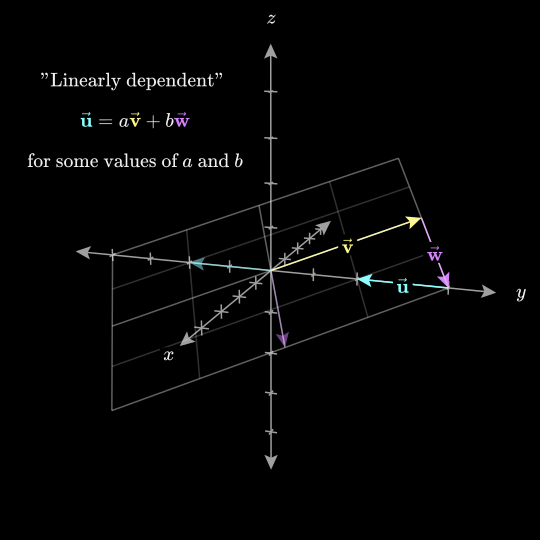
Vectors are linearly independent if none of them can be expressed as a linear combination of the others.
Example:
(1,0)
(0,1)
These vectors are independent.
Example of dependent vectors:
(2,4)
(1,2)
Because one is a multiple of the other.
10. Basis of a Vector Space
A basis is a set of linearly independent vectors that span the entire vector space.
Example in ℝ²:
Basis vectors:
(1,0)
(0,1)
These vectors generate the entire space.
11. Dimension of a Vector Space
The dimension of a vector space is the number of vectors in its basis.
Examples:
ℝ² → dimension = 2
ℝ³ → dimension = 3
Polynomial space P₂ → dimension = 3
12. Coordinate Representation
Vectors can be expressed in terms of basis vectors.
Example:
v = (3,4)
In basis:
i = (1,0)
j = (0,1)
Then:
v = 3i + 4j
13. Standard Basis
The standard basis consists of unit vectors.
For ℝ³:
i = (1,0,0)
j = (0,1,0)
k = (0,0,1)
14. Vector Spaces in Higher Dimensions
Vector spaces can have very high dimensions.
Example:
ℝ¹⁰⁰
Used in machine learning.
Each dimension represents a feature.
15. Inner Product Spaces
Some vector spaces include an inner product.
This allows measurement of:
- angles
- lengths
Example:
Dot product.
16. Norm of a Vector
The norm measures vector length.
Example:
v = (3,4)
||v|| = 5
17. Orthogonal Vectors
Vectors are orthogonal if their dot product is zero.
Example:
(1,0)
(0,1)
18. Orthogonal Basis
A basis where vectors are perpendicular.
Example:
Standard coordinate axes.
19. Applications of Vector Spaces
Vector spaces are used in many areas.
Physics
Used in:
- quantum mechanics
- relativity
- electromagnetism
Computer Graphics
Objects in games and animations use vector spaces.
Machine Learning
Data is represented as vectors in high-dimensional spaces.
Example:
Feature vectors.
Signal Processing
Signals can be represented as vectors.
Used in:
- audio processing
- image compression
Economics
Vector spaces help analyze economic models.
20. Infinite Dimensional Vector Spaces
Some vector spaces contain infinitely many dimensions.
Example:
Function spaces.
Used in advanced mathematics.
21. Vector Spaces and Linear Transformations
Linear transformations map one vector space to another.
Example:
Rotation transformation.
Matrices represent these transformations.
22. Importance of Vector Spaces
Vector spaces form the foundation of linear algebra.
They allow:
- representation of complex systems
- solving equations
- modeling real-world problems
- analyzing large datasets
Without vector spaces, many modern technologies would not exist.
Conclusion
Vector spaces are one of the most fundamental structures in mathematics. They provide a powerful framework for studying vectors and linear relationships between mathematical objects. By defining operations such as vector addition and scalar multiplication, vector spaces allow mathematicians and scientists to analyze complex systems in a structured way.
Concepts such as linear independence, basis, span, and dimension provide deeper insights into the structure of vector spaces and allow efficient representation of data and transformations. Vector spaces extend far beyond simple geometric vectors and include polynomials, matrices, and functions, making them incredibly versatile.
Their applications span numerous fields including physics, engineering, computer graphics, machine learning, and economics. In modern science and technology, vector spaces play a central role in data analysis, signal processing, optimization, and artificial intelligence.
Understanding vector spaces is essential for mastering advanced mathematics and many cutting-edge technological applications.