


1. Introduction to Combinatorics
Combinatorics is a branch of mathematics that deals with counting, arranging, and selecting objects according to specific rules. It focuses on determining how many possible ways events or arrangements can occur.
Combinatorics is fundamental to many areas of mathematics and computer science because it provides tools for analyzing structures, calculating probabilities, and solving complex counting problems.
In everyday life, combinatorics appears in situations such as:
- Arranging books on a shelf
- Selecting teams from a group of players
- Determining possible passwords
- Calculating lottery outcomes
- Designing computer algorithms
Combinatorics plays a central role in fields such as:
- Probability theory
- Statistics
- Computer science
- Cryptography
- Game theory
- Network theory
- Operations research
The study of combinatorics allows mathematicians to analyze patterns and structures efficiently, making it an essential part of discrete mathematics.
2. Basic Principles of Counting
Counting principles form the foundation of combinatorics.
Two important rules are:
- Addition principle
- Multiplication principle
Addition Principle
If one task can be performed in m ways and another task can be performed in n ways, and the tasks cannot occur simultaneously, then the total number of ways is:
m + n
Example:
A student can choose a book from:
3 mathematics books
2 physics books
Total choices:
3 + 2 = 5
Multiplication Principle
If a process consists of several steps and each step can occur in multiple ways, the total number of outcomes is the product of the possibilities.
Example:
A password contains:
2 letters and 3 digits.
If letters have 26 possibilities and digits have 10 possibilities:
Total possibilities:
26 × 26 × 10 × 10 × 10
3. Factorials
Factorials are used extensively in combinatorics.
The factorial of a number n is:
n! = n × (n−1) × (n−2) × … × 1
Examples:
5! = 5 × 4 × 3 × 2 × 1 = 120
3! = 3 × 2 × 1 = 6
Special case:
0! = 1
Factorials represent the number of ways objects can be arranged.
4. Permutations
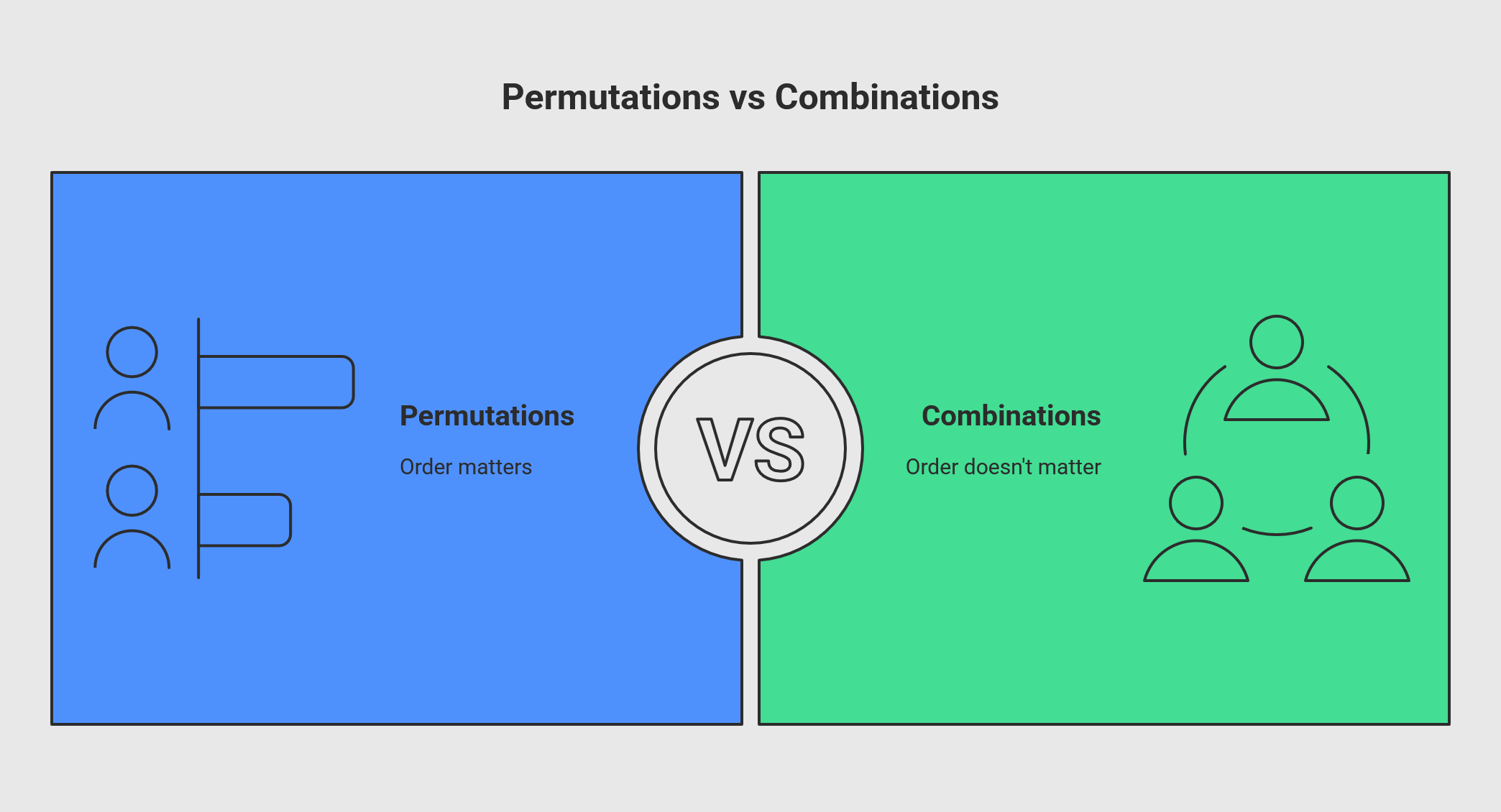
A permutation is an arrangement of objects where order matters.
Example:
Arranging letters A, B, C.
Possible permutations:
ABC
ACB
BAC
BCA
CAB
CBA
Total permutations:
3! = 6
Permutations Formula
If we arrange r objects from n objects:
nPr = n! / (n − r)!
Example:
Number of ways to arrange 3 people from 5.
5P3 = 5! / 2!
= 60
Permutations with Repetition
When repetition is allowed:
Number of permutations:
n^r
Example:
3-digit codes using digits 0–9.
10^3 = 1000
Circular Permutations
Arrangements around a circle.
Formula:
(n − 1)!
Example:
4 people around a table:
3! = 6
5. Combinations
A combination is a selection of objects where order does not matter.
Example:
Selecting 2 students from 4.
Possible selections:
AB
AC
AD
BC
BD
CD
Combination Formula
nCr = n! / (r!(n − r)!)
Example:
Selecting 3 students from 5:
5C3 = 10
6. Differences Between Permutations and Combinations
| Feature | Permutation | Combination |
|---|---|---|
| Order | Important | Not important |
| Example | Arranging people | Selecting people |
Example:
AB and BA
Permutation: different
Combination: same
7. Binomial Theorem
The binomial theorem expands expressions of the form:
(a + b)^n
Formula:
(a + b)^n = Σ (nCr a^(n−r) b^r)
Example:
(a + b)^3
= a³ + 3a²b + 3ab² + b³
Binomial coefficients appear in Pascal’s triangle.
8. Pascal’s Triangle
Pascal’s triangle is a triangular arrangement of numbers.
Each number is the sum of the two numbers above it.
Example:
1
1 1
1 2 1
1 3 3 1
These numbers represent binomial coefficients.
9. Multiset Combinations
Sometimes elements can repeat.
Example:
Selecting candies from unlimited supply.
Formula:
(n + r − 1)C r
10. Pigeonhole Principle
If more objects than containers exist, at least one container holds multiple objects.
Example:
If 13 people are in a room:
At least two share the same birth month.
11. Inclusion–Exclusion Principle
This principle counts elements in overlapping sets.
Formula:
|A ∪ B| = |A| + |B| − |A ∩ B|
For three sets:
|A ∪ B ∪ C|
= |A| + |B| + |C|
− intersections
- triple intersection
12. Combinatorial Identities
Important identities include:
nC0 = 1
nCn = 1
nCr = nC(n−r)
13. Generating Functions
Generating functions represent sequences using power series.
Example:
1 + x + x² + x³ + …
They help solve recurrence relations.
14. Recurrence Relations
Recurrence relations define sequences recursively.
Example:
Fibonacci sequence:
F(n) = F(n−1) + F(n−2)
15. Graph Theory and Combinatorics
Graph theory problems often involve combinatorics.
Examples:
- counting paths
- network structures
- graph colorings
16. Combinatorics in Probability
Probability relies heavily on combinatorics.
Example:
Probability of drawing cards from a deck.
Using combinations:
52C5
17. Applications in Computer Science
Combinatorics is used in:
- algorithm design
- complexity analysis
- database indexing
- cryptography
18. Applications in Cryptography
Secure encryption relies on large combinations and permutations.
Example:
Password security.
19. Applications in Artificial Intelligence
AI algorithms use combinatorial search.
Examples:
- game playing
- optimization
- planning problems
20. Applications in Biology
Combinatorics helps analyze:
- genetic combinations
- protein interactions
- biological networks
21. Applications in Network Design
Network routing problems involve combinatorial optimization.
Examples:
- traveling salesman problem
- shortest path problems
22. Importance of Combinatorics
Combinatorics provides powerful techniques for counting and analyzing arrangements.
It forms the foundation for probability theory, computer science, and optimization.
Many modern technologies rely on combinatorial algorithms.
Conclusion
Combinatorics is a vital branch of mathematics that focuses on counting, arranging, and selecting objects according to specific rules. By using principles such as permutations, combinations, factorials, and counting techniques, combinatorics allows mathematicians to analyze complex structures and determine the number of possible outcomes in a system.
The field has wide applications in probability, statistics, computer science, cryptography, and network analysis. Concepts such as Pascal’s triangle, binomial theorem, and the pigeonhole principle provide powerful tools for solving real-world problems involving arrangements and selections.
Combinatorics also plays a critical role in algorithm design and artificial intelligence, where efficient counting and optimization techniques are required. As modern technology continues to rely on large-scale data analysis and complex networks, the importance of combinatorics continues to grow.
Understanding combinatorics helps develop strong analytical and problem-solving skills and provides a foundation for advanced mathematical and computational studies.