
1. Introduction to Determinants
A determinant is a numerical value associated with a square matrix. It is one of the most important concepts in linear algebra and plays a vital role in solving systems of linear equations, finding matrix inverses, determining the area or volume of geometric shapes, and understanding linear transformations.
The determinant converts a square matrix into a single scalar value that provides important information about the matrix. For example, the determinant can indicate whether a matrix is invertible, whether vectors are linearly independent, or whether a system of equations has a unique solution.
Determinants are closely related to matrices but are not matrices themselves. They are values calculated from matrices. The determinant of a matrix A is commonly written as:
det(A) or |A|
For example, if a matrix A is:
A =
[ a b ]
[ c d ]
then its determinant is written as:
|A| = ad − bc
Determinants are used extensively in mathematics, physics, engineering, computer graphics, statistics, and machine learning.
The concept of determinants dates back to the 17th century when mathematicians began studying systems of linear equations. Later, mathematicians such as Gottfried Wilhelm Leibniz, Pierre-Simon Laplace, and Augustin-Louis Cauchy contributed significantly to the development of determinant theory.
2. Definition of Determinant
A determinant is defined only for square matrices, meaning matrices with the same number of rows and columns.
If a matrix has order:
n × n
then it has a determinant.
Example of a square matrix:
A =
[2 3]
[4 5]
The determinant is:
|A| = (2×5) − (3×4)
|A| = 10 − 12
|A| = −2
Thus, the determinant is −2.
The value of the determinant provides important information about the matrix.
If:
det(A) ≠ 0 → matrix is invertible
det(A) = 0 → matrix is singular
3. Determinant of a 1×1 Matrix
The determinant of a 1×1 matrix is simply the element itself.
Example:
A = [5]
|A| = 5
4. Determinant of a 2×2 Matrix
For a 2×2 matrix:
A =
[ a b ]
[ c d ]
The determinant is calculated as:
|A| = ad − bc
Example:
A =
[3 5]
[2 4]
|A| = (3×4) − (5×2)
|A| = 12 − 10
|A| = 2
5. Determinant of a 3×3 Matrix
For a 3×3 matrix:
A =
[ a11 a12 a13 ]
[ a21 a22 a23 ]
[ a31 a32 a33 ]
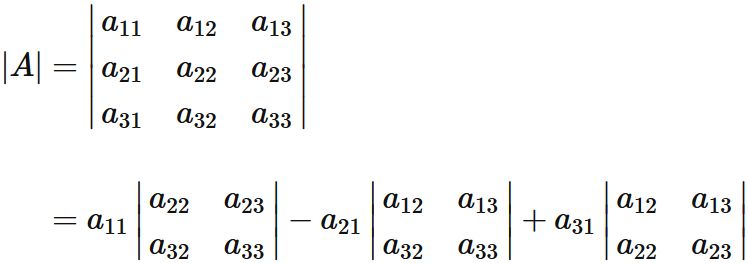
The determinant can be calculated using expansion by minors or Sarrus rule.
Expansion Formula
|A| =
a11(a22a33 − a23a32)
− a12(a21a33 − a23a31)
- a13(a21a32 − a22a31)
Example:
A =
[1 2 3]
[0 4 5]
[1 0 6]
|A| =
1(4×6 − 5×0)
− 2(0×6 − 5×1)
- 3(0×0 − 4×1)
= 1(24) − 2(−5) + 3(−4)
= 24 + 10 − 12
= 22
6. Minor of an Element
The minor of an element in a matrix is the determinant obtained after removing the row and column of that element.
Example:
A =
[1 2 3]
[4 5 6]
[7 8 9]
Minor of element 1:
Remove row 1 and column 1:
[5 6]
[8 9]
Minor = (5×9 − 6×8)
= 45 − 48
= −3
7. Cofactor of an Element
The cofactor is related to the minor.
Formula:
Cij = (−1)^(i+j) × Mij
Where:
Mij = minor
Example:
If minor = −3
Then cofactor depends on sign.
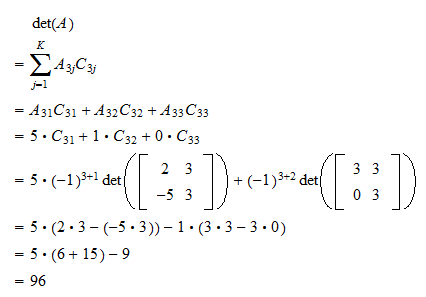
8. Cofactor Expansion (Laplace Expansion)
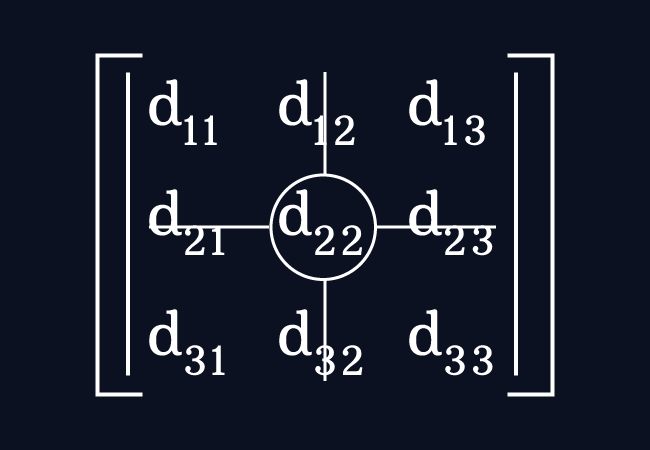
Determinants can be expanded along any row or column.
Example:
Expanding along first row:
|A| = a11C11 + a12C12 + a13C13
This method is widely used for large matrices.
9. Determinant of Higher Order Matrices
For matrices larger than 3×3, determinants are computed using:
- Cofactor expansion
- Row reduction methods
- Triangular matrix methods
These techniques simplify calculations.
10. Properties of Determinants
Determinants have many useful properties.
Property 1: Determinant of Identity Matrix
|I| = 1
Example:
I =
[1 0 0]
[0 1 0]
[0 0 1]
Determinant = 1
Property 2: Interchanging Rows
If two rows are interchanged:
determinant changes sign.
Property 3: Two Identical Rows
If two rows are identical:
determinant = 0
Property 4: Row Multiplication
If a row is multiplied by k:
determinant also multiplies by k.
Property 5: Determinant of Triangular Matrix
The determinant equals the product of diagonal elements.
Example:
[2 0 0]
[0 3 0]
[0 0 4]
Determinant = 2×3×4 = 24
Property 6: Determinant of Transpose
|Aᵀ| = |A|
Property 7: Determinant of Product
|AB| = |A| |B|
11. Singular and Non-Singular Matrices
A matrix is singular if:
det(A) = 0
A matrix is non-singular if:
det(A) ≠ 0
Non-singular matrices have inverses.
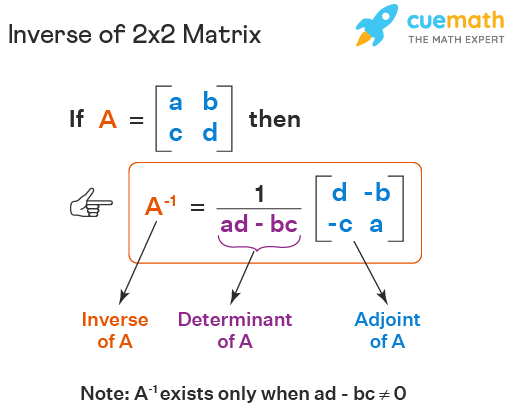
12. Determinant and Matrix Inverse
The inverse of a matrix exists only if:
det(A) ≠ 0
For a 2×2 matrix:
A =
[ a b ]
[ c d ]
Inverse:
1/(ad − bc)
[ d −b ]
[ −c a ]
13. Determinants in Solving Linear Equations
Determinants help solve systems of linear equations using Cramer’s Rule.
Example:
a1x + b1y = c1
a2x + b2y = c2
Solution:
x = Dx / D
y = Dy / D
Where:
D = determinant of coefficients.
14. Geometric Interpretation of Determinants
Determinants have geometric meaning.
Area of Parallelogram
If two vectors form a parallelogram:
Area = |determinant|
Example:
Vectors:
(2,3) and (4,1)
Area:
| 2 3 |
| 4 1 |
= 2×1 − 3×4
= 2 − 12
= −10
Area = 10
Volume of Parallelepiped
In 3D space, determinant gives volume.
15. Determinants in Linear Transformations
Determinants measure scaling factor of transformations.
If determinant = 2:
Area doubles.
If determinant = 0:
Transformation collapses space.
16. Determinants in Eigenvalues
Eigenvalues are calculated using determinants.
Formula:
|A − λI| = 0
Solving this gives eigenvalues.
Used in:
- quantum mechanics
- machine learning
- stability analysis
17. Determinants in Calculus
Determinants appear in:
- Jacobians
- coordinate transformations
- multivariable calculus
Jacobian determinant measures change of variables.
18. Determinants in Physics
Applications include:
- rotational dynamics
- electromagnetism
- relativity
- quantum mechanics
Determinants help compute vector products and transformations.
19. Determinants in Computer Graphics
In computer graphics, determinants help determine:
- orientation of shapes
- surface normals
- transformation matrices
They are essential in 3D rendering and game development.
20. Determinants in Machine Learning
Determinants are used in:
- covariance matrices
- Gaussian distributions
- optimization algorithms
They help understand data spread and structure.
21. Determinants in Engineering
Engineers use determinants in:
- structural analysis
- circuit analysis
- control systems
Determinants help solve simultaneous equations.
22. Advantages of Determinants
Determinants help in:
- checking matrix invertibility
- solving linear equations
- calculating geometric quantities
- analyzing transformations
They simplify many complex calculations.
Conclusion
Determinants are essential mathematical tools that provide valuable information about matrices and linear systems. They convert square matrices into scalar values that help determine properties such as invertibility, linear independence, and geometric transformations. Determinants play a significant role in solving systems of linear equations, computing matrix inverses, calculating areas and volumes, and understanding linear transformations.
From theoretical mathematics to practical applications in engineering, physics, and computer science, determinants remain a cornerstone concept in linear algebra. Their ability to reveal structural information about matrices makes them indispensable in many scientific and technological fields.
Understanding determinants helps build a strong foundation for advanced topics such as eigenvalues, vector spaces, differential equations, and machine learning algorithms.