


Introduction
Reflection of light is one of the most fundamental phenomena in optics. It occurs when a beam of light strikes a surface and bounces back into the same medium instead of passing through it. Reflection allows us to see objects around us because light from sources such as the Sun or lamps reflects off objects and enters our eyes.
The study of reflection has played a significant role in the development of optical science and technology. Many devices and instruments rely on reflection of light, including:
- Mirrors
- Telescopes
- Cameras
- Optical instruments
- Solar reflectors
Reflection occurs when electromagnetic waves of light interact with the surface of a material. Depending on the nature of the surface, the reflection can be regular (specular) or irregular (diffuse).
Understanding reflection of light is essential in many fields such as physics, engineering, photography, astronomy, and architecture.
Nature of Light and Reflection


Light behaves as an electromagnetic wave composed of oscillating electric and magnetic fields. When light waves strike a surface, interactions between the electromagnetic wave and the atoms of the material determine whether the light is absorbed, transmitted, or reflected.
When light hits a surface:
- Some energy may be absorbed
- Some may be transmitted
- Some may be reflected
Reflection occurs because atoms in the surface material absorb the incoming light energy and then re-emit it in a specific direction.
This process happens extremely quickly, giving the appearance that the light simply “bounces” off the surface.
Laws of Reflection

The reflection of light follows two fundamental laws known as the laws of reflection.
First Law of Reflection
The incident ray, the reflected ray, and the normal at the point of incidence lie in the same plane.
Second Law of Reflection
The angle of incidence is equal to the angle of reflection.
[
\theta_i = \theta_r
]
Where:
- ( \theta_i ) = angle of incidence
- ( \theta_r ) = angle of reflection
These laws apply to all types of reflecting surfaces.
Types of Reflection
Regular (Specular) Reflection


Regular reflection occurs when light strikes a smooth, polished surface.
Characteristics:
- Reflected rays remain parallel.
- Clear images are formed.
- Occurs in mirrors and polished metals.
Examples include reflection in:
- Plane mirrors
- Calm water surfaces
- Polished metal surfaces
Diffuse Reflection


Diffuse reflection occurs when light strikes a rough surface.
Characteristics:
- Reflected rays scatter in many directions.
- No clear image is formed.
- Most objects in everyday life reflect light diffusely.
Examples include reflection from:
- Walls
- Paper
- Clothing
- Trees
Diffuse reflection allows objects to be visible from many directions.
Reflection from Plane Mirrors

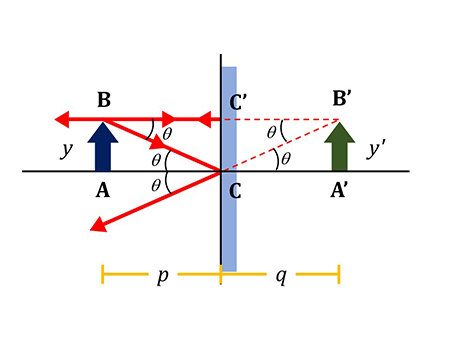
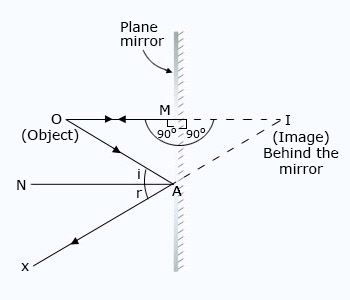
A plane mirror is a flat reflecting surface.
Characteristics of images formed by plane mirrors:
- Image is virtual
- Image is upright
- Image size equals object size
- Image distance equals object distance
- Image is laterally inverted
Lateral Inversion
In lateral inversion:
- Left appears right
- Right appears left
This is why writing appears reversed in a mirror.
Reflection from Spherical Mirrors
Concave Mirrors


A concave mirror curves inward like the inside of a sphere.
Properties:
- Converges parallel rays to a focal point
- Can produce real or virtual images
Applications:
- Shaving mirrors
- Reflecting telescopes
- Headlights
Convex Mirrors


A convex mirror curves outward.
Properties:
- Diverges light rays
- Forms virtual, upright, smaller images
- Provides a wider field of view
Applications include:
- Rear-view mirrors
- Security mirrors
- Road safety mirrors
Mirror Formula and Magnification


The relationship between object distance, image distance, and focal length is given by the mirror formula.
[
\frac{1}{f} = \frac{1}{v} + \frac{1}{u}
]
Where:
- (f) = focal length
- (v) = image distance
- (u) = object distance
Magnification
[
m = \frac{h_i}{h_o} = \frac{v}{u}
]
Where:
- (h_i) = image height
- (h_o) = object height
Magnification indicates how much the image size differs from the object.
Applications of Reflection of Light


Reflection of light is used in many technologies.
Optical Instruments
Telescopes and microscopes use mirrors to focus light.
Periscopes
Used in submarines and observation devices.
Solar Concentrators
Reflectors concentrate sunlight to generate heat and electricity.
Cameras
Mirrors are used in optical viewfinder systems.
Road Safety
Convex mirrors improve visibility at intersections.
Importance of Reflection in Everyday Life
Reflection of light plays an essential role in daily life.
It enables:
- Vision and perception
- Optical instruments
- Communication technologies
- Lighting and illumination
Without reflection, it would be impossible to see objects around us.
Conclusion
Reflection of light is the process by which light rays bounce off surfaces and return into the same medium. It follows two fundamental laws that describe the relationship between incident and reflected rays.
Reflection occurs in two forms: regular reflection from smooth surfaces and diffuse reflection from rough surfaces. Mirrors use reflection to form images, and different types of mirrors produce different types of images.
The principles of reflection are used in numerous technologies such as telescopes, cameras, mirrors, and solar energy systems. Understanding reflection is essential for studying optics and many applications in science and engineering.