


Introduction
In physics, the concept of force plays a fundamental role in understanding motion and interactions between objects. Every movement or change in motion occurs because of forces acting on objects. When a person pushes a door, pulls a rope, kicks a ball, or lifts a book, forces are involved.
Force is defined as a push or pull acting on an object that can change its state of motion, shape, or direction. It is one of the most important concepts in classical mechanics and forms the foundation of Newton’s laws of motion.
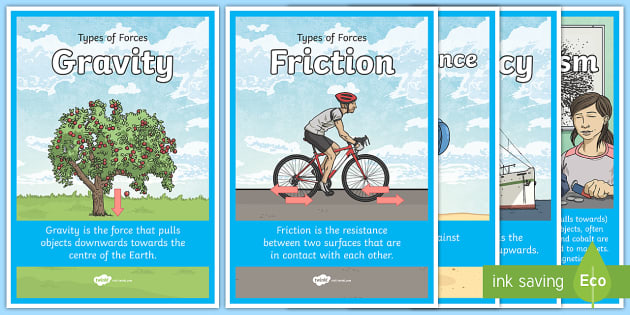
One particular type of force that plays a major role in everyday life is friction. Friction is the force that opposes motion between two surfaces that are in contact with each other. Without friction, many everyday activities such as walking, driving vehicles, or writing with a pencil would not be possible.
Understanding force and friction allows scientists and engineers to design machines, vehicles, and structures that function efficiently. These concepts are also essential in fields such as mechanical engineering, aerospace engineering, robotics, and biomechanics.
Force
Definition of Force
Force is defined as an interaction that causes an object to accelerate, decelerate, change direction, or change shape.
Mathematically, force is related to acceleration through Newton’s second law:
[
F = ma
]
Where:
- (F) = force
- (m) = mass
- (a) = acceleration
Force is a vector quantity, meaning it has both magnitude and direction.
Unit of Force
The SI unit of force is the Newton (N).
One Newton is defined as the force required to accelerate a mass of 1 kilogram by 1 meter per second squared.
[
1N = 1,kg \cdot m/s^2
]
Other units sometimes used include:
Dyne (CGS unit)
[
1N = 10^5 , dyne
]
Characteristics of Force
Force has several important characteristics:
- Force has magnitude.
- Force has direction.
- Force can change the speed of an object.
- Force can change the direction of motion.
- Force can change the shape of an object.
For example:
- Compressing a spring changes its shape.
- Pushing a car causes it to move.
- Applying brakes slows a vehicle.
Types of Forces
Forces in physics are categorized into different types based on their origin and how they act.
Contact Forces
Contact forces act only when two objects physically touch each other.
Examples include:
Frictional Force
Force opposing motion between surfaces.
Normal Force
Force exerted by a surface supporting an object.
Tension Force
Force transmitted through a string or rope.
Applied Force
Force exerted by a person or object.
Air Resistance
Force opposing motion through air.
Non-Contact Forces
Non-contact forces act without physical contact between objects.
Examples include:
Gravitational Force
Force of attraction between masses.
Magnetic Force
Force between magnetic objects.
Electrostatic Force
Force between electric charges.
Representation of Forces
Forces are represented using vectors.
A force vector shows:
- Magnitude (length of arrow)
- Direction (orientation of arrow)
For example:
A force of 10 N acting to the right is represented by an arrow pointing right.
When multiple forces act on an object, the resultant force determines the object’s motion.
Balanced and Unbalanced Forces
Balanced Forces
Balanced forces occur when the net force acting on an object is zero.
Example:
A book resting on a table.
Gravity pulls the book downward, while the table exerts an equal upward normal force.
Result:
Object remains at rest.
Unbalanced Forces
Unbalanced forces occur when the net force acting on an object is not zero.
Example:
Pushing a stationary box causes it to move.
Result:
Object accelerates.
Free Body Diagrams
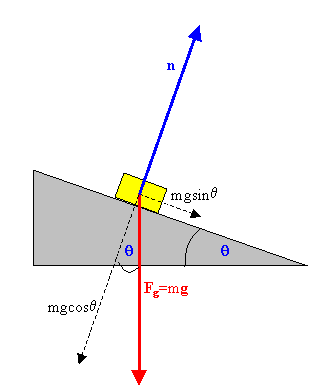
A free body diagram is a simplified drawing that shows all forces acting on an object.
Common forces in such diagrams include:
Weight
Normal force
Friction
Tension
Applied force
Free body diagrams help analyze motion and solve physics problems.
Friction


Definition of Friction
Friction is the force that opposes the relative motion or attempted motion between two surfaces in contact.
Friction acts parallel to the surface of contact and in the opposite direction of motion.
For example:
When a book slides across a table, friction acts opposite to the direction of motion.
Causes of Friction
Friction occurs mainly because surfaces are not perfectly smooth.
Two primary causes include:
Surface Roughness
Microscopic irregularities on surfaces interlock with each other.
Molecular Adhesion
At very small scales, atoms from different surfaces attract each other.
These effects create resistance to motion.
Types of Friction
Friction can be classified into several types.
Static Friction
Static friction acts on objects that are not moving but have a tendency to move.
Example:
Pushing a heavy box that has not yet started moving.
Static friction increases until motion begins.
Kinetic Friction
Kinetic friction acts when objects are already moving relative to each other.
Example:
A book sliding across a table.
Kinetic friction is usually less than static friction.
Rolling Friction
Rolling friction occurs when an object rolls over a surface.
Example:
Wheels of a car moving along a road.
Rolling friction is much smaller than sliding friction.
Fluid Friction
Fluid friction occurs when objects move through fluids such as air or water.
Example:
Air resistance acting on a moving car.
Water resistance on a swimming fish.
Laws of Friction
The basic laws of friction were formulated by Amontons and Coulomb.
First Law
Friction is proportional to the normal force between surfaces.
[
F_f = \mu N
]
Where:
(F_f) = frictional force
(\mu) = coefficient of friction
(N) = normal force
Second Law
Friction is independent of the apparent area of contact.
Third Law
Kinetic friction is usually less than maximum static friction.
Coefficient of Friction
The coefficient of friction represents how rough two surfaces are.
It is a dimensionless quantity.
Two types exist:
Static coefficient:
[
\mu_s
]
Kinetic coefficient:
[
\mu_k
]
Usually:
[
\mu_s > \mu_k
]
Advantages of Friction
Although friction often causes energy loss, it also provides many benefits.
Walking
Friction between shoes and ground allows walking.
Driving
Friction between tires and road enables vehicles to move.
Writing
Friction between pen and paper allows writing.
Holding Objects
Friction helps us grip objects.
Disadvantages of Friction
Friction can also cause problems.
Energy Loss
Mechanical energy converts to heat.
Wear and Tear
Machine parts wear out over time.
Reduced Efficiency
Machines lose energy due to friction.
Methods to Reduce Friction
Engineers use several techniques to reduce friction.
Lubrication
Oil and grease reduce contact between surfaces.
Polishing
Smooth surfaces reduce roughness.
Ball Bearings
Rolling elements reduce sliding friction.
Streamlining
Reduces air resistance.
Increasing Friction
Sometimes friction must be increased.
Methods include:
Using rough surfaces
Adding tread patterns to tires
Using chalk in sports
Applying sand on icy roads
Applications of Force and Friction
Force and friction are essential in many real-world situations.
Engineering
Machine design depends on friction control.
Transportation
Vehicles rely on friction for traction.
Sports
Athletes use friction for grip and movement.
Construction
Structures must withstand forces safely.
Robotics
Robots rely on friction to move and manipulate objects.
Importance in Physics
Force and friction are central concepts in classical mechanics.
They help explain:
Motion of objects
Energy transfer
Mechanical systems
Structural stability
These concepts are used in advanced topics such as:
Dynamics
Engineering mechanics
Thermodynamics
Fluid mechanics
Summary
Force is a fundamental physical quantity that describes interactions capable of changing an object’s motion or shape. It is a vector quantity measured in Newtons and is essential for understanding motion according to Newton’s laws.
Friction is a type of contact force that opposes motion between surfaces in contact. While friction can cause energy loss and wear in machines, it is also essential for many everyday activities such as walking, driving, and writing.
Different types of friction—static, kinetic, rolling, and fluid—play important roles in physical systems. Engineers carefully manage friction to improve efficiency and safety in machines and vehicles.
Understanding force and friction helps explain many physical processes and provides a foundation for studying mechanics and engineering.