


Introduction
In physics, motion is one of the most fundamental phenomena studied in classical mechanics. To understand motion, physicists describe how objects change position with time. Several physical quantities are used to characterize motion, including distance, displacement, speed, velocity, and acceleration. These quantities help explain how far an object travels, how fast it moves, and how its motion changes over time.
Distance and displacement describe how far an object moves. Speed and velocity describe how fast the object moves. Acceleration describes how the velocity changes with time.
These quantities are essential in kinematics, the branch of physics that studies motion without considering the forces causing it. By analyzing these quantities, scientists can predict how objects move in different situations.
For example, when a car travels along a road, we can describe:
- The total distance the car has traveled
- The change in position from start to end
- The rate at which the car moves
- The direction of motion
- How quickly the speed changes
Understanding these quantities helps in studying motion in transportation, engineering, sports, robotics, and astronomy.
Distance
Definition of Distance
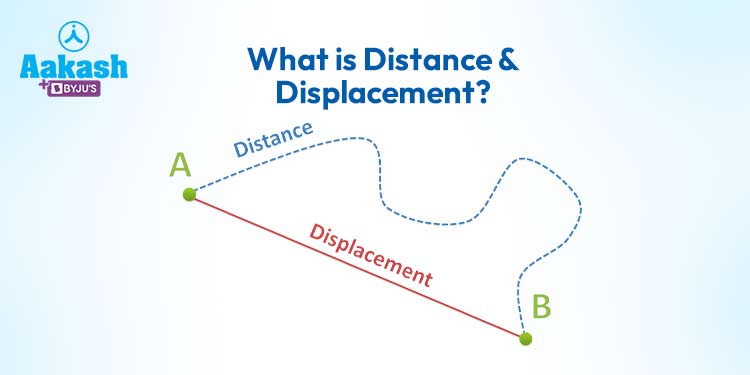
Distance is the total length of the path traveled by an object during motion.
Distance is a scalar quantity, meaning it has magnitude but no direction.
It tells us how much ground an object has covered, regardless of the direction of motion.
For example, if a person walks 10 meters forward and then 5 meters backward, the total distance traveled is:
[
Distance = 10 + 5 = 15 , m
]
Distance only measures the total path length.
Characteristics of Distance
Distance has several important properties:
- It is always positive.
- It does not depend on direction.
- It depends on the path taken.
- It is a scalar quantity.
- It is measured in units of length.
The SI unit of distance is meter (m).
Other units include:
Kilometer (km)
Centimeter (cm)
Millimeter (mm)
Examples of Distance
Example 1
A runner completes one lap of a circular track of length 400 meters.
Distance traveled = 400 meters
Example 2
A car moves:
20 km east
10 km west
Distance traveled = 30 km
Even though the directions differ, the total path length is added.
Displacement
Definition of Displacement
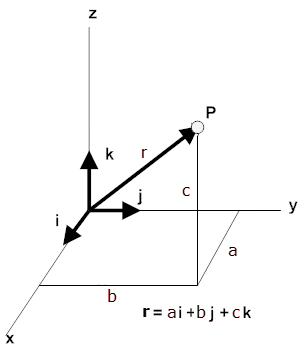
Displacement is the shortest straight-line distance between the initial and final positions of an object, along with direction.
Displacement is a vector quantity.
Mathematically:
[
Displacement = Final\ Position – Initial\ Position
]
[
s = x_f – x_i
]
Where:
(x_f) = final position
(x_i) = initial position
Characteristics of Displacement
Displacement has several properties:
- It has magnitude and direction.
- It is independent of the path taken.
- It can be positive, negative, or zero.
- It is always the shortest path between two points.
The SI unit of displacement is meter (m).
Examples of Displacement
Example 1
A person walks from point A to point B which is 10 meters east.
Displacement = 10 m east
Example 2
A person walks 10 meters east and then returns to the starting point.
Distance = 20 m
Displacement = 0
Even though motion occurred, the final position is the same as the initial position.
Distance vs Displacement
| Feature | Distance | Displacement |
|---|---|---|
| Type | Scalar | Vector |
| Direction | Not required | Required |
| Path dependency | Depends on path | Independent of path |
| Sign | Always positive | Can be positive, negative, or zero |
Distance describes how much ground is covered, while displacement describes how far and in what direction an object moved.
Speed
Definition of Speed
Speed is the rate at which distance is covered with respect to time.
[
Speed = \frac{Distance}{Time}
]
Speed is a scalar quantity because it does not involve direction.
The SI unit of speed is:
[
m/s
]
Other common units include:
km/h
cm/s
Average Speed
Average speed is defined as:
[
Average\ Speed = \frac{Total\ Distance}{Total\ Time}
]
Example:
A car travels 120 km in 2 hours.
[
Average\ Speed = \frac{120}{2} = 60 , km/h
]
Average speed gives an overall measure of motion during a journey.
Instantaneous Speed
Instantaneous speed is the speed of an object at a particular moment in time.
For example:
The speedometer of a car shows instantaneous speed.
Instantaneous speed may change continuously during motion.
Uniform Speed
An object has uniform speed if it covers equal distances in equal intervals of time.
Example:
A train moving at a constant speed of 50 km/h.
Non-Uniform Speed
Non-uniform speed occurs when the distance covered in equal intervals of time is different.
Example:
A car moving in city traffic.
Velocity


Definition of Velocity
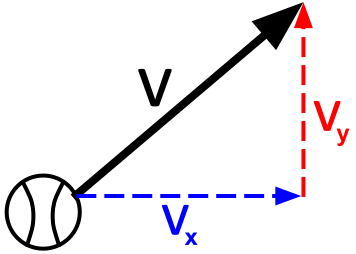
Velocity is the rate of change of displacement with respect to time.
[
Velocity = \frac{Displacement}{Time}
]
Velocity is a vector quantity because it includes direction.
Example:
Velocity = 20 m/s east
Magnitude = 20 m/s
Direction = east
Average Velocity
Average velocity is defined as:
[
Average\ Velocity = \frac{Total\ Displacement}{Total\ Time}
]
Example:
A person walks:
10 m east
then 10 m west
Displacement = 0
Average velocity = 0
Instantaneous Velocity
Instantaneous velocity is the velocity of an object at a specific moment.
It includes both speed and direction at that instant.
Uniform Velocity
An object has uniform velocity if:
- Speed remains constant
- Direction remains constant
Example:
A train moving along a straight track at constant speed.
Changing Velocity
Velocity changes when:
- Speed changes
- Direction changes
- Both change
Example:
A car turning around a curve.
Even if speed remains constant, velocity changes because direction changes.
Speed vs Velocity
| Feature | Speed | Velocity |
|---|---|---|
| Quantity type | Scalar | Vector |
| Depends on | Distance | Displacement |
| Direction | Not included | Included |
| Sign | Always positive | Can be positive or negative |
Speed measures how fast, while velocity measures how fast and in which direction.
Acceleration


Definition of Acceleration
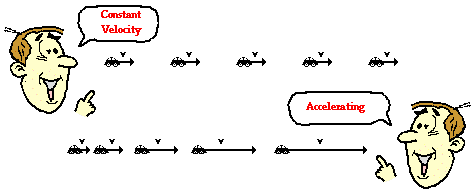
Acceleration is the rate of change of velocity with respect to time.
[
a = \frac{v – u}{t}
]
Where:
(u) = initial velocity
(v) = final velocity
(t) = time
Acceleration is a vector quantity.
The SI unit of acceleration is:
[
m/s^2
]
Types of Acceleration
Uniform Acceleration
Acceleration remains constant.
Example:
Free fall under gravity.
Non-Uniform Acceleration
Acceleration changes with time.
Example:
A car in traffic.
Positive Acceleration
Velocity increases with time.
Example:
A car speeding up.
Negative Acceleration (Deceleration)
Velocity decreases with time.
Example:
Applying brakes.
Graphical Representation of Motion
Distance-Time Graph
A distance-time graph shows how distance changes with time.
Features:
Horizontal line → object at rest
Straight line → uniform speed
Curve → changing speed
Slope of graph:
[
Speed = \frac{Distance}{Time}
]
Velocity-Time Graph
A velocity-time graph shows velocity changes with time.
Slope of graph:
[
Acceleration = \frac{\Delta v}{\Delta t}
]
Area under the graph gives displacement.
Motion with Constant Acceleration
Three important equations describe motion with constant acceleration.
[
v = u + at
]
[
s = ut + \frac{1}{2}at^2
]
[
v^2 = u^2 + 2as
]
These equations are widely used in solving motion problems.
Applications in Real Life
Understanding distance, displacement, speed, velocity, and acceleration is important in many real-world situations.
Transportation
Cars, trains, airplanes, and ships use motion concepts for navigation.
Sports
Athletes analyze speed and acceleration to improve performance.
Engineering
Design of vehicles and machines requires motion analysis.
Astronomy
Planets and satellites move with velocity and acceleration.
Robotics
Robots calculate displacement and velocity to navigate environments.
Importance in Physics
These motion quantities form the foundation of classical mechanics.
They help explain:
Projectile motion
Circular motion
Planetary motion
Newton’s laws of motion
Energy and momentum
Without understanding these quantities, studying advanced physics topics would be difficult.
Summary
Distance, displacement, speed, velocity, and acceleration are fundamental quantities used to describe motion in physics.
Distance measures the total path traveled, while displacement measures the change in position. Speed describes how fast an object moves, while velocity includes both speed and direction. Acceleration describes how velocity changes with time.
Together, these quantities allow scientists and engineers to analyze motion accurately. They play a crucial role in understanding transportation systems, sports performance, engineering designs, and many natural phenomena.
These concepts form the basis for the study of mechanics and are essential for understanding more advanced areas of physics.