


Introduction
Magnetism is a fundamental physical phenomenon arising from the motion of electric charges and the intrinsic magnetic properties of elementary particles. It is one of the fundamental forces of nature and is closely related to electricity, forming the basis of the unified theory of electromagnetism.
Magnetism manifests as forces of attraction or repulsion between objects due to the presence of magnetic fields. Materials that produce magnetic fields are known as magnets, and they interact with other magnetic materials and moving charges.
Magnetic effects have been observed for thousands of years. Ancient civilizations discovered naturally magnetized minerals such as lodestone, which could attract iron. Scientific understanding of magnetism developed gradually with contributions from many scientists, including William Gilbert, who proposed that Earth itself behaves like a giant magnet.
Later discoveries connected magnetism with electricity through the work of Hans Christian Ørsted, André-Marie Ampère, and James Clerk Maxwell.
Magnetism plays an essential role in modern science and technology, including electric motors, generators, magnetic storage devices, medical imaging systems, and particle accelerators.
Magnetic Fields
A magnetic field is a region of space in which magnetic forces can be detected.
Magnetic fields are produced by:
- Permanent magnets
- Electric currents
- Moving electric charges
- Magnetic materials
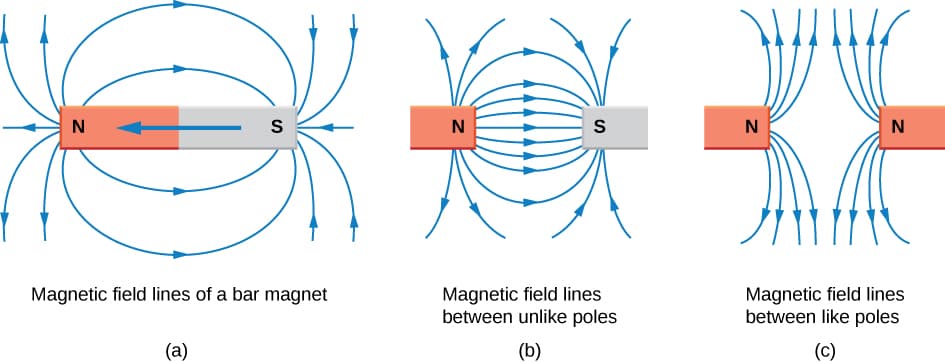
Magnetic fields are represented by magnetic field lines, which indicate the direction and strength of the magnetic field.
Key characteristics of magnetic field lines include:
- They form closed loops.
- Outside a magnet, they emerge from the north pole and enter the south pole.
- Inside the magnet, they travel from south to north.
The strength of a magnetic field is represented by the symbol B, known as magnetic flux density.
Magnetic Dipoles


A magnetic dipole is the simplest form of magnetism.
A dipole consists of two opposite magnetic poles:
- North pole
- South pole
Magnetic dipoles generate magnetic fields similar to those of small bar magnets.
Atoms themselves act as tiny magnetic dipoles due to:
- Electron orbital motion
- Electron spin
The strength of a magnetic dipole is described by its magnetic dipole moment.
Magnetic Flux
Magnetic flux measures the total magnetic field passing through a given area.
It is defined as:
[
\Phi = BA \cos \theta
]
where
- (B) = magnetic field strength
- (A) = area
- (\theta) = angle between the magnetic field and the area
Magnetic flux is measured in units called webers (Wb).
Magnetic Force on Moving Charges
A charged particle moving in a magnetic field experiences a force known as the Lorentz force.
The magnitude of the force is given by:
[
F = qvB \sin \theta
]
where
- (q) = charge of the particle
- (v) = velocity
- (B) = magnetic field strength
- (\theta) = angle between velocity and magnetic field
This force causes charged particles to move in circular or helical paths.
Magnetism and Electric Currents


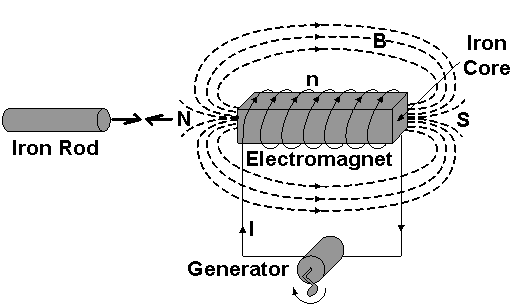
Electric currents produce magnetic fields.
This phenomenon was first observed by Hans Christian Ørsted.
When an electric current flows through a wire, a circular magnetic field forms around the wire.
The direction of the magnetic field can be determined using the right-hand rule.
Ampère’s Law
Ampère’s law describes the relationship between electric currents and magnetic fields.
It states that the magnetic field around a closed loop is proportional to the current passing through the loop.
Mathematically:
[
\oint B \cdot dl = \mu_0 I
]
where
- (B) = magnetic field
- (I) = current
- (\mu_0) = permeability of free space
Electromagnets
Electromagnets are magnets created by electric currents.
They consist of coils of wire, often wrapped around a soft iron core.
When current flows through the coil:
- A magnetic field is generated
- The iron core becomes magnetized
Electromagnets are widely used in:
- Electric motors
- Transformers
- Relays
- Magnetic lifting devices
Types of Magnetism
Magnetic materials can be classified into several types based on how they respond to magnetic fields.
Diamagnetism
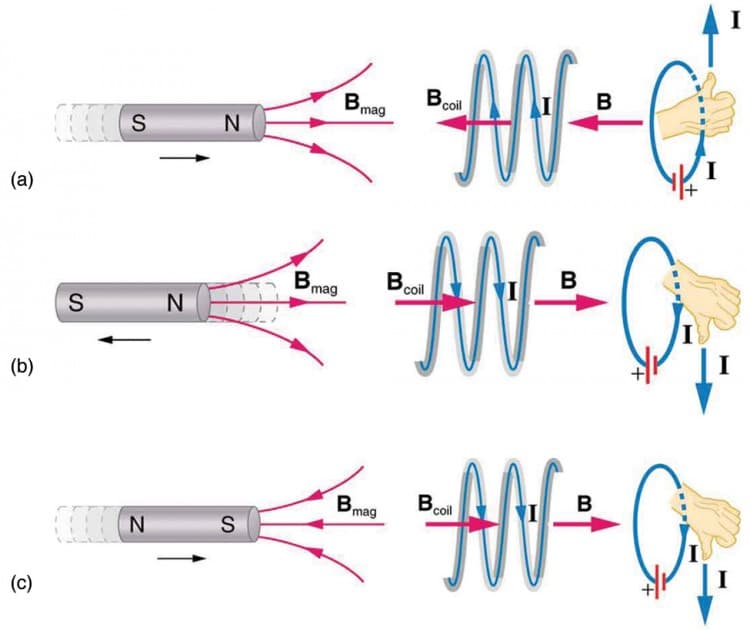

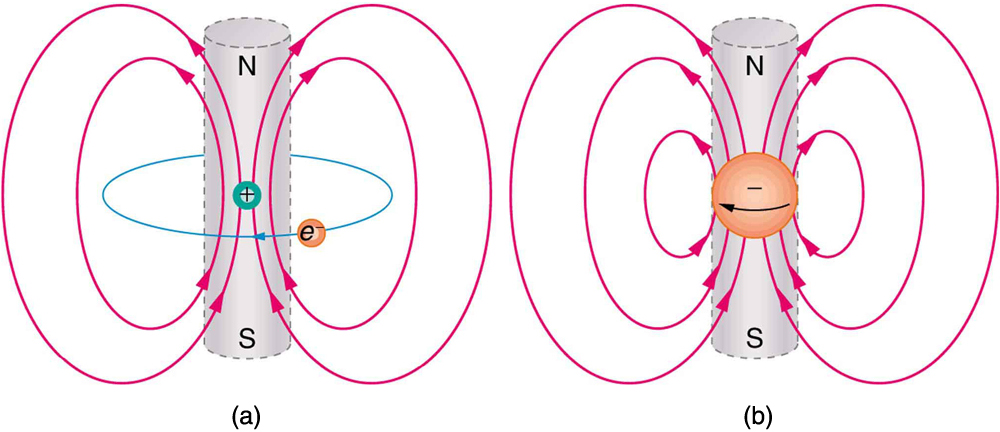

Diamagnetism occurs in materials where all electrons are paired.
When an external magnetic field is applied:
- The material produces a weak magnetic field in the opposite direction.
As a result, diamagnetic materials are slightly repelled by magnets.
Examples include:
- Copper
- Bismuth
- Water
Diamagnetism is usually very weak.
Paramagnetism


Paramagnetism occurs in materials with unpaired electrons.
When a magnetic field is applied:
- Atomic magnetic moments align partially with the field.
This causes weak attraction to the magnetic field.
Examples include:
- Aluminum
- Magnesium
- Oxygen
Paramagnetism disappears when the external field is removed.
Ferromagnetism

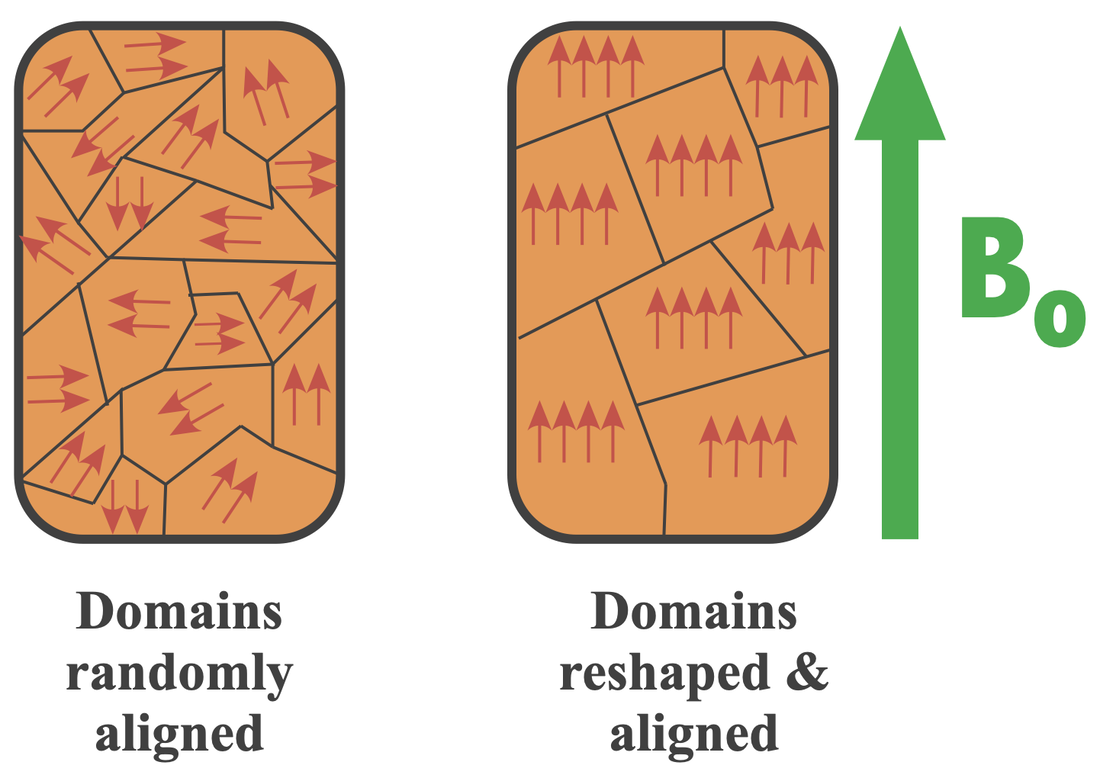


Ferromagnetism is the strongest form of magnetism.
In ferromagnetic materials:
- Atomic magnetic moments align in regions called magnetic domains.
When a magnetic field is applied:
- Domains align with the field
- The material becomes strongly magnetized.
Examples include:
- Iron
- Nickel
- Cobalt
Ferromagnetic materials can retain magnetization even after the external field is removed.
Magnetic Domains
Ferromagnetic materials contain microscopic regions called domains.
Within each domain:
- Atomic magnetic moments are aligned in the same direction.
In an unmagnetized material:
- Domains are randomly oriented.
When a magnetic field is applied:
- Domains align with the field
- The material becomes magnetized.
Hysteresis
Magnetic materials exhibit a phenomenon known as hysteresis.
Hysteresis describes the lag between magnetization and the applied magnetic field.
This behavior is represented by a hysteresis loop, which shows how magnetization changes with magnetic field strength.
Hysteresis is important in magnetic memory devices and transformers.
Earth’s Magnetism
Earth behaves like a giant magnet with a magnetic field extending into space.
This magnetic field forms the magnetosphere, which protects the planet from charged particles from the Sun.
Earth’s magnetic field is believed to originate from the motion of molten iron in the planet’s outer core.
Magnetic compasses use Earth’s magnetic field to determine direction.
Applications of Magnetism
Magnetism plays an essential role in modern technology.
Electric Motors
Electric motors convert electrical energy into mechanical motion using magnetic forces.
Generators
Generators convert mechanical energy into electrical energy through electromagnetic induction.
Magnetic Storage
Magnetic materials store data in devices such as hard drives and magnetic tapes.
Medical Imaging
Magnetic resonance imaging (MRI) uses strong magnetic fields to produce images of the human body.
Transportation
Magnetic levitation trains use magnetic forces to reduce friction and increase speed.
Magnetism in Modern Physics
Magnetism is a key concept in many areas of physics, including:
- Electromagnetism
- Solid-state physics
- Quantum mechanics
- Astrophysics
Modern research explores advanced magnetic materials such as:
- Spintronic materials
- Magnetic nanoparticles
- Quantum magnetic systems
Conclusion
Magnetism is a fundamental physical phenomenon arising from moving electric charges and intrinsic magnetic properties of particles. Magnetic fields influence the motion of charged particles and produce forces between magnetic materials.
Different types of magnetism—including diamagnetism, paramagnetism, and ferromagnetism—arise from the behavior of electrons within atoms and their interactions with magnetic fields. Understanding these phenomena has led to numerous technological advancements, including electric motors, generators, data storage devices, and medical imaging technologies.
Magnetism continues to be an active area of research in physics and materials science, with new discoveries contributing to the development of advanced technologies and deeper understanding of the natural world.