


1. Introduction to Number Theory
Number theory is a branch of mathematics that studies the properties and relationships of integers. It focuses on understanding the behavior of numbers, particularly whole numbers, and exploring patterns, structures, and relationships among them.
Number theory is often referred to as the “Queen of Mathematics” because of its deep theoretical significance and its connections to many other areas of mathematics.
Historically, number theory was studied for purely theoretical purposes, but today it has many practical applications in fields such as:
- Cryptography
- Computer science
- Coding theory
- Digital security
- Data encryption
- Computer algorithms
Number theory deals with concepts such as:
- Prime numbers
- Divisibility
- Greatest common divisors
- Modular arithmetic
- Diophantine equations
These topics allow mathematicians to explore fundamental questions about numbers and their relationships.
2. Integers and Their Properties
The integers are the set of whole numbers, including negative numbers, zero, and positive numbers.
Notation:
ℤ = {…, −3, −2, −1, 0, 1, 2, 3, …}
Integers are the foundation of number theory.
Basic operations on integers include:
- Addition
- Subtraction
- Multiplication
- Division
However, division is not always possible within integers unless the result is also an integer.
3. Divisibility
Divisibility is one of the most important concepts in number theory.
An integer a divides another integer b if there exists an integer k such that:
b = a × k
Notation:
a | b
Example:
3 | 12
Because:
12 = 3 × 4
If a does not divide b, we write:
a ∤ b
4. Divisibility Rules
Certain rules help determine divisibility.
Examples:
Divisible by 2 → last digit even
Divisible by 3 → sum of digits divisible by 3
Divisible by 5 → last digit 0 or 5
Divisible by 9 → sum of digits divisible by 9
Example:
123
1 + 2 + 3 = 6
6 divisible by 3 → number divisible by 3.
5. Prime Numbers
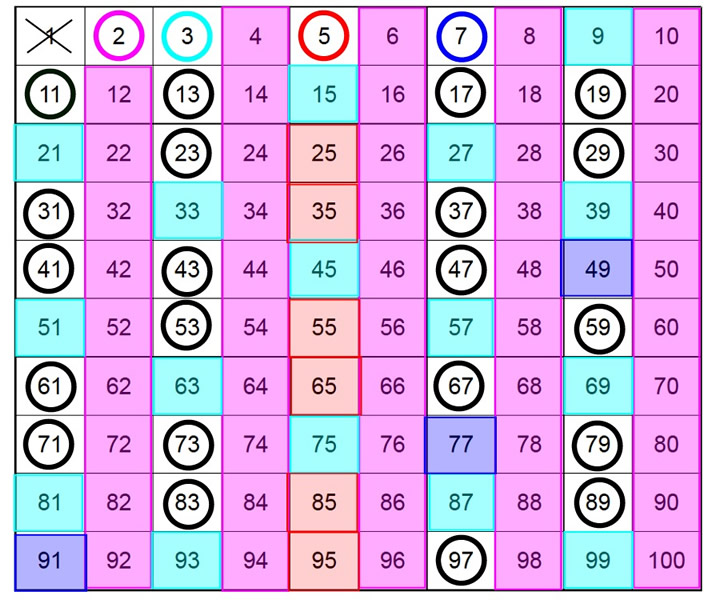
A prime number is a natural number greater than 1 that has exactly two divisors:
1 and itself.
Examples:
2, 3, 5, 7, 11, 13
Prime numbers are the building blocks of integers.
Composite Numbers
Numbers with more than two factors.
Example:
12 = 2 × 2 × 3
Composite numbers can be expressed as products of primes.
6. Fundamental Theorem of Arithmetic
Every integer greater than 1 can be uniquely expressed as a product of prime numbers.
Example:
60 = 2² × 3 × 5
This factorization is unique.
This theorem is fundamental in number theory.
7. Greatest Common Divisor (GCD)
The greatest common divisor of two integers is the largest integer that divides both numbers.
Example:
GCD(12,18)
Factors of 12:
1,2,3,4,6,12
Factors of 18:
1,2,3,6,9,18
GCD = 6
Euclidean Algorithm
An efficient method for finding GCD.
Example:
GCD(48,18)
48 = 18×2 + 12
18 = 12×1 + 6
12 = 6×2 + 0
GCD = 6
8. Least Common Multiple (LCM)
The least common multiple is the smallest number divisible by both numbers.
Example:
LCM(6,8)
Multiples:
6 → 6,12,18,24
8 → 8,16,24
LCM = 24
9. Modular Arithmetic
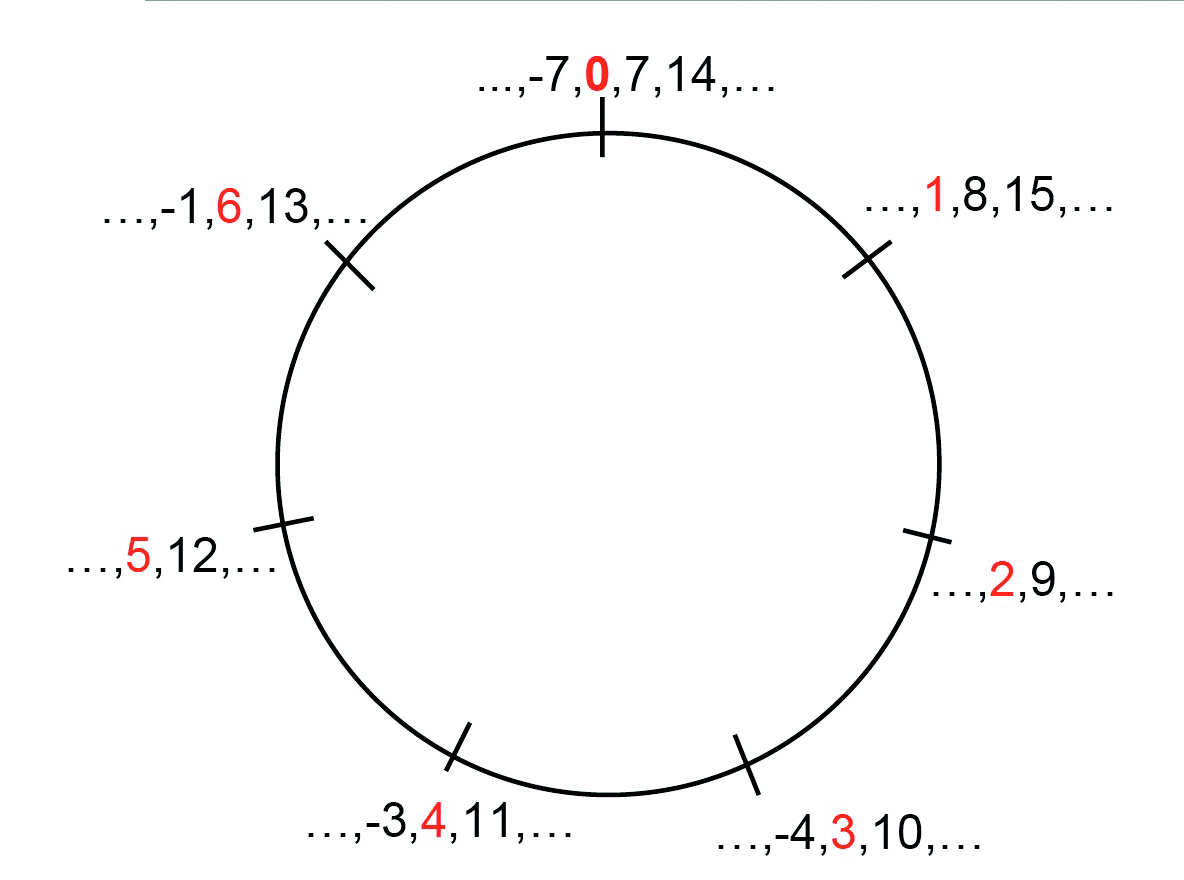
Modular arithmetic deals with remainders.
Example:
17 mod 5 = 2
Because:
17 = 5×3 + 2
Modular arithmetic is similar to clock arithmetic.
Congruence
Two numbers are congruent if they have the same remainder.
Notation:
a ≡ b (mod n)
Example:
17 ≡ 2 (mod 5)
10. Applications of Modular Arithmetic
Modular arithmetic is widely used in:
- cryptography
- hashing algorithms
- computer science
- error detection
11. Euler’s Totient Function
Euler’s function counts numbers less than n that are relatively prime to n.
Notation:
φ(n)
Example:
φ(10)
Numbers less than 10 relatively prime to 10:
1,3,7,9
φ(10) = 4
12. Fermat’s Little Theorem
If p is prime and a is not divisible by p:
a^(p−1) ≡ 1 (mod p)
Example:
2⁴ ≡ 1 (mod 5)
This theorem is widely used in cryptography.
13. Diophantine Equations
Diophantine equations involve integer solutions.
Example:
2x + 3y = 7
Solutions must be integers.
These equations appear in many number theory problems.
14. Perfect Numbers
A perfect number equals the sum of its proper divisors.
Example:
6
Divisors:
1,2,3
Sum:
1 + 2 + 3 = 6
15. Fibonacci Numbers
The Fibonacci sequence appears in number theory.
Sequence:
1,1,2,3,5,8,13…
Each number equals the sum of the previous two.
16. Cryptography and Number Theory
Modern cryptography relies heavily on number theory.
Example:
RSA encryption.
It uses large prime numbers and modular arithmetic.
17. Number Theory in Computer Science
Number theory is used in:
- hashing algorithms
- encryption
- coding theory
- data security
18. Number Theory in Coding Theory
Coding theory uses number theory for error detection.
Examples:
- QR codes
- digital communication systems
19. Advanced Topics in Number Theory
Some advanced topics include:
- algebraic number theory
- analytic number theory
- transcendental numbers
- prime distribution
These areas explore deeper properties of numbers.
20. Importance of Number Theory
Number theory provides insight into the fundamental nature of numbers.
It has applications in mathematics, cryptography, and computer science.
The study of primes and divisibility has led to important discoveries in modern technology.
Conclusion
Number theory is one of the oldest and most fascinating branches of mathematics, focusing on the study of integers and their properties. From basic concepts such as divisibility and prime numbers to advanced topics like modular arithmetic and Diophantine equations, number theory provides powerful tools for understanding the structure of numbers.
Although number theory was originally developed as a purely theoretical discipline, it now plays a crucial role in modern technology, particularly in cryptography and digital security. The use of prime numbers and modular arithmetic forms the backbone of many encryption systems that protect sensitive information in the digital age.
As mathematical research continues to advance, number theory remains a central area of study, offering deep insights into the patterns and relationships that govern numbers and contributing to developments in computer science, data security, and computational mathematics.