


Tags:
Quadratic Equations in Mathematics
Quadratic equations are a fundamental concept in algebra and play an important role in many areas of mathematics, science, engineering, economics, and computer science. A quadratic equation is a polynomial equation of degree two, meaning the highest power of the variable is two.
Quadratic equations appear in many real-world problems involving motion, geometry, optimization, and physics. They describe relationships where variables change in a non-linear way, producing a characteristic curved graph called a parabola.
For example:
x² − 5x + 6 = 0
This equation contains the squared variable x², which makes it quadratic.
Quadratic equations are studied extensively because they provide insight into how mathematical relationships behave when variables are squared. They also serve as the foundation for many advanced mathematical topics, including calculus, mathematical modeling, and differential equations.
1. Definition of a Quadratic Equation
A quadratic equation is an equation of the form:
ax² + bx + c = 0
Where:
- a, b, and c are constants
- x is the variable
- a ≠ 0
Example:
2x² + 3x − 5 = 0
In this equation:
a = 2
b = 3
c = −5
The term x² indicates that the equation is quadratic.
2. Components of a Quadratic Equation
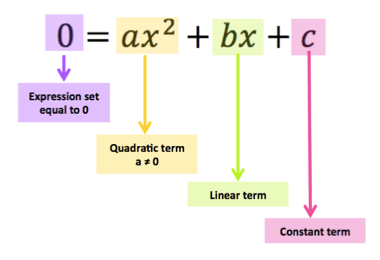
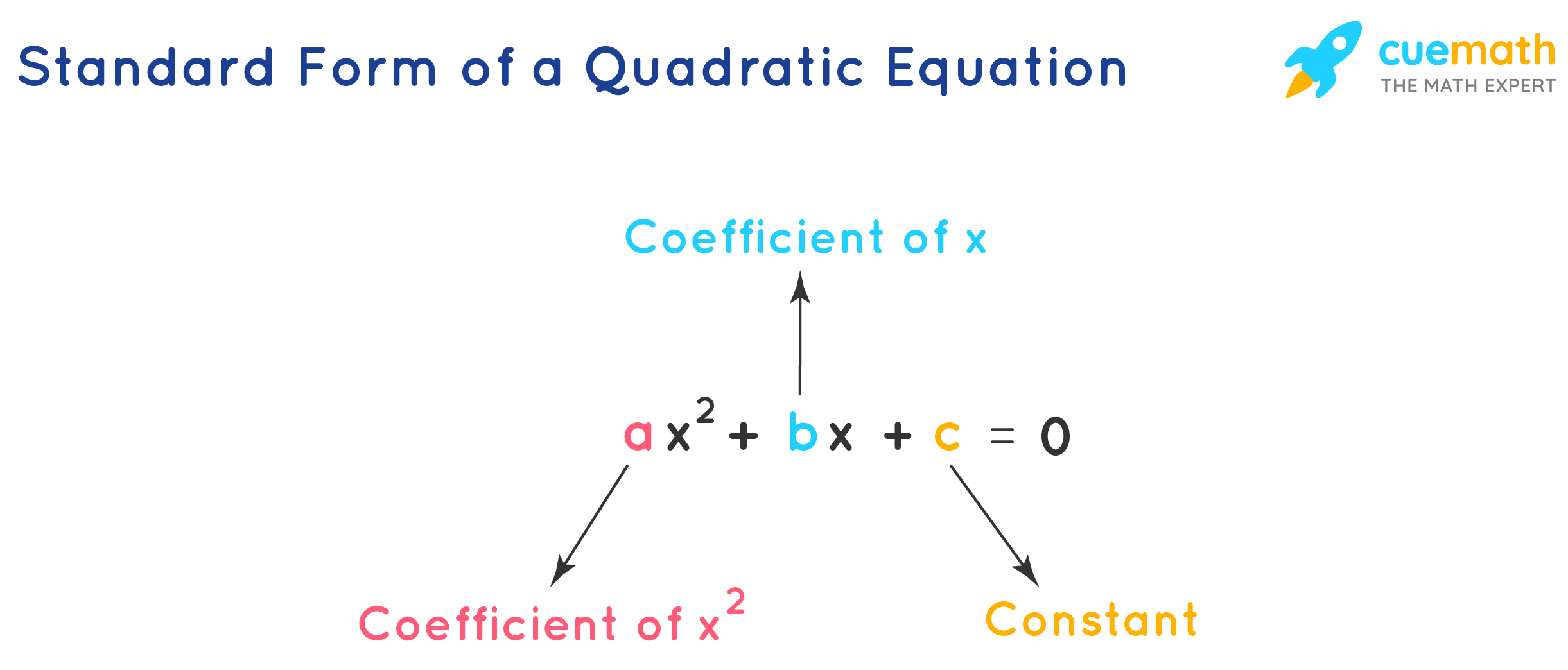


Quadratic equations contain several important components.
Variable
The unknown quantity represented by a letter.
Example:
x in the equation:
x² + 4x + 4 = 0
Coefficients
Coefficients are numerical values multiplying the variable terms.
Example:
In the equation:
3x² + 5x + 1 = 0
3 and 5 are coefficients.
Constant Term
The constant is the number without a variable.
Example:
In the equation:
x² + 6x + 9 = 0
The constant term is 9.
Quadratic Term
The term containing the squared variable.
Example:
4x²
3. Standard Form of Quadratic Equation
The general form is:
ax² + bx + c = 0
Where:
- a determines the shape of the parabola
- b influences the position
- c determines the y-intercept
Example:
x² − 7x + 10 = 0
This equation follows the standard form.
4. Graph of Quadratic Equations

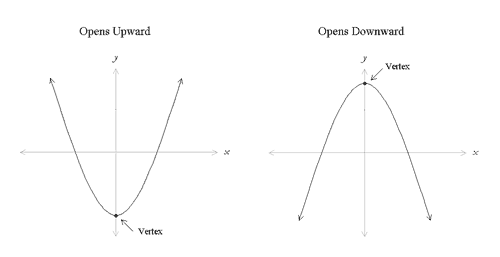


The graph of a quadratic equation is called a parabola.
Characteristics of a parabola include:
- a curved shape
- symmetry
- a vertex
Vertex
The vertex is the highest or lowest point of the parabola.
If the parabola opens upward, the vertex is the minimum point.
If it opens downward, the vertex is the maximum point.
Axis of Symmetry
The vertical line that divides the parabola into two identical halves.
Equation:
x = −b / 2a
Direction of Opening
If:
a > 0 → parabola opens upward
a < 0 → parabola opens downward
5. Methods of Solving Quadratic Equations


There are several methods to solve quadratic equations.
5.1 Factoring Method
Factoring rewrites the quadratic expression as a product of two binomials.
Example:
x² + 5x + 6 = 0
Factor:
(x + 2)(x + 3) = 0
Solutions:
x = −2
x = −3
5.2 Completing the Square
This method transforms a quadratic equation into a perfect square.
Example:
x² + 6x + 5 = 0
Step 1:
x² + 6x = −5
Step 2:
Add 9 to both sides
(x + 3)² = 4
Step 3:
Take square root
x + 3 = ±2
Solutions:
x = −1 or x = −5
5.3 Quadratic Formula
The quadratic formula solves any quadratic equation.
Formula:
x = (−b ± √(b² − 4ac)) / 2a
Example:
x² − 5x + 6 = 0
Substitute values:
a = 1
b = −5
c = 6
Solutions:
x = 2
x = 3
6. The Discriminant
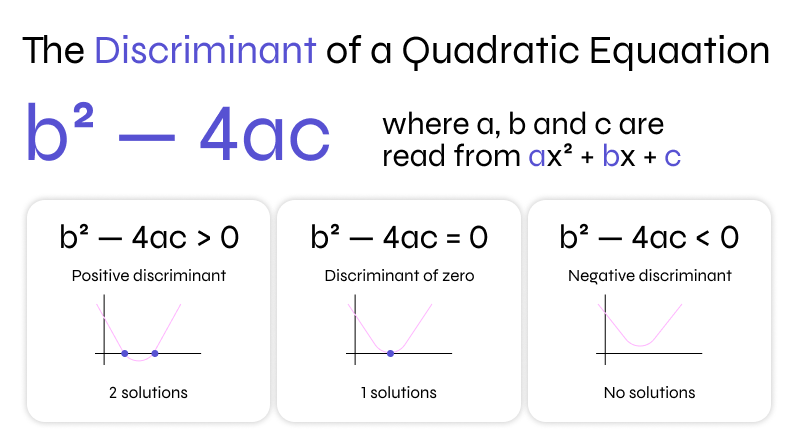

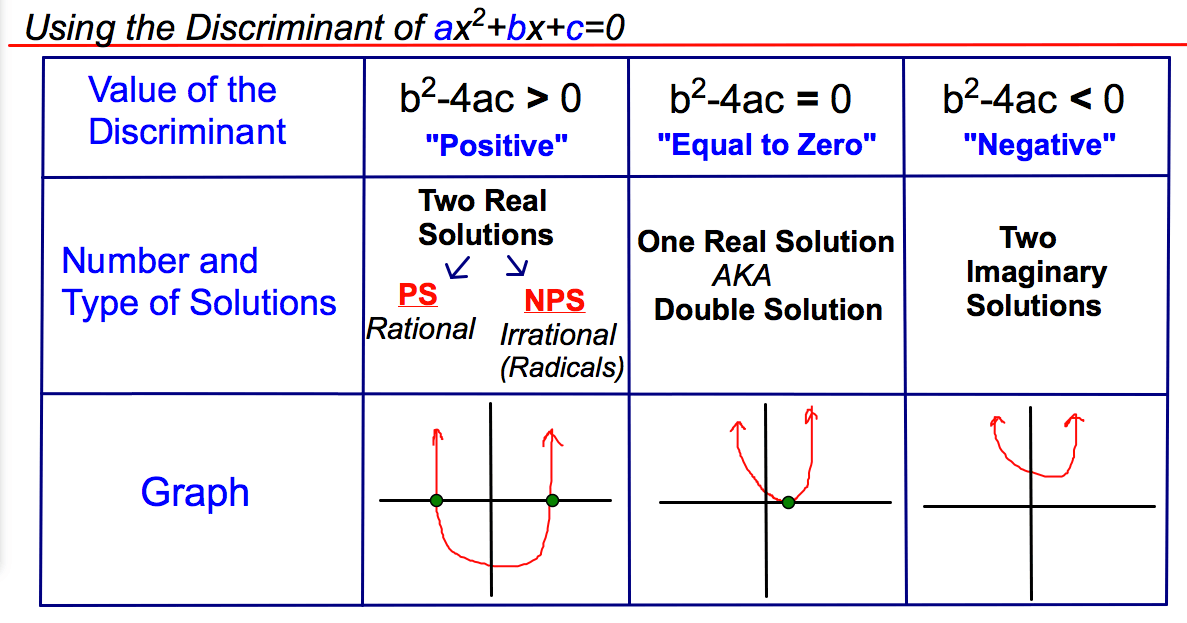
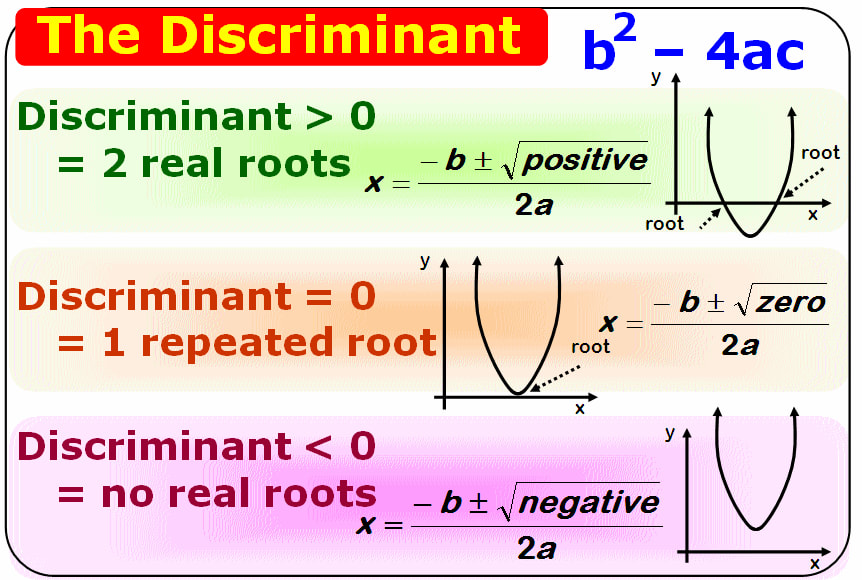
The discriminant determines the nature of the solutions.
Discriminant formula:
D = b² − 4ac
Cases
D > 0
Two real and distinct roots.
D = 0
One real repeated root.
D < 0
Two complex roots.
7. Roots of Quadratic Equations
Roots are values of x that satisfy the equation.
Example:
x² − 9 = 0
Factor:
(x − 3)(x + 3) = 0
Roots:
3 and −3
These roots represent the points where the graph crosses the x-axis.
8. Vertex Form of Quadratic Equation
Another form is:
y = a(x − h)² + k
Where:
(h, k) represents the vertex.
Example:
y = (x − 2)² + 3
Vertex:
(2, 3)
9. Quadratic Functions
A quadratic function describes a relationship between variables.
Example:
f(x) = x² + 2x + 1
The output depends on the input value of x.
Quadratic functions model many real-world processes.
10. Applications of Quadratic Equations
Quadratic equations appear in many real-world situations.
Physics
Projectile motion follows a quadratic path.
Example:
Height of a thrown object.
Engineering
Quadratic equations help calculate structural curves.
Economics
Profit and cost functions often form quadratic relationships.
Architecture
Parabolic arches use quadratic shapes.
11. Quadratic Equations in Geometry
Quadratic equations appear in geometric problems.
Example:
Area formulas.
Example:
Area of square:
A = x²
12. Maximum and Minimum Values
Quadratic functions can have maximum or minimum values.
Example:
y = x² − 4x + 3
Vertex gives minimum value.
These concepts are important in optimization problems.
13. Quadratic Inequalities
Quadratic inequalities involve expressions like:
x² − 5x + 6 > 0
Solutions represent ranges of values.
Graphical methods help identify solution intervals.
14. Quadratic Equations in Coordinate Geometry
Quadratic equations describe curves in coordinate geometry.
Example:
Parabolas
They are used to analyze geometric relationships.
15. Relationship Between Roots and Coefficients
For equation:
ax² + bx + c = 0
Sum of roots:
−b / a
Product of roots:
c / a
These relationships help analyze equations quickly.
16. Historical Development
Quadratic equations have been studied for thousands of years.
Ancient civilizations developed methods to solve quadratic problems in geometry and commerce.
Mathematicians later formalized algebraic methods that led to the modern quadratic formula.
17. Quadratic Equations in Advanced Mathematics
Quadratic equations lead to many advanced topics including:
- polynomial theory
- calculus
- complex numbers
- mathematical modeling
These topics expand the study of quadratic relationships.
18. Importance of Quadratic Equations
Quadratic equations are important because they:
- describe curved relationships
- model real-world phenomena
- help solve optimization problems
- form the basis of many mathematical theories
They are essential in mathematics education.
19. Quadratic Equations in Computer Science
Quadratic equations appear in:
- graphics rendering
- optimization algorithms
- physics simulations
- machine learning models
Computational methods often solve quadratic equations efficiently.
20. Summary
Quadratic equations are polynomial equations of degree two that play a crucial role in algebra and many scientific disciplines. Their characteristic parabolic graphs make them useful for modeling real-world phenomena involving curved motion and optimization.
Understanding quadratic equations involves learning their structure, graphical representation, solving methods, and applications. Techniques such as factoring, completing the square, and using the quadratic formula allow mathematicians to find solutions efficiently.
Because of their wide range of applications in physics, engineering, economics, and computer science, quadratic equations remain one of the most important topics in mathematics.