


Introduction
Maxwell’s equations are a set of four fundamental equations that describe how electric and magnetic fields behave and interact with each other and with electric charges. These equations form the foundation of classical electromagnetism, one of the most important branches of physics.
The equations were formulated by the Scottish physicist James Clerk Maxwell in the 19th century. Maxwell combined several earlier discoveries about electricity and magnetism into a unified mathematical framework. His work revealed that electric and magnetic fields are interconnected and that changing electric fields can produce magnetic fields, and vice versa.
Maxwell’s equations explain many electromagnetic phenomena, including:
- Electric fields produced by charges
- Magnetic fields produced by currents
- Electromagnetic waves such as light
- Radio waves and microwaves
- Electromagnetic radiation
One of the most remarkable predictions of Maxwell’s theory was the existence of electromagnetic waves, which travel at the speed of light. This discovery led to the understanding that light itself is an electromagnetic wave.
Maxwell’s equations are fundamental to many modern technologies, including:
- Radio communication
- Wireless networks
- Electrical power systems
- Optical technologies
- Radar systems
These equations also laid the groundwork for later developments in physics, including relativity and quantum electrodynamics.
Historical Development of Electromagnetism


Before Maxwell developed his equations, several scientists contributed to the understanding of electricity and magnetism.
Charles-Augustin de Coulomb
Coulomb studied the forces between electric charges and formulated Coulomb’s law.
Hans Christian Ørsted
Ørsted discovered that an electric current produces a magnetic field.
André-Marie Ampère
Ampère developed mathematical laws describing magnetic fields produced by electric currents.
Michael Faraday
Faraday discovered electromagnetic induction and introduced the concept of electric and magnetic field lines.
Maxwell unified these discoveries into a complete mathematical theory.
Electric and Magnetic Fields


Maxwell’s equations describe two fundamental fields.
Electric Field
An electric field is produced by electric charges and acts on other charges.
Magnetic Field
A magnetic field is produced by moving charges or electric currents.
The electric field is represented by the vector (E), and the magnetic field by the vector (B).
These fields interact and influence each other according to Maxwell’s equations.
Maxwell’s Four Equations
Maxwell’s equations consist of four fundamental relationships:
- Gauss’s law for electricity
- Gauss’s law for magnetism
- Faraday’s law of induction
- Ampère–Maxwell law
Each equation describes a different aspect of electromagnetic behavior.
Gauss’s Law for Electricity


Gauss’s law describes how electric charges produce electric fields.
Mathematical form:
[
\oint \vec{E} \cdot d\vec{A} = \frac{Q}{\epsilon_0}
]
Where:
- (E) = electric field
- (Q) = enclosed charge
- (\epsilon_0) = permittivity of free space
This equation states that the electric flux through a closed surface depends on the charge inside the surface.
Gauss’s Law for Magnetism


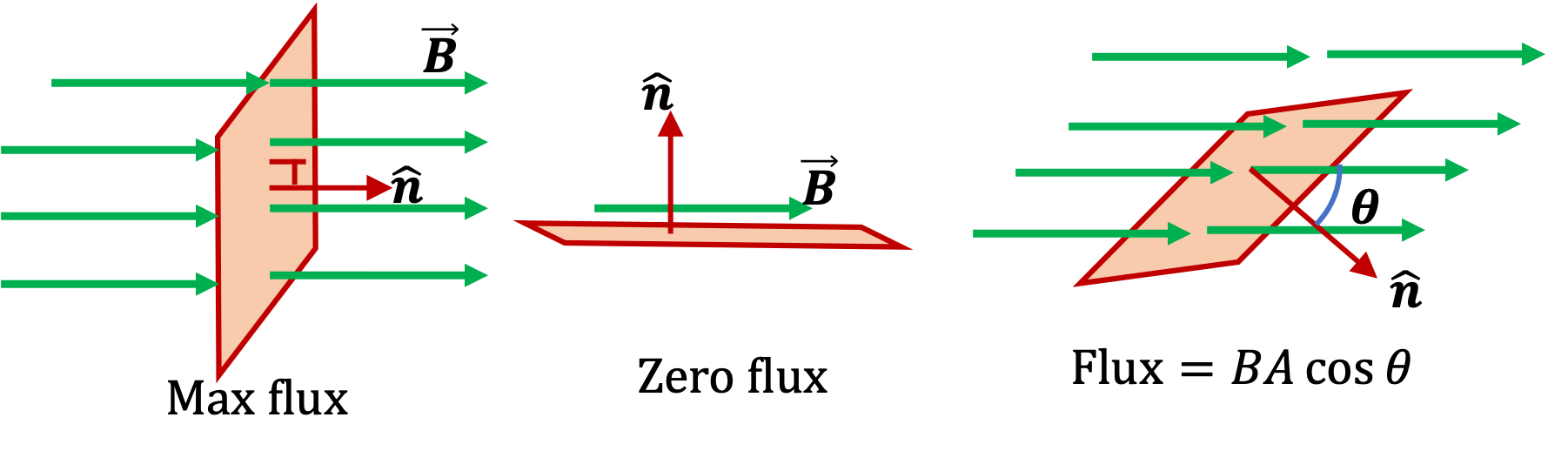
Gauss’s law for magnetism states that magnetic monopoles do not exist.
Mathematical form:
[
\oint \vec{B} \cdot d\vec{A} = 0
]
This means:
- Magnetic field lines always form closed loops.
- There are no isolated magnetic charges.
Unlike electric charges, magnetic poles always occur in pairs.
Faraday’s Law of Electromagnetic Induction


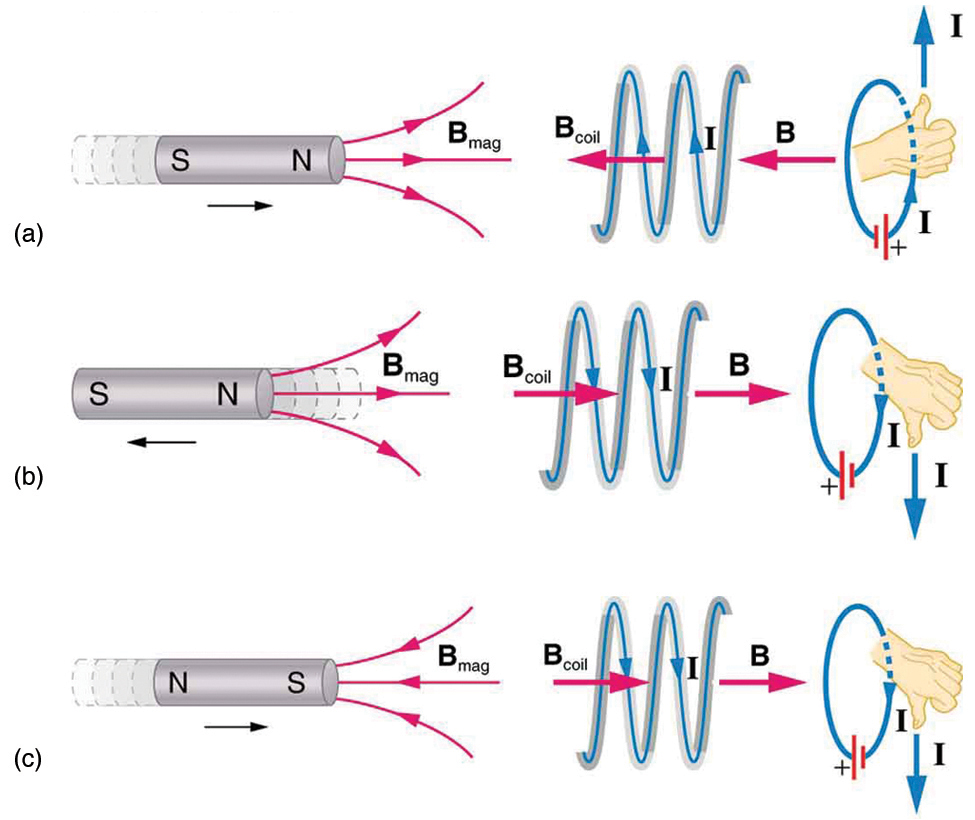
Faraday’s law describes how changing magnetic fields produce electric fields.
Mathematical form:
[
\oint \vec{E} \cdot d\vec{l} = -\frac{d\Phi_B}{dt}
]
Where:
- ( \Phi_B ) = magnetic flux
This principle explains:
- Electric generators
- Transformers
- Induction motors
Ampère–Maxwell Law

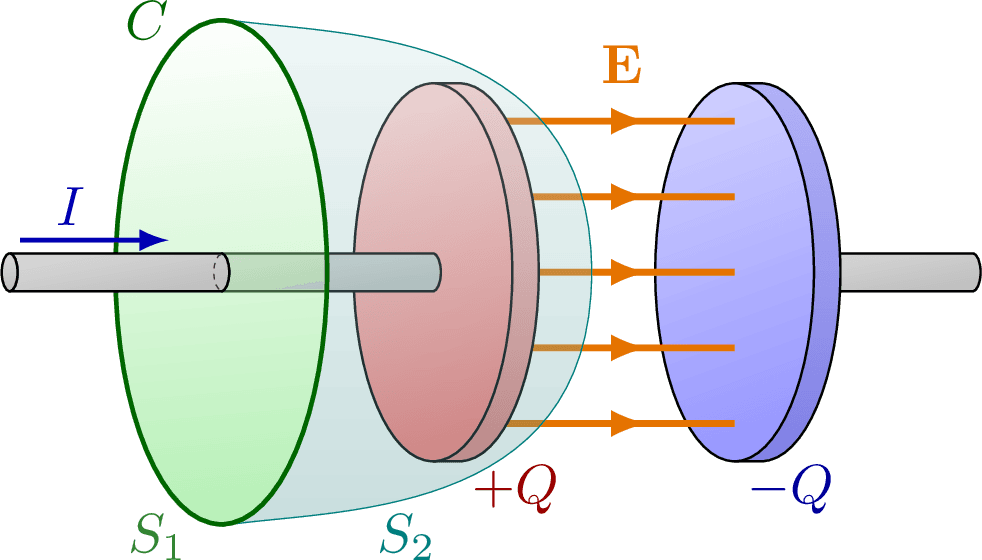


Ampère’s law originally described magnetic fields produced by electric currents.
Maxwell modified the law by introducing displacement current.
Mathematical form:
[
\oint \vec{B} \cdot d\vec{l} =
\mu_0 I + \mu_0 \epsilon_0 \frac{d\Phi_E}{dt}
]
This equation shows that:
- Electric currents produce magnetic fields.
- Changing electric fields also produce magnetic fields.
This insight allowed Maxwell to predict electromagnetic waves.
Electromagnetic Waves


By combining his equations, Maxwell discovered that electric and magnetic fields can propagate through space as waves.
These waves travel at the speed:
[
c = \frac{1}{\sqrt{\mu_0 \epsilon_0}}
]
This speed equals the speed of light, proving that light is an electromagnetic wave.
Electromagnetic waves include:
- Radio waves
- Microwaves
- Infrared radiation
- Visible light
- Ultraviolet radiation
- X-rays
- Gamma rays
Maxwell’s Equations in Differential Form


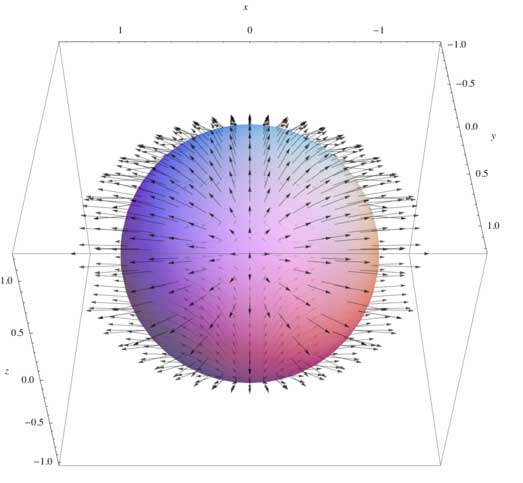
Maxwell’s equations can also be written in differential form.
Gauss’s Law
[
\nabla \cdot E = \frac{\rho}{\epsilon_0}
]
Gauss’s Law for Magnetism
[
\nabla \cdot B = 0
]
Faraday’s Law
[
\nabla \times E = -\frac{\partial B}{\partial t}
]
Ampère–Maxwell Law
[
\nabla \times B =
\mu_0 J + \mu_0 \epsilon_0 \frac{\partial E}{\partial t}
]
These equations describe how electromagnetic fields vary in space and time.
Applications of Maxwell’s Equations


Maxwell’s equations explain many technologies.
Wireless Communication
Radio and television signals use electromagnetic waves.
Radar
Radar systems detect objects using reflected electromagnetic waves.
Power Transmission
Electric power systems rely on electromagnetic fields.
Medical Imaging
Technologies such as MRI involve electromagnetic fields.
Importance in Modern Physics
Maxwell’s equations are among the most important equations in physics.
They:
- Unified electricity and magnetism
- Predicted electromagnetic waves
- Explained the nature of light
They also influenced:
- Einstein’s theory of relativity
- Quantum electrodynamics
- Modern electromagnetic technology
Conclusion
Maxwell’s equations provide a complete mathematical description of electromagnetism. These four equations explain how electric charges and currents produce electric and magnetic fields and how these fields interact and propagate through space.
The equations reveal that light is an electromagnetic wave and unify electricity, magnetism, and optics into a single theoretical framework. Maxwell’s theory has had a profound impact on science and technology, forming the basis for modern communication systems, electrical engineering, and many areas of physics.
Even today, Maxwell’s equations remain one of the cornerstones of theoretical physics and continue to guide research and technological innovation.