


Logic and Propositions in Mathematics
Logic is a fundamental area of mathematics that deals with reasoning, validity of arguments, and the structure of mathematical statements. It provides the framework that mathematicians use to determine whether statements are true or false and whether conclusions logically follow from given premises.
Logic is particularly important in mathematics, computer science, artificial intelligence, philosophy, and linguistics. It forms the basis for algorithms, programming languages, automated reasoning systems, and formal proofs.
The study of logic in mathematics usually begins with propositions, which are statements that have a definite truth value. By combining propositions using logical operations, mathematicians can build complex statements and analyze their logical relationships.
This field is often divided into two main branches:
- Propositional Logic
- Predicate Logic
Both of these areas allow mathematicians to represent and analyze reasoning in a precise and systematic way.
1. Propositions
A proposition is a declarative statement that is either true or false, but not both.
Examples of propositions:
- “5 is greater than 2.” (True)
- “The Earth is flat.” (False)
- “7 + 3 = 10.” (True)
Examples of statements that are not propositions:
- “Close the door.”
- “How are you?”
- “x + 2 = 5”
The last example is not a proposition because the truth depends on the value of x.
Thus, a proposition must satisfy two conditions:
- It must be a statement.
- It must have a definite truth value.
Propositions are often represented using letters or symbols such as:
p, q, r, s
For example:
p: “It is raining.”
q: “The ground is wet.”
These symbols make it easier to analyze logical relationships.
2. Truth Values
Every proposition has a truth value, which indicates whether it is true or false.
Truth values are usually represented by:
T → True
F → False
Example:
p: “4 is an even number.”
Truth value: T
Another example:
q: “9 is a prime number.”
Truth value: F
Truth values play a crucial role in logic because logical operations depend on the truth values of the propositions involved.
3. Compound Propositions
A compound proposition is formed by combining two or more propositions using logical connectives.
Example:
p: “It is raining.”
q: “The ground is wet.”
Compound statement:
“It is raining and the ground is wet.”
Logical connectives include:
- AND
- OR
- NOT
- IF–THEN
- IF AND ONLY IF
These connectives allow us to build complex logical expressions.
4. Logical Connectives
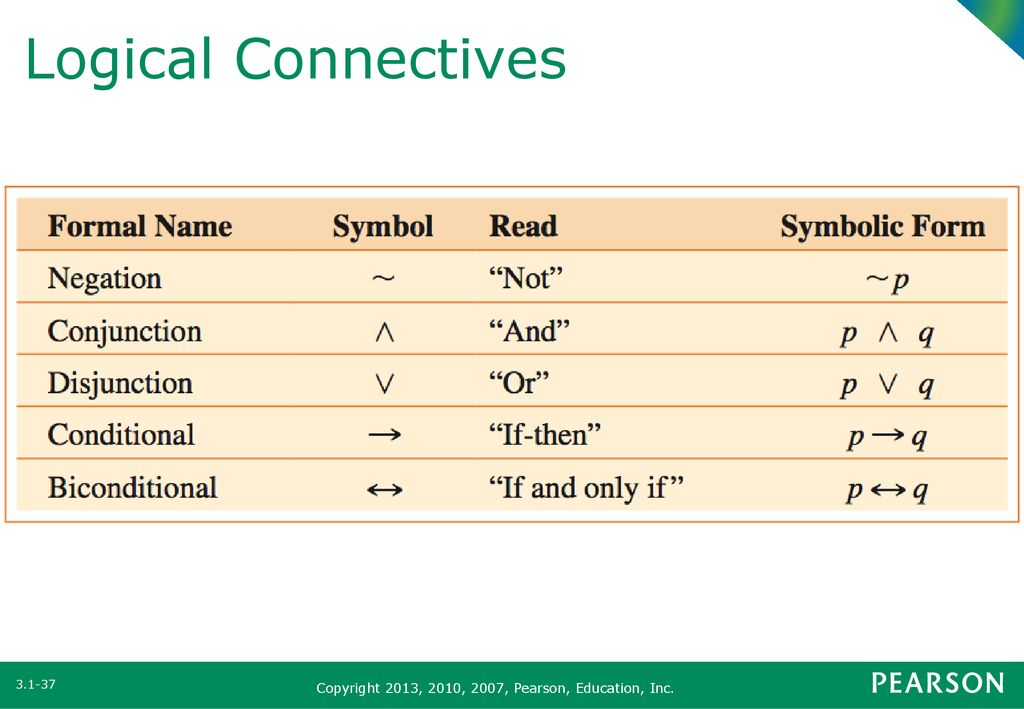

Logical connectives are symbols used to combine propositions.
4.1 Negation (NOT)
Negation reverses the truth value of a proposition.
Symbol:
¬p
Example:
p: “The number is even.”
¬p: “The number is not even.”
Truth table:
| p | ¬p |
|---|---|
| T | F |
| F | T |
4.2 Conjunction (AND)
The conjunction of two propositions is true only when both propositions are true.
Symbol:
p ∧ q
Example:
p: “It is raining.”
q: “It is cold.”
p ∧ q: “It is raining and it is cold.”
Truth table:
| p | q | p ∧ q |
|---|---|---|
| T | T | T |
| T | F | F |
| F | T | F |
| F | F | F |
4.3 Disjunction (OR)
The disjunction of two propositions is true if at least one is true.
Symbol:
p ∨ q
Example:
“It is raining or it is snowing.”
Truth table:
| p | q | p ∨ q |
|---|---|---|
| T | T | T |
| T | F | T |
| F | T | T |
| F | F | F |
4.4 Implication (IF–THEN)
Implication represents conditional statements.
Symbol:
p → q
Example:
“If it rains, then the ground gets wet.”
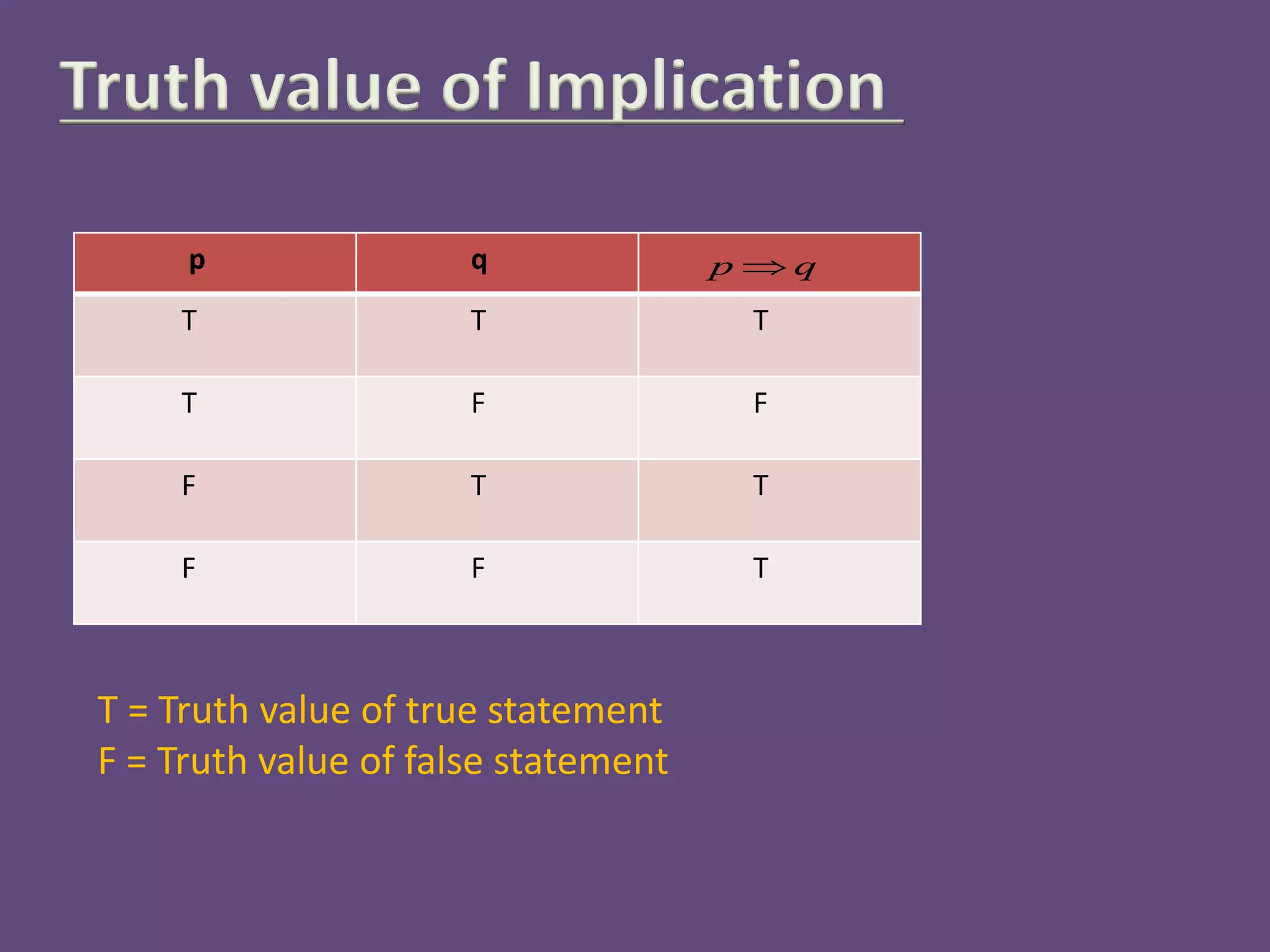
Truth table:
| p | q | p → q |
|---|---|---|
| T | T | T |
| T | F | F |
| F | T | T |
| F | F | T |
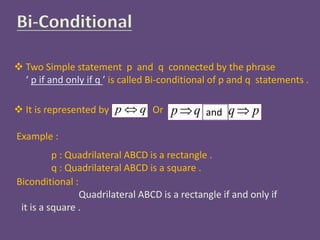
4.5 Biconditional
The biconditional is true when both statements have the same truth value.
Symbol:
p ↔ q
Example:
“A number is even if and only if it is divisible by 2.”
Truth table:
| p | q | p ↔ q |
|---|---|---|
| T | T | T |
| T | F | F |
| F | T | F |
| F | F | T |
5. Truth Tables
Truth tables are used to determine the truth value of compound statements.
Example:
Expression:
(p ∧ q) → p
Truth table:
| p | q | p ∧ q | (p ∧ q) → p |
|---|---|---|---|
| T | T | T | T |
| T | F | F | T |
| F | T | F | T |
| F | F | F | T |
Truth tables help determine logical properties such as:
- Tautology
- Contradiction
- Contingency
6. Tautologies, Contradictions, and Contingencies
Tautology
A statement that is always true.
Example:
p ∨ ¬p
Truth table:
| p | ¬p | p ∨ ¬p |
|---|---|---|
| T | F | T |
| F | T | T |
Contradiction
A statement that is always false.
Example:
p ∧ ¬p
Contingency
A statement that can be true or false depending on conditions.
Example:
p ∧ q
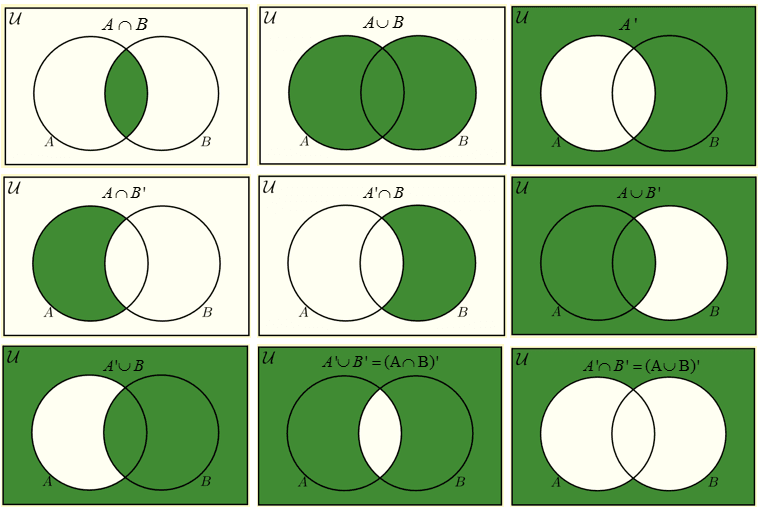
7. Logical Equivalence
Two statements are logically equivalent if they have the same truth values for all cases.
Example:
p → q is equivalent to:
¬p ∨ q
Logical equivalence is often written as:
p ≡ q
These equivalences simplify logical expressions.
8. Laws of Logic
There are several important laws used in logical reasoning.
Identity Laws
p ∧ T ≡ p
p ∨ F ≡ p
Domination Laws
p ∨ T ≡ T
p ∧ F ≡ F
Idempotent Laws
p ∨ p ≡ p
p ∧ p ≡ p
Double Negation
¬(¬p) ≡ p
Commutative Laws
p ∨ q ≡ q ∨ p
p ∧ q ≡ q ∧ p
Associative Laws
(p ∨ q) ∨ r ≡ p ∨ (q ∨ r)
9. De Morgan’s Laws


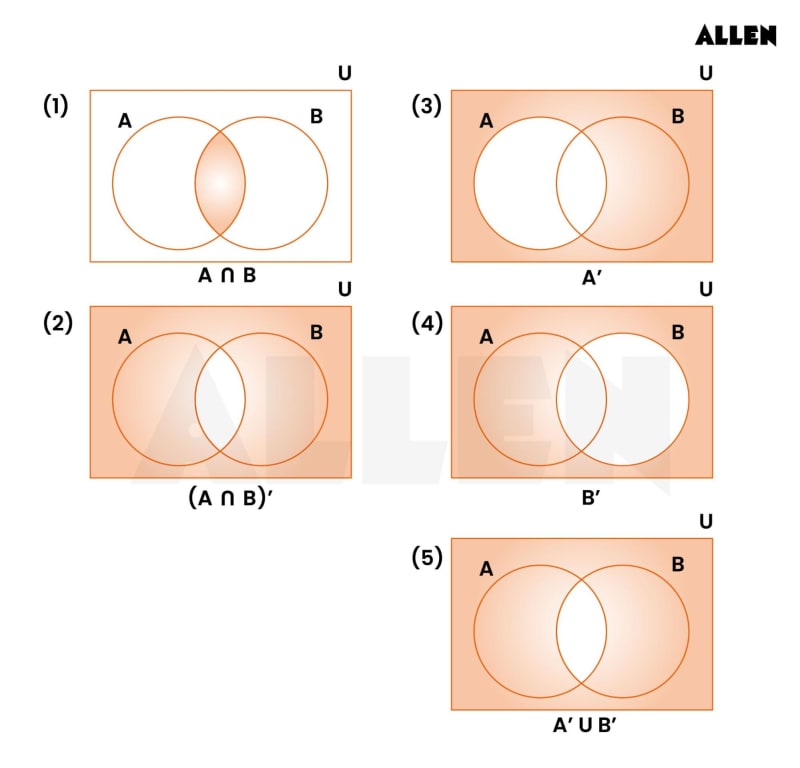
De Morgan’s laws describe relationships between negation and logical operations.
First law:
¬(p ∧ q) ≡ ¬p ∨ ¬q
Second law:
¬(p ∨ q) ≡ ¬p ∧ ¬q
These laws are important in mathematics, computer science, and digital circuit design.
10. Predicate Logic
Propositional logic deals with whole statements, but sometimes we need more expressive power.
Predicate logic introduces variables and quantifiers.
Example:
“x is greater than 5”
This is called a predicate because its truth depends on the value of x.
Example predicate:
P(x): “x > 5”
11. Quantifiers


Quantifiers specify how many elements satisfy a predicate.
Universal Quantifier
Symbol:
∀
Meaning: “for all”
Example:
∀x (x + 0 = x)
Meaning: For every x, x + 0 equals x.
Existential Quantifier
Symbol:
∃
Meaning: “there exists”
Example:
∃x (x² = 4)
Meaning: There exists a number whose square equals 4.
12. Logical Reasoning and Arguments
Logic allows us to determine whether arguments are valid.
Example argument:
- If it rains, the ground gets wet.
- It rains.
- Therefore, the ground gets wet.
This argument follows a valid rule called modus ponens.
13. Rules of Inference
Rules of inference are patterns of reasoning.
Modus Ponens
p → q
p
∴ q
Modus Tollens
p → q
¬q
∴ ¬p
Hypothetical Syllogism
p → q
q → r
∴ p → r
Disjunctive Syllogism
p ∨ q
¬p
∴ q
These rules are used in mathematical proofs and logical arguments.
14. Methods of Proof
Logic is essential for mathematical proofs.
Common proof methods include:
Direct Proof
Start from known facts and logically derive the conclusion.
Proof by Contradiction
Assume the opposite and show it leads to contradiction.
Proof by Contrapositive
Instead of proving:
p → q
Prove:
¬q → ¬p
Mathematical Induction
Used to prove statements for all natural numbers.
15. Boolean Algebra
Boolean algebra is a branch of algebra based on logical operations.
It is widely used in:
- Digital electronics
- Computer circuits
- Programming
Boolean variables can take only two values:
0 (False)
1 (True)
Operations include:
- AND
- OR
- NOT
Boolean algebra forms the basis of logic gates in computer hardware.
16. Applications of Logic
Logic has numerous applications across many disciplines.
Computer Science
Logic is used in:
- programming languages
- algorithms
- database queries
- automated reasoning
Artificial Intelligence
AI systems use logical rules to perform reasoning and decision making.
Digital Circuit Design
Logic gates form the building blocks of computers.
Examples:
- AND gate
- OR gate
- NOT gate
Mathematics
Logic ensures that mathematical proofs are valid and consistent.
Philosophy
Logic is used to analyze arguments and philosophical reasoning.
17. Importance of Logic in Mathematics
Logic is often called the foundation of mathematics because it ensures that reasoning is consistent and valid.
Without logic:
- mathematical proofs would not be reliable
- arguments could not be verified
- theories could not be built systematically
Logic also helps mathematicians understand the structure of mathematical systems.
18. Modern Developments in Logic
Modern mathematical logic includes several advanced fields:
Set Theory
Studies collections of objects.
Model Theory
Examines relationships between mathematical structures and logical languages.
Proof Theory
Analyzes the structure of mathematical proofs.
Computability Theory
Studies what problems can be solved by algorithms.
These fields connect logic with computer science and theoretical mathematics.
19. Summary
Logic and propositions form the foundation of mathematical reasoning. They provide tools for analyzing statements, constructing valid arguments, and proving mathematical results.
Key ideas include:
- propositions
- truth values
- logical connectives
- truth tables
- logical equivalence
- predicate logic
- quantifiers
- inference rules
- proof techniques
Through these concepts, logic ensures that mathematical reasoning is precise, consistent, and reliable.
Logic also plays a crucial role in computer science, artificial intelligence, digital electronics, and philosophy, making it one of the most important subjects in both mathematics and modern technology.