


Tags:
Basic Operations in Mathematics (Addition, Subtraction, Multiplication, Division)
Basic operations form the foundation of mathematics and are essential for performing calculations in everyday life. The four primary arithmetic operations are addition, subtraction, multiplication, and division. These operations are used to combine numbers, find differences, determine repeated quantities, and distribute values.
These operations are fundamental to mathematics education and are the building blocks for more advanced topics such as algebra, geometry, statistics, and calculus. Every mathematical calculation, from simple counting to complex scientific computations, relies on these four operations.
The study of arithmetic operations dates back thousands of years, when early civilizations developed numerical systems to solve problems involving trade, agriculture, and construction. Over time, these operations evolved into the structured mathematical processes used today.
Understanding how these operations work and how they relate to one another is essential for developing strong mathematical reasoning and problem-solving skills.
1. Addition


Definition of Addition
Addition is the mathematical operation used to combine two or more numbers to obtain their total or sum.
The symbol used for addition is:
Example:
3 + 5 = 8
Here:
- 3 and 5 are called addends
- 8 is called the sum
Addition represents the concept of combining quantities.
Example:
If you have 3 apples and receive 2 more apples, the total number of apples becomes:
3 + 2 = 5
Understanding Addition
Addition can be visualized using objects or number lines.
Example:
Number line:
Start at 4 and move 3 steps forward.
4 + 3 = 7
Addition always moves toward larger numbers when dealing with positive numbers.
Properties of Addition
Addition follows several important mathematical properties.
Commutative Property
The order of numbers does not change the result.
a + b = b + a
Example:
3 + 7 = 7 + 3
Associative Property
The grouping of numbers does not change the result.
(a + b) + c = a + (b + c)
Example:
(2 + 3) + 4 = 2 + (3 + 4)
Identity Property
Adding zero does not change the number.
a + 0 = a
Example:
8 + 0 = 8
Addition with Larger Numbers
When adding multi-digit numbers, we align digits according to place value.
Example:
  345
+ 278
-----
  623
This method involves adding each column starting from the right.
2. Subtraction


Definition of Subtraction
Subtraction is the mathematical operation used to find the difference between two numbers.
The symbol used is:
−
Example:
9 − 4 = 5
Here:
- 9 is the minuend
- 4 is the subtrahend
- 5 is the difference
Subtraction represents removing or taking away quantities.
Understanding Subtraction
Example:
If you have 7 candies and give away 3 candies:
7 − 3 = 4
You now have 4 candies left.
Subtraction Using Number Line
Example:
8 − 3
Start at 8 and move 3 steps backward.
Result:
5
Borrowing in Subtraction
When subtracting multi-digit numbers, sometimes borrowing is required.
Example:
  402
- 178
-----
  224
Borrowing allows subtraction when the top digit is smaller than the bottom digit.
Properties of Subtraction
Subtraction does not satisfy commutative or associative properties.
Example:
5 − 3 ≠ 3 − 5
However, subtraction can be expressed as addition of negative numbers.
Example:
7 − 3 = 7 + (−3)
3. Multiplication


Definition of Multiplication
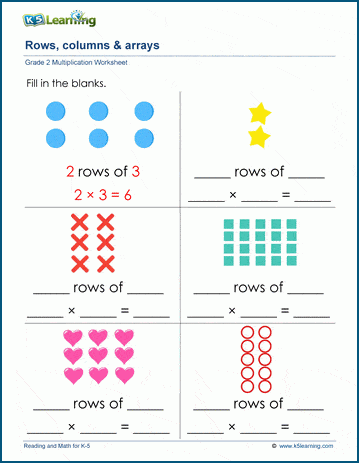
Multiplication is the operation of repeated addition.
The symbol used is:
×
Example:
4 × 3 = 12
This means:
4 + 4 + 4 = 12
Here:
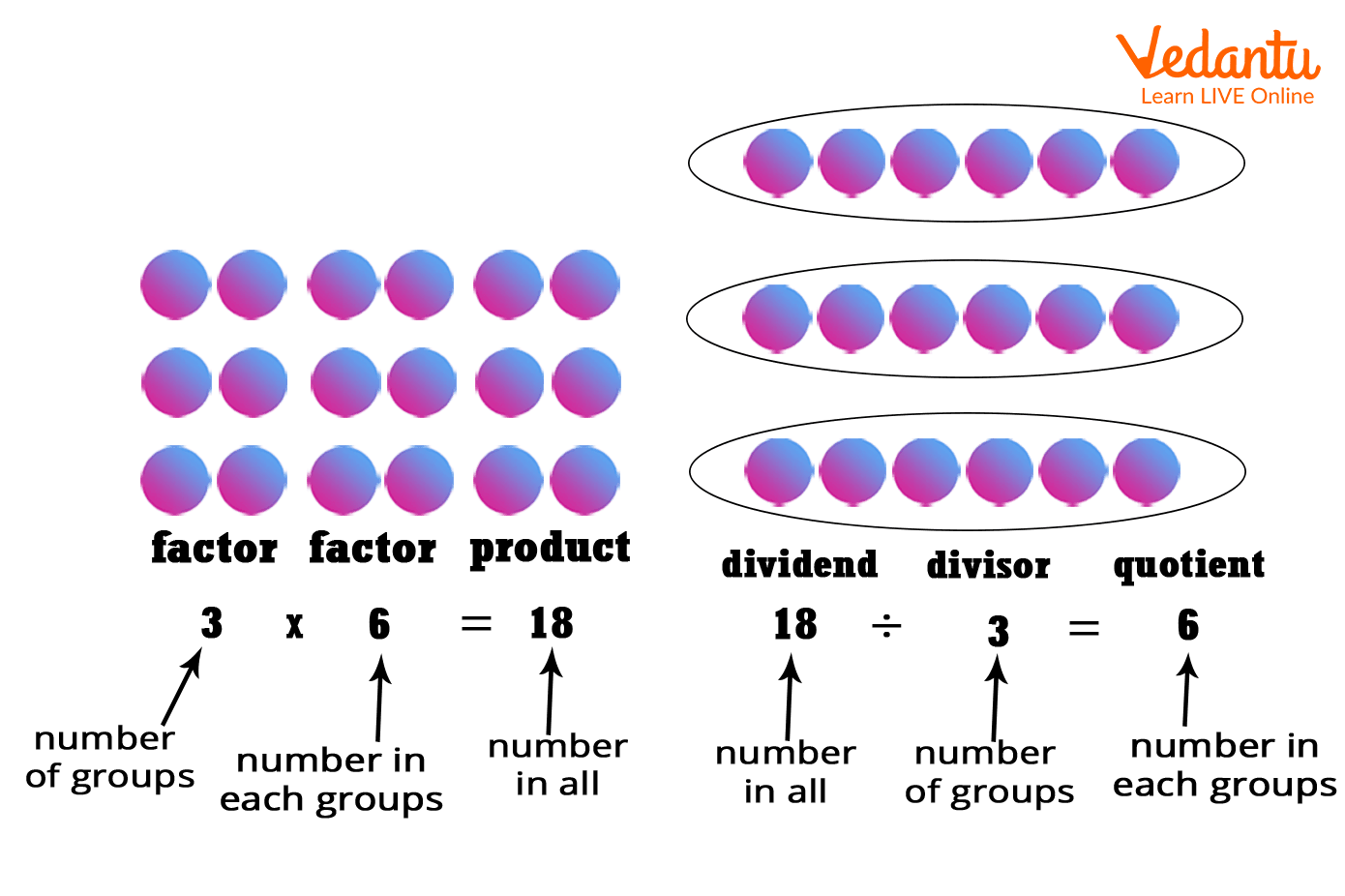
- 4 and 3 are factors
- 12 is the product
Multiplication as Groups
Example:
3 groups of 5 apples.
3 × 5 = 15
Multiplication helps calculate repeated quantities efficiently.
Multiplication Table
The multiplication table helps perform multiplication quickly.
Example:
6 × 7 = 42
Learning multiplication tables is essential for arithmetic proficiency.
Properties of Multiplication
Commutative Property
a × b = b × a
Example:
5 × 4 = 4 × 5
Associative Property
(a × b) × c = a × (b × c)
Example:
(2 × 3) × 4 = 2 × (3 × 4)
Identity Property
a × 1 = a
Example:
9 × 1 = 9
Zero Property
a × 0 = 0
Example:
7 × 0 = 0
Multiplying Multi-Digit Numbers
Example:
  34
× 12
-----
  68
 340
-----
 408
This method multiplies digits step by step.
4. Division


Definition of Division
Division is the operation of splitting a quantity into equal parts.
The symbol used is:
÷
Example:
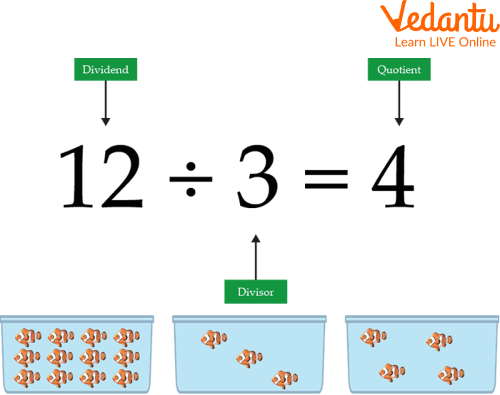
12 ÷ 3 = 4
Here:
- 12 is the dividend
- 3 is the divisor
- 4 is the quotient
Division as Sharing
Example:
If 12 candies are shared among 3 children:
Each child gets:
4 candies
Division as Repeated Subtraction
Example:
12 ÷ 3
12 − 3 − 3 − 3 − 3
Four subtractions lead to zero.
Result:
4
Long Division
Example:
84 ÷ 4
Step-by-step:
4 goes into 8 → 2
4 goes into 4 → 1
Result:
21
Division by Zero
Division by zero is undefined.
Example:
5 ÷ 0
This operation has no valid result in mathematics.
5. Relationships Between Operations
The four operations are interconnected.
Addition and subtraction are inverse operations.
Example:
8 − 3 = 5
5 + 3 = 8
Multiplication and division are also inverse operations.
Example:
4 × 5 = 20
20 ÷ 5 = 4
Understanding these relationships helps solve equations and check answers.
6. Order of Operations
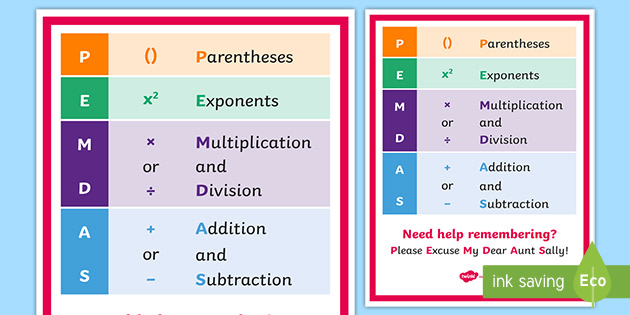
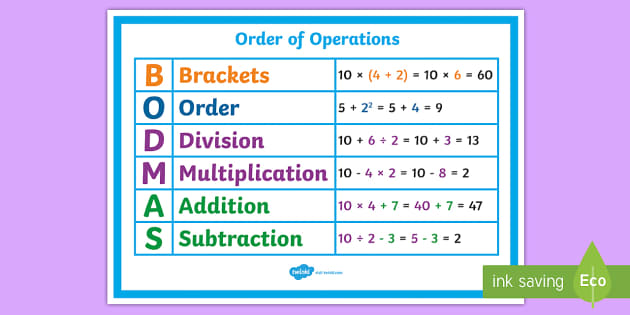

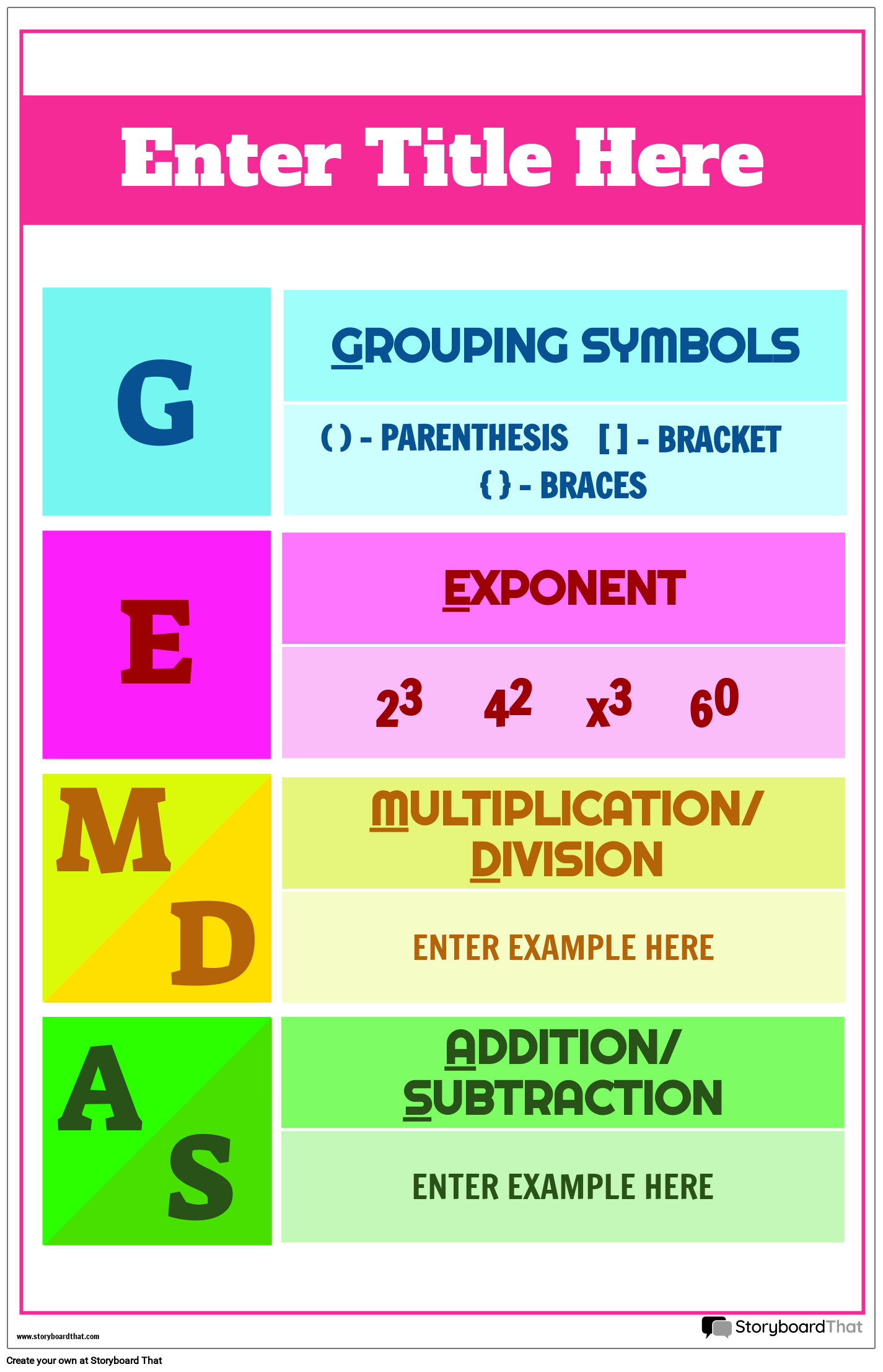
When multiple operations appear in one expression, a specific order must be followed.
Common rule:
PEMDAS
- Parentheses
- Exponents
- Multiplication
- Division
- Addition
- Subtraction
Example:
3 + 5 × 2
First multiply:
5 × 2 = 10
Then add:
3 + 10 = 13
7. Applications in Daily Life
Basic operations are used in many everyday situations.
Shopping
Addition calculates total prices.
Subtraction determines change.
Example:
Total bill:
$10 + $5 + $3 = $18
Cooking
Recipes require multiplication and division.
Example:
Double a recipe:
2 cups → 4 cups
Travel
Multiplication calculates distance.
Example:
Speed × time.
Finance
Division calculates equal payments.
Example:
$100 divided among 4 people.
8. Basic Operations with Different Number Types
These operations apply to many number systems.
Examples include:
- integers
- fractions
- decimals
- rational numbers
Example with decimals:
2.5 + 1.3 = 3.8
Example with fractions:
1/2 + 1/4 = 3/4
9. Importance in Mathematics
Basic operations are the foundation of arithmetic.
They enable:
- problem solving
- logical reasoning
- quantitative analysis
Without these operations, advanced mathematics would not exist.
10. Historical Development
Ancient civilizations developed arithmetic operations to solve practical problems.
Early mathematical systems appeared in:
- ancient Egypt
- Mesopotamia
- India
- Greece
Over centuries, these operations evolved into modern arithmetic methods.
11. Role in Modern Technology
Basic arithmetic operations are fundamental in computing.
Computers perform billions of calculations using these operations every second.
Applications include:
- programming
- algorithms
- scientific computing
- data analysis
12. Summary
Addition, subtraction, multiplication, and division are the four fundamental arithmetic operations in mathematics. They allow us to combine numbers, find differences, calculate repeated quantities, and divide quantities into equal parts.
These operations form the basis for mathematical reasoning and are used in nearly every aspect of daily life, including finance, science, engineering, and technology.
Understanding these basic operations is essential for learning advanced mathematical concepts and solving real-world problems effectively.