


Introduction
Geometrical optics, also known as ray optics, is the branch of optics that describes light propagation in terms of straight-line paths called rays. This approach is used when the wavelength of light is much smaller than the size of the objects with which it interacts. In such situations, light can be treated as traveling in straight lines rather than exhibiting wave behavior.
Geometrical optics explains many everyday optical phenomena such as:
- Reflection from mirrors
- Refraction through lenses
- Formation of images by optical devices
- Light propagation in transparent media
The theory of geometrical optics is based on a few fundamental principles that describe how light travels and interacts with surfaces. These principles allow physicists and engineers to design optical systems such as cameras, microscopes, telescopes, and eyeglasses.
Geometrical optics differs from physical optics, which considers wave phenomena such as interference and diffraction. While wave optics provides a more complete description of light behavior, geometrical optics remains extremely useful because of its simplicity and practical applications.
The study of geometrical optics plays a major role in fields such as:
- Optical engineering
- Astronomy
- Photography
- Vision science
- Laser technology
Understanding geometrical optics allows scientists to analyze and design complex optical instruments.
Nature of Light in Geometrical Optics

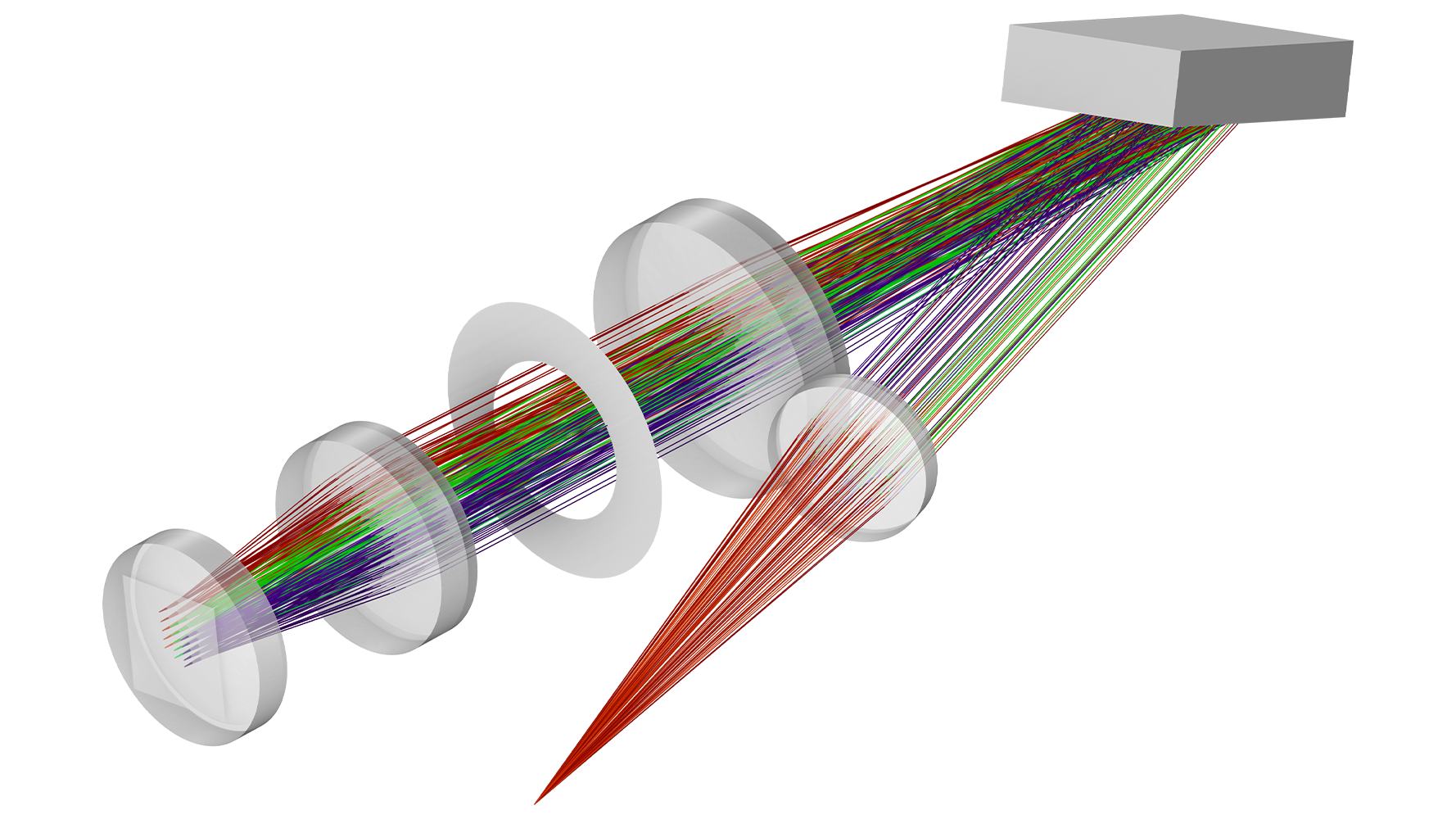
In geometrical optics, light is modeled as rays that travel in straight lines through uniform media. A ray represents the direction of energy propagation of light.
The ray model works well when:
- The wavelength of light is very small compared to the size of objects.
- Wave effects such as diffraction are negligible.
Key assumptions of geometrical optics include:
- Light travels in straight lines in homogeneous media.
- Light rays change direction when interacting with surfaces.
- Light rays can be reflected or refracted depending on the properties of materials.
This simplified model makes it easier to analyze optical systems.
Laws of Reflection


Reflection occurs when light rays strike a surface and bounce back into the same medium.
The laws of reflection describe how this process occurs.
First Law
The incident ray, reflected ray, and the normal to the surface all lie in the same plane.
Second Law
The angle of incidence equals the angle of reflection.
[
\theta_i = \theta_r
]
Reflection occurs in many everyday situations such as mirrors, polished surfaces, and water surfaces.
Reflection is classified into:
- Specular reflection – smooth surfaces produce clear reflections.
- Diffuse reflection – rough surfaces scatter light in many directions.
Laws of Refraction


Refraction occurs when light passes from one medium into another and changes direction due to a change in speed.
The relationship between angles of incidence and refraction is given by Snell’s law:
[
n_1 \sin \theta_1 = n_2 \sin \theta_2
]
Where:
- (n_1) = refractive index of first medium
- (n_2) = refractive index of second medium
Refraction explains many optical phenomena such as:
- Bending of light in water
- Formation of rainbows
- Functioning of lenses
Refractive Index

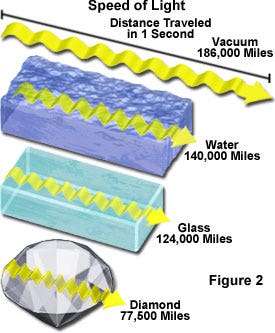

The refractive index of a medium measures how much light slows down in that medium.
It is defined as:
[
n = \frac{c}{v}
]
Where:
- (c) = speed of light in vacuum
- (v) = speed of light in the medium
Materials with higher refractive indices bend light more strongly.
Examples:
- Air ≈ 1.00
- Water ≈ 1.33
- Glass ≈ 1.5
Total Internal Reflection

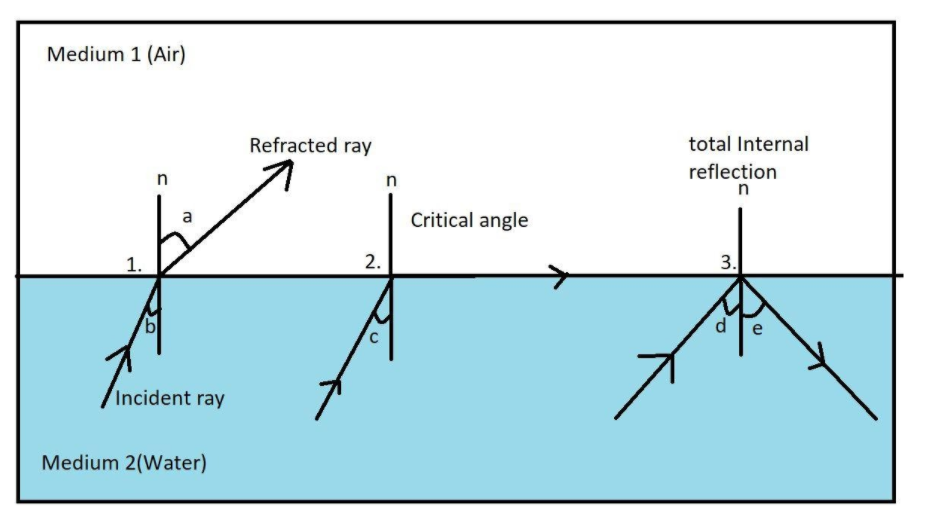
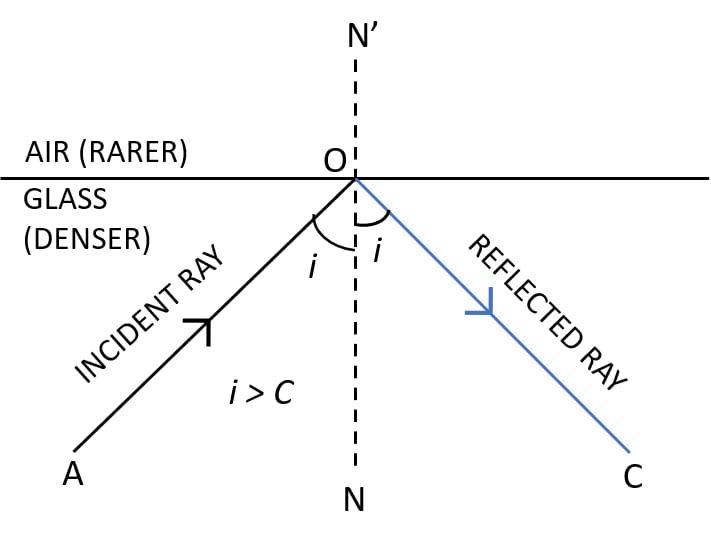
Total internal reflection occurs when light travels from a denser medium to a less dense medium and the angle of incidence exceeds the critical angle.
Under these conditions:
- Light does not refract out of the medium.
- It reflects completely back into the medium.
This principle is used in:
- Optical fibers
- Endoscopes
- Prism-based optical instruments
Mirrors and Image Formation


Mirrors form images by reflecting light rays.
Plane Mirrors
Produce images that are:
- Virtual
- Upright
- Same size as the object
Concave Mirrors
Can produce real or virtual images depending on object position.
Convex Mirrors
Always produce virtual, upright, and smaller images.
Ray diagrams help determine image location and characteristics.
Lenses and Image Formation


Lenses refract light to form images.
Two main types of lenses exist.
Convex Lenses
Converge parallel rays to a focal point.
Concave Lenses
Diverge parallel rays outward.
The lens equation describes image formation:
[
\frac{1}{f} = \frac{1}{v} + \frac{1}{u}
]
Where:
- (f) = focal length
- (u) = object distance
- (v) = image distance
Optical Instruments


Geometrical optics is essential in designing optical instruments.
Examples include:
Microscope
Uses lenses to magnify small objects.
Telescope
Used to observe distant celestial objects.
Camera
Forms images on sensors or film.
Human Eye
Uses a lens system to focus light onto the retina.
Understanding ray optics helps optimize these devices.
Applications of Geometrical Optics


Geometrical optics has many practical applications.
Fiber Optics
Used in high-speed communication systems.
Photography
Camera lenses form focused images.
Medical Imaging
Endoscopes use optical fibers.
Laser Systems
Precise optical alignment is based on ray optics.
Importance in Physics
Geometrical optics provides a simple and powerful framework for understanding how light interacts with objects.
It allows scientists and engineers to analyze complex optical systems and design devices that manipulate light efficiently.
Although wave optics provides a deeper understanding of light, geometrical optics remains indispensable for many practical applications.
Conclusion
Geometrical optics is the study of light propagation using the ray model. It explains how light travels in straight lines and how it interacts with surfaces through reflection and refraction. Using simple geometric principles, it becomes possible to analyze image formation, optical devices, and many natural optical phenomena.
This branch of optics is essential for understanding mirrors, lenses, and optical instruments. It forms the basis for technologies ranging from eyeglasses and cameras to fiber-optic communication systems and telescopes.
Geometrical optics remains one of the most important and widely used tools in physics and optical engineering.