


Tags:
LCM and HCF in Mathematics
LCM (Least Common Multiple) and HCF (Highest Common Factor) are important concepts in arithmetic and number theory. These ideas help us understand how numbers relate to each other through multiples and factors. They are widely used in solving mathematical problems involving fractions, divisibility, scheduling, algebra, and real-life applications such as time cycles and resource distribution.
The Least Common Multiple (LCM) of two or more numbers is the smallest number that is a multiple of each of those numbers. The Highest Common Factor (HCF), also known as the Greatest Common Divisor (GCD), is the largest number that divides two or more numbers exactly.
Understanding LCM and HCF strengthens a student’s foundation in mathematics because these concepts appear frequently in arithmetic operations, algebraic expressions, and problem-solving scenarios.
1. Factors and Multiples
Before understanding LCM and HCF, it is important to understand factors and multiples.
Factors
A factor of a number is a number that divides another number exactly without leaving a remainder.
Example:
Factors of 12:
1, 2, 3, 4, 6, 12
Explanation:
12 ÷ 3 = 4
12 ÷ 6 = 2
Since the division leaves no remainder, these numbers are factors.
Multiples
A multiple of a number is obtained by multiplying that number by integers.
Example:
Multiples of 4:
4, 8, 12, 16, 20, 24, …
Multiples continue indefinitely because numbers can be multiplied by any integer.
2. Understanding HCF (Highest Common Factor)

Definition
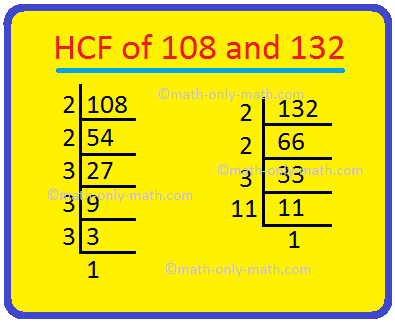
The Highest Common Factor (HCF) of two or more numbers is the largest number that divides all of them exactly.
HCF is also called:
- Greatest Common Divisor (GCD)
- Greatest Common Factor (GCF)
Example:
Find the HCF of 12 and 18.
Factors of 12:
1, 2, 3, 4, 6, 12
Factors of 18:
1, 2, 3, 6, 9, 18
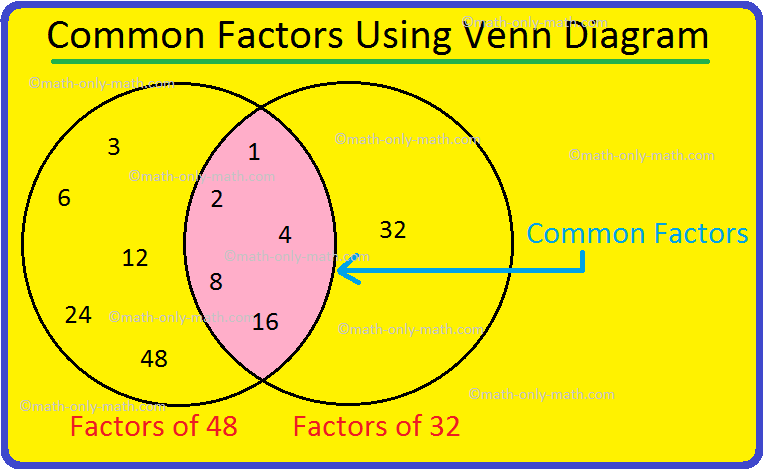
Common factors:
1, 2, 3, 6
Highest common factor:
6
Thus:
HCF(12,18) = 6
3. Methods to Find HCF
There are several methods for finding the HCF.
Factor Listing Method
List all factors of each number and find the greatest common factor.
Example:
Find HCF of 16 and 24.
Factors of 16:
1, 2, 4, 8, 16
Factors of 24:
1, 2, 3, 4, 6, 8, 12, 24
Common factors:
1, 2, 4, 8
HCF:
8
Prime Factorization Method
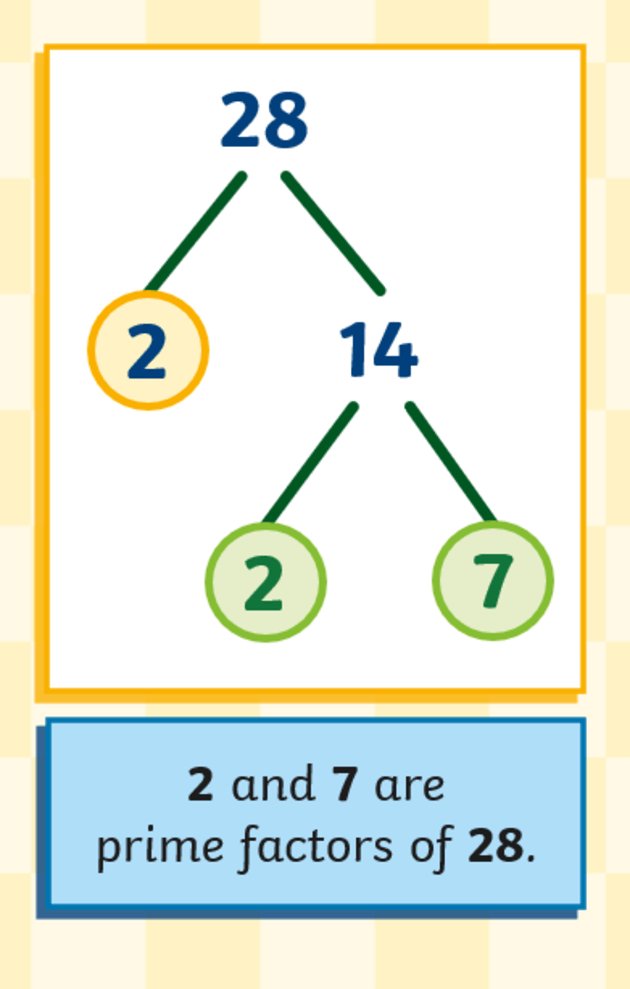
This method involves expressing numbers as products of prime numbers.
Example:
Find HCF of 36 and 48.
Prime factorization:
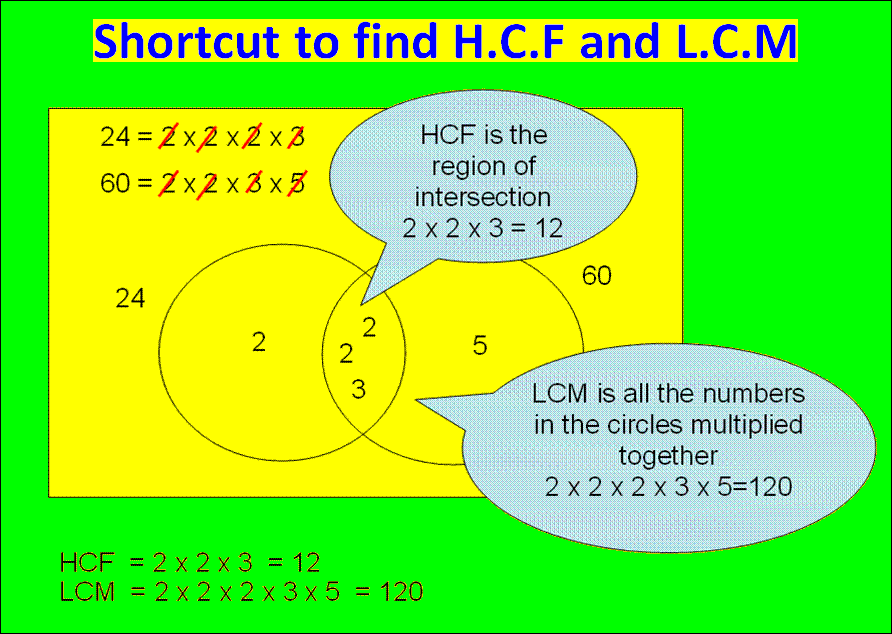
36 = 2 × 2 × 3 × 3
48 = 2 × 2 × 2 × 2 × 3
Common prime factors:
2 × 2 × 3
HCF = 12
Division Method
This method repeatedly divides numbers until a remainder appears.
Example:
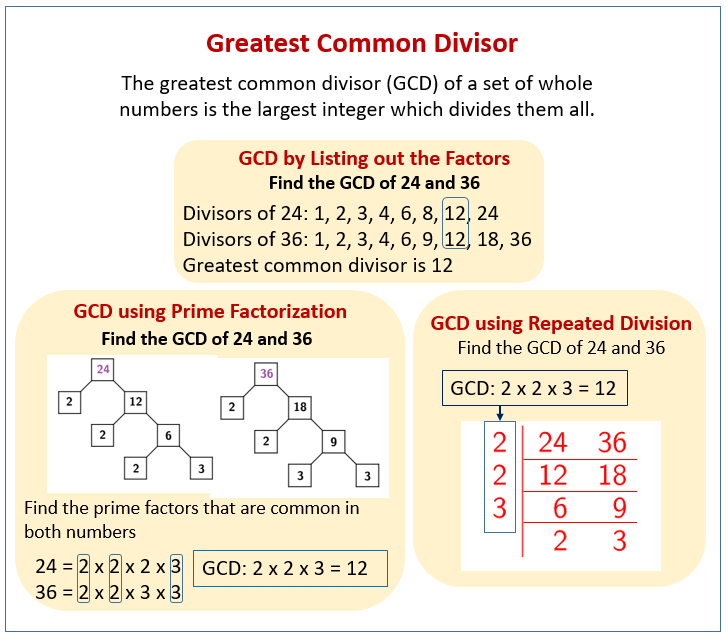
Find HCF of 24 and 36.
36 ÷ 24 = 1 remainder 12
24 ÷ 12 = 2 remainder 0
HCF = 12
4. Understanding LCM (Least Common Multiple)

Definition
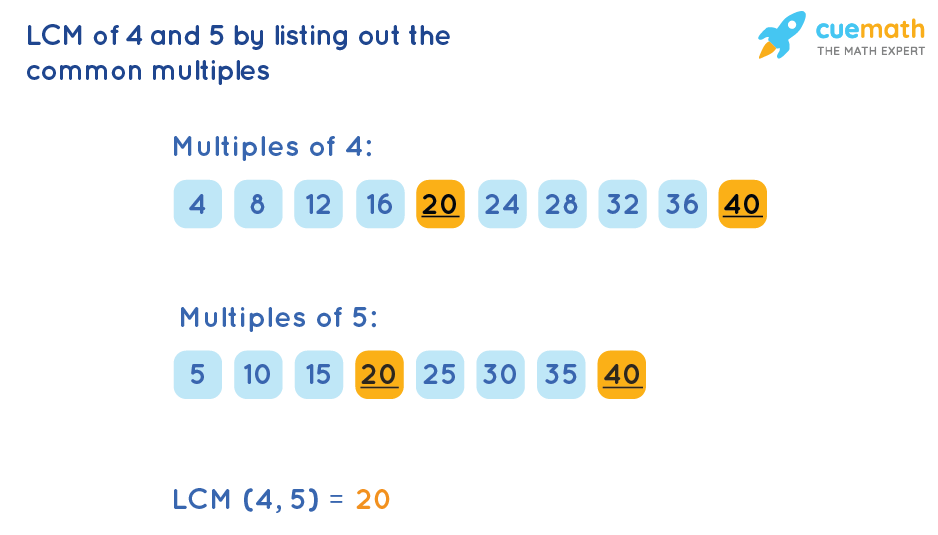
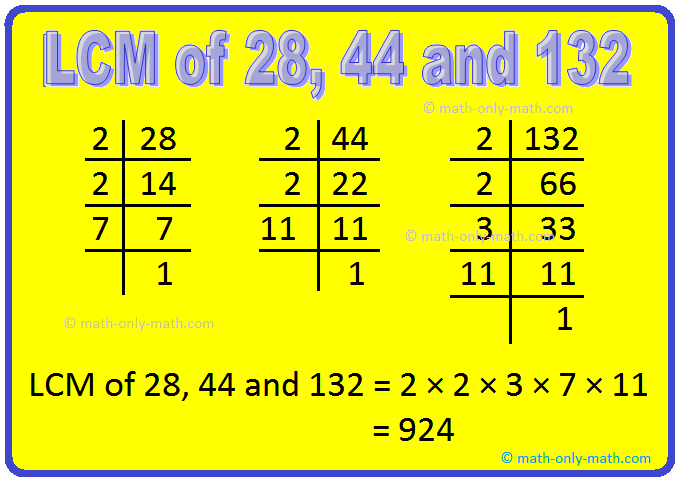
The Least Common Multiple (LCM) of two or more numbers is the smallest number that is a multiple of all the numbers.
Example:
Find LCM of 4 and 6.
Multiples of 4:
4, 8, 12, 16, 20…
Multiples of 6:
6, 12, 18, 24…
Common multiples:
12, 24…
Smallest common multiple:
12
LCM(4,6) = 12
5. Methods to Find LCM
Listing Multiples Method
List multiples of each number and find the smallest common one.
Example:
LCM of 3 and 5
Multiples of 3:
3, 6, 9, 12, 15…
Multiples of 5:
5, 10, 15…
LCM = 15
Prime Factorization Method
Example:
Find LCM of 12 and 18.
Prime factorization:
12 = 2² × 3
18 = 2 × 3²
Take highest powers:
2² × 3²
LCM = 36
Division Method
Numbers are divided by prime numbers until all become 1.
Example:
Find LCM of 8 and 12.
8 = 2³
12 = 2² × 3
LCM = 2³ × 3
LCM = 24
6. Relationship Between LCM and HCF
There is an important relationship between LCM and HCF.
For two numbers:
LCM × HCF = Product of the numbers
Example:
Numbers = 12 and 18
HCF = 6
LCM = 36
Check:
36 × 6 = 216
12 × 18 = 216
Thus the relationship holds.
7. Prime Factorization and Number Theory
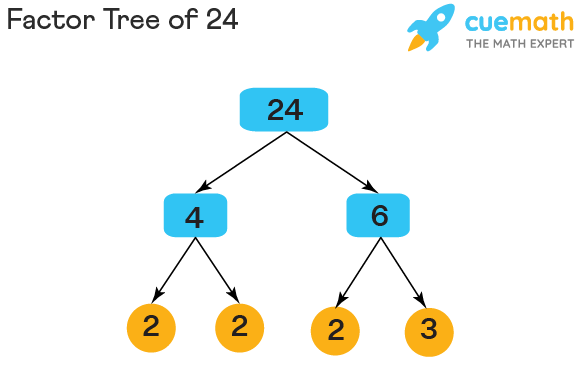
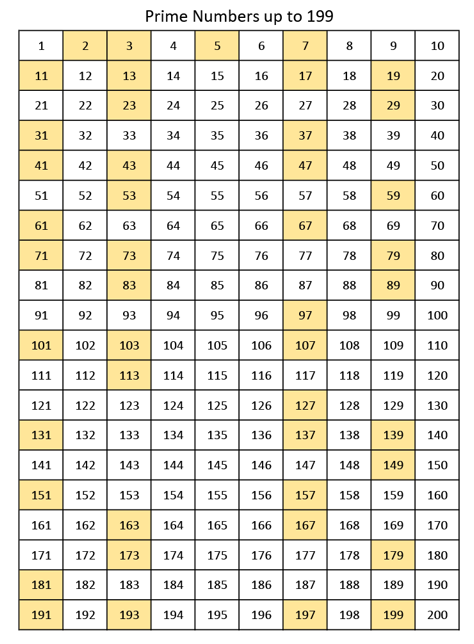

Prime factorization plays an important role in determining both LCM and HCF.
A prime number is a number that has only two factors:
1 and itself.
Examples:
2, 3, 5, 7, 11
Composite numbers can be expressed as products of primes.
Example:
60 = 2 × 2 × 3 × 5
This representation helps identify common factors and multiples easily.
8. Applications of HCF
HCF is useful in many mathematical and real-world situations.
Simplifying Fractions
Example:
12/18
HCF = 6
12 ÷ 6 = 2
18 ÷ 6 = 3
Simplified fraction:
2/3
Dividing Items Equally
Example:
24 apples and 36 oranges must be packed into equal baskets.
HCF = 12
Thus:
12 baskets can be formed.
Arranging Objects
HCF helps determine the largest group size when arranging objects evenly.
9. Applications of LCM
LCM is used when events repeat at regular intervals.
Scheduling Events
Example:
Two traffic lights change every 6 minutes and 8 minutes.
LCM of 6 and 8:
24
Both lights change together every 24 minutes.
Adding Fractions
LCM helps find common denominators.
Example:
1/4 + 1/6
LCM of 4 and 6 = 12
Convert:
3/12 + 2/12 = 5/12
Cyclic Events
LCM determines when repeating cycles align.
Example:
Two machines operate every 15 minutes and 20 minutes.
LCM = 60 minutes
10. LCM and HCF in Algebra
LCM and HCF are also applied to algebraic expressions.
Example:
Find LCM of:
x² and x³
LCM = x³
Example:
HCF of:
x²y and xy²
HCF = xy
These ideas are important when simplifying algebraic expressions.
11. Differences Between LCM and HCF
| Feature | HCF | LCM |
|---|---|---|
| Meaning | Greatest common factor | Smallest common multiple |
| Focus | Factors | Multiples |
| Value | Smaller | Larger |
| Use | Simplification | Common denominators |
12. Properties of HCF
Some important properties include:
- HCF of two prime numbers is 1.
Example:
HCF(5,7) = 1
- HCF of consecutive numbers is always 1.
Example:
HCF(8,9) = 1
- HCF of identical numbers is the number itself.
Example:
HCF(12,12) = 12
13. Properties of LCM
Important properties include:
- LCM of prime numbers is their product.
Example:
LCM(3,5) = 15
- LCM of identical numbers is the number itself.
Example:
LCM(7,7) = 7
- LCM of numbers always equals or exceeds the largest number.
14. Euclidean Algorithm
The Euclidean algorithm is an efficient method for finding HCF.
Procedure:
- Divide the larger number by the smaller.
- Replace the larger number with the smaller.
- Replace the smaller number with the remainder.
- Repeat until remainder becomes zero.
Example:
Find HCF of 48 and 18.
48 ÷ 18 = 2 remainder 12
18 ÷ 12 = 1 remainder 6
12 ÷ 6 = 2 remainder 0
HCF = 6
15. Importance of LCM and HCF
LCM and HCF are essential concepts in mathematics because they:
- simplify calculations
- help solve arithmetic problems
- improve number understanding
- support algebra and number theory
They also appear in computer science algorithms and engineering calculations.
16. Role in Computer Science
In computer science, LCM and HCF are used in:
- cryptography
- algorithm design
- modular arithmetic
- number theory algorithms
The Euclidean algorithm is one of the oldest and most efficient algorithms used in computing.
17. Role in Real-Life Problem Solving
These concepts help solve real-world problems involving:
- time schedules
- resource distribution
- measurement conversions
- engineering designs
Understanding LCM and HCF helps create efficient solutions.
18. Historical Development
The study of factors and multiples dates back to ancient mathematics.
Greek mathematicians studied divisibility and number relationships.
Euclid described methods for finding the greatest common divisor more than 2000 years ago.
These ideas remain fundamental in modern mathematics.
19. Advanced Topics Related to LCM and HCF
More advanced topics related to these concepts include:
- number theory
- modular arithmetic
- Diophantine equations
- cryptographic algorithms
These topics expand the study of factors and multiples in higher mathematics.
20. Summary
LCM and HCF are fundamental concepts in arithmetic and number theory. The Least Common Multiple helps identify the smallest common multiple of numbers, while the Highest Common Factor identifies the largest common divisor.
These concepts are essential for simplifying fractions, solving arithmetic problems, scheduling events, and analyzing numerical relationships.
Understanding LCM and HCF builds a strong foundation for more advanced topics in mathematics, including algebra, number theory, and computer science. Their applications extend beyond mathematics into everyday problem-solving and modern technology.