



Introduction
In physics, momentum and impulse are fundamental concepts that describe how objects move and interact with forces. These concepts are central to the study of mechanics and help explain many everyday phenomena, such as collisions between vehicles, the motion of rockets, the recoil of guns, and the behavior of sports equipment.
Momentum describes the quantity of motion possessed by an object. It depends on both the mass of the object and its velocity. Objects with greater mass or higher velocity possess greater momentum.
Impulse, on the other hand, describes the effect of a force applied over a period of time. It represents the change in momentum produced by that force. Impulse is especially important in analyzing situations involving collisions or sudden changes in motion.
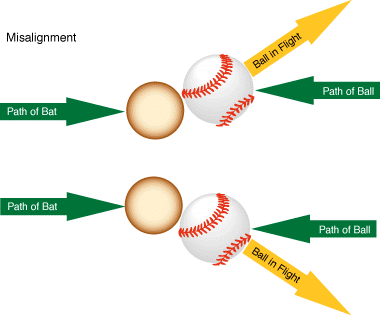
The study of momentum and impulse allows physicists to analyze systems where forces act over short time intervals, such as when a bat strikes a ball or when two cars collide. These concepts also lead to the important principle known as the law of conservation of momentum, which states that the total momentum of an isolated system remains constant.
Momentum and impulse are widely used in fields such as mechanical engineering, aerospace engineering, robotics, sports science, and transportation safety.
Linear Momentum
Definition of Momentum
Momentum is defined as the product of the mass of an object and its velocity.
Mathematically, momentum is expressed as:
[
p = mv
]
Where:
(p) = momentum
(m) = mass
(v) = velocity
Momentum is a vector quantity, meaning it has both magnitude and direction.
The direction of momentum is the same as the direction of velocity.
Unit of Momentum
The SI unit of momentum is:
[
kg \cdot m/s
]
Momentum may also be expressed as:
[
N \cdot s
]
since Newton multiplied by seconds gives the same unit.
Characteristics of Momentum
Momentum has several important properties:
- It depends on both mass and velocity.
- It is a vector quantity.
- Its direction is the same as velocity.
- It increases with mass and speed.
- It plays a key role in collisions and motion analysis.
For example, a truck moving at moderate speed may have greater momentum than a small car moving at high speed due to its larger mass.
Examples of Momentum
Examples of momentum appear frequently in everyday life.
Moving Vehicle
A heavy truck moving at 50 km/h has large momentum.
Sports
A fast-moving football possesses momentum when kicked.
Flowing Water
Water flowing in a river has momentum.
Rocket Motion
Rockets gain momentum when gases are expelled at high velocity.
Newton’s Second Law and Momentum
Newton’s second law can be expressed in terms of momentum.
The law states that:
The rate of change of momentum of an object is proportional to the applied force and occurs in the direction of the force.
Mathematically:
[
F = \frac{dp}{dt}
]
Where:
(F) = force
(p) = momentum
(t) = time
If mass remains constant, this equation reduces to:
[
F = ma
]
Thus Newton’s second law links force and momentum.
Impulse

Definition of Impulse
Impulse is defined as the product of force and the time interval during which the force acts.
[
J = F \Delta t
]
Where:
(J) = impulse
(F) = force
(\Delta t) = time interval
Impulse is a vector quantity.
Unit of Impulse
The SI unit of impulse is:
[
N \cdot s
]
This is equivalent to the unit of momentum.
Impulse-Momentum Theorem
The impulse-momentum theorem states:
Impulse applied to an object equals the change in its momentum.
Mathematically:
[
J = \Delta p
]
or
[
F \Delta t = mv_f – mv_i
]
Where:
(v_i) = initial velocity
(v_f) = final velocity
This relationship explains how forces change motion.
Practical Interpretation
A small force applied over a long time can produce the same impulse as a large force applied over a short time.
Example:
Catching a ball with soft hands increases the time interval and reduces the force experienced.
Impulse in Graphical Form
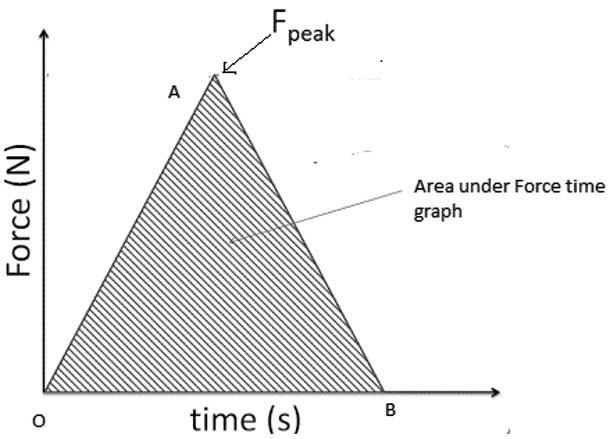
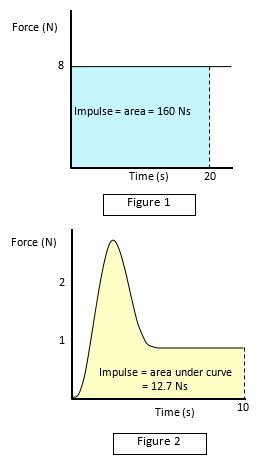
Impulse can also be represented using a force–time graph.
The impulse equals the area under the force–time curve.
This graphical method is useful in analyzing collisions and impacts.
Applications of Impulse
Impulse is widely used in many practical situations.
Sports
Athletes increase contact time to reduce impact forces.
Safety Equipment
Airbags and seat belts increase stopping time during collisions.
Packaging
Soft packaging materials increase impact time to protect fragile items.
Hammering
A hammer applies large force for a short time interval.
Conservation of Momentum


Law of Conservation of Momentum
The law of conservation of momentum states:
In an isolated system with no external forces, the total momentum remains constant.
Mathematically:
[
p_{initial} = p_{final}
]
or
[
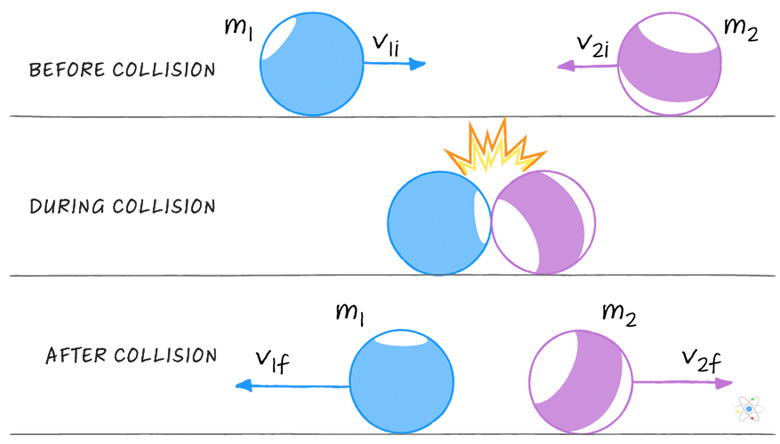
m_1v_1 + m_2v_2 = m_1v_1′ + m_2v_2′
]
Where:
(v_1) and (v_2) are initial velocities.
(v_1′) and (v_2′) are final velocities.
Collisions
A collision occurs when two or more objects interact for a short time and exert forces on each other.
Collisions are classified into different types.
Elastic Collision
In elastic collisions:
Momentum is conserved.
Kinetic energy is also conserved.
Examples include collisions between billiard balls and gas molecules.
Inelastic Collision
In inelastic collisions:
Momentum is conserved.
Kinetic energy is not conserved.
Some energy converts into heat, sound, or deformation.
Example:
Car accidents.
Perfectly Inelastic Collision
In perfectly inelastic collisions, objects stick together after collision.
Example:
Two lumps of clay colliding and sticking together.
Momentum in Rocket Propulsion
Rocket propulsion works based on the conservation of momentum.
When a rocket expels gases backward at high velocity, the rocket moves forward with equal momentum in the opposite direction.
This principle allows rockets to move in space where there is no air.
Momentum in Sports
Momentum plays a major role in sports.
Examples include:
Cricket bat striking ball
Football kicking
Boxing punches
Golf swings
Athletes often increase momentum to achieve greater impact.
Momentum and Safety
Momentum concepts are important in designing safety systems.
Airbags
Increase collision time and reduce force.
Seat Belts
Prevent passengers from moving forward suddenly.
Crash Barriers
Absorb momentum during vehicle collisions.
These systems reduce injuries by controlling impulse and force.
Importance of Momentum and Impulse
Momentum and impulse are essential concepts in physics because they help analyze interactions between objects, especially during collisions.
They are widely used in:
Mechanical engineering
Transportation safety
Sports science
Aerospace engineering
Robotics
Understanding these principles allows engineers to design safer vehicles, better sports equipment, and efficient propulsion systems.
Summary
Momentum is the quantity of motion possessed by an object and is defined as the product of mass and velocity. It is a vector quantity that depends on both the mass and speed of an object.
Impulse is the product of force and the time interval over which the force acts. The impulse-momentum theorem states that impulse equals the change in momentum of an object.
The law of conservation of momentum states that the total momentum of an isolated system remains constant. This principle is crucial for understanding collisions, rocket propulsion, and many mechanical processes.
Momentum and impulse are fundamental tools in physics and engineering that help explain how forces affect motion and how objects interact with each other.