


Introduction
Newton’s laws of motion are three fundamental principles that describe the relationship between the motion of objects and the forces acting on them. These laws form the foundation of classical mechanics, which is a major branch of physics concerned with the motion of objects ranging from small particles to large celestial bodies.
The laws were formulated by the English scientist Sir Isaac Newton in the 17th century and were first published in his famous work Philosophiæ Naturalis Principia Mathematica in 1687. Newton’s laws revolutionized the understanding of motion and provided a mathematical framework for analyzing physical systems.
Before Newton, scientists such as Galileo studied motion, but Newton unified those ideas and introduced the concept of force as the cause of motion changes. These laws remain essential in physics, engineering, and everyday life.
Newton’s three laws explain:
- Why objects remain at rest or move uniformly
- How forces change motion
- Why forces occur in pairs
These laws apply to many real-world phenomena, including the motion of vehicles, projectiles, planets, machines, and everyday objects.
Historical Background
Before Newton developed his laws, earlier philosophers such as Aristotle believed that objects required continuous force to remain in motion. According to Aristotle’s view, motion would naturally stop unless a force continued to push the object.
Later, Galileo Galilei challenged this idea. Through experiments with inclined planes, Galileo discovered that objects tend to maintain their state of motion unless acted upon by external influences. This concept became the basis of Newton’s first law.
Newton built upon Galileo’s discoveries and developed three precise mathematical laws that describe motion. These laws are still widely used today to analyze mechanical systems.
Force
Before discussing Newton’s laws, it is important to understand the concept of force.
Force is defined as a push or pull acting on an object that can change its state of motion.
Examples of forces include:
- Gravitational force
- Frictional force
- Tension force
- Magnetic force
- Applied force
Force is a vector quantity, meaning it has both magnitude and direction.
The SI unit of force is Newton (N).
[
1,N = 1,kg \cdot m/s^2
]
Newton’s First Law of Motion (Law of Inertia)


Statement of the First Law
Newton’s First Law states:
An object remains at rest or continues to move with uniform velocity in a straight line unless acted upon by an external force.
This law is often called the Law of Inertia.
Concept of Inertia
Inertia is the tendency of an object to resist changes in its state of motion.
Objects naturally resist changes such as:
- Starting motion
- Stopping motion
- Changing direction
The greater the mass of an object, the greater its inertia.
Example:
A heavy truck is harder to start moving than a bicycle because it has more inertia.
Types of Inertia
Inertia of Rest
The tendency of an object to remain at rest.
Example:
A book lying on a table remains at rest until someone pushes it.
Inertia of Motion
The tendency of a moving object to continue moving.
Example:
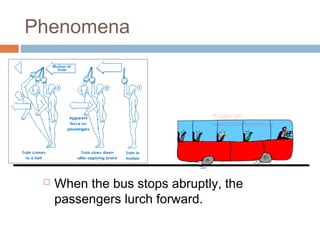
Passengers in a moving bus lean forward when the bus suddenly stops.
Inertia of Direction
The tendency of an object to resist changes in direction.
Example:
Passengers move sideways when a vehicle turns sharply.
Examples of Newton’s First Law
- A ball remains stationary until kicked.
- A hockey puck slides for a long distance on ice due to minimal friction.
- Dust particles fall out when a carpet is shaken.
- Passengers fall backward when a bus suddenly starts moving.
These examples demonstrate how objects resist changes in motion.
Newton’s Second Law of Motion


Statement of the Second Law
Newton’s Second Law states:
The rate of change of momentum of an object is directly proportional to the applied force and occurs in the direction of the force.
This law provides the quantitative relationship between force, mass, and acceleration.
Mathematical Expression
Newton’s second law is commonly written as:
[
F = ma
]
Where:
(F) = force
(m) = mass
(a) = acceleration
This equation shows that acceleration is directly proportional to the applied force and inversely proportional to mass.
Momentum and Force
Momentum is defined as:
[
p = mv
]
Where:
(m) = mass
(v) = velocity
Newton originally expressed the second law in terms of momentum:
[
F = \frac{dp}{dt}
]
This means force changes the momentum of an object.
Effects of Force
Force can cause:
- Acceleration
- Deceleration
- Change in direction
- Deformation of objects
Example:
When a football is kicked, the applied force changes its velocity.
Applications of Newton’s Second Law
Newton’s second law is widely used in engineering and physics.
Examples include:
Vehicle acceleration
Rocket propulsion
Sports mechanics
Machine design
Structural engineering
For example, a car with a powerful engine produces greater force, resulting in higher acceleration.
Newton’s Third Law of Motion


Statement of the Third Law
Newton’s Third Law states:
For every action, there is an equal and opposite reaction.
This means forces always occur in pairs.
Action and Reaction Forces
When two objects interact:
- Object A exerts force on object B
- Object B exerts equal and opposite force on object A
These forces are called action and reaction forces.
Characteristics:
- Equal magnitude
- Opposite direction
- Act on different objects
Examples of Newton’s Third Law
Walking
When a person walks:
- The foot pushes the ground backward.
- The ground pushes the person forward.
Rocket Launch
Rocket engines push gases downward.
The gases push the rocket upward.
Swimming
A swimmer pushes water backward.
Water pushes the swimmer forward.
Gun Recoil
When a gun fires a bullet:
- Bullet moves forward.
- Gun recoils backward.
Free Body Diagrams
A free body diagram is a diagram used to show all forces acting on an object.
Common forces include:
Weight
Normal force
Friction
Tension
Applied force
Free body diagrams help solve problems involving Newton’s laws.
Types of Forces
Several forces appear in Newtonian mechanics.
Gravitational Force
Attractive force between masses.
Frictional Force
Force opposing motion between surfaces.
Normal Force
Force exerted by surfaces supporting objects.
Tension Force
Force transmitted through strings or cables.
Air Resistance
Force resisting motion through air.
Applications of Newton’s Laws
Newton’s laws are applied in many fields.
Transportation
Design of vehicles and braking systems.
Aerospace Engineering
Rocket launches and spacecraft motion.
Sports Science
Analyzing athlete performance.
Mechanical Engineering
Machine design and structural analysis.
Robotics
Robot movement and control systems.
Limitations of Newton’s Laws
Although Newton’s laws are powerful, they have limitations.
They are not accurate for:
Objects moving close to the speed of light (relativity).
Extremely small particles (quantum mechanics).
For everyday speeds and sizes, however, Newton’s laws work extremely well.
Importance in Physics
Newton’s laws form the basis for many areas of physics.
They are used in:
Mechanics
Engineering physics
Astrophysics
Structural engineering
Vehicle dynamics
Understanding these laws allows scientists and engineers to predict how objects will move under different forces.
Summary
Newton’s laws of motion are three fundamental principles that explain how objects move and interact with forces. The first law describes inertia and explains why objects resist changes in motion. The second law provides the mathematical relationship between force, mass, and acceleration. The third law explains that forces occur in equal and opposite pairs.
Together, these laws provide a powerful framework for analyzing motion and predicting the behavior of physical systems. From everyday activities like walking and driving to complex technologies like rockets and satellites, Newton’s laws remain essential for understanding the physical world.