


Introduction to Inequalities
In mathematics, inequalities are mathematical statements that compare two expressions and show that one quantity is greater than, less than, greater than or equal to, or less than or equal to another quantity. Unlike equations, which state that two expressions are equal, inequalities describe relationships where values are not necessarily equal but follow a certain order.
Inequalities are widely used in algebra, calculus, optimization, economics, engineering, statistics, and many scientific disciplines. They help represent real-world conditions where values are restricted within certain limits rather than fixed to a single number.
For example, consider the statement:
[
x > 5
]
This inequality indicates that the variable (x) can take any value greater than 5. Unlike equations, which typically have specific solutions, inequalities usually have a range of possible solutions.
Inequalities are particularly useful when modeling practical situations such as budget constraints, physical limits, safety ranges, or performance thresholds.
Definition of Inequality
An inequality is a mathematical relation that compares two expressions and indicates that one is larger or smaller than the other.
General form:
[
a < b
]
or
[
a > b
]
where (a) and (b) are expressions.
Instead of equality, inequalities use special symbols to show the relationship between values.
Inequality Symbols
The following symbols are commonly used in mathematics to represent inequalities.
Less Than
Symbol:
[
<
]
Example:
[
3 < 7
]
Meaning: 3 is less than 7.
Greater Than
Symbol:
[
]
Example:
[
9 > 4
]
Meaning: 9 is greater than 4.
Less Than or Equal To
Symbol:
[
\le
]
Example:
[
x \le 10
]
Meaning: (x) can be less than or equal to 10.
Greater Than or Equal To
Symbol:
[
\ge
]
Example:
[
x \ge 2
]
Meaning: (x) can be greater than or equal to 2.
Not Equal To
Symbol:
[
\neq
]
Example:
[
x \neq 3
]
Meaning: (x) cannot be equal to 3.
Types of Inequalities
Inequalities can be categorized into several types depending on their structure.
Linear Inequalities
A linear inequality contains variables raised only to the first power.
Example:
[
2x + 3 > 7
]
Solving:
[
2x > 4
]
[
x > 2
]
Linear inequalities produce solution intervals rather than single values.
Quadratic Inequalities
A quadratic inequality contains variables raised to the power of 2.
Example:
[
x^2 – 5x + 6 > 0
]
First factor:
[
(x-2)(x-3) > 0
]
Then determine intervals where the expression is positive.
Quadratic inequalities typically produce multiple solution ranges.
Polynomial Inequalities
These involve higher degree polynomials.
Example:
[
x^3 – x > 0
]
Solve by factoring and testing intervals.
Rational Inequalities
A rational inequality contains fractions with variables.
Example:
[
\frac{x+2}{x-3} > 0
]
Solve by determining where numerator and denominator change signs.
Absolute Value Inequalities
These involve absolute value expressions.
Example:
[
|x-4| < 3
]
Meaning the distance between (x) and 4 is less than 3.
Solution:
[
1 < x < 7
]
Absolute value inequalities often produce compound inequalities.
Compound Inequalities
A compound inequality combines two inequalities together.
Example:
[
3 < x < 7
]
Meaning:
[
x > 3 \text{ AND } x < 7
]
Compound inequalities describe values within a specific interval.
Graphing Inequalities
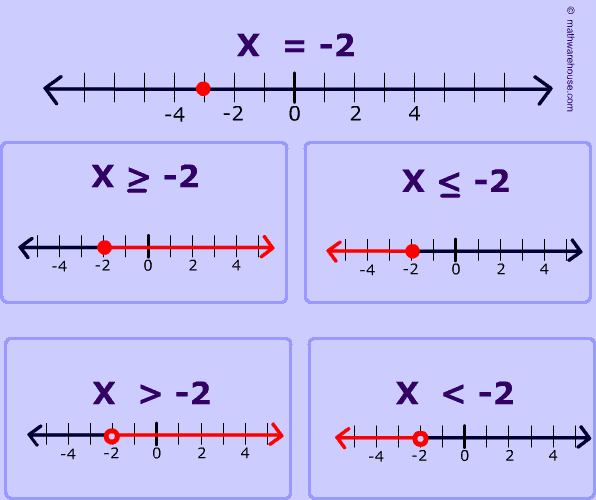
Inequalities can be represented graphically using number lines or coordinate planes.
Graphing on a Number Line
Example:
[
x > 3
]
Steps:
- Draw number line.
- Place open circle at 3.
- Shade to the right.
Open circle means the endpoint is not included.
Example:
[
x \le 5
]
Steps:
- Place closed circle at 5.
- Shade to the left.
Closed circle means the endpoint is included.
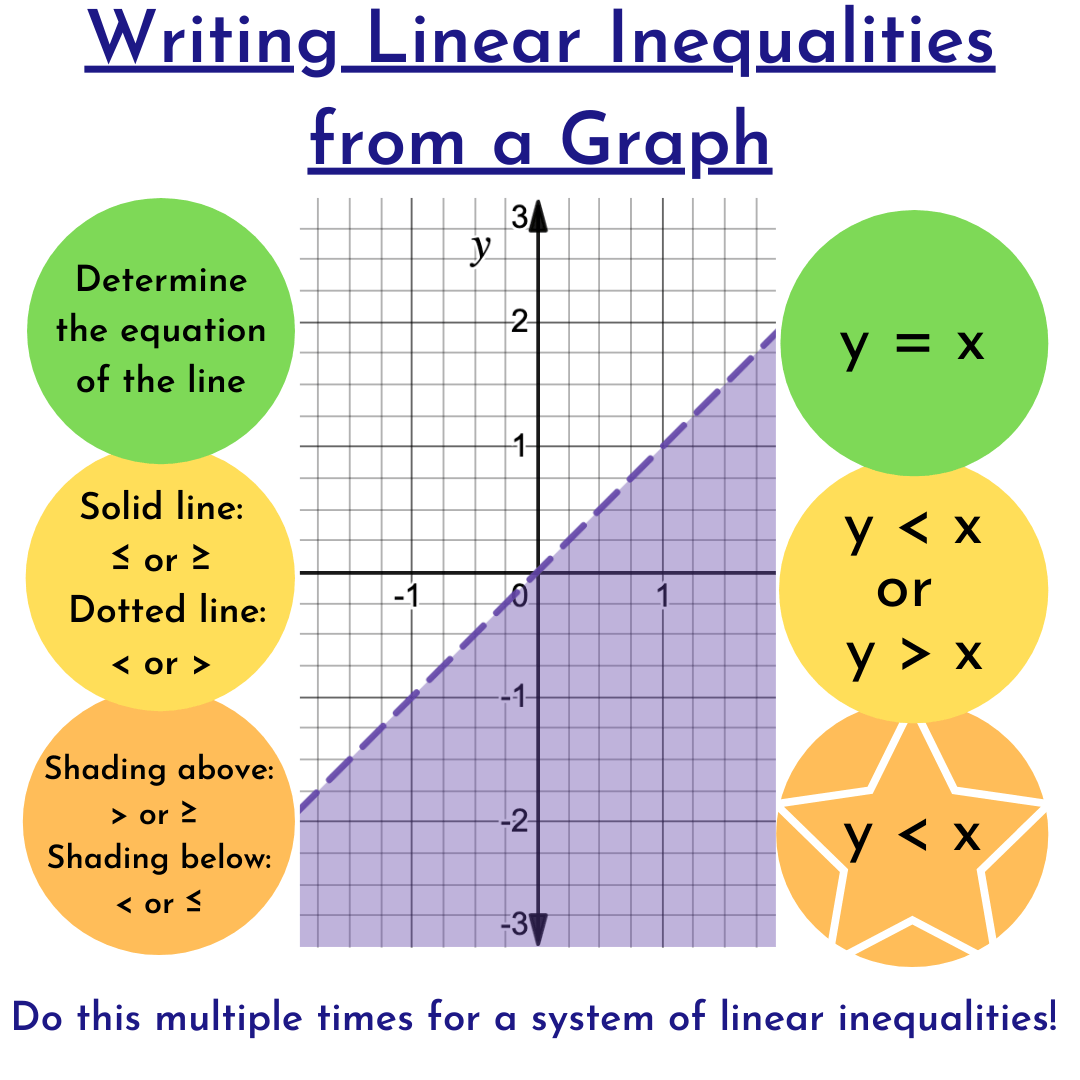
Graphing Linear Inequalities in Two Variables
Example:
[
y > 2x + 1
]
Steps:
- Graph line (y = 2x + 1).
- Use dashed line (since inequality is strict).
- Shade region above the line.
If inequality is ≥ or ≤, use solid line.
Systems of Inequalities
A system of inequalities involves two or more inequalities solved together.
Example:
[
y > x
]
[
y < 2x + 3
]
Solution is the region that satisfies both conditions simultaneously.
This is shown as the overlapping shaded region on a graph.
Properties of Inequalities
Inequalities follow several algebraic rules.
Addition Property
Adding the same number to both sides keeps inequality true.
Example:
[
x > 3
]
Add 5:
[
x + 5 > 8
]
Subtraction Property
Subtracting same number maintains inequality.
Example:
[
x + 4 < 9
]
Subtract 4:
[
x < 5
]
Multiplication Property
Multiplying both sides by positive number keeps inequality same.
Example:
[
x > 2
]
Multiply by 3:
[
3x > 6
]
Negative Multiplication Rule
Multiplying by a negative number reverses the inequality.
Example:
[
x > 2
]
Multiply by -1:
[
-x < -2
]
Division Property
Dividing both sides by positive number keeps inequality same.
Dividing by negative reverses it.
Interval Notation
Solutions to inequalities are often expressed using interval notation.
Examples:
[
x > 3
]
Interval:
[
(3, \infty)
]
Example:
[
2 \le x < 6
]
Interval:
[
[2, 6)
]
Symbols meaning:
( ) = endpoint excluded
[ ] = endpoint included
Solving Inequalities
Solving inequalities follows similar steps as solving equations.
Example:
[
3x + 4 > 10
]
Step 1:
[
3x > 6
]
Step 2:
[
x > 2
]
Solving Quadratic Inequalities
Example:
[
x^2 – 5x + 6 < 0
]
Step 1: Factor
[
(x-2)(x-3) < 0
]
Step 2: Determine intervals
Solution:
[
2 < x < 3
]
Solving Absolute Value Inequalities
Example:
[
|x-5| < 2
]
Rewrite as compound inequality:
[
-2 < x-5 < 2
]
Add 5:
[
3 < x < 7
]
Inequalities in Calculus
Inequalities are essential in calculus for:
- Limits
- Optimization
- Bounding functions
- Convergence analysis
Example:
[
|f(x)| \le g(x)
]
Used in comparison tests.
Important Inequalities in Mathematics
Many famous inequalities are fundamental in advanced mathematics.
Triangle Inequality
States:
[
|a + b| \le |a| + |b|
]
Used in:
- geometry
- vector analysis
- complex numbers
Cauchy–Schwarz Inequality
Important in linear algebra.
[
(a_1b_1 + a_2b_2 + … + a_nb_n)^2 \le (a_1^2 + …)(b_1^2 + …)
]
Used in:
- statistics
- machine learning
- physics
Arithmetic Mean – Geometric Mean Inequality (AM-GM)
[
\frac{a+b}{2} \ge \sqrt{ab}
]
Important in optimization problems.
Applications of Inequalities
Inequalities appear in many practical situations.
Economics
Used in:
- cost constraints
- profit maximization
- budget limitations
Example:
[
cost \le budget
]
Engineering
Used to maintain safety conditions.
Example:
Stress must remain below maximum threshold.
Physics
Used to define ranges.
Example:
Speed must be less than escape velocity.
Computer Science
Used in:
- algorithm complexity analysis
- optimization
- machine learning constraints
Statistics
Used in probability bounds such as:
- Chebyshev inequality
- Markov inequality
Optimization Problems
Inequalities define constraints in optimization.
Example:
Maximize profit:
[
P = 5x + 3y
]
Subject to:
[
x + y \le 10
]
[
x \ge 0
]
[
y \ge 0
]
Solution found using linear programming.
Inequalities in Geometry
Geometry uses inequalities extensively.
Example:
Triangle inequality:
Sum of any two sides must be greater than third side.
Inequalities in Number Theory
Number theory uses inequalities to analyze integer relationships.
Example:
Prime number bounds.
Historical Development
Inequalities have been studied since ancient mathematics.
Ancient Greek mathematicians used inequalities in geometric proofs.
Later developments in algebra introduced symbolic representation of inequalities.
In modern mathematics, inequalities are central in fields such as optimization theory and functional analysis.
Importance of Inequalities
Inequalities help:
- Describe ranges instead of exact values
- Model real-world constraints
- Analyze function behavior
- Optimize solutions
They form the backbone of many mathematical models.
Conclusion
Inequalities are an essential part of mathematics that describe relationships between quantities when exact equality is not required. From simple comparisons between numbers to complex systems that govern optimization problems and advanced theoretical mathematics, inequalities provide powerful tools for analyzing and understanding mathematical relationships.
Their applications span across science, engineering, economics, statistics, and computer science. Mastering inequalities enables mathematicians and scientists to define limits, evaluate constraints, and solve practical problems involving ranges of values.
Understanding inequalities not only strengthens algebraic skills but also builds a foundation for advanced mathematical topics such as calculus, optimization, and mathematical modeling.