Tag Archives: molecular geometry

Hybridization

Image
Image
Image
Image

1. Introduction to Hybridization

Hybridization is a fundamental concept in chemistry that explains how atomic orbitals combine to form new orbitals suitable for bonding in molecules. The concept was introduced by the scientist Linus Pauling to explain the shapes and bonding patterns of molecules that could not be adequately described by simple atomic orbital theory.

In atoms, electrons occupy atomic orbitals such as s, p, d, and f orbitals. However, when atoms form molecules, these orbitals can mix or combine to produce new orbitals known as hybrid orbitals. These hybrid orbitals have different shapes, orientations, and energies compared to the original atomic orbitals.

Hybridization allows atoms to form stronger and more directional bonds, which helps explain molecular geometry and chemical bonding patterns. It is closely related to molecular geometry and valence bond theory.

For example, carbon atoms in methane form four identical bonds arranged in a tetrahedral shape. Without hybridization, carbon would have two unpaired electrons and could form only two bonds. Hybridization explains how carbon reorganizes its orbitals to create four equivalent bonding orbitals.

Hybridization is particularly important in:

  • Organic chemistry
  • Molecular geometry prediction
  • Chemical bonding theory
  • Materials science
  • Biological molecules

Understanding hybridization helps chemists explain the structures of molecules such as methane, ethene, benzene, and many complex organic compounds.


2. Atomic Orbitals and Their Shapes

Image
Image
Image
Image

Before understanding hybridization, it is important to understand atomic orbitals.

Atomic orbitals are regions around the nucleus where electrons are most likely to be found. Each orbital has a characteristic shape.

s Orbitals

  • Spherical shape
  • Only one orientation
  • Found in every energy level

p Orbitals

  • Dumbbell-shaped
  • Three orientations (px, py, pz)
  • Found from the second energy level onward

d Orbitals

  • Complex shapes
  • Five orientations
  • Found from the third energy level onward

f Orbitals

  • Even more complex shapes
  • Seven orientations
  • Found in higher energy levels

Hybridization occurs when these orbitals combine to form hybrid orbitals.


3. Concept of Hybridization

Image
Image
Image
Image

Hybridization involves the mixing of atomic orbitals of similar energy to produce new hybrid orbitals.

These hybrid orbitals:

  • Have identical energy levels
  • Are oriented in specific directions
  • Form stronger covalent bonds

The number of hybrid orbitals formed equals the number of atomic orbitals mixed.

For example:

1 s orbital + 3 p orbitals → 4 sp³ hybrid orbitals

Hybridization occurs in the valence shell of atoms during bond formation.

Hybrid orbitals explain the orientation of bonds and the shapes of molecules.


4. Types of Hybridization

Image
Image
Image
Image

Several types of hybridization exist depending on the number of orbitals involved.


sp Hybridization

sp hybridization occurs when one s orbital mixes with one p orbital.

Total hybrid orbitals formed: 2

Geometry: Linear

Bond angle: 180°

Example:

Acetylene (C₂H₂)

In this molecule, carbon atoms form two sp hybrid orbitals.

The remaining p orbitals form π bonds.


sp² Hybridization

sp² hybridization occurs when one s orbital mixes with two p orbitals.

Total hybrid orbitals formed: 3

Geometry: Trigonal planar

Bond angle: 120°

Example:

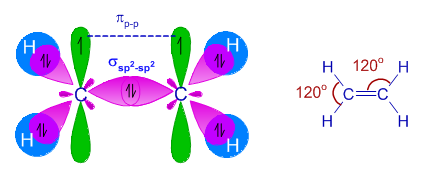
Ethene (C₂H₄)

Each carbon atom forms three sp² hybrid orbitals.

The remaining p orbital forms a π bond between carbon atoms.


sp³ Hybridization

sp³ hybridization occurs when one s orbital mixes with three p orbitals.

Total hybrid orbitals formed: 4

Geometry: Tetrahedral

Bond angle: 109.5°

Example:

Methane (CH₄)

The carbon atom forms four equivalent sp³ hybrid orbitals that bond with hydrogen atoms.


5. Advanced Hybridization Types

Image
Image
Image
Image

Some molecules involve hybridization with d orbitals.


sp³d Hybridization

Involves one s orbital, three p orbitals, and one d orbital.

Total hybrid orbitals: 5

Geometry: Trigonal bipyramidal

Bond angles: 90° and 120°

Example:

Phosphorus pentachloride (PCl₅)


sp³d² Hybridization

Involves one s orbital, three p orbitals, and two d orbitals.

Total hybrid orbitals: 6

Geometry: Octahedral

Bond angle: 90°

Example:

Sulfur hexafluoride (SF₆)


6. Hybridization and Sigma and Pi Bonds

Image
Image
Image
Image

Hybridization helps explain the formation of two types of covalent bonds.


Sigma (σ) Bonds

Sigma bonds form through head-on overlap of orbitals.

They are the strongest type of covalent bond.

Examples:

sp³–s overlap in methane.


Pi (π) Bonds

Pi bonds form through side-by-side overlap of p orbitals.

They occur in double and triple bonds.

Example:

Ethene contains one σ bond and one π bond between carbon atoms.


7. Hybridization in Organic Molecules

Image
Image
Image
Image

Hybridization is especially important in organic chemistry.


Methane (CH₄)

Carbon is sp³ hybridized.

Geometry: tetrahedral.


Ethene (C₂H₄)

Carbon atoms are sp² hybridized.

Contains a carbon-carbon double bond.


Acetylene (C₂H₂)

Carbon atoms are sp hybridized.

Contains a carbon-carbon triple bond.


Benzene (C₆H₆)

Carbon atoms are sp² hybridized.

The molecule has a delocalized π electron system.


8. Importance of Hybridization

Hybridization explains many important chemical phenomena.

It helps explain:

  • Molecular shapes
  • Bond angles
  • Bond strength
  • Reactivity of molecules
  • Structure of organic compounds

Hybridization is also important in understanding:

  • Catalysis
  • Molecular spectroscopy
  • Chemical reactions

9. Applications in Modern Chemistry

Hybridization concepts are widely used in many scientific fields.

Organic Chemistry

Understanding carbon bonding patterns.

Drug Design

Molecular shapes influence biological activity.

Materials Science

Carbon hybridization leads to materials such as diamond and graphene.

Nanotechnology

Hybridized orbitals determine the structure of nanomaterials.


10. Limitations of Hybridization Theory

Although hybridization is very useful, it has limitations.

It is primarily part of valence bond theory and may not accurately describe some molecules.

For complex molecules, molecular orbital theory provides a more accurate description.

Despite these limitations, hybridization remains one of the most widely used concepts for explaining molecular structure.


11. Conclusion

Hybridization is a key concept in chemistry that explains how atomic orbitals combine to form hybrid orbitals suitable for chemical bonding. By mixing s, p, and sometimes d orbitals, atoms can form hybrid orbitals that produce specific molecular shapes and bond angles.

Different types of hybridization, including sp, sp², sp³, sp³d, and sp³d², correspond to different molecular geometries such as linear, trigonal planar, tetrahedral, trigonal bipyramidal, and octahedral structures.

Hybridization plays a crucial role in understanding molecular geometry, chemical bonding, and the behavior of organic and inorganic molecules. It helps explain the structure of countless chemical compounds, from simple molecules to complex biological macromolecules.

Because of its ability to connect atomic structure with molecular shape, hybridization remains one of the most important and widely used concepts in modern chemistry.


Tags

Molecular Geometry (VSEPR Theory)

Image
Image
Image
Image

1. Introduction to Molecular Geometry

Molecular geometry refers to the three-dimensional arrangement of atoms in a molecule. Understanding the spatial arrangement of atoms is essential because the shape of a molecule determines many of its physical and chemical properties. These properties include polarity, reactivity, boiling point, intermolecular interactions, and biological activity.

One of the most widely used models for predicting molecular geometry is the VSEPR theory, which stands for Valence Shell Electron Pair Repulsion theory. This theory provides a simple yet powerful method for determining the shape of molecules based on the arrangement of electron pairs around a central atom.

According to VSEPR theory, electron pairs around a central atom repel each other because they carry negative charges. As a result, they arrange themselves in space as far apart as possible to minimize repulsion. This arrangement determines the overall shape of the molecule.

Understanding molecular geometry is important in many areas of chemistry, including:

  • Chemical bonding
  • Reaction mechanisms
  • Drug design
  • Molecular biology
  • Materials science

For example, the unique bent shape of the water molecule is responsible for many of its unusual properties, including its polarity and ability to form hydrogen bonds.

Molecular geometry also plays a crucial role in biological systems. The shape of molecules determines how enzymes recognize substrates, how DNA replicates, and how proteins fold into functional structures.


2. Fundamentals of VSEPR Theory

Image
Image
Image
Image

The Valence Shell Electron Pair Repulsion theory was developed to explain molecular shapes by considering the repulsion between electron pairs in the valence shell of a central atom.

The key idea behind VSEPR theory is that electron pairs repel one another due to their negative charges. To minimize this repulsion, electron pairs arrange themselves as far apart as possible.

Types of Electron Pairs

There are two types of electron pairs considered in VSEPR theory.

Bonding pairs

These are electron pairs shared between atoms to form covalent bonds.

Lone pairs

These are pairs of electrons that belong to a single atom and are not involved in bonding.

Lone pairs occupy more space than bonding pairs because they are attracted only to the nucleus of the central atom. As a result, lone pairs exert stronger repulsive forces.

Electron Domains

In VSEPR theory, regions of electron density around a central atom are called electron domains.

Each of the following counts as one electron domain:

  • A single bond
  • A double bond
  • A triple bond
  • A lone pair

The arrangement of electron domains determines the molecular geometry.


3. Electron Domain Geometry

Image
Image
Image
Image

Electron domain geometry describes the arrangement of electron pairs around a central atom.

The most common electron domain geometries are:


Linear Geometry

Occurs when there are two electron domains around the central atom.

Bond angle: 180°

Example: Carbon dioxide (CO₂)


Trigonal Planar Geometry

Occurs when there are three electron domains.

Bond angle: 120°

Example: Boron trifluoride (BF₃)


Tetrahedral Geometry

Occurs when there are four electron domains.

Bond angle: 109.5°

Example: Methane (CH₄)


Trigonal Bipyramidal Geometry

Occurs when there are five electron domains.

Bond angles: 90° and 120°

Example: Phosphorus pentachloride (PCl₅)


Octahedral Geometry

Occurs when there are six electron domains.

Bond angle: 90°

Example: Sulfur hexafluoride (SF₆)


4. Molecular Shapes with Lone Pairs

Image
Image
Image
Image

When lone pairs are present on the central atom, the molecular shape differs from the electron domain geometry.

Because lone pairs occupy more space, they distort the bond angles.


Bent Geometry

Occurs when there are two bonding pairs and one or two lone pairs.

Example: Water (H₂O)

Bond angle ≈ 104.5°


Trigonal Pyramidal

Occurs when there are three bonding pairs and one lone pair.

Example: Ammonia (NH₃)

Bond angle ≈ 107°


Seesaw Geometry

Occurs with four bonding pairs and one lone pair.

Example: Sulfur tetrafluoride (SF₄)


T-Shaped Geometry

Occurs when three bonding pairs and two lone pairs are present.

Example: Chlorine trifluoride (ClF₃)


Square Planar Geometry

Occurs when four bonding pairs and two lone pairs are present.

Example: Xenon tetrafluoride (XeF₄)


5. Bond Angles and Molecular Shape

Image
Image
Image
Image

Bond angles are the angles between bonds that connect atoms in a molecule.

The ideal bond angles depend on electron domain geometry.

Typical bond angles include:

Linear → 180°
Trigonal planar → 120°
Tetrahedral → 109.5°
Trigonal bipyramidal → 90° and 120°
Octahedral → 90°

Lone pairs reduce bond angles because they repel bonding pairs more strongly.

For example:

Methane (CH₄) → 109.5°
Ammonia (NH₃) → 107°
Water (H₂O) → 104.5°


6. Molecular Polarity and Geometry

Image
Image
Image
Image

Molecular geometry plays a crucial role in determining whether a molecule is polar or nonpolar.

Polarity depends on two factors:

  • Electronegativity differences between atoms
  • The shape of the molecule

If bond dipoles cancel due to symmetrical geometry, the molecule is nonpolar.

Example:

Carbon dioxide (CO₂) is linear and nonpolar.

If dipoles do not cancel, the molecule becomes polar.

Example:

Water (H₂O) is bent and polar.

Polarity influences many properties such as solubility and intermolecular interactions.


7. Applications of Molecular Geometry

Molecular geometry is essential for understanding many chemical and biological processes.


Chemical Reactivity

The shape of molecules influences how they collide and react with other molecules.


Drug Design

Pharmaceutical molecules must have specific shapes to interact with biological receptors.


Biological Molecules

Protein folding and DNA structure depend on molecular geometry.


Materials Science

The structure of molecules determines material properties such as hardness and conductivity.


8. Limitations of VSEPR Theory

Although VSEPR theory is very useful, it has certain limitations.

It works best for simple molecules with well-defined central atoms.

However, it may not accurately describe:

  • Molecules with transition metals
  • Molecules with extensive electron delocalization
  • Highly complex molecular structures

More advanced theories such as molecular orbital theory and valence bond theory provide more detailed explanations.


9. Importance in Chemistry

Molecular geometry is a key concept that connects chemical bonding with molecular behavior.

It helps explain:

  • Chemical reactions
  • Physical properties
  • Molecular interactions
  • Biological processes
  • Material properties

By understanding molecular geometry, chemists can predict how molecules will behave in different environments.


10. Conclusion

Molecular geometry describes the three-dimensional arrangement of atoms in molecules and is essential for understanding the structure and behavior of chemical substances. The VSEPR theory provides a simple and effective way to predict molecular shapes based on electron pair repulsion.

By analyzing electron domains around a central atom, VSEPR theory explains common molecular geometries such as linear, trigonal planar, tetrahedral, trigonal bipyramidal, and octahedral structures. The presence of lone pairs further modifies these shapes, producing bent, trigonal pyramidal, and other geometries.

Molecular geometry influences many important properties, including polarity, reactivity, and intermolecular interactions. As a result, it plays a crucial role in chemistry, biology, materials science, and pharmaceutical research.

Understanding molecular geometry allows scientists to predict how molecules interact, how chemical reactions occur, and how complex biological systems function.


Tags

Covalent Bonding

Image
Image
Image
Image

1. Introduction to Covalent Bonding

Covalent bonding is one of the fundamental types of chemical bonding that occurs when atoms share pairs of electrons. This type of bonding is most commonly observed between nonmetal atoms, which have similar electronegativities and prefer to share electrons rather than transfer them completely.

In covalent bonding, two atoms overlap their atomic orbitals and share electrons in order to achieve a more stable electronic configuration. By sharing electrons, atoms can complete their outer electron shells and achieve a configuration similar to that of noble gases.

Covalent bonds are responsible for forming a vast range of substances, from simple molecules such as hydrogen and oxygen to complex organic molecules like proteins, DNA, and polymers. Most compounds in biological systems are formed through covalent bonding.

Understanding covalent bonding is crucial for explaining:

  • Molecular structures
  • Chemical reactivity
  • Properties of organic and inorganic compounds
  • Molecular geometry
  • Biological macromolecules
  • Chemical synthesis

Unlike ionic compounds, which form crystal lattices, covalent compounds usually form discrete molecules. These molecules are held together internally by strong covalent bonds and externally by weaker intermolecular forces.

The study of covalent bonding also forms the basis of many advanced areas of chemistry, including organic chemistry, biochemistry, molecular biology, and materials science.


2. Formation of Covalent Bonds

Image
Image
Image
Image

Covalent bonds form when two atoms share one or more pairs of electrons. This sharing allows each atom to achieve a stable electron configuration.

Atoms form covalent bonds when the difference in electronegativity between them is relatively small. Because neither atom strongly dominates the electron attraction, they share electrons rather than transfer them.

Example: Hydrogen Molecule

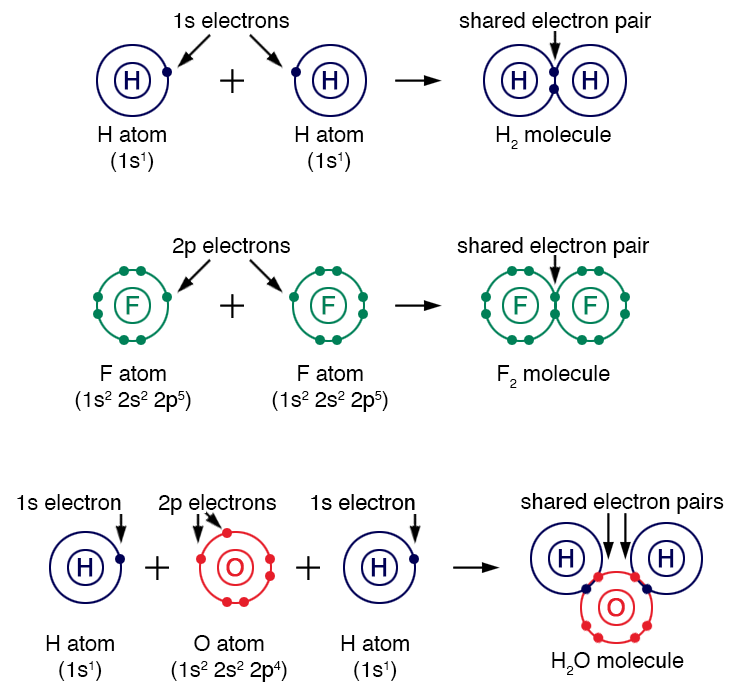
A hydrogen atom contains one electron in its outer shell. Two hydrogen atoms can share their electrons, forming a covalent bond and creating a hydrogen molecule (H₂).

Each hydrogen atom effectively has two electrons in its outer shell, satisfying the duet rule, which is a simplified version of the octet rule for hydrogen.

Orbital Overlap

Covalent bonding occurs when atomic orbitals overlap. The overlapping region contains shared electron pairs that attract both nuclei, holding the atoms together.

Orbital overlap increases the probability of finding shared electrons between the nuclei, which stabilizes the molecule.


3. The Octet Rule in Covalent Bonding

Image
Image
Image
Image

The octet rule states that atoms tend to form bonds until they are surrounded by eight electrons in their outermost shell.

This rule explains why atoms share electrons in covalent bonds.

Example:

Oxygen has six valence electrons. By sharing two electrons with another oxygen atom, each atom achieves eight electrons in its outer shell.

Although the octet rule works well for many elements, there are several exceptions:

  • Hydrogen requires only two electrons.
  • Some molecules have expanded octets.
  • Some molecules have incomplete octets.

Despite these exceptions, the octet rule remains a useful guideline for understanding covalent bonding.


4. Types of Covalent Bonds

Image
Image
Image
Image

Covalent bonds can be classified based on the number of shared electron pairs.


Single Covalent Bonds

A single covalent bond involves the sharing of one pair of electrons.

Example:

Hydrogen molecule (H₂)

These bonds are relatively long and weaker compared to multiple bonds.


Double Covalent Bonds

A double bond involves the sharing of two pairs of electrons.

Example:

Oxygen molecule (O₂)

Double bonds are shorter and stronger than single bonds.


Triple Covalent Bonds

A triple bond involves three pairs of shared electrons.

Example:

Nitrogen molecule (N₂)

Triple bonds are the strongest and shortest covalent bonds.


5. Polar and Nonpolar Covalent Bonds

Image
Image
Image
Image

Covalent bonds can also be classified based on how electrons are shared.


Nonpolar Covalent Bonds

In nonpolar covalent bonds, electrons are shared equally between atoms.

This occurs when atoms have similar electronegativity values.

Example:

Hydrogen molecule (H₂)

Because electrons are shared equally, no partial charges develop.


Polar Covalent Bonds

In polar covalent bonds, electrons are shared unequally.

The atom with higher electronegativity attracts electrons more strongly.

Example:

Water (H₂O)

This unequal sharing produces partial positive and negative charges, creating a dipole.

Polar covalent bonds are responsible for many important chemical and biological properties.


6. Lewis Structures

Image
Image
Image
Image

Lewis structures are diagrams that represent the arrangement of valence electrons in molecules.

They show:

  • Bonding electron pairs
  • Lone pairs of electrons

Lewis structures help predict molecular shape and bonding patterns.

Steps for drawing Lewis structures include:

  1. Count total valence electrons.
  2. Arrange atoms around the central atom.
  3. Form single bonds between atoms.
  4. Distribute remaining electrons to satisfy the octet rule.
  5. Form multiple bonds if necessary.

Lewis structures are essential tools in understanding molecular structure.


7. Molecular Geometry and VSEPR Theory

Image
Image
Image
Image

The VSEPR theory (Valence Shell Electron Pair Repulsion theory) explains the shapes of molecules based on electron pair repulsion.

Electron pairs around a central atom repel each other and arrange themselves to minimize repulsion.

Common molecular shapes include:

Linear
Trigonal planar
Tetrahedral
Trigonal pyramidal
Bent

Molecular geometry influences physical properties such as polarity and reactivity.


8. Bond Length and Bond Energy

Bond length is the distance between the nuclei of two bonded atoms.

Bond energy is the amount of energy required to break a bond.

General relationships include:

  • Shorter bonds are stronger.
  • Triple bonds are stronger than double bonds.
  • Double bonds are stronger than single bonds.

Bond energy influences chemical reaction rates and molecular stability.


9. Covalent Network Solids

Image
Image
Image
Image

Some substances form extended networks of covalent bonds rather than discrete molecules.

Examples include:

Diamond
Graphite
Silicon dioxide

These materials form covalent network solids with extremely strong bonds throughout the structure.

Properties include:

  • Very high melting points
  • Exceptional hardness
  • Poor electrical conductivity (except graphite)

Diamond is one of the hardest known natural substances due to its strong covalent network.


10. Importance of Covalent Bonding

Covalent bonding is essential for many chemical and biological systems.

It explains:

  • Structure of organic molecules
  • Formation of biological macromolecules
  • Chemical reactions in living organisms
  • Material properties in polymers and plastics

Most compounds found in living organisms are covalent molecules.

Examples include:

Proteins
DNA
Carbohydrates
Lipids

Covalent bonding therefore plays a crucial role in life processes.


11. Applications in Modern Science

Covalent bonding is important in many technological fields.

Organic Chemistry

Most organic compounds contain covalent bonds.

Polymer Science

Plastics and synthetic fibers are formed through covalent bonding.

Pharmaceuticals

Drug molecules interact with biological targets through covalent and noncovalent interactions.

Nanotechnology

Carbon nanotubes and graphene involve covalent bonding networks.

Materials Science

Covalent bonding determines the strength and stability of many advanced materials.


12. Conclusion

Covalent bonding is one of the most important mechanisms by which atoms combine to form molecules. By sharing electrons, atoms achieve stable electronic configurations and create a vast array of chemical substances.

Covalent bonds vary in strength and character depending on the number of shared electrons and differences in electronegativity. These bonds determine molecular structure, polarity, and chemical reactivity.

From simple molecules such as hydrogen to complex biological macromolecules like DNA, covalent bonding underlies much of the chemistry of life and matter. Understanding covalent bonding is therefore essential for studying chemistry, biology, materials science, and many modern technologies.


Tags