Tag Archives: molecular polarity

Intermolecular Forces

Image
Image
Image
Image

1. Introduction to Intermolecular Forces

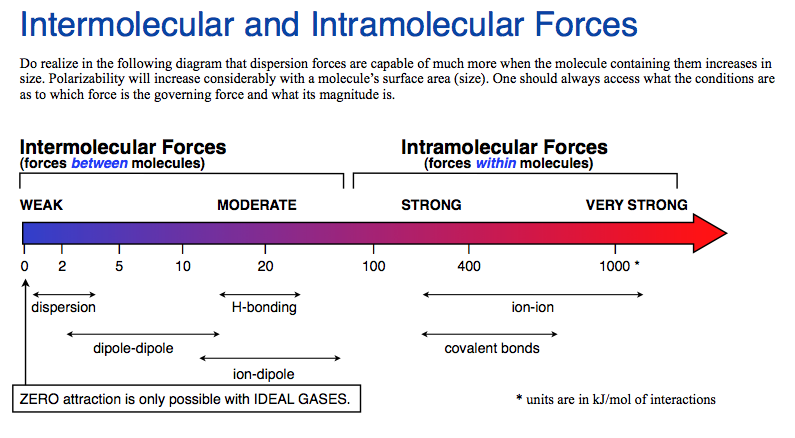
Intermolecular forces are the attractive forces that occur between molecules. These forces are weaker than chemical bonds such as ionic or covalent bonds, but they play a crucial role in determining the physical properties of substances. Properties such as boiling point, melting point, viscosity, solubility, and surface tension are largely influenced by intermolecular interactions.

While chemical bonds hold atoms together within molecules, intermolecular forces act between separate molecules. These forces determine how molecules interact with one another in liquids, solids, and gases.

Intermolecular forces are essential in many chemical and biological processes. They influence the structure of biological macromolecules, determine how substances dissolve in solvents, and control the behavior of materials at the molecular level.

Examples of phenomena influenced by intermolecular forces include:

  • Water forming droplets due to surface tension
  • Ice floating on water because of hydrogen bonding
  • The condensation of gases into liquids
  • The folding of proteins in biological systems

Understanding intermolecular forces helps chemists predict and explain the behavior of substances in different states of matter.


2. Types of Intermolecular Forces

Image
Image
Image
Image

There are several types of intermolecular forces. The most common include:

  • London dispersion forces
  • Dipole–dipole interactions
  • Hydrogen bonding
  • Ion–dipole interactions

These forces vary in strength and arise from different types of molecular interactions.


3. London Dispersion Forces

Image
Image
Image
Image

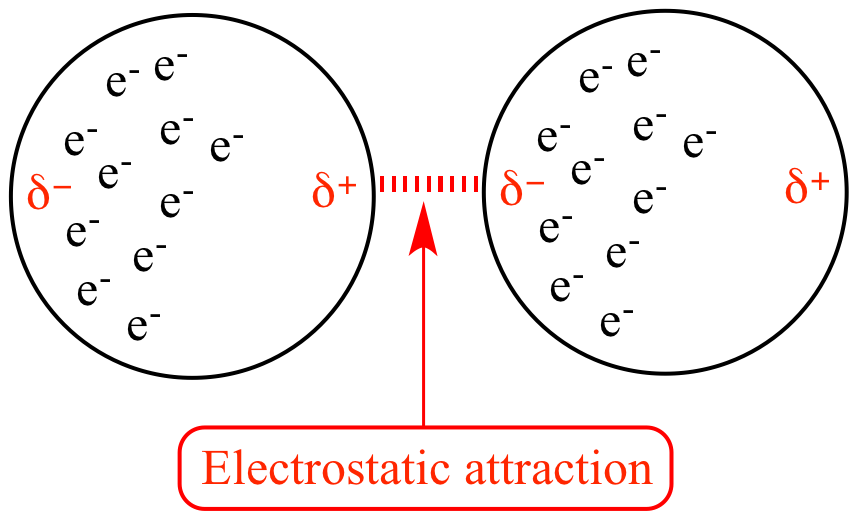
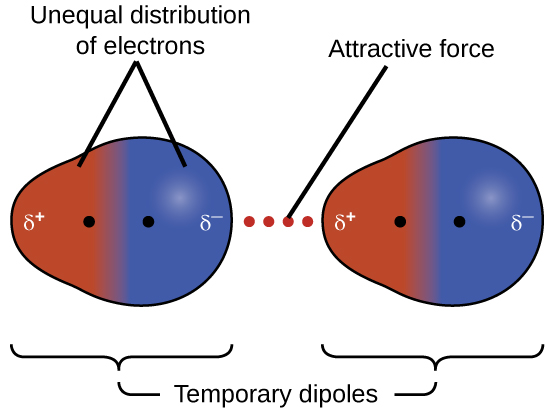
London dispersion forces are the weakest type of intermolecular force. They arise from temporary fluctuations in the electron distribution of atoms or molecules.

At any moment, electrons may be unevenly distributed around an atom or molecule. This uneven distribution creates a temporary dipole, where one part of the molecule becomes slightly negative and another part becomes slightly positive.

This temporary dipole can induce a dipole in a neighboring molecule, resulting in an attractive force between them.

London dispersion forces occur in all atoms and molecules, regardless of whether they are polar or nonpolar.

These forces become stronger under certain conditions:

  • Larger molecules with more electrons
  • Greater molecular surface area
  • Increased polarizability of electron clouds

Examples of substances dominated by dispersion forces include noble gases and nonpolar molecules such as methane.


4. Dipole–Dipole Interactions

Image
Image
Image

Dipole–dipole interactions occur between polar molecules. In these molecules, electrons are shared unequally, resulting in partial positive and negative charges.

The positive end of one molecule is attracted to the negative end of another molecule. This attraction creates dipole–dipole forces.

These interactions are stronger than London dispersion forces but weaker than hydrogen bonding.

Examples of polar molecules that exhibit dipole–dipole interactions include:

  • Hydrogen chloride (HCl)
  • Sulfur dioxide (SO₂)
  • Acetone

The strength of dipole–dipole interactions depends on the magnitude of the molecular dipole moment.


5. Hydrogen Bonding

Image
Image
Image
Image

Hydrogen bonding is a special type of dipole–dipole interaction that occurs when hydrogen is bonded to highly electronegative atoms such as:

  • Oxygen
  • Nitrogen
  • Fluorine

When hydrogen is bonded to these atoms, it becomes strongly positive because the electronegative atom pulls electrons toward itself.

The positively charged hydrogen atom can then attract the lone pair electrons of nearby electronegative atoms.

Hydrogen bonds are significantly stronger than other intermolecular forces.


Importance of Hydrogen Bonding

Hydrogen bonding is responsible for many important properties of substances.

Properties of Water

Water has unusually high boiling and melting points because of strong hydrogen bonding between molecules.

Hydrogen bonding also causes water to have:

  • High surface tension
  • High heat capacity
  • Expansion upon freezing

Biological Systems

Hydrogen bonds stabilize biological molecules such as:

  • DNA double helix
  • Protein structures
  • Enzyme-substrate interactions

These interactions are essential for life processes.


6. Ion–Dipole Interactions

Image
Image
Image
Image

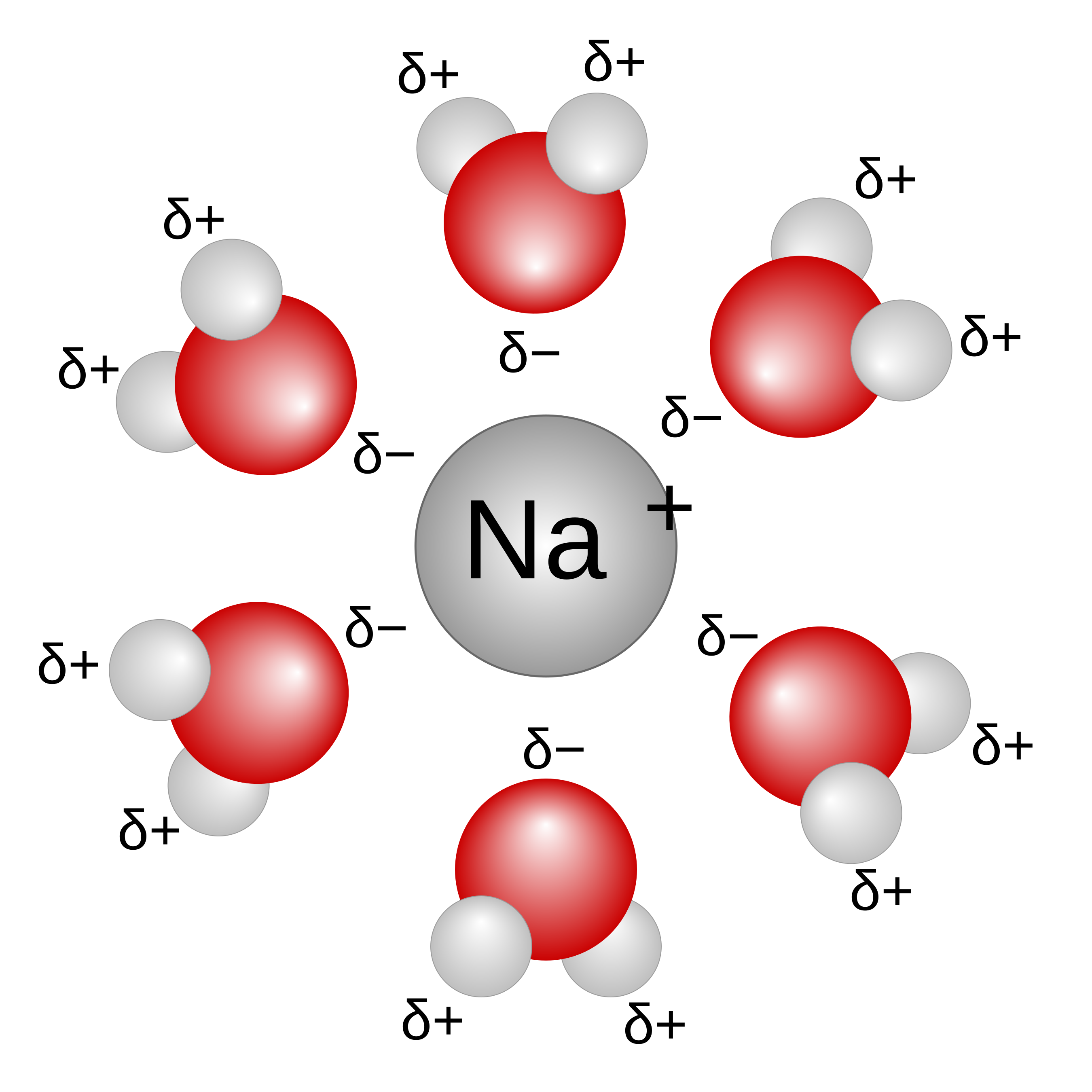
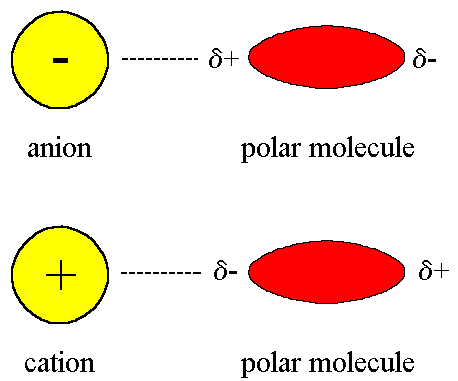
Ion–dipole interactions occur between ions and polar molecules.

This type of force is particularly important when ionic compounds dissolve in polar solvents such as water.

For example, when sodium chloride dissolves in water:

  • Sodium ions attract the negative oxygen end of water molecules.
  • Chloride ions attract the positive hydrogen end of water molecules.

These interactions stabilize ions in solution and allow the compound to dissolve.

Ion–dipole forces are stronger than most intermolecular forces.


7. Relative Strength of Intermolecular Forces

The strength of intermolecular forces generally follows this order:

Ion–dipole interactions (strongest)
Hydrogen bonding
Dipole–dipole interactions
London dispersion forces (weakest)

However, large molecules with many electrons can have strong dispersion forces that rival other intermolecular interactions.

The strength of intermolecular forces affects many physical properties of substances.


8. Intermolecular Forces and Physical Properties

Image
Image
Image
Image

Intermolecular forces strongly influence physical properties.


Boiling Point

Stronger intermolecular forces require more energy to separate molecules.

Therefore, substances with stronger forces have higher boiling points.


Melting Point

Substances with strong intermolecular attractions require more energy to transition from solid to liquid.


Viscosity

Viscosity is a measure of a liquid’s resistance to flow.

Liquids with strong intermolecular forces tend to have higher viscosity.


Surface Tension

Surface tension arises from intermolecular forces acting on molecules at the surface of a liquid.

Water has high surface tension due to hydrogen bonding.


9. Intermolecular Forces in Biology

Intermolecular forces are essential for biological systems.

They help maintain the structure of many biological molecules.

Examples include:

  • Hydrogen bonding in DNA base pairing
  • Protein folding through hydrogen bonding and dipole interactions
  • Lipid membrane formation through dispersion forces

Without these forces, biological molecules would not maintain their functional shapes.


10. Applications in Chemistry and Technology

Understanding intermolecular forces is important in many scientific fields.

Drug Design

Drug molecules must interact with biological targets through intermolecular forces.

Materials Science

Intermolecular interactions determine properties of polymers and plastics.

Environmental Chemistry

Pollutant behavior depends on intermolecular interactions with water and air.

Nanotechnology

Weak intermolecular forces help assemble nanoscale structures.


11. Comparison with Chemical Bonds

It is important to distinguish intermolecular forces from chemical bonds.

Chemical bonds:

  • Hold atoms together within molecules
  • Strong interactions
  • Include ionic, covalent, and metallic bonds

Intermolecular forces:

  • Act between molecules
  • Much weaker than chemical bonds
  • Influence physical properties rather than chemical composition

12. Conclusion

Intermolecular forces are essential interactions that occur between molecules. Although weaker than chemical bonds, they play a crucial role in determining the physical and chemical behavior of substances.

Different types of intermolecular forces—including London dispersion forces, dipole–dipole interactions, hydrogen bonding, and ion–dipole interactions—arise from various molecular interactions and charge distributions.

These forces influence many properties such as boiling point, melting point, viscosity, and solubility. They are also critical for biological systems, materials science, and many technological applications.

By understanding intermolecular forces, chemists can explain how molecules interact, how substances change state, and how complex molecular systems function.


Tags

Molecular Geometry (VSEPR Theory)

Image
Image
Image
Image

1. Introduction to Molecular Geometry

Molecular geometry refers to the three-dimensional arrangement of atoms in a molecule. Understanding the spatial arrangement of atoms is essential because the shape of a molecule determines many of its physical and chemical properties. These properties include polarity, reactivity, boiling point, intermolecular interactions, and biological activity.

One of the most widely used models for predicting molecular geometry is the VSEPR theory, which stands for Valence Shell Electron Pair Repulsion theory. This theory provides a simple yet powerful method for determining the shape of molecules based on the arrangement of electron pairs around a central atom.

According to VSEPR theory, electron pairs around a central atom repel each other because they carry negative charges. As a result, they arrange themselves in space as far apart as possible to minimize repulsion. This arrangement determines the overall shape of the molecule.

Understanding molecular geometry is important in many areas of chemistry, including:

  • Chemical bonding
  • Reaction mechanisms
  • Drug design
  • Molecular biology
  • Materials science

For example, the unique bent shape of the water molecule is responsible for many of its unusual properties, including its polarity and ability to form hydrogen bonds.

Molecular geometry also plays a crucial role in biological systems. The shape of molecules determines how enzymes recognize substrates, how DNA replicates, and how proteins fold into functional structures.


2. Fundamentals of VSEPR Theory

Image
Image
Image
Image

The Valence Shell Electron Pair Repulsion theory was developed to explain molecular shapes by considering the repulsion between electron pairs in the valence shell of a central atom.

The key idea behind VSEPR theory is that electron pairs repel one another due to their negative charges. To minimize this repulsion, electron pairs arrange themselves as far apart as possible.

Types of Electron Pairs

There are two types of electron pairs considered in VSEPR theory.

Bonding pairs

These are electron pairs shared between atoms to form covalent bonds.

Lone pairs

These are pairs of electrons that belong to a single atom and are not involved in bonding.

Lone pairs occupy more space than bonding pairs because they are attracted only to the nucleus of the central atom. As a result, lone pairs exert stronger repulsive forces.

Electron Domains

In VSEPR theory, regions of electron density around a central atom are called electron domains.

Each of the following counts as one electron domain:

  • A single bond
  • A double bond
  • A triple bond
  • A lone pair

The arrangement of electron domains determines the molecular geometry.


3. Electron Domain Geometry

Image
Image
Image
Image

Electron domain geometry describes the arrangement of electron pairs around a central atom.

The most common electron domain geometries are:


Linear Geometry

Occurs when there are two electron domains around the central atom.

Bond angle: 180°

Example: Carbon dioxide (CO₂)


Trigonal Planar Geometry

Occurs when there are three electron domains.

Bond angle: 120°

Example: Boron trifluoride (BF₃)


Tetrahedral Geometry

Occurs when there are four electron domains.

Bond angle: 109.5°

Example: Methane (CH₄)


Trigonal Bipyramidal Geometry

Occurs when there are five electron domains.

Bond angles: 90° and 120°

Example: Phosphorus pentachloride (PCl₅)


Octahedral Geometry

Occurs when there are six electron domains.

Bond angle: 90°

Example: Sulfur hexafluoride (SF₆)


4. Molecular Shapes with Lone Pairs

Image
Image
Image
Image

When lone pairs are present on the central atom, the molecular shape differs from the electron domain geometry.

Because lone pairs occupy more space, they distort the bond angles.


Bent Geometry

Occurs when there are two bonding pairs and one or two lone pairs.

Example: Water (H₂O)

Bond angle ≈ 104.5°


Trigonal Pyramidal

Occurs when there are three bonding pairs and one lone pair.

Example: Ammonia (NH₃)

Bond angle ≈ 107°


Seesaw Geometry

Occurs with four bonding pairs and one lone pair.

Example: Sulfur tetrafluoride (SF₄)


T-Shaped Geometry

Occurs when three bonding pairs and two lone pairs are present.

Example: Chlorine trifluoride (ClF₃)


Square Planar Geometry

Occurs when four bonding pairs and two lone pairs are present.

Example: Xenon tetrafluoride (XeF₄)


5. Bond Angles and Molecular Shape

Image
Image
Image
Image

Bond angles are the angles between bonds that connect atoms in a molecule.

The ideal bond angles depend on electron domain geometry.

Typical bond angles include:

Linear → 180°
Trigonal planar → 120°
Tetrahedral → 109.5°
Trigonal bipyramidal → 90° and 120°
Octahedral → 90°

Lone pairs reduce bond angles because they repel bonding pairs more strongly.

For example:

Methane (CH₄) → 109.5°
Ammonia (NH₃) → 107°
Water (H₂O) → 104.5°


6. Molecular Polarity and Geometry

Image
Image
Image
Image

Molecular geometry plays a crucial role in determining whether a molecule is polar or nonpolar.

Polarity depends on two factors:

  • Electronegativity differences between atoms
  • The shape of the molecule

If bond dipoles cancel due to symmetrical geometry, the molecule is nonpolar.

Example:

Carbon dioxide (CO₂) is linear and nonpolar.

If dipoles do not cancel, the molecule becomes polar.

Example:

Water (H₂O) is bent and polar.

Polarity influences many properties such as solubility and intermolecular interactions.


7. Applications of Molecular Geometry

Molecular geometry is essential for understanding many chemical and biological processes.


Chemical Reactivity

The shape of molecules influences how they collide and react with other molecules.


Drug Design

Pharmaceutical molecules must have specific shapes to interact with biological receptors.


Biological Molecules

Protein folding and DNA structure depend on molecular geometry.


Materials Science

The structure of molecules determines material properties such as hardness and conductivity.


8. Limitations of VSEPR Theory

Although VSEPR theory is very useful, it has certain limitations.

It works best for simple molecules with well-defined central atoms.

However, it may not accurately describe:

  • Molecules with transition metals
  • Molecules with extensive electron delocalization
  • Highly complex molecular structures

More advanced theories such as molecular orbital theory and valence bond theory provide more detailed explanations.


9. Importance in Chemistry

Molecular geometry is a key concept that connects chemical bonding with molecular behavior.

It helps explain:

  • Chemical reactions
  • Physical properties
  • Molecular interactions
  • Biological processes
  • Material properties

By understanding molecular geometry, chemists can predict how molecules will behave in different environments.


10. Conclusion

Molecular geometry describes the three-dimensional arrangement of atoms in molecules and is essential for understanding the structure and behavior of chemical substances. The VSEPR theory provides a simple and effective way to predict molecular shapes based on electron pair repulsion.

By analyzing electron domains around a central atom, VSEPR theory explains common molecular geometries such as linear, trigonal planar, tetrahedral, trigonal bipyramidal, and octahedral structures. The presence of lone pairs further modifies these shapes, producing bent, trigonal pyramidal, and other geometries.

Molecular geometry influences many important properties, including polarity, reactivity, and intermolecular interactions. As a result, it plays a crucial role in chemistry, biology, materials science, and pharmaceutical research.

Understanding molecular geometry allows scientists to predict how molecules interact, how chemical reactions occur, and how complex biological systems function.


Tags