


1. Introduction to Simple Harmonic Motion
Simple Harmonic Motion (SHM) is one of the most important concepts in classical physics and plays a central role in understanding oscillatory systems. It describes a special type of periodic motion where an object moves back and forth about an equilibrium position under the influence of a restoring force that is directly proportional to its displacement from that position.
Many natural phenomena exhibit SHM or approximate it under certain conditions. The vibration of a guitar string, oscillation of a mass attached to a spring, swinging of a pendulum, and even the motion of atoms in solids can often be modeled using simple harmonic motion.
SHM is particularly significant because it provides a mathematical model that is both simple and extremely powerful. Many complex systems can be approximated as simple harmonic oscillators when the displacement from equilibrium is small.
Understanding SHM is essential for studying waves, acoustics, electronics, mechanical vibrations, and even quantum mechanics.
2. Definition of Simple Harmonic Motion
Simple harmonic motion can be defined as:
A type of periodic motion in which the restoring force acting on a particle is directly proportional to its displacement from the equilibrium position and always directed toward that equilibrium position.
Mathematically:
F = −kx
Where:
F = restoring force
k = force constant (spring constant)
x = displacement from equilibrium
The negative sign indicates that the force acts in the direction opposite to displacement.
Since force causes acceleration according to Newton’s second law:
F = ma
Therefore:
ma = −kx
or
a = −(k/m)x
This equation shows that acceleration is proportional to displacement and directed toward the equilibrium position.
This characteristic property defines simple harmonic motion.
3. Basic Concepts of SHM
1. Equilibrium Position
The equilibrium position is the point where the net force acting on the particle is zero.
At this point:
- Acceleration = 0
- Restoring force = 0
- Potential energy is minimum
- Velocity is maximum
The oscillating body continuously passes through this position during motion.
2. Displacement
Displacement is the distance of the particle from the equilibrium position.
In SHM, displacement varies periodically with time and follows a sinusoidal pattern.
If x represents displacement, then:
x = A sin(ωt + φ)
Where:
A = amplitude
ω = angular frequency
t = time
φ = phase constant
3. Amplitude
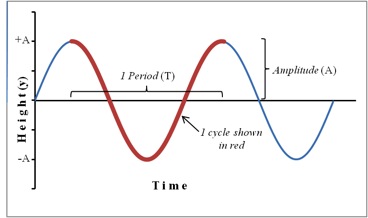
Amplitude is the maximum displacement from the equilibrium position.
It represents the maximum extent of oscillation.
Example:
If a mass attached to a spring moves 5 cm on either side of equilibrium, then the amplitude is 5 cm.
Amplitude determines the energy of the oscillating system.
4. Time Period
The time period (T) is the time taken to complete one full oscillation.
One oscillation means the particle returns to its original position with the same velocity direction.
Unit: seconds
5. Frequency
Frequency (f) is the number of oscillations completed in one second.
f = 1 / T
Unit: Hertz (Hz)
Example:
If the time period is 0.5 seconds:
f = 1 / 0.5 = 2 Hz
This means the system completes two oscillations per second.
6. Angular Frequency
Angular frequency (ω) represents the rate of oscillation in radians.
ω = 2πf
ω = 2π / T
Unit: radians per second
Angular frequency is commonly used in mathematical descriptions of SHM.
4. Mathematical Description of SHM
The motion of a particle undergoing SHM can be described mathematically using sinusoidal functions.
Displacement Equation
x = A sin(ωt + φ)
or
x = A cos(ωt + φ)
Where:
x = displacement
A = amplitude
ω = angular frequency
t = time
φ = phase constant
This equation represents how displacement changes with time.
Velocity Equation
Velocity is the rate of change of displacement.
v = dx/dt
If
x = A sin(ωt)
Then
v = Aω cos(ωt)
Maximum velocity occurs at the equilibrium position.
v_max = Aω
Acceleration Equation
Acceleration is the rate of change of velocity.
a = dv/dt
For SHM:
a = −ω²x
This equation confirms that acceleration is proportional to displacement and opposite in direction.
Maximum acceleration occurs at maximum displacement.
a_max = ω²A
5. Graphical Representation of SHM


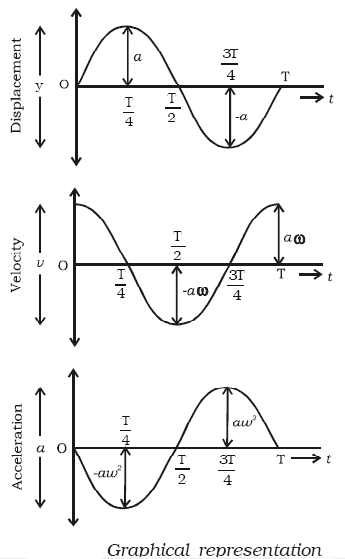
Graphical analysis helps visualize simple harmonic motion clearly.
Displacement vs Time Graph
The displacement-time graph is a sine or cosine curve.
It shows how the particle moves between maximum positive and negative displacements.
Characteristics:
- Periodic pattern
- Smooth oscillation
- Maximum displacement equals amplitude
Velocity vs Time Graph
The velocity graph is also sinusoidal but shifted by 90° in phase relative to displacement.
Velocity is maximum when displacement is zero.
Velocity becomes zero at extreme positions.
Acceleration vs Time Graph
Acceleration graph is also sinusoidal.
However, it is opposite in phase with displacement.
When displacement is maximum, acceleration is maximum but in the opposite direction.
6. Energy in Simple Harmonic Motion
Energy continuously transforms during SHM.
The total mechanical energy remains constant if there is no energy loss.
Potential Energy
Potential energy is stored when the particle is displaced.
PE = ½ kx²
Maximum potential energy occurs at maximum displacement.
Kinetic Energy
Kinetic energy is due to motion.
KE = ½ mv²
Maximum kinetic energy occurs at the equilibrium position.
Total Energy
Total energy remains constant.
E = KE + PE
In SHM:
E = ½ kA²
Energy continuously shifts between kinetic and potential forms.
At equilibrium:
- KE = maximum
- PE = minimum
At extreme positions:
- KE = zero
- PE = maximum
7. Examples of Simple Harmonic Motion
Mass-Spring System

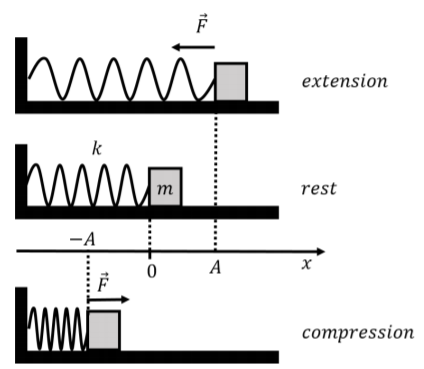


A mass attached to a spring is the classic example of SHM.
When the spring is stretched or compressed, a restoring force acts on the mass.
According to Hooke’s law:
F = −kx
Time period of oscillation:
T = 2π √(m/k)
Where:
m = mass
k = spring constant
Heavier mass increases the time period, while a stiffer spring decreases it.
Simple Pendulum

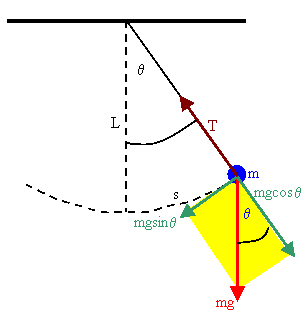

A pendulum consists of a small mass suspended from a string.
When displaced slightly and released, it oscillates.
For small angles, pendulum motion approximates SHM.
Time period:
T = 2π √(L/g)
Where:
L = length of pendulum
g = acceleration due to gravity
Interestingly, the time period does not depend on mass.
8. Phase and Phase Difference
Phase describes the stage of oscillation at any instant.
It is represented by:
ωt + φ
Where φ is the phase constant.
Two oscillations may have:
- Same phase
- Different phases
Phase difference describes how much one oscillation leads or lags another.
It is measured in radians or degrees.
Example:
Two waves separated by π radians are completely opposite.
9. Damped Harmonic Motion
In real systems, oscillations gradually decrease due to energy loss.
This is called damping.
Causes include:
- Air resistance
- Friction
- Internal energy losses
Examples:
- Pendulum eventually stopping
- Vibrating tuning fork losing sound
- Car suspension systems
Damping reduces amplitude over time.
10. Forced Oscillations and Resonance
When an external periodic force acts on a system, it produces forced oscillations.
If the frequency of the applied force equals the natural frequency, resonance occurs.
Resonance produces large amplitudes.
Examples:
- Musical instruments
- Radio tuning circuits
- Vibrations in bridges
Resonance is useful but can also cause structural damage if uncontrolled.
11. Applications of SHM
SHM is used in many technologies.
Timekeeping
Pendulum clocks use SHM to measure time accurately.
Sound and Music
Musical instruments rely on oscillations.
Electronics
Oscillators produce periodic signals used in communication devices.
Earthquake Engineering
Buildings are designed considering vibrational motion.
Medical Devices
Ultrasound imaging uses oscillatory waves.
Quantum Mechanics
Atoms and molecules often behave like harmonic oscillators.
12. SHM in Nature
Many natural processes involve oscillations.
Examples include:
- Heartbeat rhythm
- Breathing cycles
- Vibrations of atoms in solids
- Ocean waves
- Alternating electrical currents
Even microscopic particles in molecules vibrate in patterns similar to SHM.
13. SHM and Circular Motion
SHM can be understood as the projection of uniform circular motion onto a straight line.
If a particle moves in a circle with constant speed and its motion is projected onto a diameter, the resulting motion is simple harmonic motion.
This relationship explains the sinusoidal nature of SHM equations.
It also helps visualize phase relationships.
14. Importance of SHM in Physics
SHM is extremely important because it provides a simple model for many complex physical systems.
Reasons for its importance:
- Many systems behave like harmonic oscillators.
- Mathematical analysis is simple.
- Helps explain wave motion.
- Fundamental to quantum mechanics.
- Important in electronics and signal processing.
Because of these reasons, SHM is considered one of the most fundamental topics in physics.
Conclusion
Simple harmonic motion is a fundamental form of periodic motion where the restoring force is proportional to displacement and directed toward equilibrium. It is characterized by sinusoidal motion, constant time period, and continuous energy transformation between kinetic and potential forms.
SHM appears in countless natural and technological systems, from vibrating strings and pendulums to electrical circuits and molecular vibrations. The mathematical simplicity and universal applicability of SHM make it one of the most powerful models in physics.
By understanding SHM, scientists and engineers gain insights into oscillations, waves, vibrations, and resonance. This knowledge is essential for designing mechanical systems, electronic devices, musical instruments, and scientific instruments.
Thus, simple harmonic motion serves as a cornerstone for understanding a wide range of physical phenomena across classical and modern physics.
Tags: