


1. Introduction to the Periodic Table
The periodic table is one of the most important tools in chemistry. It is a systematic arrangement of all known chemical elements organized according to their atomic numbers, electron configurations, and recurring chemical properties. The periodic table allows scientists to understand the relationships between different elements and predict their chemical behavior.
Each element in the periodic table is represented by a unique symbol and occupies a specific position determined primarily by its atomic number, which is the number of protons present in the nucleus of the atom. The arrangement of elements reveals patterns known as periodic trends, which repeat regularly across the table.
The periodic table serves as a universal reference for chemists, physicists, and researchers in many scientific fields. It provides information about elements such as:
- Atomic number
- Atomic mass
- Electron configuration
- Chemical reactivity
- Physical state of elements
- Valence electrons
Through the periodic table, scientists can predict how elements will interact, form compounds, and participate in chemical reactions.
The table currently contains 118 confirmed elements, ranging from hydrogen to oganesson. These elements include naturally occurring substances and artificially synthesized elements produced in laboratories.
2. Historical Development of the Periodic Table

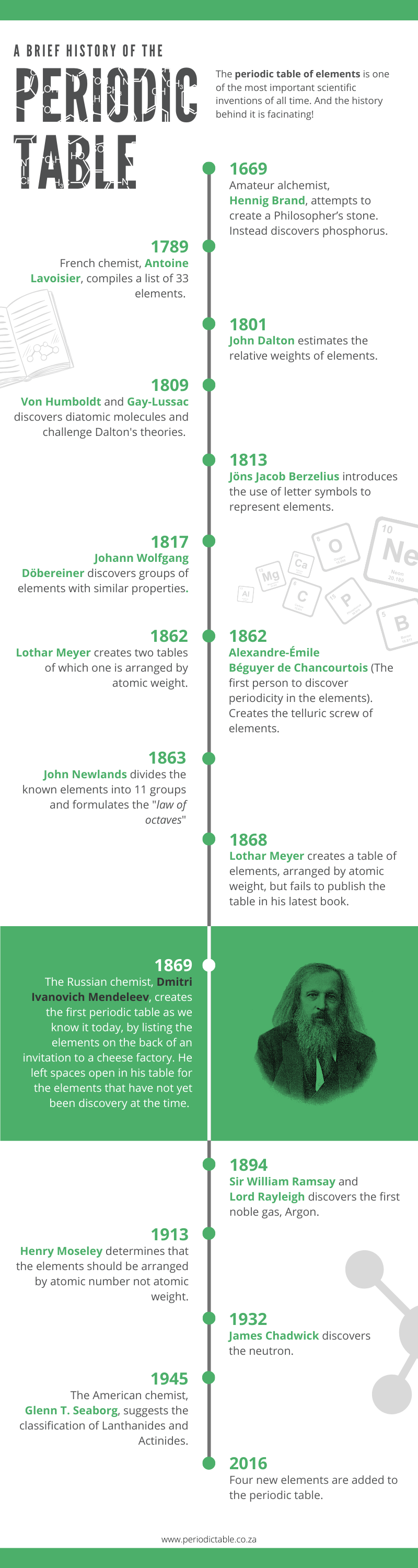

The development of the periodic table is one of the most significant achievements in the history of chemistry. The modern periodic table evolved through the contributions of several scientists.
Early Classification Attempts
Before the periodic table was developed, scientists attempted to classify elements based on their properties. Early attempts included grouping elements with similar chemical behaviors.
For example, some chemists noticed similarities among elements such as lithium, sodium, and potassium, which all reacted vigorously with water.
Dobereiner’s Triads
In the early nineteenth century, Johann Wolfgang Döbereiner proposed grouping elements into sets of three called triads. These triads contained elements with similar properties, and the atomic mass of the middle element was approximately the average of the other two.
Although this approach worked for a few groups, it did not apply to all elements.
Newlands’ Law of Octaves
In 1864, John Newlands arranged elements by increasing atomic mass and observed that every eighth element had similar properties.
He called this pattern the Law of Octaves, comparing it to musical octaves. However, the law worked only for lighter elements and failed for heavier ones.
Mendeleev’s Periodic Table
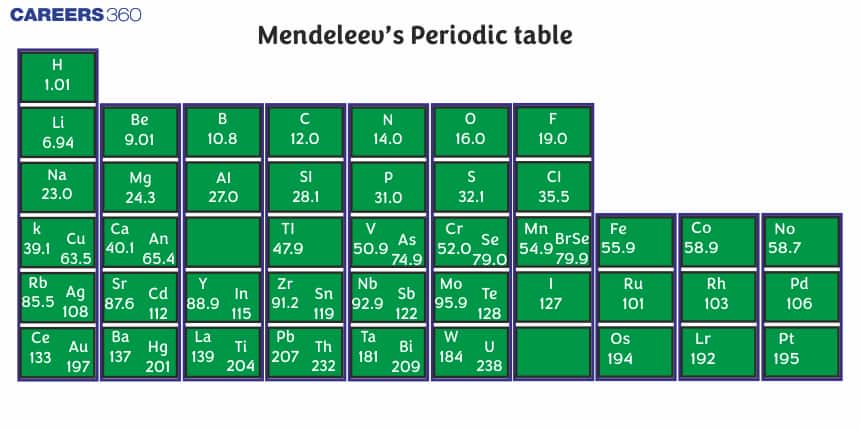
The most important breakthrough came in 1869 when Dmitri Mendeleev proposed the first widely accepted periodic table.
Mendeleev arranged elements according to increasing atomic mass and grouped elements with similar chemical properties in the same columns.
One of the most remarkable aspects of Mendeleev’s table was that he left gaps for undiscovered elements and predicted their properties accurately.
Later discoveries confirmed his predictions, strengthening the validity of the periodic table.
Modern Periodic Table
The modern periodic table is based on atomic number rather than atomic mass.
This modification was introduced by Henry Moseley in 1913 after discovering that atomic number corresponds to the number of protons in the nucleus.
The modern periodic law states:
The physical and chemical properties of elements are periodic functions of their atomic numbers.
3. Structure of the Periodic Table


The periodic table is organized into rows and columns.
Rows are called periods, and columns are called groups.
Periods
Periods are the horizontal rows of the periodic table.
There are seven periods in the periodic table.
Each period corresponds to the filling of a principal energy level.
For example:
- Period 1 contains hydrogen and helium.
- Period 2 contains elements from lithium to neon.
As one moves across a period from left to right, the atomic number increases and elements gradually change from metals to nonmetals.
Groups
Groups are the vertical columns of the periodic table.
There are 18 groups.
Elements in the same group have similar chemical properties because they have the same number of valence electrons.
For example:
Group 1 elements are highly reactive metals.
Group 18 elements are noble gases with very low reactivity.
4. Blocks of the Periodic Table

The periodic table can be divided into four blocks based on electron configuration.
s-Block
The s-block includes Groups 1 and 2.
Characteristics:
- Elements have electrons in s orbitals.
- Includes alkali metals and alkaline earth metals.
- Highly reactive metals.
Examples include lithium, sodium, and magnesium.
p-Block
The p-block includes Groups 13–18.
Characteristics:
- Elements have electrons in p orbitals.
- Contains metals, metalloids, and nonmetals.
Examples include carbon, nitrogen, oxygen, and chlorine.
d-Block
The d-block contains transition metals.
Characteristics:
- Electrons fill d orbitals.
- Metals with high melting points and good conductivity.
Examples include iron, copper, and nickel.
f-Block
The f-block includes lanthanides and actinides.
Characteristics:
- Electrons fill f orbitals.
- Many elements are radioactive.
Examples include uranium and plutonium.
5. Classification of Elements


Elements can be classified into three main categories.
Metals
Metals are located on the left side and center of the periodic table.
Characteristics:
- Good conductors of heat and electricity
- Malleable and ductile
- Usually shiny
- Tend to lose electrons in reactions
Examples include iron, copper, aluminum, and gold.
Nonmetals
Nonmetals are found on the right side of the periodic table.
Characteristics:
- Poor conductors of heat and electricity
- Brittle solids or gases
- Tend to gain electrons in reactions
Examples include oxygen, nitrogen, and sulfur.
Metalloids
Metalloids have properties intermediate between metals and nonmetals.
They are located along the staircase line of the periodic table.
Examples include silicon, arsenic, and germanium.
Metalloids are important in semiconductor technology.
6. Important Groups in the Periodic Table


Certain groups have special names and properties.
Alkali Metals (Group 1)
Highly reactive metals that react strongly with water.
Examples:
- Lithium
- Sodium
- Potassium
Alkaline Earth Metals (Group 2)
Reactive metals but less reactive than alkali metals.
Examples:
- Magnesium
- Calcium
- Barium
Halogens (Group 17)
Highly reactive nonmetals.
Examples:
- Fluorine
- Chlorine
- Bromine
Noble Gases (Group 18)
Chemically inert gases with full valence shells.
Examples:
- Helium
- Neon
- Argon
7. Periodic Trends


Periodic trends describe predictable patterns in element properties.
Atomic Radius
Atomic radius generally:
- Decreases across a period
- Increases down a group
Ionization Energy
Ionization energy is the energy required to remove an electron.
Trend:
- Increases across a period
- Decreases down a group
Electronegativity
Electronegativity measures an atom’s ability to attract electrons.
Trend:
- Increases across a period
- Decreases down a group
Metallic Character
Metallic character refers to the tendency of an element to lose electrons.
Trend:
- Increases down a group
- Decreases across a period
8. Applications of the Periodic Table
The periodic table has numerous applications in science and technology.
Predicting Chemical Behavior
Chemists can predict how elements react based on their positions.
Material Development
Understanding element properties helps design new materials.
Medicine
Many elements are used in medical treatments and diagnostics.
Environmental Science
The periodic table helps study pollutants and environmental chemistry.
Industrial Chemistry
Elements are used in manufacturing metals, alloys, and chemicals.
9. Modern Discoveries and Synthetic Elements
Scientists continue to discover and synthesize new elements.
Superheavy elements are created in particle accelerators by colliding atomic nuclei.
These elements exist for only fractions of a second before decaying.
Research on these elements helps scientists understand nuclear structure and stability.
10. Conclusion
The periodic table is a cornerstone of modern chemistry. It organizes all known chemical elements in a way that reveals patterns in their physical and chemical properties.
From its early development by Mendeleev to the modern atomic number–based arrangement, the periodic table has evolved into a powerful tool for understanding matter.
By studying the periodic table, scientists can predict the behavior of elements, design new materials, and explore the fundamental structure of the universe.
Its ability to organize complex information into a simple framework makes it one of the most important achievements in scientific history.