

Introduction to Polynomials
In mathematics, polynomials are one of the most fundamental and widely used algebraic structures. They appear in algebra, calculus, number theory, engineering, economics, physics, computer science, and many other fields. A polynomial is an algebraic expression composed of variables, constants, and exponents combined using addition, subtraction, and multiplication.
Unlike many other mathematical expressions, polynomials do not include variables in denominators, negative exponents, fractional exponents, or radicals involving variables. Because of this restriction, polynomials are relatively easy to analyze and manipulate, making them essential building blocks in mathematics.
A simple example of a polynomial is:
[
3x^2 + 2x + 5
]
In this expression:
- 3x² is a term
- 2x is another term
- 5 is the constant term
Together they form a polynomial expression.
Polynomials are important because they can approximate complex functions, describe curves and surfaces, represent physical phenomena, and solve real-world problems.
Definition of Polynomial
A polynomial is an expression of the form:
[
a_n x^n + a_{n-1} x^{n-1} + \dots + a_2 x^2 + a_1 x + a_0
]
Where:
- x = variable
- a₀, a₁, a₂ … aₙ = constants called coefficients
- n = non-negative integer (degree of polynomial)
Example:
[
4x^3 + 2x^2 – 7x + 9
]
Here:
- Degree = 3
- Coefficients = 4, 2, -7
- Constant = 9
Components of a Polynomial
A polynomial consists of several important parts.
1. Terms
A term is a single part of a polynomial separated by addition or subtraction.
Example:
[
5x^3 + 2x^2 – 4x + 7
]
Terms are:
- 5x³
- 2x²
- -4x
- 7
2. Coefficient
The coefficient is the numerical factor multiplied by the variable.
Example:
In 6x², the coefficient is 6.
3. Constant
The constant term has no variable.
Example:
[
4x^3 + 5x – 8
]
Constant = -8
4. Degree
The degree of a polynomial is the highest exponent of the variable.
Example:
[
7x^4 + 3x^2 + x + 1
]
Degree = 4
Types of Polynomials Based on Number of Terms
Polynomials can be classified based on how many terms they contain.
Monomial
A polynomial with one term.
Examples:
[
5x^2
]
[
7y
]
[
3
]
Binomial
A polynomial with two terms.
Examples:
[
x + 5
]
[
3x^2 – 7
]
Trinomial
A polynomial with three terms.
Examples:
[
x^2 + 3x + 5
]
[
2x^2 – x + 7
]
Polynomial (General)
A polynomial with more than three terms.
Example:
[
x^4 + 2x^3 + 3x^2 + x + 6
]
Types of Polynomials Based on Degree
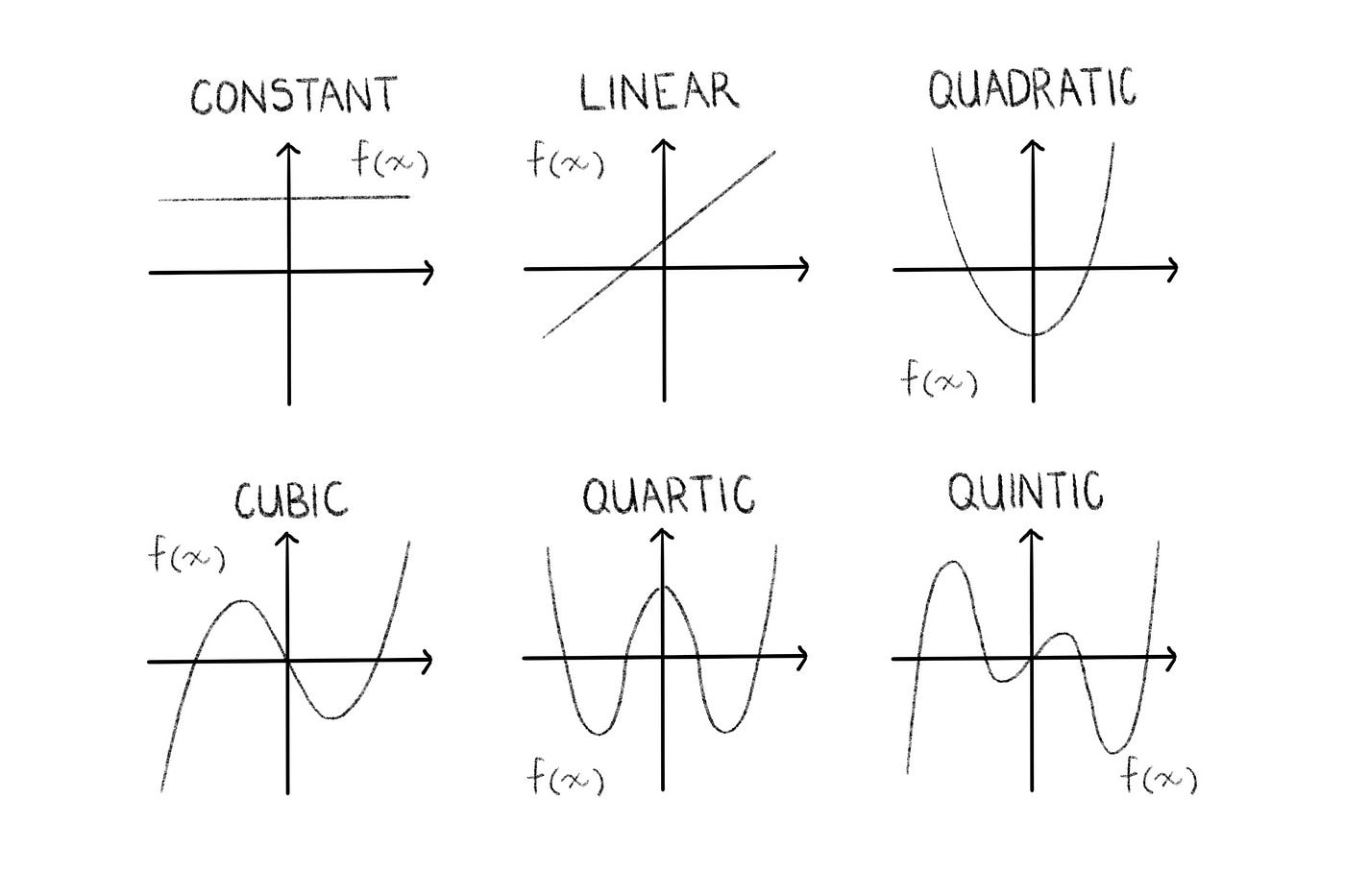
Polynomials are also classified by degree.
Constant Polynomial
Degree = 0
Example:
[
7
]
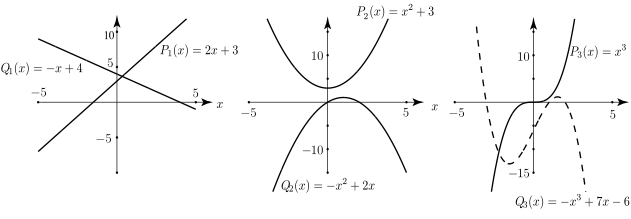
Linear Polynomial
Degree = 1
Example:
[
2x + 3
]
Graph of a linear polynomial is a straight line.
Quadratic Polynomial
Degree = 2
Example:
[
x^2 + 3x + 2
]
Graph is a parabola.
Cubic Polynomial
Degree = 3
Example:
[
x^3 + 2x^2 – x + 5
]
Graph can have up to two turning points.
Quartic Polynomial
Degree = 4
Example:
[
x^4 + 2x^2 + 1
]
Graph can have three turning points.
Quintic Polynomial
Degree = 5
Example:
[
x^5 + 2x^3 + x + 7
]
Higher degree polynomials have more complex curves.
Polynomial Functions
A polynomial function is a function defined by a polynomial expression.
Example:
[
f(x) = 2x^3 – x + 5
]
This function maps values of x to values of f(x).
Polynomial functions are continuous and smooth.
Properties:
- No sharp corners
- No breaks
- No vertical asymptotes
Operations on Polynomials
Polynomials can be manipulated using various algebraic operations.
Addition of Polynomials
Add like terms.
Example:
[
(3x^2 + 2x + 5) + (2x^2 + 4x + 1)
]
Result:
[
5x^2 + 6x + 6
]
Subtraction of Polynomials
Example:
[
(5x^2 + 4x + 3) – (2x^2 + x + 1)
]
Result:
[
3x^2 + 3x + 2
]
Multiplication of Polynomials
Example:
[
(x + 2)(x + 3)
]
Using distributive property:
[
x^2 + 5x + 6
]
Division of Polynomials
Division methods include:
- Long division
- Synthetic division
Example:
[
(x^2 + 5x + 6) ÷ (x + 2)
]
Result:
[
x + 3
]
Factoring Polynomials
Factoring means writing a polynomial as a product of simpler polynomials.
Example:
[
x^2 + 5x + 6
]
Factor:
[
(x + 2)(x + 3)
]
Common factoring methods:
- Greatest Common Factor (GCF)
- Factoring trinomials
- Difference of squares
- Sum and difference of cubes
- Grouping
Polynomial Graphs
The graph of a polynomial shows how the function behaves.
Key features:
Intercepts
- x-intercept → where graph crosses x-axis
- y-intercept → where graph crosses y-axis
End Behavior
End behavior depends on:
- Degree
- Leading coefficient
Example:
If degree is even and coefficient positive:
Graph opens upwards on both sides.
Turning Points
A polynomial of degree n can have at most:
[
n-1
]
turning points.
Polynomial Roots and Zeros
A root or zero of a polynomial is the value of x where:
[
f(x) = 0
]
Example:
[
x^2 – 5x + 6 = 0
]
Factor:
[
(x-2)(x-3)=0
]
Roots:
[
x = 2, 3
]
Fundamental Theorem of Algebra
The Fundamental Theorem of Algebra states:
Every polynomial equation of degree n has exactly n complex roots (counting multiplicity).
Example:
A cubic polynomial always has 3 roots.
Polynomial Theorems
Important theorems related to polynomials include:
Remainder Theorem
If polynomial f(x) is divided by (x − a), remainder is:
[
f(a)
]
Factor Theorem
If:
[
f(a) = 0
]
then (x − a) is a factor.
Applications of Polynomials
Polynomials are widely used in real-world applications.
Physics
Used to describe motion, trajectories, and physical systems.
Example:
Projectile motion equations.
Engineering
Used in:
- Structural design
- Signal processing
- Control systems
Economics
Used to model:
- Cost functions
- Revenue functions
- Profit functions
Computer Graphics
Curves in animation and design often use polynomial interpolation.
Example:
Bezier curves.
Statistics
Regression models use polynomial equations to fit data.
Polynomial Interpolation
Polynomial interpolation is used to find a polynomial that passes through given data points.
Example:
Given points:
(1,2), (2,3), (3,5)
A polynomial can be created that fits these points exactly.
Methods include:
- Lagrange interpolation
- Newton interpolation
Special Polynomials
Several special polynomials are important in mathematics.
Chebyshev Polynomials
Used in approximation theory.
Legendre Polynomials
Used in physics, especially in solving differential equations.
Hermite Polynomials
Used in probability theory and quantum mechanics.
Taylor Polynomials
Used in calculus to approximate functions.
Example:
[
e^x \approx 1 + x + x^2/2 + x^3/6
]
Multivariable Polynomials
Polynomials can have more than one variable.
Example:
[
3x^2y + 2xy^2 + 5
]
Variables:
x and y.
These are used in:
- algebraic geometry
- optimization
- physics
Polynomial Rings
In abstract algebra, polynomials form a ring.
Example:
R[x]
This means polynomials with coefficients in ring R.
Polynomial rings are fundamental in:
- algebra
- coding theory
- cryptography
Polynomial Approximation
Many complicated functions can be approximated using polynomials.
Example:
[
sin(x)
]
can be approximated using Taylor polynomial.
This concept is heavily used in:
- numerical analysis
- machine learning
- scientific computing
Advantages of Polynomials
Polynomials are extremely useful because they:
- Are easy to compute
- Are continuous and smooth
- Can approximate many functions
- Are simple to differentiate and integrate
Limitations of Polynomials
Polynomials cannot represent:
- Vertical asymptotes
- Discontinuous functions
- Exponential growth perfectly
- Periodic behavior accurately over large intervals
Historical Development of Polynomials
The concept of polynomials has existed for thousands of years.
Ancient Civilizations
Babylonians solved quadratic equations around 2000 BCE.
Greek Mathematics
Greek mathematicians studied geometric interpretations of algebraic equations.
Islamic Golden Age
Persian mathematician Al-Khwarizmi developed systematic algebraic methods.
Renaissance Period
Italian mathematicians discovered formulas for solving cubic and quartic equations.
Modern Mathematics
Polynomials became central in algebra and calculus development.
Polynomials in Modern Technology
Polynomials are used in modern technologies including:
- Computer graphics
- Cryptography
- Signal processing
- Machine learning algorithms
- Data fitting
- Robotics motion planning
Conclusion
Polynomials are among the most important structures in mathematics. Their simplicity, flexibility, and powerful properties make them essential tools for both theoretical mathematics and practical applications.
From basic algebra taught in schools to advanced scientific research, polynomials play a crucial role in understanding patterns, solving equations, modeling real-world systems, and building modern technology.
Their ability to approximate complex functions, describe curves and shapes, and solve practical problems ensures that polynomials remain a central topic in mathematics and science.