

Introduction
Motion in two dimensions (2D motion) is an important concept in classical mechanics that describes the movement of objects in a plane. Unlike motion in one dimension, where an object moves along a straight line, motion in two dimensions involves movement along two perpendicular axes, typically the x-axis and y-axis. This means that the position of an object must be described using two coordinates rather than one.
Many natural and technological phenomena involve two-dimensional motion. Examples include the motion of a projectile thrown into the air, a football kicked across a field, a bird flying through the sky, or a car turning along a curved road. In these cases, the motion occurs simultaneously in both horizontal and vertical directions.
The study of motion in two dimensions falls under the branch of physics called kinematics, which focuses on describing motion without considering the forces that cause it. By analyzing the components of motion separately along the x and y directions, physicists can simplify complex motion into manageable mathematical relationships.
Understanding two-dimensional motion is essential because it forms the foundation for many advanced topics such as projectile motion, circular motion, orbital mechanics, and vector analysis.
Coordinate System for Two-Dimensional Motion
To analyze motion in two dimensions, a coordinate system is required.
Cartesian Coordinate System
The most commonly used coordinate system is the Cartesian coordinate system, which consists of two perpendicular axes:
- Horizontal axis (x-axis)
- Vertical axis (y-axis)
The point where the axes intersect is called the origin (0,0).
The position of an object in two-dimensional space is represented by a coordinate pair:
[
(x, y)
]
Where:
- (x) represents horizontal position
- (y) represents vertical position
For example, if an object is located 3 meters to the right and 4 meters upward from the origin, its position is written as:
[
(3,4)
]
This coordinate system allows physicists to track the movement of objects over time.
Position Vector
In two-dimensional motion, position is often expressed using a vector.
A vector quantity has both magnitude and direction.
The position vector is written as:
[
\vec{r} = x\hat{i} + y\hat{j}
]
Where:
- (x) is the horizontal component
- (y) is the vertical component
- (\hat{i}) and (\hat{j}) are unit vectors along the x and y axes
The magnitude of the position vector is given by:
[
|\vec{r}| = \sqrt{x^2 + y^2}
]
This represents the distance from the origin to the object.
Position vectors are extremely useful because they allow motion to be analyzed mathematically in both directions simultaneously.
Displacement in Two Dimensions
Displacement represents the change in position of an object.
If the initial position is:
[
(x_1, y_1)
]
and the final position is:
[
(x_2, y_2)
]
Then the displacement vector is:
[
\vec{s} = (x_2 – x_1)\hat{i} + (y_2 – y_1)\hat{j}
]
The magnitude of displacement is:
[
|\vec{s}| = \sqrt{(x_2 – x_1)^2 + (y_2 – y_1)^2}
]
Unlike distance, displacement depends only on the initial and final positions and not the path taken.
Velocity in Two Dimensions
Velocity in two-dimensional motion describes how quickly the position changes with time.
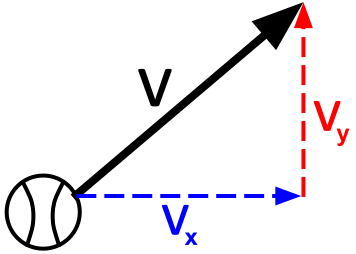
Velocity is also a vector quantity and can be expressed as:
[
\vec{v} = v_x \hat{i} + v_y \hat{j}
]
Where:
- (v_x) is the velocity component in the x-direction
- (v_y) is the velocity component in the y-direction
The magnitude of velocity is:
[
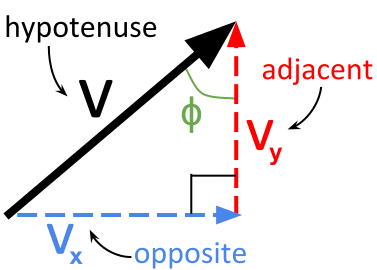
v = \sqrt{v_x^2 + v_y^2}
]
The direction of velocity is given by:
[
\theta = \tan^{-1} \left(\frac{v_y}{v_x}\right)
]
This angle represents the direction of motion relative to the horizontal axis.
Acceleration in Two Dimensions
Acceleration describes how velocity changes with time.
In two-dimensional motion, acceleration also has two components:
[
\vec{a} = a_x \hat{i} + a_y \hat{j}
]
Where:
- (a_x) is acceleration in the horizontal direction
- (a_y) is acceleration in the vertical direction
The magnitude of acceleration is:
[
a = \sqrt{a_x^2 + a_y^2}
]
In many physical situations, acceleration may occur in only one direction while velocity exists in both directions.
For example, in projectile motion:
- Horizontal acceleration is zero
- Vertical acceleration equals gravitational acceleration
Independent Motion of Components
One of the most important principles in two-dimensional motion is the independence of motion along perpendicular axes.
This means that motion along the x-axis and y-axis can be treated separately.
Horizontal motion and vertical motion do not affect each other.
For example, if a ball is thrown horizontally:
- Horizontal velocity remains constant
- Vertical velocity increases due to gravity
This principle simplifies calculations significantly.
Projectile Motion

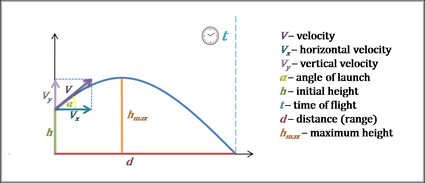
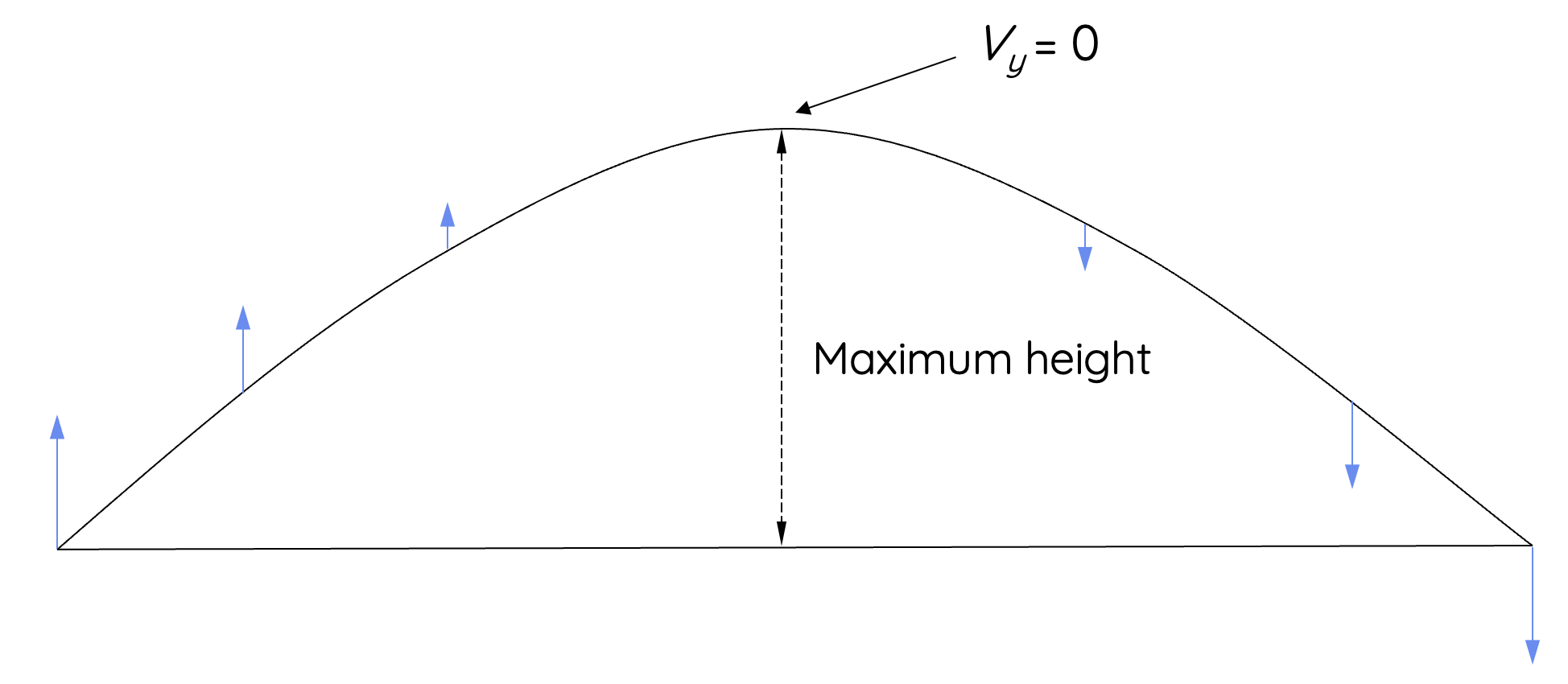
Projectile motion is a special case of two-dimensional motion where an object is thrown into the air and moves under the influence of gravity alone.
Examples include:
- Throwing a ball
- Shooting a basketball
- Launching fireworks
- Cannonball motion
In projectile motion:
Horizontal motion is uniform.
Vertical motion is uniformly accelerated.
Components of Initial Velocity
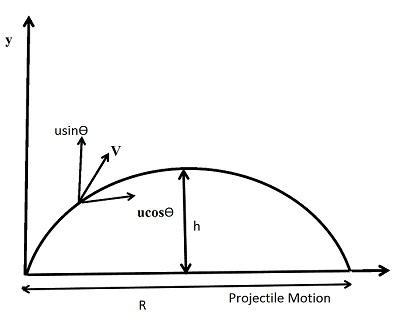
When an object is projected with velocity (v_0) at an angle (\theta), the velocity splits into two components.
Horizontal component:
[
v_x = v_0 \cos\theta
]
Vertical component:
[
v_y = v_0 \sin\theta
]
These components determine how the object moves.
Time of Flight
Time of flight is the total time the projectile remains in the air.
[
T = \frac{2 v_0 \sin\theta}{g}
]
Where:
- (g) is gravitational acceleration.
Maximum Height
The maximum vertical height reached is:
[
H = \frac{v_0^2 \sin^2\theta}{2g}
]
At this point, vertical velocity becomes zero.
Horizontal Range
The horizontal distance traveled is:
[
R = \frac{v_0^2 \sin 2\theta}{g}
]
Maximum range occurs when:
[
\theta = 45^\circ
]
Trajectory of a Projectile
The path followed by a projectile is called its trajectory.
The trajectory is a parabola.
The equation of trajectory is:
[
y = x \tan\theta – \frac{g x^2}{2 v_0^2 \cos^2\theta}
]
This equation shows the curved path of projectile motion.
Relative Motion in Two Dimensions
Relative motion occurs when the motion of one object is observed relative to another moving object.
If two objects move with velocities:
[
\vec{v}_A
]
and
[
\vec{v}_B
]
Then relative velocity is:
[
\vec{v}_{AB} = \vec{v}_A – \vec{v}_B
]
Relative motion is important in:
Navigation
Aircraft motion
River crossing problems
Motion in a Plane


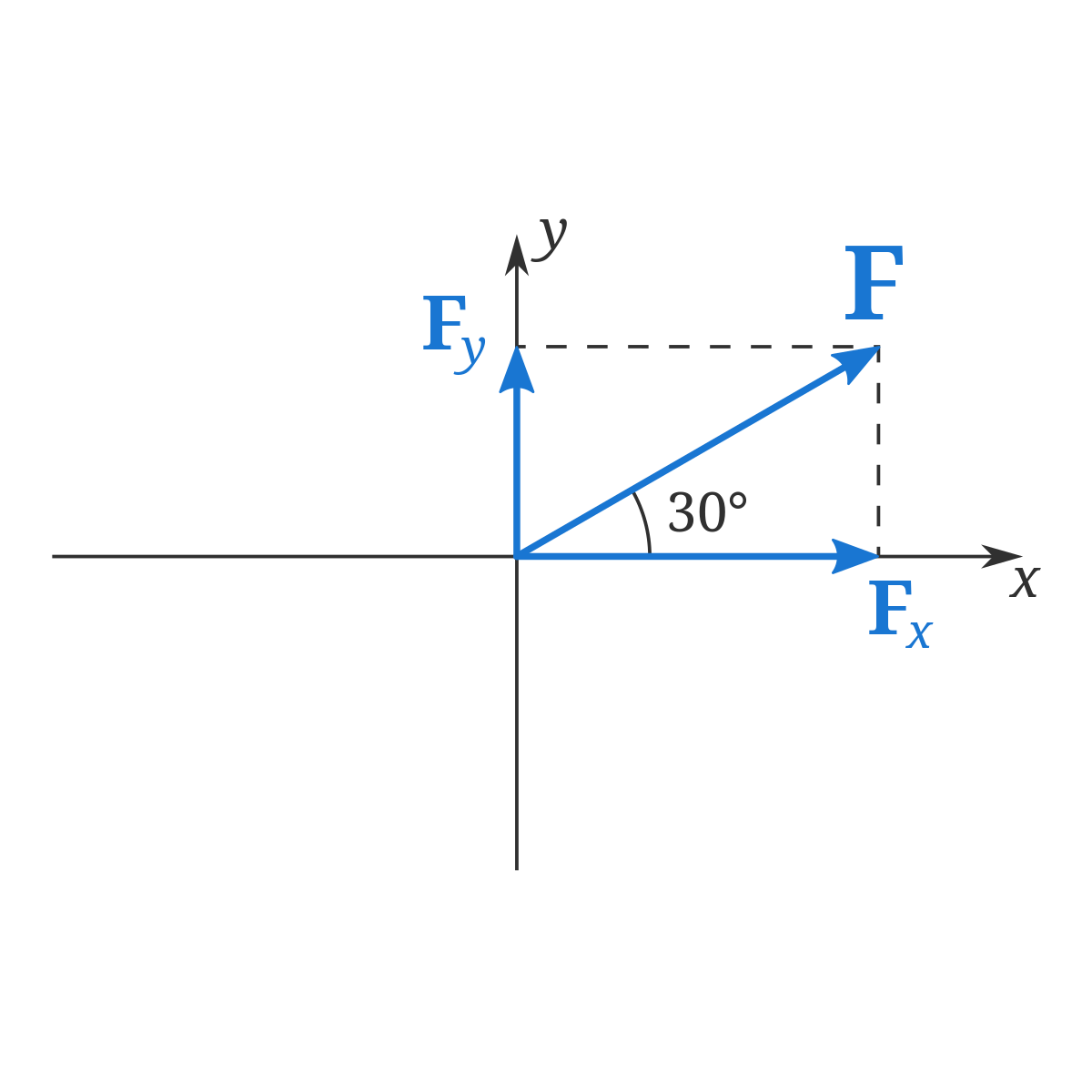
Two-dimensional motion often involves vector addition.
There are two methods for adding vectors:
Triangle Law
Vectors are arranged head-to-tail.
Parallelogram Law
Vectors are drawn from the same origin and the diagonal represents the resultant.
Vector resolution allows a vector to be split into perpendicular components.
This technique is fundamental in analyzing motion.
Circular Motion as Two-Dimensional Motion
Circular motion is also an example of two-dimensional motion.
In circular motion:
- The object moves in a circular path.
- Velocity continuously changes direction.
The acceleration directed toward the center is called centripetal acceleration.
[
a_c = \frac{v^2}{r}
]
Where:
- (v) is velocity
- (r) is radius
Even if speed is constant, acceleration exists due to the changing direction.
Applications of Two-Dimensional Motion
Two-dimensional motion appears in many real-world situations.
Sports
Ball trajectories in cricket, football, basketball, and golf follow projectile motion.
Engineering
Design of bridges, ramps, and mechanical systems requires motion analysis.
Aerospace
Rocket launches and satellite trajectories involve two-dimensional motion.
Navigation
Ships and aircraft determine relative motion and vector directions.
Robotics
Robot movement across surfaces requires planar motion analysis.
Experimental Study of Two-Dimensional Motion
Physicists study two-dimensional motion using several experimental techniques.
Motion sensors
High-speed cameras
Computer simulations
Trajectory tracking software
These tools allow accurate measurement of position, velocity, and acceleration.
Limitations of Ideal Two-Dimensional Motion
In theoretical physics problems, simplifying assumptions are often made:
Air resistance is ignored.
Gravity is constant.
Earth’s curvature is neglected.
In real-world scenarios, additional factors affect motion.
These include:
Air drag
Wind forces
Variable gravity
Surface friction
More advanced physics models incorporate these effects.
Importance in Physics
Two-dimensional motion plays a crucial role in many fields of physics.
Mechanics
Astrophysics
Engineering physics
Fluid dynamics
Space science
It also forms the basis for understanding three-dimensional motion, where objects move in space along three axes.
Summary
Motion in two dimensions describes the movement of objects in a plane, requiring two coordinates to define position. Unlike one-dimensional motion, objects move simultaneously along horizontal and vertical directions.
The key to understanding two-dimensional motion is breaking vectors into components along the x and y axes. This allows independent analysis of motion along each direction.
Projectile motion is one of the most important examples of two-dimensional motion. It demonstrates how gravity affects vertical motion while horizontal motion remains uniform.
Understanding two-dimensional motion provides essential knowledge for studying many real-world systems, from sports and engineering to aerospace and planetary motion.