

Tags:
Ratios and Proportions in Mathematics
Ratios and proportions are fundamental mathematical concepts used to compare quantities and describe relationships between numbers. These concepts are widely used in everyday life, science, engineering, economics, and many other fields.
A ratio expresses the relationship between two quantities, indicating how many times one value contains or is contained within another. A proportion, on the other hand, states that two ratios are equal.
Ratios and proportions are essential tools for solving problems involving scaling, mixing, measurements, rates, and comparisons. They also form the foundation for advanced topics such as algebra, trigonometry, statistics, and calculus.
Understanding ratios and proportions helps people interpret real-world data, perform calculations, and make logical comparisons between quantities.
1. Understanding Ratios
Definition of a Ratio
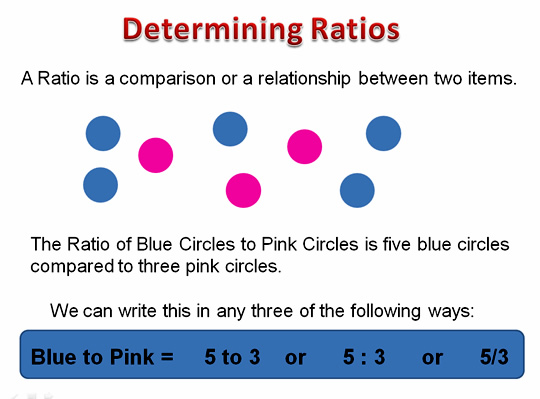
A ratio is a mathematical expression used to compare two quantities.
A ratio shows how many times one value is contained in another.
For example, if there are:
- 4 apples
- 2 oranges
The ratio of apples to oranges is:
4 : 2
This means there are 4 apples for every 2 oranges.
Ways to Write Ratios
Ratios can be written in three common forms:
- Using a colon
3 : 5 - Using the word “to”
3 to 5 - As a fraction
3/5
All three forms represent the same ratio.
Terms in a Ratio
In a ratio a : b:
- a is called the antecedent
- b is called the consequent
Example:
In the ratio 4 : 7
- 4 is the antecedent
- 7 is the consequent
2. Simplifying Ratios
Ratios can often be simplified in the same way as fractions.
Example:
6 : 8
Divide both numbers by their greatest common divisor.
GCD of 6 and 8 = 2
6 ÷ 2 = 3
8 ÷ 2 = 4
Simplified ratio:
3 : 4
Simplifying ratios makes comparisons easier to understand.
3. Types of Ratios
Ratios can appear in different forms depending on what is being compared.
Part-to-Part Ratio
A part-to-part ratio compares two different parts of a group.
Example:
In a class:
- 10 boys
- 15 girls
Ratio of boys to girls:
10 : 15
Simplified:
2 : 3
Part-to-Whole Ratio
A part-to-whole ratio compares one part to the total.
Example:
Total students = 25
Boys = 10
Ratio of boys to total students:
10 : 25
Simplified:
2 : 5
4. Equivalent Ratios


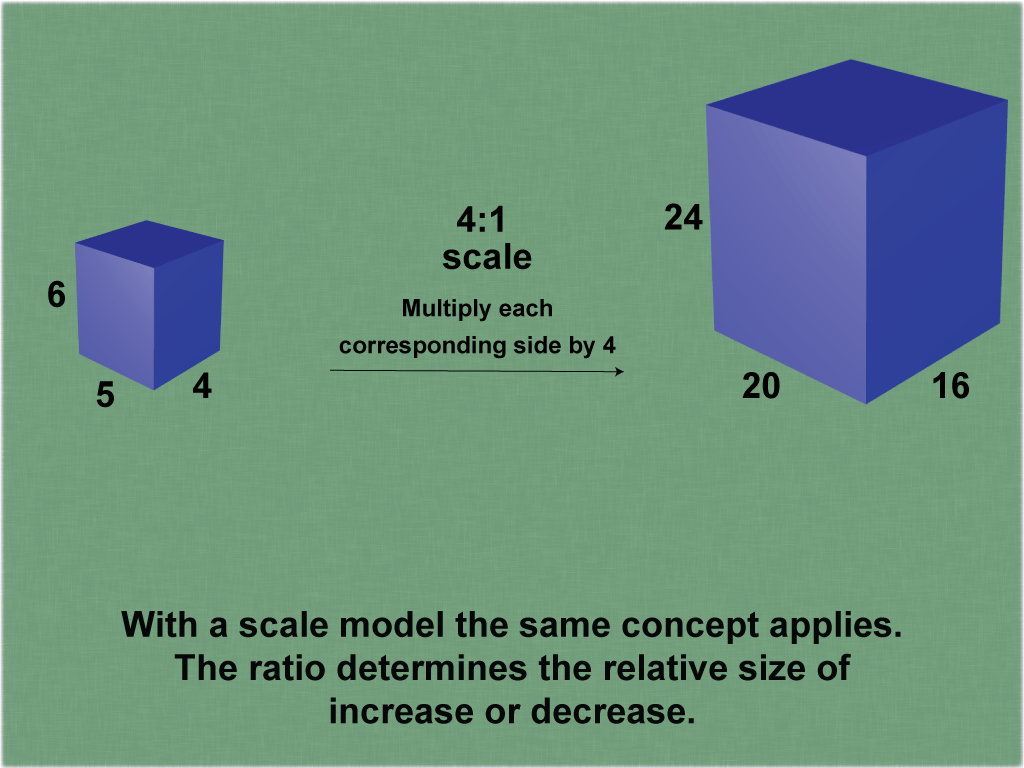
Equivalent ratios represent the same relationship between numbers.
Example:
2 : 3
Equivalent ratios include:
4 : 6
6 : 9
8 : 12
These ratios are obtained by multiplying both terms by the same number.
Example:
2 × 2 = 4
3 × 2 = 6
Equivalent ratios are important when solving proportion problems.
5. Understanding Proportions
Definition of Proportion
A proportion is an equation stating that two ratios are equal.
Example:
2/3 = 4/6
This shows that the two ratios represent the same relationship.
Proportions are used to solve problems involving unknown quantities.
Structure of a Proportion
A proportion has four numbers.
Example:
a/b = c/d
Here:
- a and d are called extremes
- b and c are called means
Cross Multiplication
Cross multiplication is used to solve proportions.
Example:
3/4 = x/8
Cross multiply:
3 × 8 = 4 × x
24 = 4x
x = 6
6. Direct Proportion
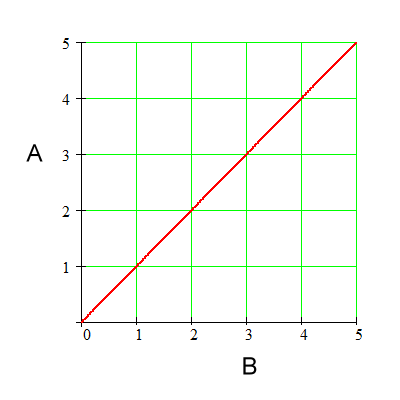
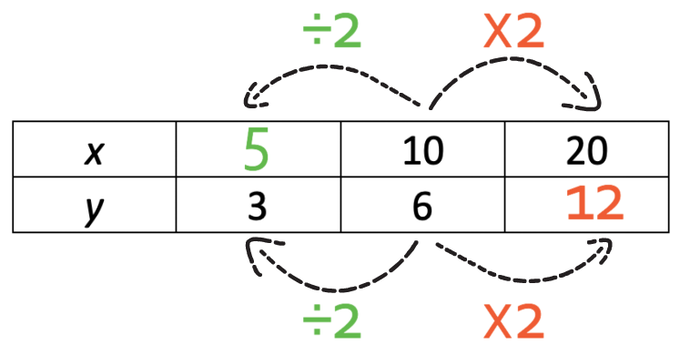

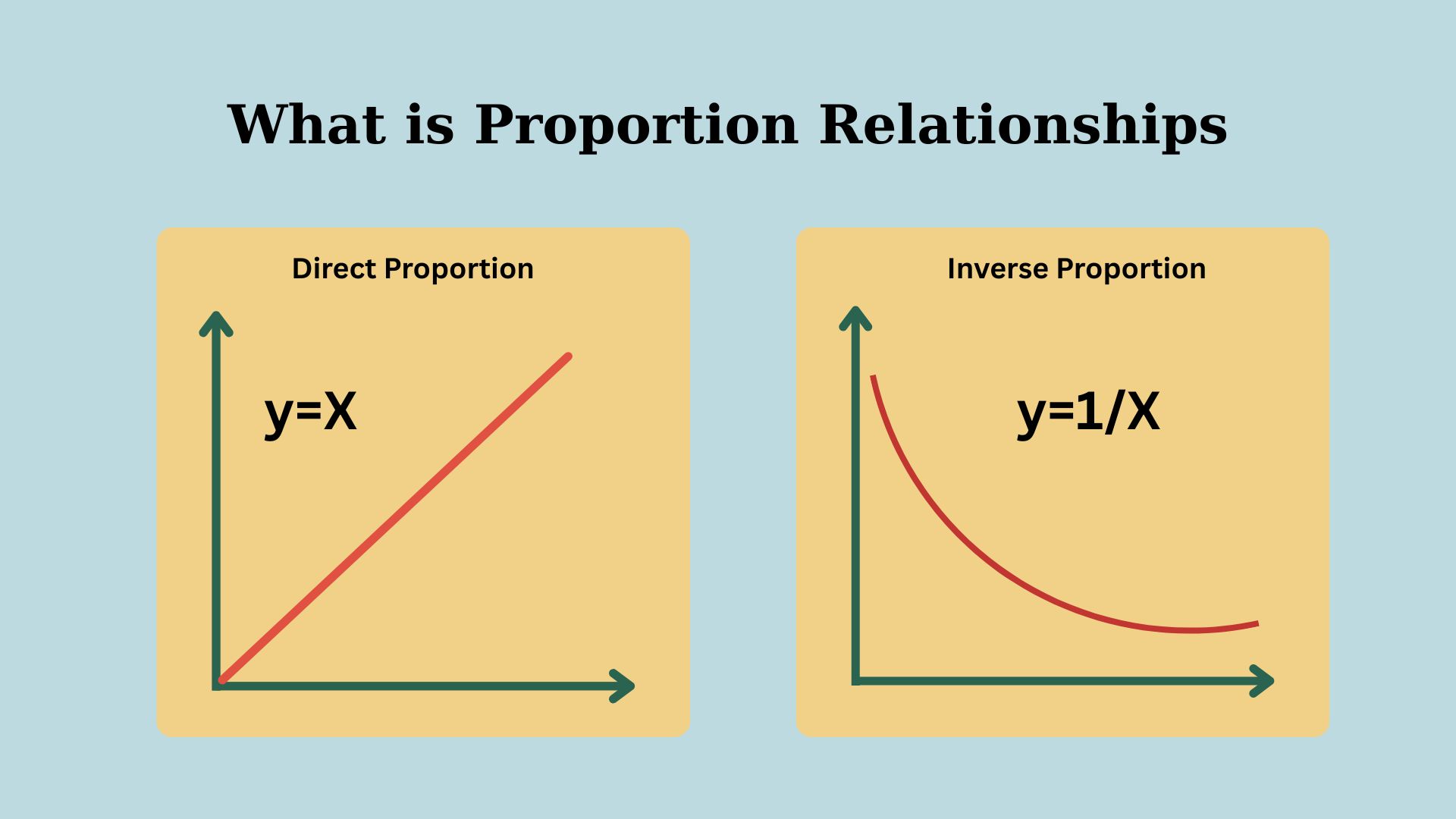
Two quantities are in direct proportion when one increases or decreases in the same ratio as the other.
Mathematically:
y = kx
Where k is the constant of proportionality.
Example of Direct Proportion
If one notebook costs $2:
1 notebook = $2
2 notebooks = $4
3 notebooks = $6
Cost is directly proportional to the number of notebooks.
Graph of Direct Proportion
The graph of a direct proportion is a straight line passing through the origin.
7. Inverse Proportion

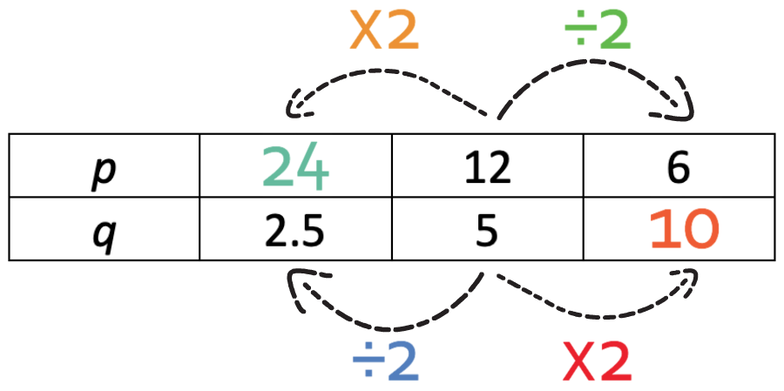
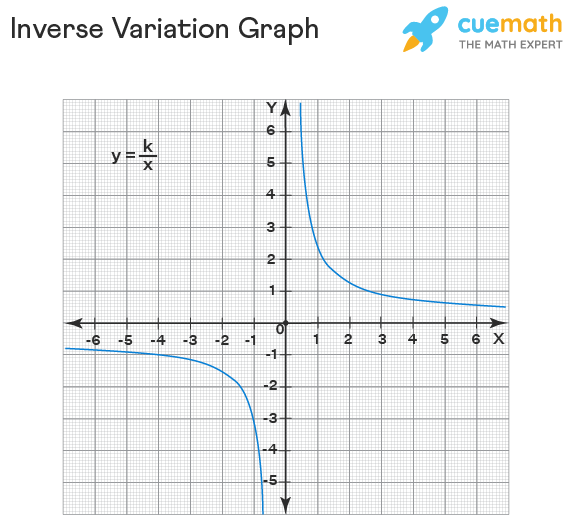
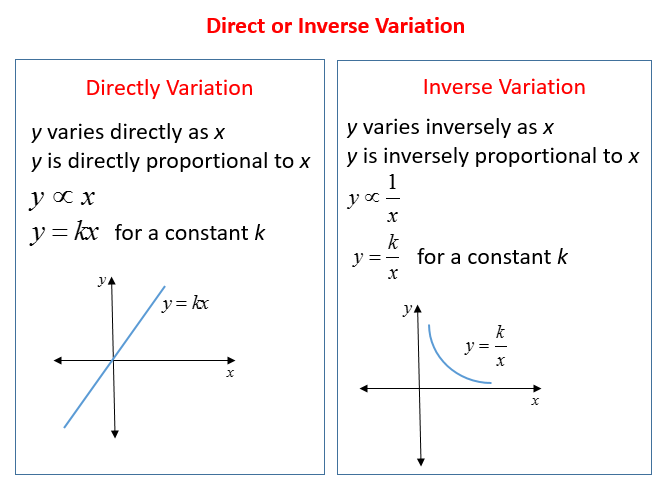
Two quantities are in inverse proportion when one increases while the other decreases.
Mathematical relationship:
xy = k
Where k is a constant.
Example of Inverse Proportion
If 4 workers complete a job in 6 hours:
More workers reduce time.
Example:
4 workers → 6 hours
6 workers → 4 hours
Workers and time are inversely proportional.
8. Continued Proportion
When three numbers are in proportion such that:
a : b = b : c
They form a continued proportion.
Example:
2 : 4 = 4 : 8
Here:
4 is the mean proportional.
9. Compound Ratio
A compound ratio is obtained by multiplying two or more ratios.
Example:
2 : 3 and 4 : 5
Compound ratio:
(2×4) : (3×5)
8 : 15
Compound ratios are used in complex comparisons.
10. Applications of Ratios
Ratios appear in many real-life situations.
Cooking
Recipes often use ratios.
Example:
2 cups flour : 1 cup sugar
This ratio maintains flavor balance.
Maps and Scale
Maps use ratios to represent distances.
Example:
1 cm : 10 km
This means 1 cm on the map equals 10 km in reality.
Mixing Solutions
Chemistry uses ratios when mixing substances.
Example:
Water to chemical ratio.
Finance
Ratios are used to compare financial quantities.
Examples include:
- profit ratios
- interest rates
- investment comparisons
Sports Statistics
Ratios are used to evaluate performance.
Example:
Goals per game.
11. Applications of Proportions
Proportions help solve many practical problems.
Speed and Distance
Example:
If a car travels 60 km in 1 hour:
Distance is proportional to time.
Currency Conversion
Exchange rates use proportions.
Example:
1 USD = 80 INR
Construction
Architects use proportional scaling when designing buildings.
Photography
Aspect ratios determine image dimensions.
Example:
16 : 9
12. Ratio Tables
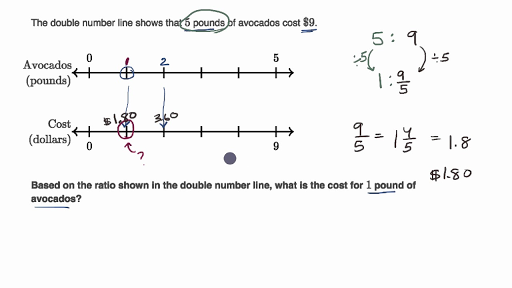
A ratio table lists pairs of values that maintain a constant ratio.
Example:
| Apples | Oranges |
|---|---|
| 2 | 3 |
| 4 | 6 |
| 6 | 9 |
Each pair represents the same ratio.
Ratio tables help visualize proportional relationships.
13. Unit Rate
A unit rate expresses a ratio with denominator 1.
Example:
60 km in 2 hours
Unit rate:
30 km per hour
Unit rates simplify comparisons.
14. Ratios and Fractions
Ratios are closely related to fractions.
Example:
2 : 5 = 2/5
Fractions express part-to-whole relationships, while ratios compare quantities.
15. Ratios and Percentages
Percentages are ratios with denominator 100.
Example:
25%
25/100
1/4
Percentages allow easy comparison of proportions.
16. Importance in Mathematics
Ratios and proportions are fundamental in mathematics because they describe relationships between numbers.
They are used in:
- algebra
- geometry
- trigonometry
- statistics
Many mathematical formulas rely on proportional relationships.
17. Role in Science and Engineering
In science and engineering, ratios and proportions help describe relationships between variables.
Examples include:
- density
- speed
- concentration
- electrical resistance
These relationships allow scientists and engineers to model real-world systems.
18. Ratio and Proportion in Data Analysis
In statistics, ratios help interpret data.
Examples:
- population ratios
- probability ratios
- risk ratios
These measurements help analyze trends and relationships.
19. Historical Development
The study of ratios and proportions dates back to ancient civilizations.
Greek mathematicians studied proportional relationships in geometry.
These ideas were later developed into formal mathematical theories used in modern mathematics.
20. Summary
Ratios and proportions are essential mathematical tools used to compare quantities and describe relationships between numbers.
A ratio compares two quantities, while a proportion states that two ratios are equal.
These concepts appear in many real-world applications, including cooking, construction, finance, science, and engineering.
Understanding ratios and proportions helps build strong mathematical reasoning and prepares students for advanced topics in mathematics and science.
They remain fundamental tools for analyzing relationships, solving problems, and interpreting numerical information.