


1. Introduction to Real Analysis
Real analysis is a branch of mathematics that studies the properties of real numbers, sequences, series, limits, continuity, differentiation, and integration. It provides the rigorous theoretical foundation for calculus and many advanced mathematical concepts.
Real analysis focuses on the structure of the real number system and the behavior of functions defined on real numbers. Unlike basic calculus, which often relies on intuitive ideas, real analysis emphasizes precise definitions, logical reasoning, and mathematical proofs.
The main goal of real analysis is to understand how functions behave and how limits and infinite processes work. It establishes the mathematical rigor behind concepts that appear in calculus, such as limits, derivatives, and integrals.
Real analysis is essential in many areas of mathematics and science, including:
- Advanced calculus
- Functional analysis
- Differential equations
- Mathematical physics
- Probability theory
- Optimization theory
- Economics and statistics
By studying real analysis, mathematicians gain a deeper understanding of the foundations of mathematical analysis and continuous systems.
2. The Real Number System
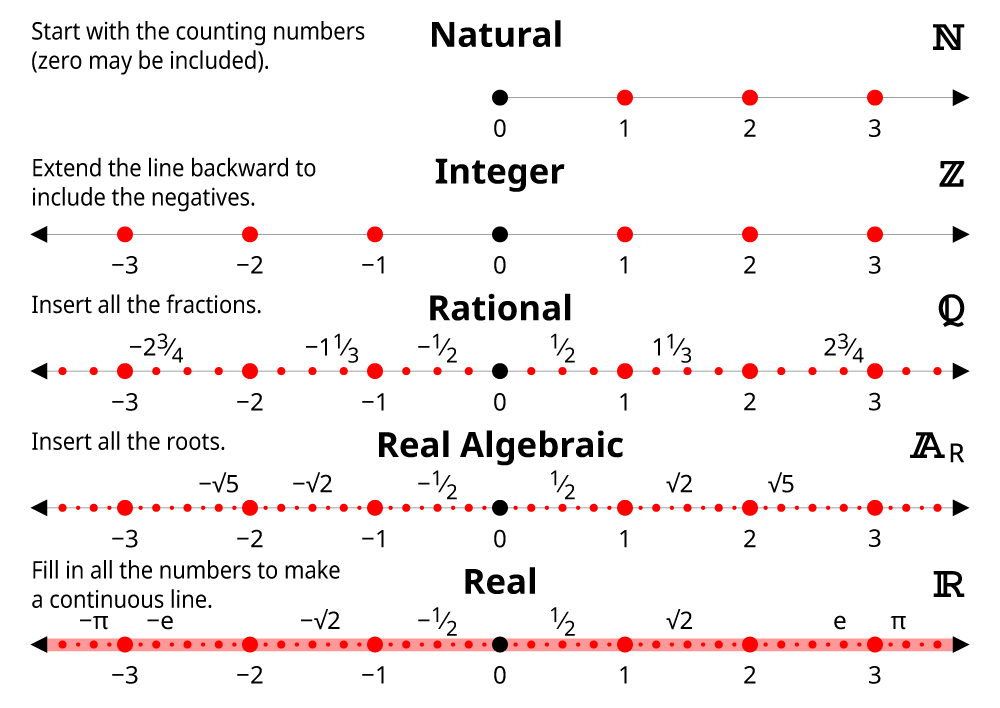
The real numbers form the basis of real analysis.
The set of real numbers is denoted by:
ℝ
It includes:
- Natural numbers
- Integers
- Rational numbers
- Irrational numbers
Examples of real numbers:
-3, -1, 0, 1, 2.5, √2, π
The real numbers can be represented on a number line, where every point corresponds to a real number.
3. Properties of Real Numbers
The real numbers satisfy several algebraic properties.
Closure Property
If a and b are real numbers:
a + b is real
a × b is real
Commutative Property
a + b = b + a
a × b = b × a
Associative Property
(a + b) + c = a + (b + c)
(a × b) × c = a × (b × c)
Distributive Property
a(b + c) = ab + ac
4. Order Properties
Real numbers follow an order structure.
If:
a > b
Then a lies to the right of b on the number line.
Properties include:
- Trichotomy law
- Transitive property
- Addition and multiplication inequalities
5. Completeness Property
One of the most important properties of real numbers is completeness.
The completeness property states that every non-empty set of real numbers that is bounded above has a least upper bound (supremum).
This property distinguishes real numbers from rational numbers.
Example:
The set of numbers less than √2 does not have a rational supremum but has a real supremum.
6. Sequences
A sequence is an ordered list of numbers.
Example:
1, 1/2, 1/3, 1/4, …
Sequences are often written as:
{aₙ}
Where n represents the position.
Convergence of Sequences
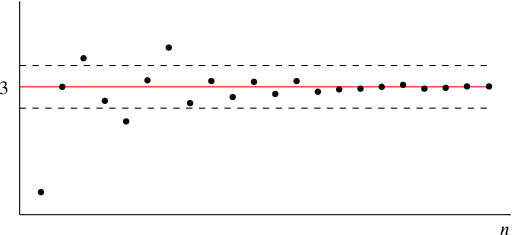
A sequence converges if its terms approach a fixed value.
Example:
aₙ = 1/n
As n increases, the sequence approaches 0.
Divergent Sequences
If a sequence does not approach a fixed value, it diverges.
Example:
aₙ = n
This sequence grows indefinitely.
7. Limits of Sequences
The limit of a sequence describes the value that sequence approaches.
Definition:
lim n→∞ aₙ = L
Meaning:
As n becomes very large, aₙ approaches L.
Epsilon Definition of Limit
A sequence converges to L if for every ε > 0, there exists N such that:
|aₙ − L| < ε
for all n > N.
This formal definition is fundamental in real analysis.
8. Infinite Series
An infinite series is the sum of infinitely many terms.
Example:
1 + 1/2 + 1/4 + 1/8 + …
If the sum approaches a finite value, the series converges.
Geometric Series
Example:
1 + r + r² + r³ + …
If |r| < 1:
Sum = 1 / (1 − r)
Harmonic Series
1 + 1/2 + 1/3 + 1/4 + …
This series diverges.
9. Functions in Real Analysis
A function is a rule that assigns each element of a set to another element.
Example:
f(x) = x²
Functions are central to real analysis.
10. Limits of Functions
Limits describe how a function behaves near a point.
Example:
lim x→2 (x²)
= 4
Limits help analyze function behavior.
11. Continuity
A function is continuous at point c if:
lim x→c f(x) = f(c)
Graphically, the function has no breaks.
Example:
f(x) = x²
is continuous everywhere.
12. Types of Discontinuities
Functions may have discontinuities.
Examples include:
- removable discontinuity
- jump discontinuity
- infinite discontinuity
13. Differentiation
Differentiation measures the rate of change of a function.
Derivative definition:
f'(x) = lim h→0 [f(x+h) − f(x)] / h
Derivatives describe slopes of curves.
14. Mean Value Theorem
The mean value theorem states that for a continuous function:
There exists a point where the derivative equals the average rate of change.
This theorem is fundamental in analysis.
15. Integration
Integration measures accumulated quantities.
Example:
Area under a curve.
Integral notation:
∫ f(x) dx
Real analysis provides rigorous definitions for integrals.
16. Riemann Integral
The Riemann integral divides a region into small intervals and sums the areas.
It is the standard definition of integration.
17. Uniform Convergence
Uniform convergence describes sequences of functions that converge uniformly.
This concept is important in functional analysis.
18. Metric Spaces
A metric space generalizes the concept of distance.
Distance function:
d(x,y)
Metric spaces extend analysis beyond real numbers.
19. Compactness
A set is compact if every open cover has a finite subcover.
Compact sets have important properties in analysis.
20. Applications of Real Analysis
Real analysis has many applications.
Physics
Used in:
- quantum mechanics
- relativity
- fluid dynamics
Economics
Used in:
- optimization models
- economic equilibrium analysis
Engineering
Used in signal processing and control systems.
Probability Theory
Real analysis provides foundations for probability and statistics.
21. Importance of Real Analysis
Real analysis strengthens mathematical rigor.
It explains the theoretical foundations behind calculus.
It also develops logical reasoning and proof techniques.
Conclusion
Real analysis is a fundamental branch of mathematics that provides a rigorous framework for studying real numbers, sequences, limits, and functions. By introducing precise definitions and formal proofs, real analysis establishes the theoretical foundation of calculus and many advanced mathematical disciplines.
Concepts such as convergence, continuity, differentiation, and integration are central to real analysis and help explain the behavior of functions and infinite processes. The field also introduces deeper mathematical ideas such as completeness, metric spaces, and compactness, which extend the study of analysis beyond simple real numbers.
Real analysis plays a critical role in many areas of mathematics, science, and engineering, providing the mathematical tools needed to analyze complex systems and solve real-world problems. Its emphasis on logical rigor and precise reasoning makes it an essential subject for anyone pursuing advanced studies in mathematics.