


Introduction
Snell’s Law is one of the most important laws in optics that describes how light bends when it passes from one medium to another. The bending of light at the boundary between two different media is called refraction. Snell’s Law provides a mathematical relationship between the angle of incidence and the angle of refraction.
When light travels between materials such as air, water, glass, or plastic, its speed changes because each material has a different optical density. This change in speed causes the direction of the light to change. Snell’s Law explains exactly how much the light bends depending on the properties of the materials involved.
The law is named after the Dutch mathematician Willebrord Snellius, who formulated the mathematical relationship in 1621. However, the principle was known earlier in various forms by scientists such as Ibn Sahl and René Descartes.
Snell’s Law is essential in understanding many optical phenomena and technologies, including:
- Lenses in cameras and eyeglasses
- Optical fibers used in communication systems
- Microscopes and telescopes
- Light behavior in water and glass
- Atmospheric optical effects
This law forms the basis for much of geometrical optics, the branch of physics that studies the behavior of light rays.
Concept of Refraction

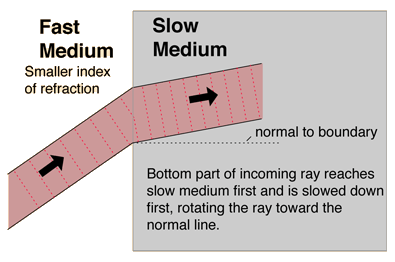
Refraction occurs when light moves from one medium to another with a different refractive index. The change in speed causes the direction of light to change.
When light crosses the boundary between two media:
- Its speed changes
- Its wavelength changes
- Its direction changes
- Its frequency remains constant
Examples of refraction include:
- A straw appearing bent in water
- Objects under water appearing closer than they actually are
- The formation of rainbows
Refraction is the physical phenomenon that Snell’s Law describes mathematically.
Statement of Snell’s Law
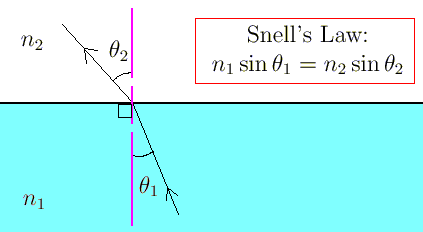

Snell’s Law states that:
The ratio of the sine of the angle of incidence to the sine of the angle of refraction is constant for a given pair of media.
Mathematical Expression
[
\frac{\sin i}{\sin r} = constant
]
Where:
- (i) = angle of incidence
- (r) = angle of refraction
This constant is equal to the relative refractive index of the two media.
A more common form of Snell’s Law is:
[
n_1 \sin i = n_2 \sin r
]
Where:
- (n_1) = refractive index of the first medium
- (n_2) = refractive index of the second medium
This equation is widely used in optical calculations.
Refractive Index and Snell’s Law
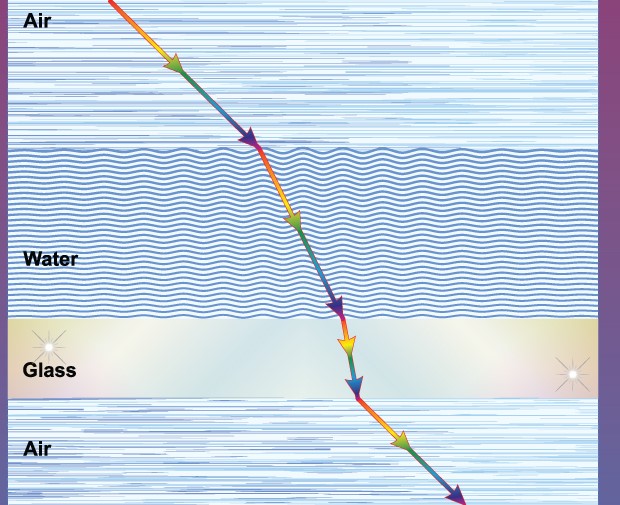
The refractive index is a measure of how much a material slows down light.
Formula
[
n = \frac{c}{v}
]
Where:
- (n) = refractive index
- (c) = speed of light in vacuum
- (v) = speed of light in the medium
Typical refractive indices:
| Medium | Refractive Index |
|---|---|
| Air | 1.0003 |
| Water | 1.33 |
| Glass | 1.5 |
| Diamond | 2.42 |
A higher refractive index means light travels more slowly in the medium.
Snell’s Law uses refractive index values to calculate the angles of refraction.
Bending of Light Explained by Snell’s Law

Snell’s Law explains how light bends depending on the optical densities of the media.
From Rarer to Denser Medium
When light moves from a medium with lower refractive index to a higher refractive index:
- Light bends toward the normal.
Example:
Air → Glass
From Denser to Rarer Medium
When light moves from a higher refractive index medium to a lower refractive index medium:
- Light bends away from the normal.
Example:
Glass → Air
This bending behavior is predicted precisely by Snell’s Law.
Derivation of Snell’s Law


Snell’s Law can be derived using Huygens’ principle.
According to Huygens’ principle:
- Every point on a wavefront acts as a source of secondary wavelets.
- The new wavefront is the envelope of these wavelets.
When light enters a slower medium:
- Part of the wave slows down first.
- The other part continues at a higher speed momentarily.
This difference causes the wavefront to rotate, changing the direction of the ray.
This geometric relationship leads directly to Snell’s Law.
Critical Angle and Total Internal Reflection
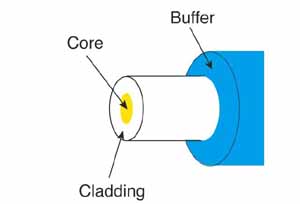
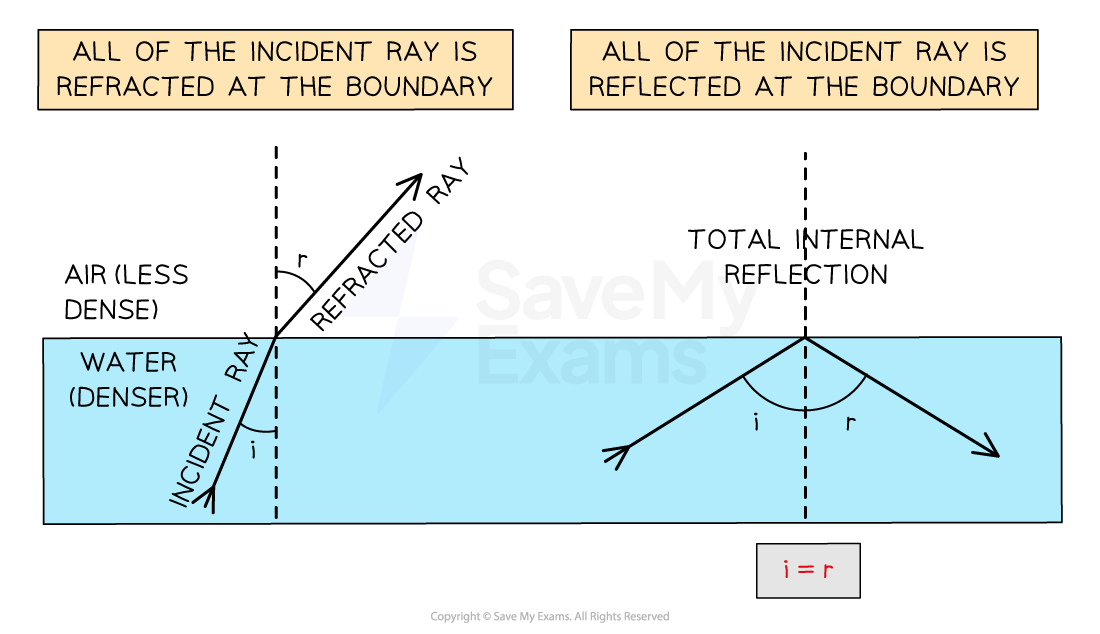
Snell’s Law also explains total internal reflection.
Critical Angle
The critical angle is the angle of incidence for which the angle of refraction becomes 90 degrees.
Formula:
[
\sin C = \frac{n_2}{n_1}
]
Where:
- (C) = critical angle
- (n_1) = refractive index of denser medium
- (n_2) = refractive index of rarer medium
If the angle of incidence exceeds the critical angle, total internal reflection occurs.
Applications include:
- Optical fibers
- Medical endoscopes
- Prism binoculars
Applications of Snell’s Law


Snell’s Law is used in many scientific and technological fields.
Optical Fibers
Used in high-speed internet communication.
Cameras
Lens systems use refraction to focus light.
Eyeglasses
Correct vision defects using precise refraction.
Microscopes and Telescopes
Use lenses designed using Snell’s Law.
Rainbows
Refraction and dispersion in raindrops produce rainbows.
Importance of Snell’s Law in Optics
Snell’s Law is one of the most important laws in optics because it allows scientists to:
- Predict how light travels through different materials
- Design optical systems and instruments
- Understand atmospheric optical effects
- Develop fiber-optic communication systems
It connects the physical behavior of light with measurable quantities such as angles and refractive indices.
Conclusion
Snell’s Law provides the mathematical relationship that governs the bending of light during refraction. It states that the ratio of the sines of the angles of incidence and refraction depends on the refractive indices of the two media involved.
This law explains how light behaves when it travels between different materials and is essential for understanding many optical phenomena and technologies. From simple observations like a bent straw in water to advanced technologies such as optical fibers and precision lenses, Snell’s Law plays a central role in modern optics.
Understanding Snell’s Law allows scientists and engineers to control and manipulate light for scientific research, communication systems, and optical instruments.