


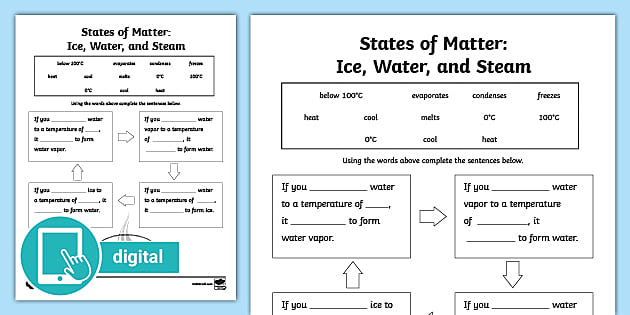

1. Introduction to States of Matter
Matter is the fundamental substance that makes up everything in the universe. In chemistry and physics, matter is defined as anything that has mass and occupies space. Matter can exist in different forms known as states of matter, depending on the arrangement and energy of its particles.
The concept of states of matter explains how atoms and molecules behave under different conditions such as temperature and pressure. When matter absorbs or releases energy, the motion and arrangement of its particles change, causing the substance to transition from one state to another.
Traditionally, scientists recognized three classical states of matter:
- Solid
- Liquid
- Gas
Later, scientists discovered a fourth state known as plasma, which is common in high-energy environments such as stars.
Modern physics has also identified additional exotic states like Bose–Einstein condensates, but the four primary states remain the most important in chemistry.
Understanding the states of matter is essential because it explains many natural phenomena, including:
- The formation of clouds
- The melting of ice
- The evaporation of water
- The behavior of gases in the atmosphere
- The operation of refrigeration systems
- The functioning of engines and industrial processes
The differences between states of matter arise mainly from:
- Particle arrangement
- Intermolecular forces
- Particle motion
- Energy levels
2. Particle Theory of Matter


The particle theory of matter, also called the kinetic molecular theory, explains the behavior of matter in different states. According to this theory:
- All matter is made of tiny particles such as atoms, molecules, or ions.
- These particles are constantly in motion.
- The speed of particle motion increases with temperature.
- There are forces of attraction between particles.
- The spacing between particles differs in different states of matter.
This theory helps explain why solids maintain shape, why liquids flow, and why gases expand to fill containers.
When energy is added to a substance, particles gain kinetic energy and move more rapidly. When energy is removed, particles slow down and come closer together.
3. Solid State of Matter


A solid is a state of matter characterized by closely packed particles arranged in a fixed pattern. The strong forces of attraction between particles keep them in fixed positions.
Characteristics of Solids
Solids have several distinctive properties:
Definite shape
Solids maintain a fixed shape regardless of the container they are placed in.
Definite volume
Solids occupy a fixed volume because particles are tightly packed.
High density
Particles are closely packed, making solids relatively dense.
Limited compressibility
Solids cannot be easily compressed due to minimal space between particles.
Particle motion
Particles vibrate around fixed positions but do not move freely.
Types of Solids
Solids can be classified into two main types:
Crystalline Solids
Crystalline solids have particles arranged in an orderly repeating pattern known as a crystal lattice.
Examples include:
- Sodium chloride crystals
- Quartz
- Diamond
- Metals
Crystalline solids have well-defined melting points.
Amorphous Solids
Amorphous solids lack a regular internal structure.
Examples include:
- Glass
- Plastic
- Rubber
- Wax
Amorphous solids soften gradually instead of melting sharply.
Examples of Solids
Common examples of solids include:
- Ice
- Wood
- Iron
- Stone
- Salt
- Sugar
Solids form the structural foundation of many objects in everyday life, including buildings, tools, and machines.
4. Liquid State of Matter



A liquid is a state of matter in which particles are close together but not fixed in position. The intermolecular forces are weaker than those in solids, allowing particles to slide past each other.
Characteristics of Liquids
Definite volume
Liquids maintain a constant volume.
No fixed shape
Liquids take the shape of the container in which they are placed.
Moderate density
Liquids are generally less dense than solids but denser than gases.
Ability to flow
Liquids can flow because particles move relative to one another.
Low compressibility
Liquids are difficult to compress due to relatively small spaces between particles.
Important Properties of Liquids
Viscosity
Viscosity is the resistance of a liquid to flow.
Examples:
- Honey has high viscosity.
- Water has low viscosity.
Surface Tension
Surface tension is the cohesive force at the surface of a liquid that allows it to form droplets.
Water droplets forming beads on surfaces demonstrate surface tension.
Capillary Action
Capillary action is the ability of liquids to move upward through narrow tubes due to adhesive and cohesive forces.
This phenomenon allows plants to transport water from roots to leaves.
Examples of Liquids
Examples include:
- Water
- Oil
- Alcohol
- Mercury
- Milk
Liquids are essential for life processes and industrial applications.
5. Gas State of Matter


A gas is a state of matter in which particles are widely spaced and move freely in all directions.
Characteristics of Gases
No fixed shape
Gases take the shape of their container.
No fixed volume
Gases expand to fill the entire container.
Very low density
Particles are far apart compared to solids and liquids.
High compressibility
Gases can be compressed significantly due to large empty spaces between particles.
Rapid particle motion
Gas particles move rapidly and randomly.
Behavior of Gases
Gas behavior is described by several gas laws:
- Boyle’s Law
- Charles’s Law
- Gay-Lussac’s Law
- Ideal Gas Law
These laws describe relationships between pressure, volume, temperature, and number of particles.
Diffusion
Diffusion is the process by which gas particles spread out and mix with other gases.
For example, the smell of perfume spreads through a room due to diffusion.
Effusion
Effusion occurs when gas particles escape through tiny openings without significant collisions.
6. Plasma State of Matter




Plasma is often called the fourth state of matter. It forms when gases are heated to extremely high temperatures or exposed to strong electromagnetic energy.
At such high energy levels, electrons are stripped from atoms, creating a mixture of positive ions and free electrons.
Characteristics of Plasma
- Highly energetic particles
- Electrically conductive
- Strong response to magnetic fields
- Often emits light
Examples of Plasma
Plasma occurs naturally and artificially.
Natural examples:
- The Sun and stars
- Lightning
- Auroras
Artificial examples:
- Neon lights
- Plasma TVs
- Plasma torches used in industry
Most of the visible universe is actually composed of plasma rather than solids, liquids, or gases.
7. Changes Between States of Matter


Matter can change from one state to another when temperature or pressure changes. These transformations are known as phase changes.
Melting
Melting is the process in which a solid changes into a liquid when heat is added.
Example: ice melting into water.
Freezing
Freezing occurs when a liquid changes into a solid due to cooling.
Example: water turning into ice.
Evaporation
Evaporation is the conversion of a liquid into a gas at temperatures below the boiling point.
Boiling
Boiling occurs when a liquid changes into a gas throughout the entire liquid at its boiling point.
Condensation
Condensation is the conversion of gas into liquid when temperature decreases.
Example: water droplets forming on a cold surface.
Sublimation
Sublimation is the direct conversion of a solid into gas without passing through the liquid state.
Example: dry ice turning into carbon dioxide gas.
Deposition
Deposition is the direct transformation of gas into solid.
Example: frost forming on surfaces during cold weather.
8. Factors Affecting States of Matter
Two primary factors influence the state of matter.
Temperature
Temperature affects the kinetic energy of particles.
Higher temperature → faster particle motion → expansion of matter.
Lower temperature → slower particle motion → particles move closer together.
Pressure
Pressure also influences particle arrangement.
Increasing pressure can compress gases into liquids or solids.
This principle is used in gas liquefaction processes.
9. Advanced States of Matter
In extreme conditions, matter can exist in unusual states beyond the classical four.
Bose–Einstein Condensate
This state occurs at extremely low temperatures close to absolute zero.
Particles behave as a single quantum entity.
Fermionic Condensate
A related state formed by fermions at ultra-low temperatures.
Superfluid
A phase where liquids flow without viscosity.
These exotic states are primarily studied in quantum physics laboratories.
10. Importance of States of Matter in Science and Technology
Understanding states of matter is essential in many scientific and technological fields.
Chemistry
Helps explain reactions, bonding, and material properties.
Physics
Explains particle behavior, thermodynamics, and quantum mechanics.
Meteorology
Weather patterns depend on phase changes of water.
Engineering
Used in refrigeration, engines, and industrial manufacturing.
Medicine
Understanding biological fluids and gases is crucial in physiology and medical technology.
Environmental Science
States of matter help explain atmospheric processes and climate systems.
11. Conclusion
The states of matter represent the fundamental forms in which matter exists. The arrangement, motion, and interactions of particles determine whether matter behaves as a solid, liquid, gas, or plasma.
Solids maintain fixed shapes and volumes due to strong intermolecular forces. Liquids have definite volume but can flow and change shape. Gases have neither fixed shape nor volume and expand to fill their containers. Plasma represents an energetic ionized state found in extreme environments.
Understanding the states of matter provides essential insight into natural phenomena and technological applications. From everyday processes such as boiling water to cosmic phenomena like stars and lightning, the behavior of matter in different states plays a crucial role in shaping the universe.
The study of states of matter forms a foundation for deeper exploration of thermodynamics, quantum mechanics, material science, and many other advanced areas of chemistry and physics.