Tag Archives: sound waves

Sound Waves

Image
Image
Image
Image

1. Introduction to Sound Waves

Sound waves are a fundamental form of wave motion that plays an essential role in communication, music, technology, and many natural processes. Sound is produced whenever an object vibrates, creating disturbances that travel through a medium such as air, water, or solids. These disturbances propagate as waves and can be detected by the human ear or specialized instruments.

Unlike light waves, sound waves require a material medium to travel through. They cannot propagate through empty space because they rely on the vibrations of particles within a medium to transfer energy. When a sound is produced, the particles of the medium vibrate back and forth around their equilibrium positions, passing energy from one particle to the next.

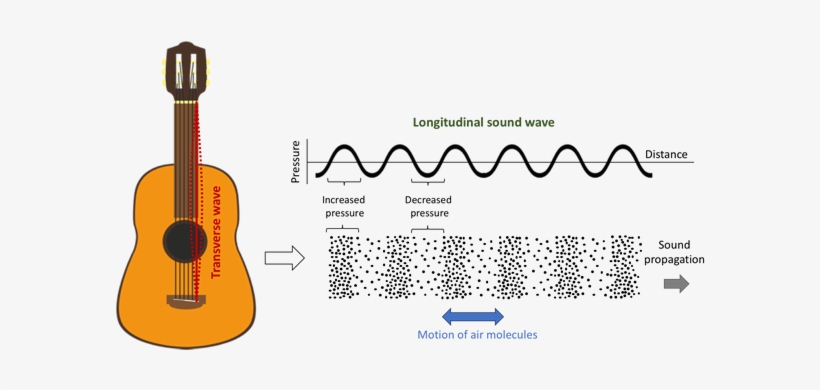
Sound waves are an example of mechanical longitudinal waves, meaning that the oscillations of the particles occur in the same direction as the wave propagation. As the wave travels, regions of compression and rarefaction form within the medium. These alternating regions create the pressure variations that our ears interpret as sound.

The study of sound waves is known as acoustics, which is a branch of physics that examines sound production, transmission, and perception. Acoustics has applications in many fields, including engineering, architecture, music, medicine, and environmental science.

Understanding sound waves helps explain phenomena such as echoes, musical tones, noise pollution, sonar systems, and ultrasound imaging.


2. Definition of Sound Waves

A sound wave can be defined as:

A mechanical longitudinal wave that propagates through a medium due to vibrations of particles and transfers energy in the form of pressure variations.

Sound waves consist of alternating regions of high pressure and low pressure within the medium.

These regions are known as:

  • Compression
  • Rarefaction

As the wave moves through the medium, particles vibrate parallel to the direction of wave propagation.

Key characteristics of sound waves include:

  • They require a medium.
  • They involve particle vibrations.
  • They carry energy.
  • They travel with a specific speed depending on the medium.

3. Production of Sound
Image
Image
Image
Image

Sound is produced whenever an object vibrates.

These vibrations disturb the surrounding medium, creating waves that travel outward.

Example: Tuning Fork

When a tuning fork is struck:

  1. The prongs vibrate.
  2. Air molecules around the fork are compressed.
  3. These compressions move outward through the air.
  4. Rarefactions follow the compressions.
  5. The alternating pattern travels as a sound wave.

Example: Human Voice

Human speech is produced by vibrations of the vocal cords in the larynx.

Air passing through the vocal cords causes them to vibrate.

These vibrations create sound waves that travel through the air.

Example: Musical Instruments

Musical instruments produce sound through vibrations of strings, membranes, or air columns.

Examples:

  • Guitar strings vibrate to produce musical tones.
  • Drums produce sound through vibrating membranes.
  • Flutes produce sound through vibrating air columns.

4. Structure of Sound Waves

Image
Image
Image
Image

Sound waves consist of two main regions.

Compression

Compression occurs when particles of the medium are pushed together.

This creates a region of high pressure and high density.

Rarefaction

Rarefaction occurs when particles move apart.

This creates a region of low pressure and low density.

These compressions and rarefactions move through the medium as the sound wave travels.

Although the wave moves forward, the particles only oscillate back and forth around their equilibrium positions.


5. Properties of Sound Waves

Sound waves have several measurable properties.

Wavelength

Wavelength is the distance between two consecutive compressions or rarefactions.

Symbol: λ

Unit: meter


Frequency

Frequency is the number of sound wave cycles passing a point per second.

Symbol: f

Unit: Hertz (Hz)

Higher frequency produces higher pitch.


Amplitude

Amplitude measures the maximum pressure variation in the wave.

Greater amplitude corresponds to louder sound.


Wave Speed

Wave speed is the rate at which sound waves travel through a medium.

The speed depends on the properties of the medium.

Formula:

v = fλ

Where:

v = velocity
f = frequency
λ = wavelength


6. Speed of Sound

The speed of sound varies depending on the medium through which it travels.

Typical speeds include:

Air (at 20°C): 343 m/s
Water: 1480 m/s
Steel: about 5000 m/s

Sound travels faster in solids than in liquids and faster in liquids than in gases.

This is because particles in solids are more closely packed and can transfer vibrations more quickly.

Factors Affecting Speed

Several factors influence sound speed:

  • Density of the medium
  • Elastic properties of the medium
  • Temperature
  • Humidity

For example, sound travels faster in warm air than in cold air because higher temperature increases molecular motion.


7. Characteristics of Sound

Image
Image
Image
Image

Sound is perceived by humans through three main characteristics.

Pitch

Pitch is determined by frequency.

High-frequency sounds produce high pitch.

Low-frequency sounds produce low pitch.

Examples:

  • Whistle: high pitch
  • Drum: low pitch

Loudness

Loudness depends on amplitude.

Larger amplitude means louder sound.

Sound intensity is measured in decibels (dB).


Quality (Timbre)

Quality distinguishes sounds produced by different instruments even when they have the same pitch and loudness.

This occurs because different instruments produce different waveforms.

For example:

A violin and piano playing the same note sound different because of their timbre.


8. Types of Sound Waves

Sound waves can be classified based on frequency.

Infrasonic Waves

Frequency less than 20 Hz.

These waves cannot be heard by humans.

Examples:

  • Earthquake vibrations
  • Elephant communication

Audible Sound

Frequency range between 20 Hz and 20,000 Hz.

This is the range detectable by the human ear.


Ultrasonic Waves

Frequency greater than 20,000 Hz.

Used in medical imaging, sonar, and industrial applications.

Animals such as bats and dolphins use ultrasonic waves for navigation.


9. Reflection of Sound

Reflection occurs when sound waves bounce off surfaces.

Example:

Echo.

An echo is heard when sound reflects from a distant object and returns to the listener.

Conditions for hearing an echo:

  • The reflecting surface must be at least 17 meters away.
  • The reflected sound must return after about 0.1 seconds.

Reflection of sound is used in designing auditoriums and concert halls.


10. Refraction of Sound

Refraction occurs when sound waves change direction due to changes in medium properties.

For example:

Sound may travel faster in warm air than in cold air.

This can cause bending of sound waves in the atmosphere.

Refraction explains why distant sounds are sometimes heard more clearly at night.


11. Diffraction of Sound

Diffraction refers to the bending of sound waves around obstacles or openings.

Because sound wavelengths are relatively large, sound diffracts easily.

This is why we can hear sounds around corners even if we cannot see the source.


12. Interference of Sound

When two sound waves meet, they combine according to the superposition principle.

This produces interference patterns.

Types:

Constructive interference – sound becomes louder
Destructive interference – sound becomes weaker

Interference is used in noise-canceling headphones.


13. Applications of Sound Waves

Sound waves have numerous applications in science and technology.

Communication

Speech and hearing rely on sound waves.

Music

Musical instruments create sound through vibrations.

Medical Imaging

Ultrasound uses high-frequency sound waves to produce images of internal organs.

SONAR

SONAR systems use sound waves to detect underwater objects.

Industrial Testing

Ultrasonic waves detect cracks in materials.


14. Sound Waves in Nature

Sound waves play important roles in the natural world.

Examples include:

  • Animal communication
  • Whale and dolphin sonar
  • Earthquake seismic waves
  • Thunder from lightning

Many animals rely on sound waves for navigation and survival.


15. Importance of Sound Waves

Sound waves are essential for many aspects of human life.

They allow:

  • Communication through speech
  • Enjoyment of music
  • Medical diagnosis using ultrasound
  • Underwater exploration
  • Scientific research in acoustics

The study of sound waves has led to many technological innovations that improve communication, healthcare, and engineering.


Conclusion

Sound waves are mechanical longitudinal waves produced by vibrating objects and transmitted through a medium. They consist of alternating compressions and rarefactions that travel through materials such as air, water, and solids.

The properties of sound waves include wavelength, frequency, amplitude, and speed. These properties determine how sound behaves and how it is perceived by the human ear in terms of pitch, loudness, and quality.

Sound waves exhibit several wave behaviors including reflection, refraction, diffraction, and interference. These behaviors explain many natural and technological phenomena such as echoes, acoustic design, sonar systems, and noise control.

The study of sound waves forms the foundation of acoustics and has applications in music, communication, medicine, engineering, and environmental science. Understanding sound waves allows scientists and engineers to analyze how sound is produced, transmitted, and detected, enabling the development of technologies that enhance our ability to communicate and explore the world around us.


Wave Properties: Frequency, Wavelength, and Amplitude

Image
Image
Image
Image

1. Introduction to Wave Properties

Wave motion is one of the most important phenomena in physics because it explains how energy and information travel through space and through different media. Waves occur in many forms, including sound waves, water waves, electromagnetic waves, and even matter waves in quantum mechanics. Although these waves may differ in their physical nature, they share several fundamental characteristics that describe how they behave and propagate.

Among the most important properties of waves are frequency, wavelength, and amplitude. These properties determine the energy carried by a wave, the speed at which it travels, and how it interacts with matter. By understanding these wave properties, scientists and engineers can analyze wave behavior in various fields such as acoustics, optics, oceanography, telecommunications, and seismology.

Every wave can be described using measurable quantities. Frequency indicates how often the wave oscillates, wavelength describes the spatial distance between repeating points in the wave, and amplitude represents the strength or intensity of the oscillation. Together, these parameters define the overall characteristics of a wave and determine how it affects its environment.

Understanding wave properties is essential for interpreting many natural phenomena. For example, the pitch of a musical note depends on frequency, the color of visible light depends on wavelength, and the loudness of a sound depends on amplitude. Similarly, ocean waves, radio signals, and seismic vibrations can all be analyzed using these same fundamental properties.

In physics, waves are often represented graphically as sinusoidal patterns. These graphical representations make it easier to visualize the relationships between frequency, wavelength, amplitude, and wave velocity.


2. Basic Structure of a Wave

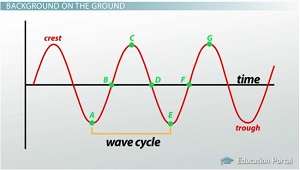
To understand wave properties, it is helpful to examine the structure of a wave. In a typical transverse wave, the wave pattern consists of alternating crests and troughs.

Crest

A crest is the highest point of a wave above the equilibrium position.

Trough

A trough is the lowest point of a wave below the equilibrium position.

Equilibrium Position

The equilibrium position is the rest position of the particles in the medium when no wave is present.

Wave Cycle

One complete wave cycle consists of one crest and one trough or the distance between two identical points such as crest to crest.

These structural features form the basis for defining important wave properties such as wavelength and amplitude.


3. Wavelength

Image
Image
Image
Image

Definition

Wavelength is the distance between two consecutive points in the same phase of a wave.

These points can include:

  • Crest to crest
  • Trough to trough
  • Compression to compression
  • Rarefaction to rarefaction

Wavelength is usually represented by the Greek letter λ (lambda).

Unit of Wavelength

The SI unit of wavelength is meter (m).

However, depending on the type of wave, wavelength may be expressed in different units such as:

  • centimeters
  • millimeters
  • nanometers
  • kilometers

For example:

  • Radio waves may have wavelengths of several kilometers.
  • Visible light wavelengths are measured in nanometers.

Examples of Wavelength

Visible light wavelengths range approximately from:

400 nm (violet light) to 700 nm (red light)

Radio waves can have wavelengths longer than 1 kilometer.

Water waves may have wavelengths ranging from a few centimeters to several meters.

Relationship with Wave Speed

Wavelength is related to wave speed and frequency through the wave equation:

v = fλ

Where:

v = wave velocity
f = frequency
λ = wavelength

If wave speed remains constant, increasing frequency results in a shorter wavelength.


4. Frequency

Image
Image
Image
Image

Definition

Frequency is the number of wave cycles passing a given point in one second.

It indicates how rapidly the wave oscillates.

Frequency is represented by the symbol f.

Unit of Frequency

The SI unit of frequency is Hertz (Hz).

1 Hz means one cycle per second.

Other commonly used units include:

  • kilohertz (kHz)
  • megahertz (MHz)
  • gigahertz (GHz)

These units are commonly used in radio communication and electronics.

Time Period

Frequency is closely related to time period.

Time period is the time required to complete one full cycle.

Relationship:

T = 1 / f

Where:

T = time period
f = frequency

Examples of Frequency

Different types of waves have different frequency ranges.

Human hearing range:

20 Hz to 20,000 Hz

Radio waves:

Thousands to billions of Hz

Visible light:

Around 4 × 10¹⁴ Hz to 7.5 × 10¹⁴ Hz

Effect of Frequency

Frequency determines many important properties.

For sound waves:

Frequency determines pitch.

Higher frequency produces higher pitch.

For electromagnetic waves:

Frequency determines energy and color.

Higher frequency waves have greater energy.


5. Amplitude

Image
Image
Image
Image

Definition

Amplitude is the maximum displacement of a particle from its equilibrium position.

It represents the height of the wave crest or the depth of the trough relative to the equilibrium line.

Amplitude is usually represented by the symbol A.

Unit of Amplitude

The unit of amplitude depends on the type of wave.

For mechanical waves:

meters

For sound waves:

pressure variations

For electromagnetic waves:

electric field intensity

Energy and Amplitude

Wave energy is strongly related to amplitude.

Energy carried by a wave is proportional to the square of the amplitude.

This means:

Doubling amplitude increases energy four times.

Examples

Sound waves:

Large amplitude → loud sound

Small amplitude → soft sound

Water waves:

Large amplitude → powerful waves

Small amplitude → gentle ripples

Light waves:

Higher amplitude → brighter light


6. Relationship Between Frequency, Wavelength, and Wave Speed

One of the most important equations in wave physics connects frequency, wavelength, and velocity.

Wave equation:

v = fλ

Where:

v = wave speed
f = frequency
λ = wavelength

This equation applies to all types of waves.

Example

If a wave has:

Frequency = 10 Hz
Wavelength = 2 m

Then:

v = 10 × 2

v = 20 m/s

Interpretation

If frequency increases while wave speed remains constant, wavelength decreases.

If wavelength increases while speed remains constant, frequency decreases.

This relationship explains many phenomena such as sound pitch changes and light color variations.


7. Wave Properties in Different Types of Waves

Sound Waves

Sound waves are longitudinal waves.

Frequency determines pitch.

Amplitude determines loudness.

Wavelength affects how sound propagates in different environments.


Light Waves

Light waves are electromagnetic waves.

Frequency determines color.

Amplitude determines brightness.

Wavelength determines position in the electromagnetic spectrum.


Water Waves

Water waves involve both transverse and longitudinal motion.

Amplitude determines wave height.

Wavelength determines distance between crests.

Frequency determines how rapidly waves arrive at the shore.


8. Graphical Representation of Wave Properties

Waves are often represented graphically to visualize their properties.

Common graphs include:

Displacement vs Distance

This graph shows the shape of the wave and helps measure wavelength.

Displacement vs Time

This graph shows how particles move over time and helps determine frequency.

Amplitude Representation

The height of the wave from equilibrium shows amplitude.

These graphical methods are widely used in physics and engineering.


9. Applications of Wave Properties

Understanding wave properties is essential in many practical applications.

Music and Acoustics

Musical instruments produce sound waves.

Frequency determines musical pitch.

Amplitude determines loudness.


Communication Technology

Radio waves carry information using frequency modulation.

Television and mobile networks rely on electromagnetic waves.


Medical Imaging

Ultrasound imaging uses high-frequency sound waves to produce images of internal organs.


Oceanography

Wave height and wavelength are studied to understand ocean currents and coastal erosion.


Astronomy

Astronomers analyze electromagnetic waves from stars and galaxies to study the universe.


10. Wave Properties in Nature

Wave properties influence many natural phenomena.

Examples include:

  • Ocean waves
  • Sound propagation in atmosphere
  • Light from the Sun
  • Seismic waves during earthquakes
  • Vibrations of atoms in solids

Understanding these properties allows scientists to analyze and predict natural processes.


11. Energy Transport by Waves

Waves transport energy without transporting matter.

Energy transfer occurs through oscillations of particles.

The amount of energy depends mainly on amplitude.

Higher amplitude waves carry more energy and can cause stronger physical effects.

For example:

Large ocean waves can damage ships and coastlines because of their high energy.

Similarly, powerful seismic waves during earthquakes cause destruction due to their large amplitude.


12. Importance of Wave Properties in Physics

Wave properties are essential for understanding many physical systems.

They help explain:

  • Sound transmission
  • Light propagation
  • Electromagnetic radiation
  • Quantum mechanical waves
  • Vibrations in mechanical systems

Many modern technologies depend on controlling wave properties.

Examples include:

  • Laser technology
  • Fiber optic communication
  • Radar systems
  • Medical imaging equipment

Thus, wave properties play a fundamental role in science and engineering.


Conclusion

Wave properties such as frequency, wavelength, and amplitude are fundamental concepts in physics that describe how waves behave and propagate through different environments. These properties determine how waves carry energy, interact with matter, and transmit information.

Wavelength describes the spatial distance between repeating points in a wave, frequency indicates how often the wave oscillates, and amplitude represents the strength or intensity of the wave. Together, these properties are related through the fundamental wave equation that connects wave speed, frequency, and wavelength.

Understanding wave properties allows scientists and engineers to analyze sound, light, ocean waves, seismic vibrations, and electromagnetic radiation. These principles are essential for modern technologies including communication systems, medical imaging devices, and scientific instruments.

The study of wave properties therefore provides a powerful framework for understanding many natural phenomena and technological applications. By analyzing frequency, wavelength, and amplitude, researchers can predict wave behavior and harness wave energy for practical purposes across many fields of science and engineering.


Tags: