


Introduction
Refraction of light is a fundamental phenomenon in optics in which light changes its direction when it passes from one transparent medium to another. This change in direction occurs because the speed of light changes when it travels between different media such as air, water, glass, or plastic.
Refraction is responsible for many optical effects observed in everyday life. For example:
- A straw appearing bent in a glass of water
- The apparent shallowness of water in a swimming pool
- The formation of rainbows
- The functioning of lenses in eyeglasses and cameras
The study of refraction helps scientists understand how light behaves when interacting with different materials. This knowledge is essential in designing optical instruments such as microscopes, telescopes, cameras, and optical fibers.
Refraction is governed by specific physical laws and mathematical relationships that describe how light bends when entering a new medium.
Nature of Light and Refraction


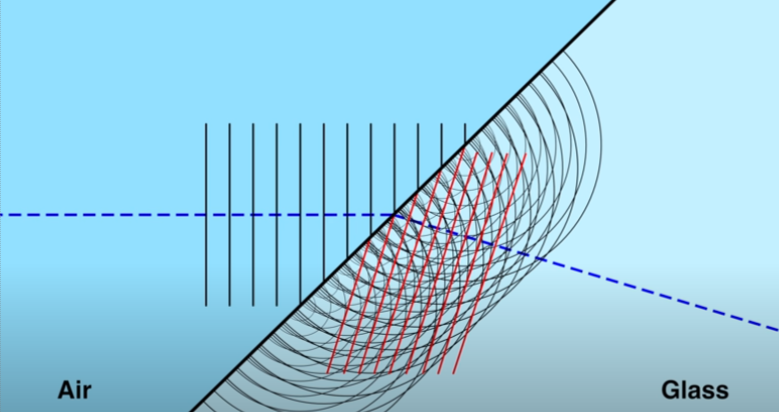
Light is an electromagnetic wave that travels through space and different materials. When light passes from one medium to another, its speed changes depending on the optical density of the medium.
Examples of different media include:
- Air
- Water
- Glass
- Plastic
- Diamond
When light enters a medium where it travels more slowly, its direction changes. This bending of light is called refraction.
Optical Density
Optical density refers to how much a medium slows down light. A medium with higher optical density slows light more strongly.
Examples:
- Glass has higher optical density than air.
- Diamond has higher optical density than glass.
Laws of Refraction

Refraction of light follows two important laws known as the laws of refraction.
First Law of Refraction
The incident ray, the refracted ray, and the normal at the point of incidence lie in the same plane.
Second Law of Refraction (Snell’s Law)
The ratio of the sine of the angle of incidence to the sine of the angle of refraction is constant for a given pair of media.
[
\frac{\sin i}{\sin r} = constant
]
This constant is called the refractive index.
Refractive Index


The refractive index measures how much light slows down in a medium.
Formula
[
n = \frac{c}{v}
]
Where:
- (n) = refractive index
- (c) = speed of light in vacuum
- (v) = speed of light in the medium
Typical refractive indices:
| Medium | Refractive Index |
|---|---|
| Air | 1.0003 |
| Water | 1.33 |
| Glass | 1.5 |
| Diamond | 2.42 |
A higher refractive index means light travels slower in that medium.
Bending of Light Between Media
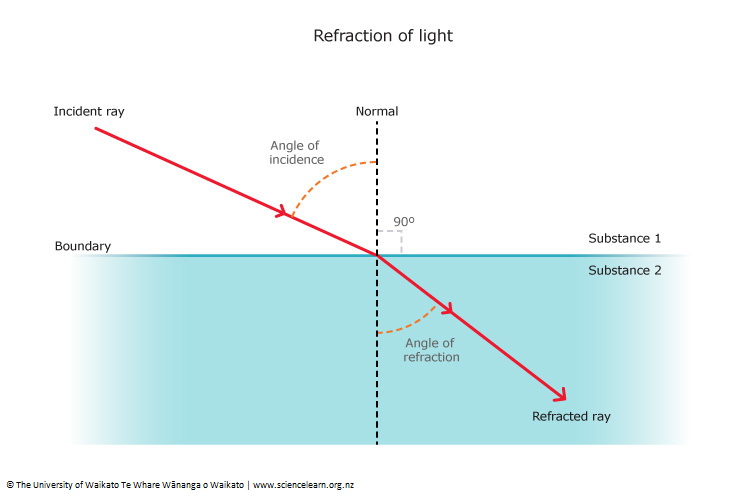

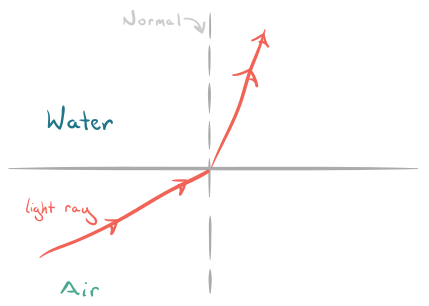
The direction of bending depends on the optical densities of the media.
Light entering a denser medium
When light travels from a less dense medium to a more dense medium:
- Light bends toward the normal.
Example:
Air → Glass
Light entering a rarer medium
When light travels from a denser medium to a less dense medium:
- Light bends away from the normal.
Example:
Water → Air
Refraction Through a Glass Slab
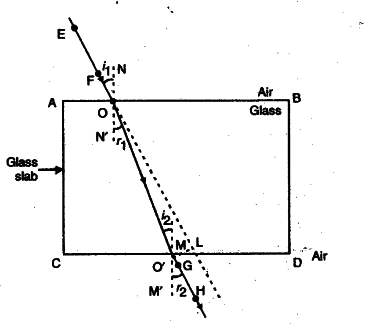
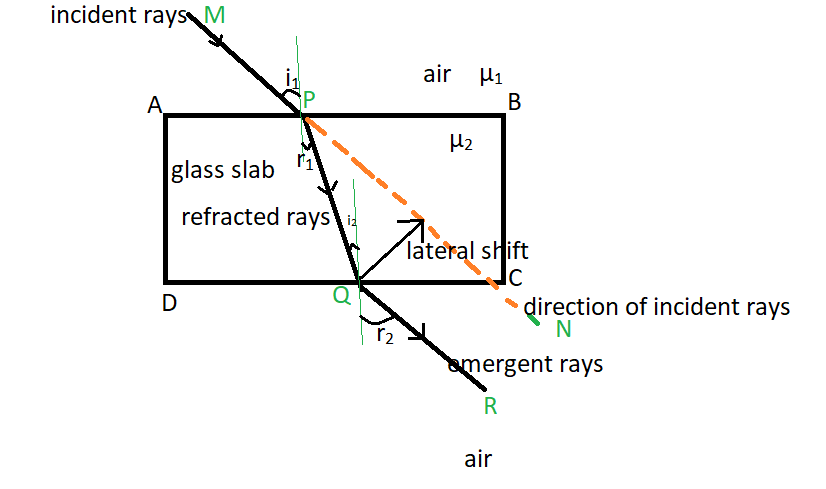
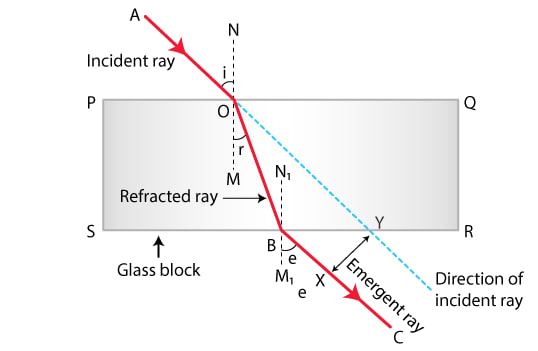
When light passes through a rectangular glass slab:
- Light bends toward the normal when entering the slab.
- Light bends away from the normal when leaving the slab.
- The emergent ray becomes parallel to the incident ray.
However, the ray is shifted sideways. This shift is called lateral displacement.
Lateral displacement depends on:
- Thickness of the slab
- Angle of incidence
- Refractive index of the material
Refraction Through a Prism


A prism is a transparent optical element with flat surfaces that refract light.
When light enters a prism:
- It bends at the first surface.
- It bends again when leaving the prism.
The overall change in direction is called the angle of deviation.
Prisms are used in:
- Spectroscopy
- Optical instruments
- Light dispersion experiments
Total Internal Reflection

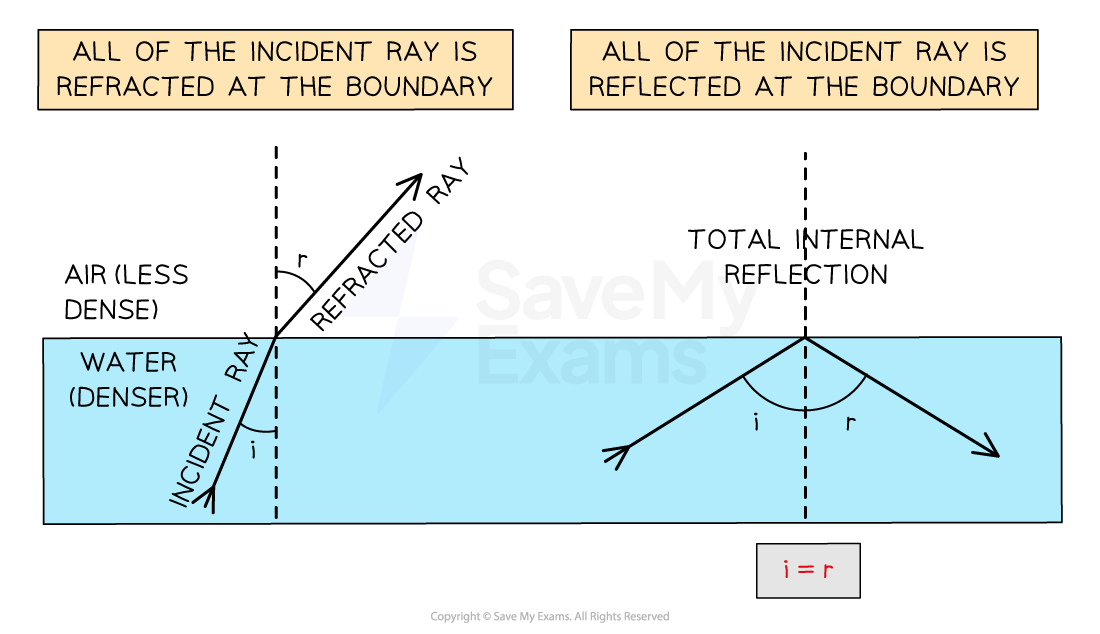

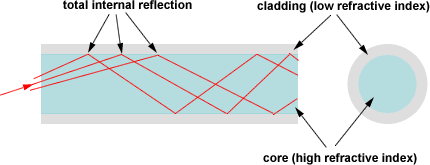
When light travels from a denser medium to a rarer medium, it may undergo total internal reflection.
This occurs when:
- Light travels from denser to rarer medium.
- Angle of incidence exceeds a certain value called the critical angle.
Instead of refracting, the light is completely reflected back into the medium.
Applications include:
- Optical fibers
- Endoscopes
- Prism binoculars
Refraction Through Lenses
Convex Lens


A convex lens converges parallel rays to a focal point.
Uses:
- Magnifying glasses
- Cameras
- Microscopes
Convex lenses can produce real or virtual images depending on object position.
Concave Lens


A concave lens diverges light rays.
Characteristics:
- Forms virtual images
- Image is smaller than the object
Applications include:
- Correcting myopia (short-sightedness)
- Door viewers
Applications of Refraction


Refraction plays an important role in many technologies.
Optical Fibers
Used in high-speed internet communication.
Eyeglasses
Correct vision defects using refraction through lenses.
Cameras
Lenses focus light onto sensors.
Microscopes
Use lenses to magnify tiny objects.
Rainbows
Formed due to refraction and dispersion of sunlight in raindrops.
Importance of Refraction
Refraction is essential in understanding optical phenomena and designing optical devices.
It explains:
- Vision and eyesight correction
- Optical instruments
- Light transmission in materials
- Atmospheric optical effects
Without refraction, modern optical technology would not exist.
Conclusion
Refraction of light occurs when light changes direction as it passes from one medium to another due to a change in speed. This bending of light is governed by the laws of refraction and described mathematically by Snell’s law.
The refractive index of a material determines how strongly it bends light. Refraction occurs in many everyday situations and is responsible for numerous optical phenomena.
The principles of refraction are used in lenses, prisms, optical fibers, microscopes, telescopes, cameras, and many other technologies. Understanding refraction is essential for studying optics and developing modern optical systems.