


Introduction to Geometric Transformations
In mathematics, transformations describe how a geometric figure changes its position, orientation, or size in a plane. Transformations are fundamental concepts in geometry because they help us understand how shapes move and how they relate to each other.
A transformation maps every point of a figure to a new position according to a specific rule. When a transformation occurs, the original figure is called the pre-image, and the resulting figure after transformation is called the image.
Transformations play an important role in many mathematical topics such as coordinate geometry, symmetry, congruence, and similarity. They are also widely used in fields like computer graphics, engineering design, robotics, physics, architecture, and animation.
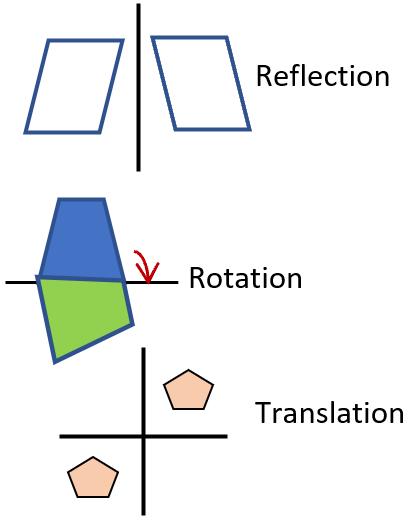
The most common types of geometric transformations are:
- Translation
- Reflection
- Rotation
- Dilation
However, the three most basic transformations studied in geometry are translation, reflection, and rotation. These transformations preserve the size and shape of figures and are therefore called rigid transformations or isometries.
Definition of Transformation
A transformation is a mathematical operation that moves or changes a geometric figure in a plane according to certain rules.
The transformation assigns each point ((x,y)) of the original figure to a new point ((x’,y’)).
The transformation can change:
- the position of a shape
- the orientation of a shape
- the direction of a shape
But rigid transformations do not change the size or shape of the figure.
Types of Transformations
The three main types of transformations studied in geometry are:
- Translation
- Reflection
- Rotation
Each transformation moves the figure in a different way.
Translation
Definition of Translation
A translation is a transformation that moves every point of a figure the same distance in the same direction.
In translation:
- The shape does not rotate.
- The shape does not change size.
- The orientation remains the same.
Translation is often described as a slide.
Example of Translation
Consider a point:
[
(2,3)
]
If we translate the point 4 units right and 2 units up:
[
(2+4, 3+2)
]
[
(6,5)
]
The new point becomes (6,5).
Translation Rule
Translation can be expressed using coordinate rules.
General rule:
[
(x,y) \rightarrow (x+a, y+b)
]
Where:
- (a) = horizontal movement
- (b) = vertical movement
Example:
[
(x,y) \rightarrow (x+3,y-2)
]
Means move:
- 3 units right
- 2 units down
Properties of Translation
Important properties include:
- Distance between points remains the same
- Angles remain unchanged
- Shape and size remain unchanged
- Orientation stays the same
Translation preserves congruence.
Reflection
Definition of Reflection
A reflection is a transformation that flips a figure over a line called the line of reflection.
Reflection produces a mirror image of the original figure.
The line of reflection acts like a mirror.
Example of Reflection
If a point lies on one side of the mirror line, the reflected point appears the same distance on the opposite side.
Example:
Point:
[
(3,4)
]
Reflection across the y-axis:
[
(-3,4)
]
Reflection Rules
Reflection Across X-axis
Rule:
[
(x,y) \rightarrow (x,-y)
]
Example:
[
(2,5) \rightarrow (2,-5)
]
Reflection Across Y-axis
Rule:
[
(x,y) \rightarrow (-x,y)
]
Example:
[
(3,4) \rightarrow (-3,4)
]
Reflection Across Origin
Rule:
[
(x,y) \rightarrow (-x,-y)
]
Reflection Across Line (y=x)
Rule:
[
(x,y) \rightarrow (y,x)
]
Properties of Reflection
Reflection preserves:
- shape
- size
- distance
However, orientation is reversed.
For example, clockwise order becomes counterclockwise.
Rotation
Definition of Rotation
A rotation is a transformation that turns a figure around a fixed point called the center of rotation.
The rotation occurs through a certain angle and in a certain direction.
Rotations can be:
- clockwise
- counterclockwise
Center of Rotation
The center of rotation is the fixed point around which the figure rotates.
Often, rotations occur around the origin (0,0).
Common Rotation Angles
Common rotation angles include:
- 90°
- 180°
- 270°
Rotation Rules
90° Counterclockwise Rotation
Rule:
[
(x,y) \rightarrow (-y,x)
]
Example:
[
(3,2) \rightarrow (-2,3)
]
180° Rotation
Rule:
[
(x,y) \rightarrow (-x,-y)
]
Example:
[
(4,5) \rightarrow (-4,-5)
]
270° Counterclockwise Rotation
Rule:
[
(x,y) \rightarrow (y,-x)
]
Example:
[
(2,3) \rightarrow (3,-2)
]
Properties of Rotation
Rotation preserves:
- shape
- size
- distance
- angle measures
However, the orientation of the figure may change depending on the rotation.
Rigid Transformations
Translation, reflection, and rotation are called rigid transformations.
They preserve:
- length
- angle
- area
- shape
Because of this property, the original and transformed figures are congruent.
Composition of Transformations
Sometimes multiple transformations are applied in sequence.
This is called a composition of transformations.
Example:
- Translate a triangle.
- Rotate it 90°.
- Reflect it across the y-axis.
The final position depends on the order of transformations.
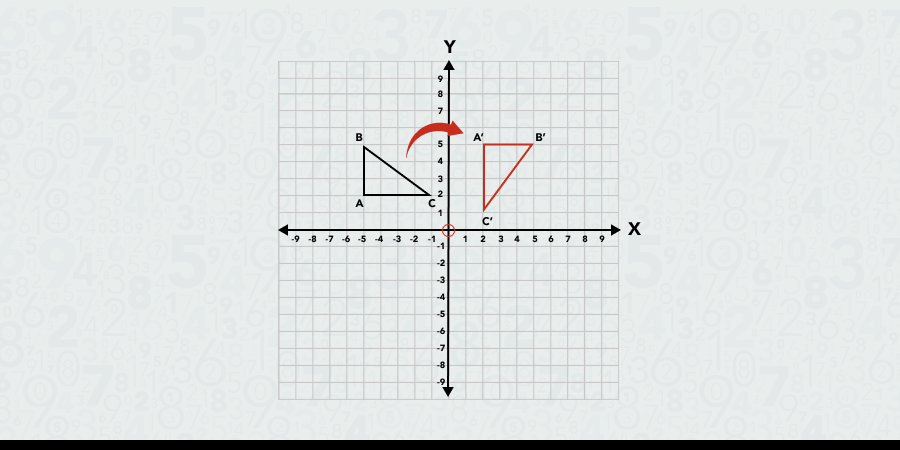
Transformations in Coordinate Geometry
Transformations are often studied using coordinate geometry.
Each transformation can be described using coordinate rules.
Example:
Triangle with vertices:
[
A(1,2), B(3,2), C(2,4)
]
After translation by (2,1):
[
A'(3,3), B'(5,3), C'(4,5)
]
Symmetry and Transformations
Transformations are closely related to symmetry.
Example:
Reflection symmetry occurs when a shape is mirrored.
Rotation symmetry occurs when a shape looks the same after rotation.
Example shapes with symmetry:
- square
- equilateral triangle
- circle
Transformations in Real Life
Transformations appear in many real-world applications.
Computer Graphics
Computer graphics use transformations to move objects on the screen.
Example:
Video game characters are translated, rotated, and reflected.
Robotics
Robots use transformations to calculate movement paths.
Architecture
Architectural designs often involve symmetrical reflections and rotations.
Physics
Physics uses transformations to describe motion and coordinate systems.
Animation
Animation relies heavily on transformations to move objects smoothly.
Transformations in Art and Design
Artists and designers use geometric transformations to create patterns.
Examples include:
- tessellations
- tiling designs
- decorative patterns
Mathematical Representation of Transformations
Transformations can also be represented using matrices.
Matrix transformations are used in:
- computer graphics
- physics simulations
- 3D modeling
Example:
Rotation matrices represent rotations in coordinate space.
Transformations in Higher Dimensions
Transformations are not limited to two dimensions.
In 3D space, transformations include:
- rotations around axes
- reflections across planes
- translations in space
These transformations are used in:
- virtual reality
- robotics
- mechanical simulations
Importance of Transformations
Transformations are important because they:
- help analyze geometric relationships
- explain symmetry
- support coordinate geometry
- model motion and movement
They also connect geometry with algebra and linear algebra.
Historical Development
The study of transformations developed alongside geometry.
Ancient mathematicians studied symmetry and reflections.
In modern mathematics, transformation geometry became an important field that focuses on geometric transformations and their properties.
Conclusion
Transformations in geometry describe how shapes move or change position within a coordinate plane. The three primary transformations—translation, reflection, and rotation—are fundamental tools for understanding geometric relationships and symmetry.
Translation slides a figure from one location to another without changing its orientation. Reflection flips a figure across a line, creating a mirror image. Rotation turns a figure around a fixed point by a specified angle.
These transformations preserve the size and shape of figures, making them rigid transformations. They play a crucial role in mathematics and have applications in many fields such as computer graphics, engineering, physics, architecture, and animation.
By studying transformations, mathematicians gain deeper insights into geometric structures and spatial relationships, making transformation geometry an essential part of mathematical education and modern scientific applications.