


Introduction to Triangles
Triangles are among the most fundamental shapes studied in geometry. A triangle is a polygon that has three sides, three vertices, and three angles. Despite its simple structure, the triangle possesses a rich set of properties and plays a central role in many areas of mathematics, especially in geometry and trigonometry.
Triangles appear in many natural and human-made structures. For example, bridges, roofs, and frameworks often use triangular designs because triangles provide structural stability. In mathematics, triangles help establish important geometric relationships such as angle sums, congruence, similarity, and trigonometric functions.
The study of triangles allows mathematicians to understand spatial relationships, solve measurement problems, and analyze shapes in both two-dimensional and three-dimensional spaces.
Definition of a Triangle
A triangle is a closed polygon formed by three line segments connecting three distinct points.
If the vertices are named A, B, and C, the triangle is written as:
[
\triangle ABC
]
The three sides are:
AB, BC, and CA
The three angles are:
∠A, ∠B, and ∠C
Basic Properties of Triangles
Triangles have several important properties.
Number of Sides
A triangle always has three sides.
Number of Angles
A triangle always has three angles.
Sum of Interior Angles
The sum of interior angles of a triangle is:
[
180^\circ
]
Example:
If two angles are 50° and 60°, the third angle is:
[
180 – (50 + 60) = 70^\circ
]
Exterior Angle Property
An exterior angle of a triangle equals the sum of the two opposite interior angles.
Example:
If two interior angles are 40° and 60°, the exterior angle is:
[
100^\circ
]
Classification of Triangles Based on Sides
Triangles can be categorized according to their side lengths.
Equilateral Triangle
An equilateral triangle has all three sides equal.
Properties:
- All sides equal
- All angles equal
- Each angle = 60°
Example:
Triangle ABC with sides:
AB = BC = CA
Isosceles Triangle
An isosceles triangle has two equal sides.
Properties:
- Two sides equal
- Base angles equal
Example:
AB = AC
Angles at B and C are equal.
Scalene Triangle
A scalene triangle has all sides different.
Properties:
- No equal sides
- No equal angles
Example:
Triangle with sides:
3, 4, 5
Classification Based on Angles
Triangles can also be classified by their angles.
Acute Triangle
All three angles are less than 90°.
Example:
45°, 60°, 75°
Right Triangle
One angle equals 90°.
Example:
3–4–5 triangle.
Right triangles are essential in trigonometry.
Obtuse Triangle
One angle is greater than 90°.
Example:
120°, 30°, 30°
Important Elements of a Triangle
Triangles include several special line segments.
Median
A median connects a vertex to the midpoint of the opposite side.
All three medians intersect at a point called the centroid.
Altitude
An altitude is a perpendicular line from a vertex to the opposite side.
The intersection of altitudes is called the orthocenter.
Angle Bisector
An angle bisector divides an angle into two equal parts.
The intersection of angle bisectors is called the incenter.
Perpendicular Bisector
A perpendicular bisector divides a side into two equal parts at 90°.
The intersection point is called the circumcenter.
Congruence of Triangles
Two triangles are congruent if they are exactly the same in shape and size.
Congruence rules include:
SSS (Side-Side-Side)
Three sides equal.
SAS (Side-Angle-Side)
Two sides and included angle equal.
ASA (Angle-Side-Angle)
Two angles and included side equal.
RHS (Right angle-Hypotenuse-Side)
Used for right triangles.
Similarity of Triangles
Two triangles are similar if they have the same shape but different sizes.
Similarity rules include:
AA (Angle-Angle)
Two angles equal.
SAS Similarity
Two sides proportional with included angle equal.
SSS Similarity
Three sides proportional.
Area of a Triangle
Area formula:
[
Area = \frac{1}{2} \times base \times height
]
Another formula using Heron’s formula:
[
Area = \sqrt{s(s-a)(s-b)(s-c)}
]
Where:
[
s = \frac{a+b+c}{2}
]
Pythagorean Theorem
In right triangles:
[
a^2 + b^2 = c^2
]
Where:
c = hypotenuse
This theorem is fundamental in geometry.
Applications of Triangles
Triangles are used in:
- bridge construction
- trigonometry
- navigation
- surveying
- architecture
Their structural strength makes them important in engineering.
Quadrilaterals

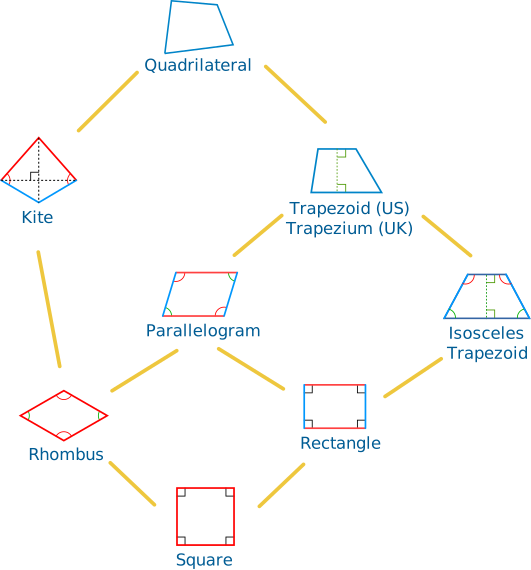

Definition of Quadrilateral
A quadrilateral is a polygon with four sides, four vertices, and four angles.
Example:
Quadrilateral ABCD
Properties of Quadrilaterals
Important properties include:
- Four sides
- Four vertices
- Four angles
- Two diagonals
The sum of interior angles equals:
[
360^\circ
]
Types of Quadrilaterals
Quadrilaterals are classified based on side lengths and angle properties.
Parallelogram
A parallelogram is a quadrilateral in which opposite sides are parallel.
Properties:
- Opposite sides equal
- Opposite angles equal
- Diagonals bisect each other
Area:
[
Area = base \times height
]
Rectangle
A rectangle is a parallelogram with four right angles.
Properties:
- Opposite sides equal
- All angles = 90°
- Diagonals equal
Area:
[
Area = length \times width
]
Square
A square is a special rectangle with all sides equal.
Properties:
- All sides equal
- All angles = 90°
- Diagonals equal and perpendicular
Area:
[
Area = side^2
]
Rhombus
A rhombus has all sides equal but angles are not necessarily 90°.
Properties:
- All sides equal
- Opposite angles equal
- Diagonals perpendicular
Area:
[
Area = \frac{1}{2} d_1 d_2
]
Trapezium (Trapezoid)
A trapezium has one pair of parallel sides.
Properties:
- Two sides parallel
- Other sides non-parallel
Area:
[
Area = \frac{1}{2}(a+b)h
]
Kite
A kite has two pairs of adjacent equal sides.
Properties:
- Diagonals perpendicular
- One diagonal bisects the other
Diagonals of Quadrilaterals
A diagonal connects opposite vertices.
Quadrilaterals always have two diagonals.
Diagonals divide quadrilaterals into triangles.
Angle Properties of Quadrilaterals
The sum of interior angles is always:
[
360^\circ
]
Example:
If three angles are:
80°, 100°, 120°
Fourth angle:
[
360 – 300 = 60^\circ
]
Area Formulas of Quadrilaterals
Different quadrilaterals have different area formulas.
Rectangle:
[
A = lw
]
Square:
[
A = a^2
]
Parallelogram:
[
A = bh
]
Rhombus:
[
A = \frac{1}{2} d_1 d_2
]
Trapezium:
[
A = \frac{1}{2}(a+b)h
]
Applications of Quadrilaterals
Quadrilaterals appear in:
- floor designs
- building structures
- road layouts
- computer graphics
- tiling patterns
Many architectural designs rely heavily on quadrilateral shapes.
Relationship Between Triangles and Quadrilaterals
Quadrilaterals can be divided into two triangles by drawing a diagonal.
This property helps calculate areas and analyze geometric relationships.
Triangles and quadrilaterals together form the basis for studying polygons.
Historical Development
Ancient civilizations studied triangles and quadrilaterals for land measurement and construction.
Greek mathematicians such as Euclid developed systematic theories of geometry.
Later mathematicians expanded these concepts in coordinate geometry and analytic geometry.
Today, triangles and quadrilaterals remain essential elements of geometric study.
Importance in Mathematics
Triangles and quadrilaterals are crucial because they:
- form the basis of polygon geometry
- support trigonometry
- help analyze shapes and areas
- appear in engineering structures
- assist in computer graphics and design
These shapes provide the foundation for understanding more complex geometric figures.
Conclusion
Triangles and quadrilaterals are fundamental geometric shapes that play an essential role in mathematics and real-world applications. A triangle, with its three sides and angles, provides the basis for many geometric theorems and trigonometric relationships. Quadrilaterals, with their four sides and angles, include a variety of shapes such as squares, rectangles, parallelograms, rhombuses, trapeziums, and kites.
Together, these shapes help mathematicians analyze space, measure areas, understand symmetry, and solve complex geometric problems. From architectural structures and engineering designs to computer graphics and scientific modeling, triangles and quadrilaterals remain among the most important shapes studied in geometry.
Mastering these concepts builds a strong foundation for advanced topics such as trigonometry, coordinate geometry, and three-dimensional geometry.