


Introduction to Trigonometric Identities
Trigonometric identities are mathematical equations that involve trigonometric functions and remain true for all values of the variables for which the functions are defined. These identities are essential tools in mathematics because they allow us to simplify complex trigonometric expressions, solve trigonometric equations, prove relationships between functions, and analyze periodic phenomena in science and engineering.
The primary trigonometric functions involved in identities include:
- sine (sin)
- cosine (cos)
- tangent (tan)
- cosecant (csc)
- secant (sec)
- cotangent (cot)
These functions are interrelated through various identities that arise from geometric properties of right triangles and the unit circle.
Trigonometric identities are widely used in algebra, geometry, calculus, physics, engineering, signal processing, astronomy, and many other scientific disciplines. Understanding these identities enables mathematicians and scientists to manipulate trigonometric expressions efficiently and solve problems involving angles and periodic motion.
Basic Trigonometric Functions


Before studying trigonometric identities, it is important to understand the six trigonometric functions.
In a right triangle:
- sin θ = opposite / hypotenuse
- cos θ = adjacent / hypotenuse
- tan θ = opposite / adjacent
The reciprocal functions are:
- csc θ = 1 / sin θ
- sec θ = 1 / cos θ
- cot θ = 1 / tan θ
These functions are the foundation of trigonometric identities.
For example:
If the opposite side is 3, adjacent side is 4, and hypotenuse is 5:
sin θ = 3/5
cos θ = 4/5
tan θ = 3/4
Using reciprocals:
csc θ = 5/3
sec θ = 5/4
cot θ = 4/3
These relationships allow the formation of many identities.
Types of Trigonometric Identities
Trigonometric identities are generally classified into several categories:
- Reciprocal identities
- Quotient identities
- Pythagorean identities
- Co-function identities
- Even and odd identities
- Sum and difference identities
- Double angle identities
- Half-angle identities
- Product-to-sum identities
Each group of identities plays an important role in mathematical problem solving.
Reciprocal Identities

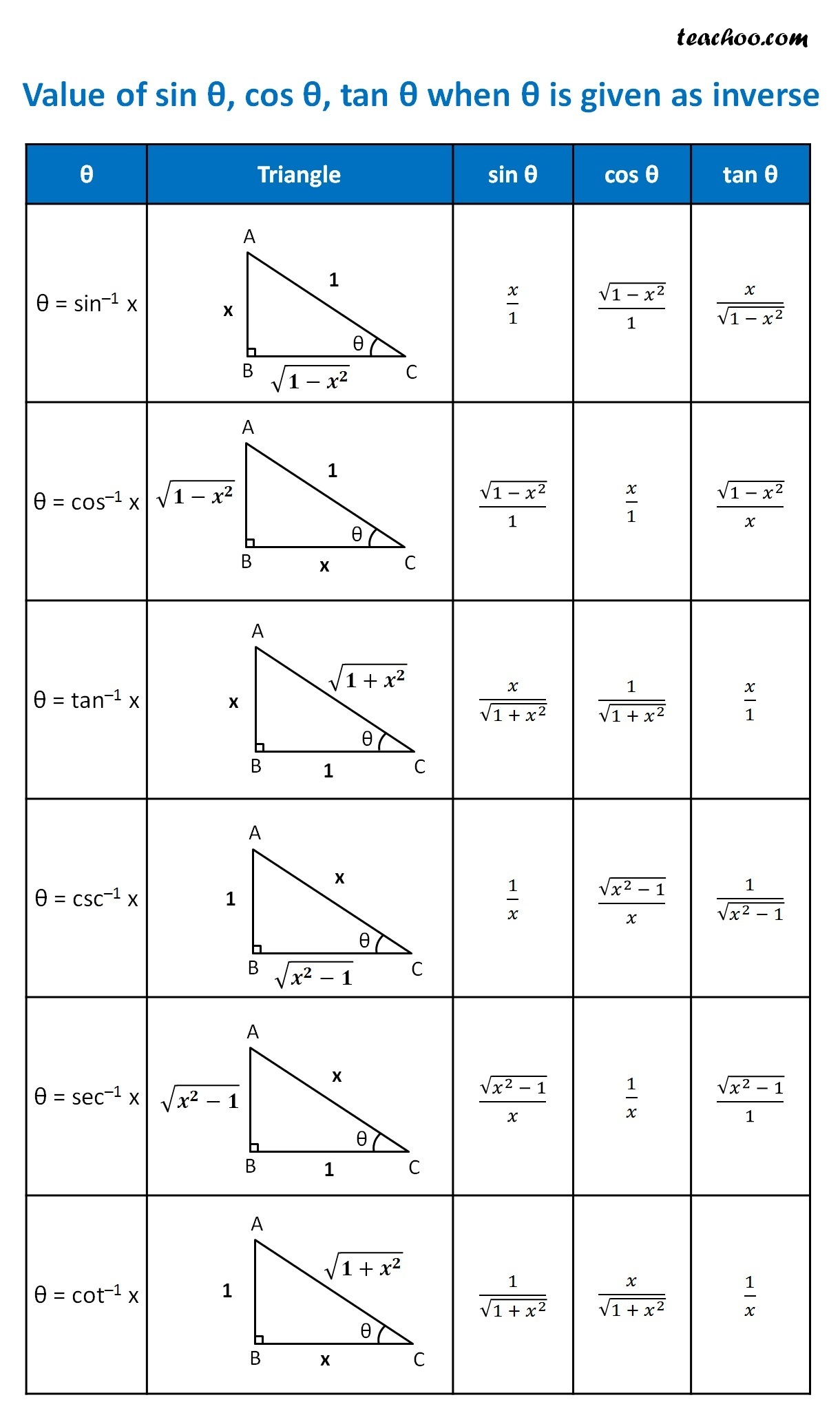
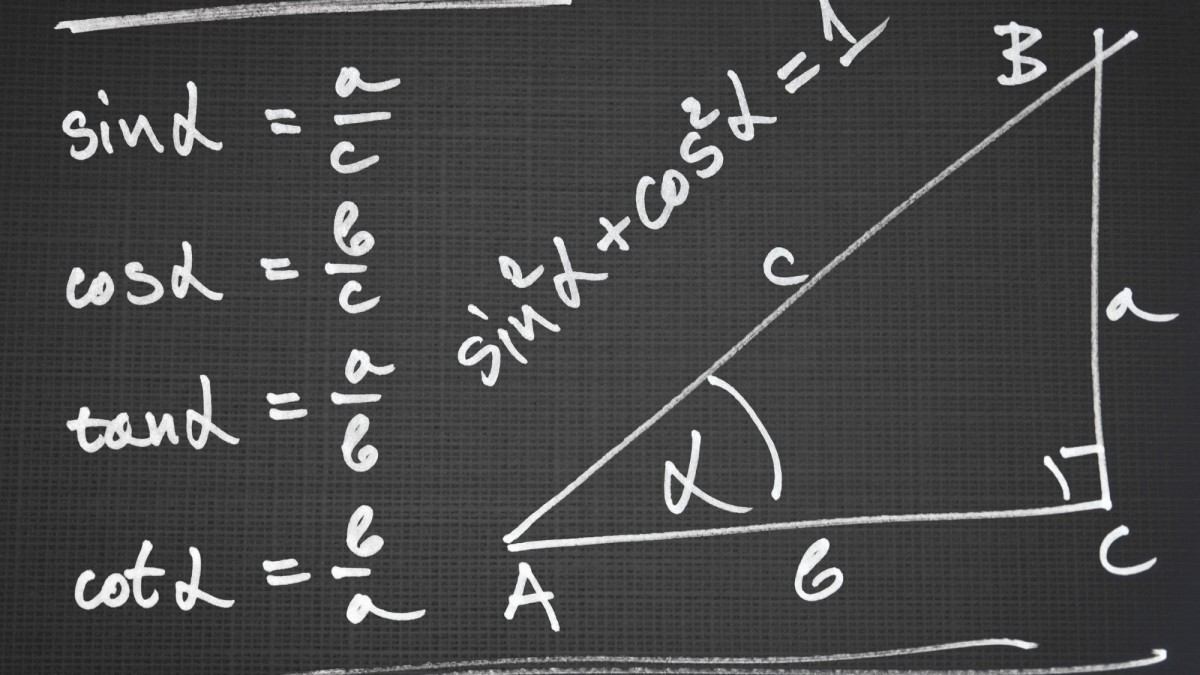
Reciprocal identities show the relationship between a trigonometric function and its reciprocal.
The identities are:
csc θ = 1 / sin θ
sec θ = 1 / cos θ
cot θ = 1 / tan θ
Similarly,
sin θ = 1 / csc θ
cos θ = 1 / sec θ
tan θ = 1 / cot θ
These identities arise from the reciprocal nature of the trigonometric functions.
Example
If
sin θ = 1/2
Then
csc θ = 2
Because
csc θ = 1 / sin θ
Reciprocal identities are often used to rewrite expressions in different forms.
Quotient Identities
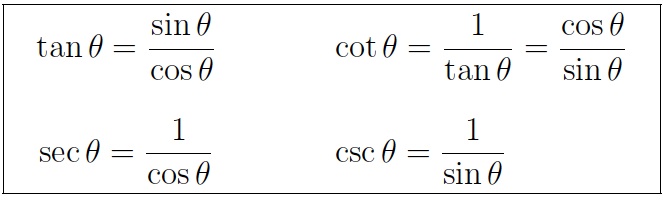
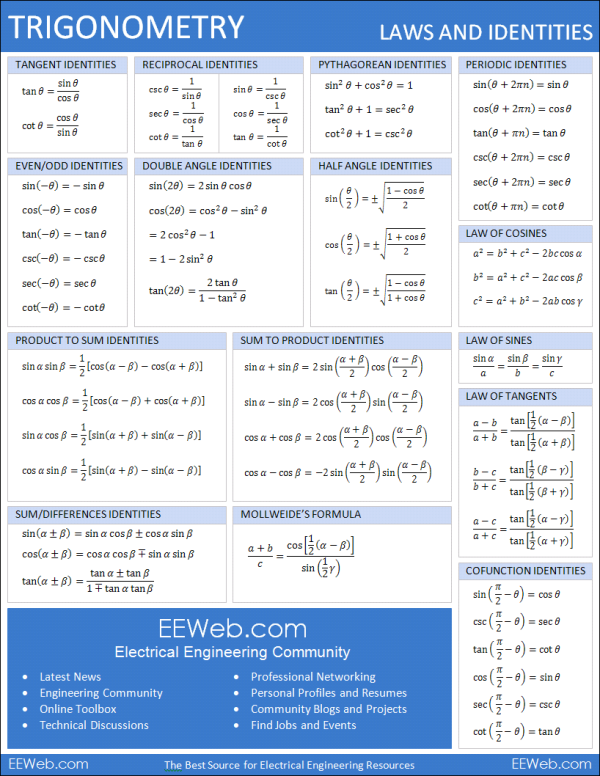


Quotient identities relate tangent and cotangent to sine and cosine.
The identities are:
tan θ = sin θ / cos θ
cot θ = cos θ / sin θ
These identities come directly from the definitions of trigonometric ratios.
Example
If
sin θ = 0.6
cos θ = 0.8
Then
tan θ = 0.6 / 0.8 = 0.75
Quotient identities are useful when converting expressions between trigonometric forms.
Pythagorean Identities

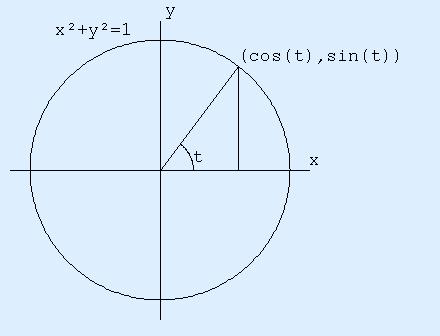
Pythagorean identities are derived from the Pythagorean theorem.
In a right triangle:
a² + b² = c²
Using trigonometric ratios, this relationship leads to the fundamental identity:
sin² θ + cos² θ = 1
Other identities derived from this include:
1 + tan² θ = sec² θ
1 + cot² θ = csc² θ
Derivation
Divide the Pythagorean equation by hypotenuse².
(opposite/hypotenuse)² + (adjacent/hypotenuse)² = 1
This gives:
sin² θ + cos² θ = 1
Example
If
sin θ = 0.6
Then
sin² θ = 0.36
Using identity:
cos² θ = 1 − 0.36 = 0.64
cos θ = 0.8
These identities are extremely important in simplifying trigonometric expressions.
Co-Function Identities


Co-function identities describe relationships between trigonometric functions of complementary angles.
Complementary angles add up to 90°.
The identities are:
sin(90° − θ) = cos θ
cos(90° − θ) = sin θ
tan(90° − θ) = cot θ
cot(90° − θ) = tan θ
sec(90° − θ) = csc θ
csc(90° − θ) = sec θ
These identities arise from the geometry of right triangles.
Example
sin(90° − 30°)
sin(60°)
Which equals
√3 / 2
Thus
cos 30° = sin 60°
Even and Odd Identities


Some trigonometric functions are even, while others are odd.
Even Functions
cos(−θ) = cos θ
sec(−θ) = sec θ
Even functions are symmetric about the y-axis.
Odd Functions
sin(−θ) = −sin θ
tan(−θ) = −tan θ
cot(−θ) = −cot θ
csc(−θ) = −csc θ
Odd functions are symmetric about the origin.
These identities are useful in simplifying expressions involving negative angles.
Sum and Difference Identities


Sum and difference identities express trigonometric functions of sums or differences of angles.
Sine
sin(A + B) = sinA cosB + cosA sinB
sin(A − B) = sinA cosB − cosA sinB
Cosine
cos(A + B) = cosA cosB − sinA sinB
cos(A − B) = cosA cosB + sinA sinB
Tangent
tan(A + B) = (tanA + tanB) / (1 − tanA tanB)
tan(A − B) = (tanA − tanB) / (1 + tanA tanB)
These formulas are important for solving trigonometric equations and simplifying expressions.
Double Angle Identities
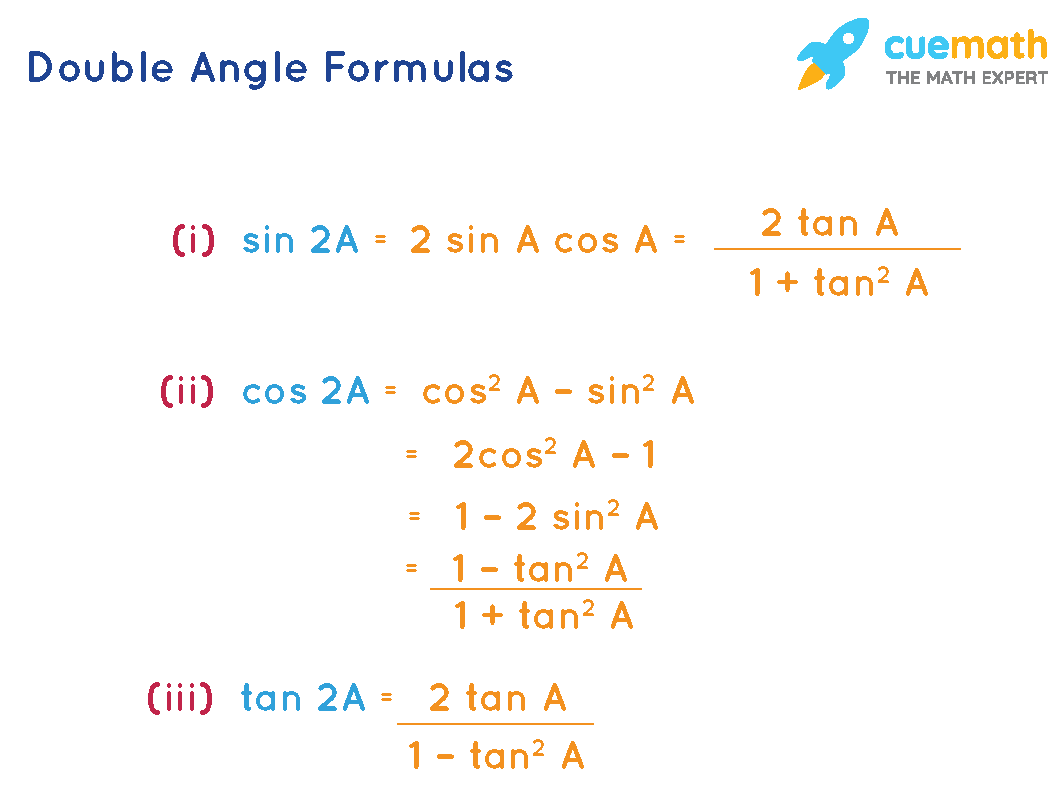

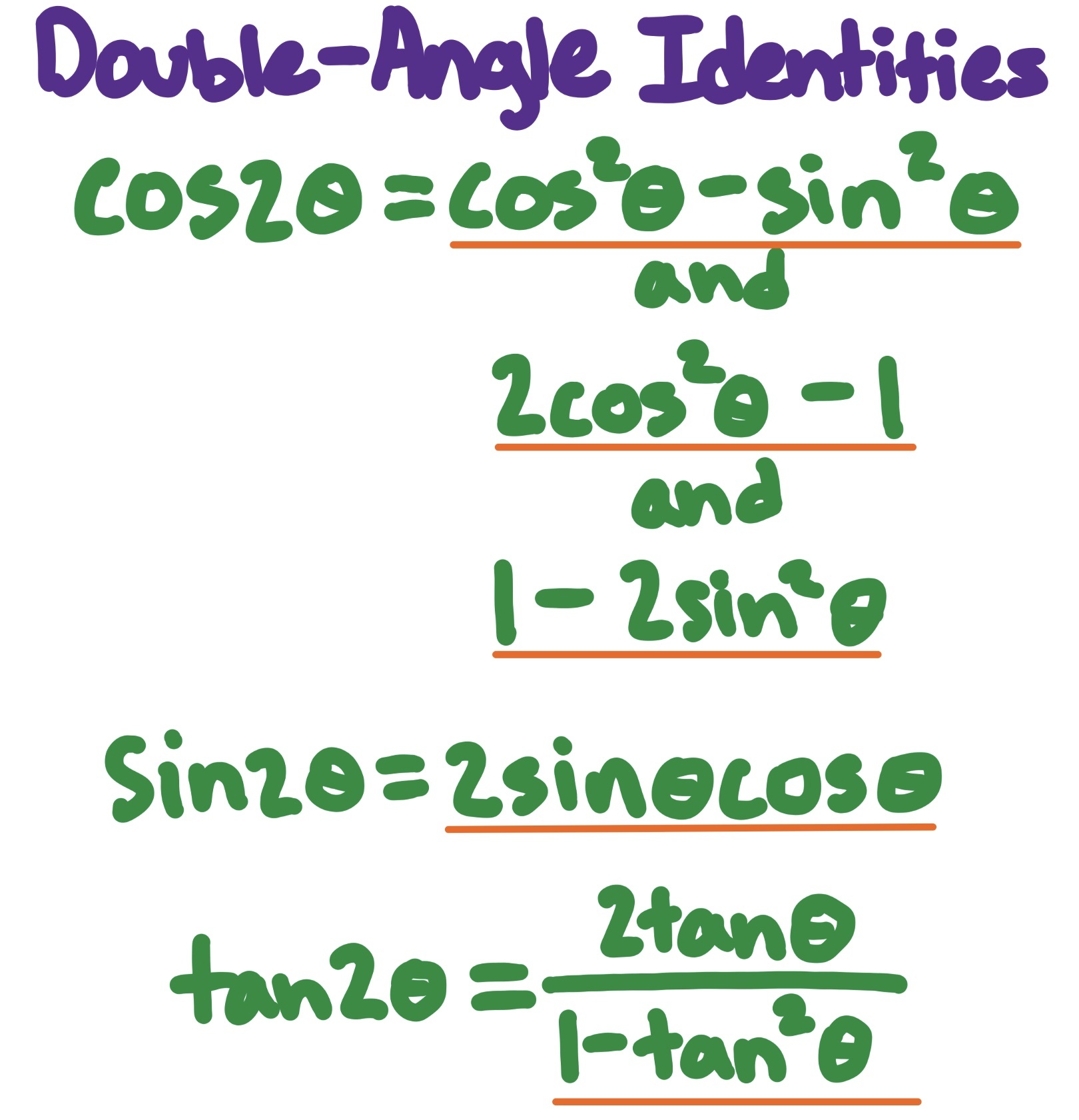
Double angle identities express trigonometric functions of twice an angle.
Sine
sin(2θ) = 2 sinθ cosθ
Cosine
cos(2θ) = cos²θ − sin²θ
This identity can also be written as:
cos(2θ) = 2cos²θ − 1
cos(2θ) = 1 − 2sin²θ
Tangent
tan(2θ) = (2tanθ) / (1 − tan²θ)
These identities are used extensively in calculus and physics.
Half-Angle Identities


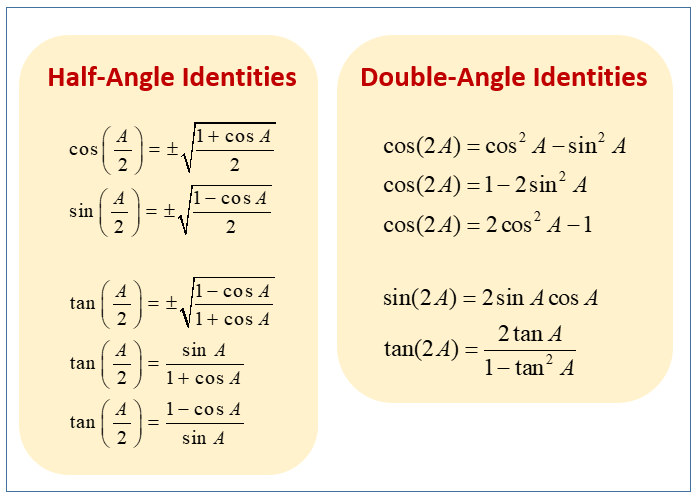
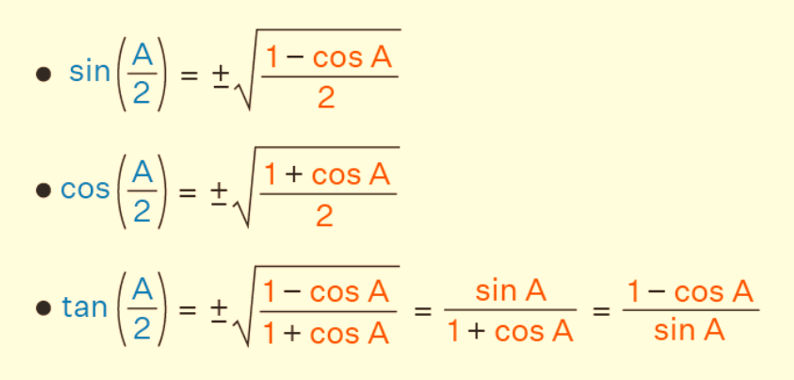
Half-angle identities express trigonometric functions of half an angle.
sin(θ/2) = √((1 − cosθ)/2)
cos(θ/2) = √((1 + cosθ)/2)
tan(θ/2) = (1 − cosθ)/sinθ
These identities are useful in calculus, integration, and solving trigonometric equations.
Product-to-Sum Identities


Product-to-sum identities convert products of trigonometric functions into sums.
Examples:
sinA sinB = ½ [cos(A − B) − cos(A + B)]
cosA cosB = ½ [cos(A − B) + cos(A + B)]
sinA cosB = ½ [sin(A + B) + sin(A − B)]
These identities are useful in signal processing and wave analysis.
Applications of Trigonometric Identities
Trigonometric identities are widely used in many areas of science and engineering.
Physics
They are used to study:
- wave motion
- sound waves
- light waves
- alternating current circuits
Engineering
Engineers use trigonometric identities in:
- structural analysis
- mechanical systems
- robotics
- electrical engineering
Astronomy
Astronomers apply trigonometry to determine:
- planetary motion
- distance between celestial objects
- orbital paths
Computer Graphics
3D modeling and animation rely heavily on trigonometric identities to compute rotations, transformations, and rendering.
Navigation
Trigonometry helps determine distances and directions for aircraft, ships, and satellites.
Importance of Trigonometric Identities in Mathematics
Trigonometric identities play a crucial role in advanced mathematics.
They are essential in:
- calculus
- differential equations
- Fourier series
- complex numbers
- signal processing
They help simplify complicated expressions and solve equations that would otherwise be extremely difficult.
Conclusion
Trigonometric identities are fundamental relationships between trigonometric functions that remain true for all valid values of the variables. These identities arise from the geometric properties of triangles and the unit circle and provide powerful tools for solving mathematical problems.
The major categories of trigonometric identities include reciprocal identities, quotient identities, Pythagorean identities, co-function identities, sum and difference identities, double-angle identities, half-angle identities, and product-to-sum identities. Each group of identities serves a specific purpose in simplifying expressions and solving equations.
Understanding trigonometric identities is essential for students studying mathematics, physics, engineering, and many other scientific disciplines. Mastery of these identities enables efficient problem solving and provides a deeper understanding of the relationships between angles, functions, and periodic phenomena.