


1. Introduction to the Doppler Effect
The Doppler effect is one of the most important and widely observed phenomena related to waves. It describes the change in frequency or wavelength of a wave when there is relative motion between the source of the wave and the observer. This effect is commonly experienced in everyday life, especially with sound waves.
A familiar example occurs when an ambulance or police siren passes by. As the vehicle approaches, the sound appears higher in pitch, and as it moves away, the sound becomes lower in pitch. This change in pitch is caused by the Doppler effect.
The Doppler effect was first described in 1842 by the Austrian physicist Christian Doppler, who proposed that the observed frequency of waves depends on the relative motion between the source and the observer. Although his original explanation focused on sound waves, the Doppler effect applies to all types of waves, including light waves, water waves, and electromagnetic waves.
The Doppler effect plays a significant role in many scientific and technological fields such as astronomy, meteorology, medical imaging, radar technology, and navigation systems. By analyzing changes in frequency or wavelength, scientists can determine the motion of distant objects, measure speeds, and study the structure of the universe.
2. Definition of the Doppler Effect
The Doppler effect can be defined as:
The Doppler effect is the apparent change in frequency, wavelength, or pitch of a wave due to the relative motion between the source of the wave and the observer.
When the source and observer move toward each other:
- Observed frequency increases
- Observed wavelength decreases
When the source and observer move away from each other:
- Observed frequency decreases
- Observed wavelength increases
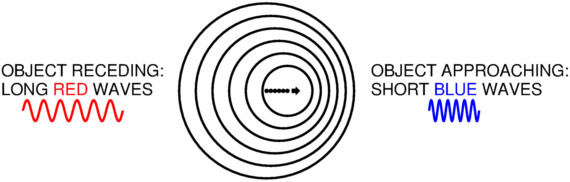
This phenomenon occurs because the motion changes the spacing between successive wavefronts reaching the observer.
3. Basic Principle of the Doppler Effect
The Doppler effect occurs because of the compression or stretching of wavefronts.
When a wave source moves relative to an observer, the waves in front of the source become compressed, while the waves behind the source become stretched.
When the Source Moves Toward the Observer
- Wavefronts are compressed
- Wavelength becomes shorter
- Frequency increases
- Sound pitch becomes higher
When the Source Moves Away from the Observer
- Wavefronts are stretched
- Wavelength becomes longer
- Frequency decreases
- Sound pitch becomes lower
The observer perceives these changes as variations in sound or light.
4. Doppler Effect in Sound Waves


Sound waves provide the most familiar example of the Doppler effect.
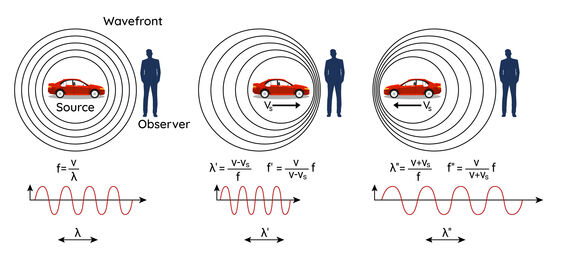
When a sound source moves through air, it produces wavefronts that travel outward in all directions.
If the source is stationary, the wavefronts are evenly spaced.
However, if the source moves:
- Wavefronts in front of the source are closer together.
- Wavefronts behind the source are farther apart.
This change in spacing causes the frequency heard by the observer to change.
Example: Ambulance Siren
When an ambulance approaches a listener:
- Sound waves are compressed
- Frequency increases
- Pitch becomes higher
When the ambulance moves away:
- Sound waves stretch
- Frequency decreases
- Pitch becomes lower
This change in pitch occurs instantly as the ambulance passes the observer.
5. Mathematical Expression of the Doppler Effect
The Doppler effect can be described mathematically.
For sound waves, the observed frequency is given by:
f′ = f (v ± v₀) / (v ∓ vₛ)
Where:
f′ = observed frequency
f = actual frequency of the source
v = speed of sound in the medium
v₀ = velocity of the observer
vₛ = velocity of the source
Signs depend on the direction of motion.
Source Approaching Observer
f′ = f (v / (v − vₛ))
Observed frequency increases.
Source Moving Away
f′ = f (v / (v + vₛ))
Observed frequency decreases.
These formulas allow scientists to calculate the change in frequency due to motion.
6. Doppler Effect When Observer Moves
The Doppler effect can also occur when the observer moves instead of the source.
Observer Moving Toward Source
Observed frequency increases.
The observer encounters wavefronts more frequently.
Observer Moving Away from Source
Observed frequency decreases.
Wavefronts reach the observer less frequently.
This situation is common when a person moves toward or away from a sound source.
7. Doppler Effect When Both Source and Observer Move
When both the source and the observer move simultaneously, the Doppler effect depends on their relative motion.
If they move toward each other:
Frequency increases.
If they move away from each other:
Frequency decreases.
The mathematical formula accounts for both velocities.
8. Doppler Effect in Light Waves

The Doppler effect also occurs in light waves and other electromagnetic radiation.
In astronomy, this effect is extremely important because it helps scientists determine whether stars and galaxies are moving toward or away from Earth.
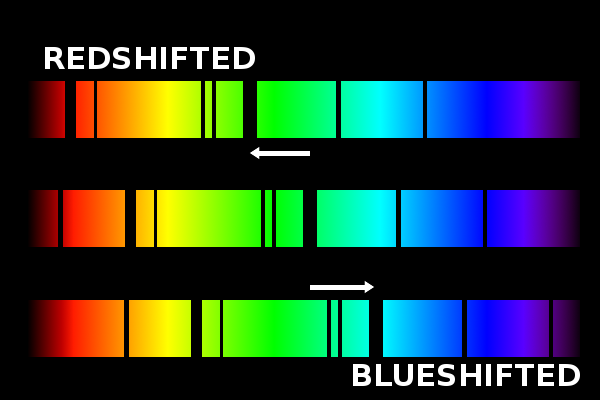
Redshift
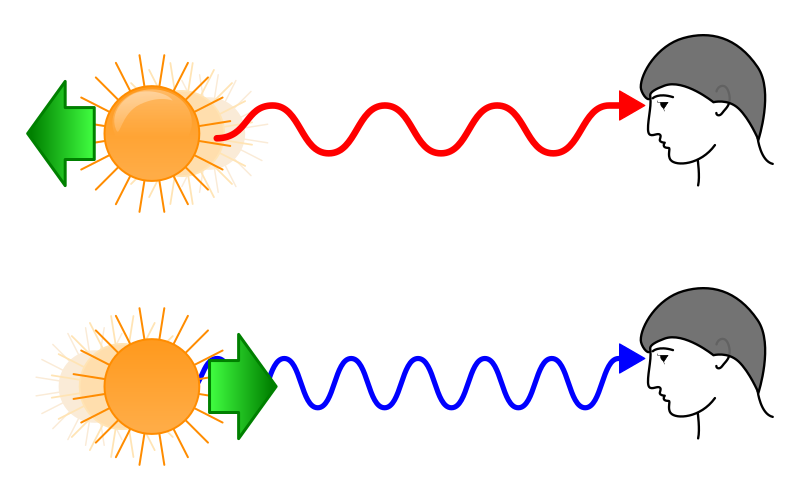
When a light source moves away from the observer:
- Wavelength increases
- Light shifts toward the red end of the spectrum
This is called redshift.
Redshift indicates that the object is moving away.
Blueshift
When a light source moves toward the observer:
- Wavelength decreases
- Light shifts toward the blue end of the spectrum
This is called blueshift.
Blueshift indicates that the object is moving closer.
Astronomers analyze these shifts in spectral lines to determine the velocity of distant stars and galaxies.
9. Applications of the Doppler Effect
The Doppler effect has many practical applications.
Radar Technology
Radar systems use the Doppler effect to measure the speed of vehicles.
Police radar guns detect the frequency shift of reflected radio waves to determine vehicle speed.
Medical Imaging
Ultrasound machines use the Doppler effect to measure blood flow.
Doctors can observe the movement of blood through arteries and veins.
This technique is known as Doppler ultrasound.
Astronomy
Astronomers use Doppler shifts to study the motion of stars and galaxies.
This helps determine:
- Star rotation
- Galaxy movement
- Expansion of the universe
Weather Forecasting
Weather radars use Doppler shifts to detect the movement of storm clouds and wind patterns.
This helps meteorologists predict severe weather conditions.
10. Doppler Effect in Everyday Life
The Doppler effect can be observed in many everyday situations.
Examples include:
- Passing ambulance siren
- Train horn approaching and leaving
- Racing car engine sound
- Airplane flying overhead
In each case, the pitch of the sound changes as the source moves relative to the observer.
11. Doppler Effect in Astronomy
The Doppler effect revolutionized modern astronomy.
By studying spectral shifts, scientists can determine:
- Speed of galaxies
- Rotation of stars
- Presence of exoplanets
One of the most important discoveries based on the Doppler effect is that most galaxies show redshift, indicating that the universe is expanding.
This observation led to the development of the Big Bang theory.
12. Limitations of the Doppler Effect
Although the Doppler effect is very useful, it has certain limitations.
- It depends on relative motion between source and observer.
- Measurements can be affected by environmental conditions.
- Accurate results require precise instruments.
Despite these limitations, it remains one of the most powerful tools in wave physics.
13. Importance of the Doppler Effect
The Doppler effect is important for several reasons.
It helps scientists:
- Measure velocities of distant objects
- Understand wave propagation
- Develop medical imaging technologies
- Study weather systems
- Analyze astronomical phenomena
The Doppler effect also demonstrates how wave properties change when the source or observer moves.
Conclusion
The Doppler effect is a fundamental phenomenon in wave physics that describes the change in frequency or wavelength of a wave due to the relative motion between the source and the observer. It occurs in all types of waves, including sound waves, water waves, and electromagnetic waves.
When a wave source moves toward an observer, the frequency appears higher and the wavelength becomes shorter. When the source moves away, the frequency decreases and the wavelength increases. This effect explains the changing pitch of passing sirens and provides valuable information about motion in various physical systems.
The Doppler effect has important applications in fields such as radar technology, medical imaging, astronomy, and weather forecasting. It has enabled scientists to measure the motion of distant galaxies and understand the expansion of the universe.
Because of its wide range of applications and its fundamental role in wave physics, the Doppler effect remains one of the most significant concepts in modern science and technology.
Tags: