



Introduction to Coordinate Geometry
Coordinate geometry, also known as analytic geometry, is a branch of mathematics that combines algebra and geometry to study geometric figures using a coordinate system. In this system, points are represented by numerical coordinates that describe their position in a plane.
The development of coordinate geometry revolutionized mathematics by allowing geometric problems to be solved using algebraic equations. This approach makes it easier to analyze shapes, calculate distances, determine slopes, and represent curves.
Coordinate geometry is widely used in mathematics, physics, engineering, computer science, navigation, and many other scientific fields. It provides a powerful framework for understanding spatial relationships and solving problems involving geometric figures.
The most common coordinate system used in coordinate geometry is the Cartesian coordinate system, which uses two perpendicular axes to locate points in a plane.
Historical Background
Coordinate geometry was developed in the 17th century by the French mathematician René Descartes. His work established a method of representing geometric shapes using algebraic equations.
Before Descartes introduced this concept, geometry and algebra were treated as separate branches of mathematics. By combining them, Descartes created a powerful mathematical tool that allowed curves and shapes to be analyzed using equations.
The Cartesian coordinate system was named after Descartes in recognition of his contribution to mathematics.
Cartesian Coordinate System
The Cartesian coordinate system consists of two perpendicular number lines called axes.
These axes intersect at a point called the origin.
The horizontal axis is called the x-axis.
The vertical axis is called the y-axis.
The point where the axes intersect is represented as:
[
(0,0)
]
This point is called the origin.
Axes of the Coordinate Plane
The coordinate plane consists of two axes.
X-axis
The x-axis is the horizontal axis.
It represents horizontal movement across the plane.
Y-axis
The y-axis is the vertical axis.
It represents vertical movement.
Coordinates of a Point
Every point in the coordinate plane is represented by an ordered pair.
The ordered pair is written as:
[
(x,y)
]
Where:
- (x) is the horizontal coordinate
- (y) is the vertical coordinate
Example:
[
(3,4)
]
This means the point lies:
- 3 units along the x-axis
- 4 units along the y-axis
Quadrants of the Coordinate Plane
The coordinate plane is divided into four regions called quadrants.
First Quadrant
Both coordinates are positive.
[
(+,+)
]
Example:
(4,5)
Second Quadrant
x is negative, y is positive.
[
(-,+)
]
Example:
(-3,4)
Third Quadrant
Both coordinates are negative.
[
(-,-)
]
Example:
(-5,-2)
Fourth Quadrant
x is positive, y is negative.
[
(+,-)
]
Example:
(4,-3)
Plotting Points
Plotting points involves locating coordinates on the plane.
Steps:
- Start at the origin.
- Move along the x-axis according to the x-value.
- Move vertically according to the y-value.
- Mark the point.
Example:
Point (2,3)
Move 2 units right, then 3 units up.
Distance Between Two Points
One of the most important formulas in coordinate geometry is the distance formula.
For two points:
[
(x_1,y_1) \quad and \quad (x_2,y_2)
]
Distance:
[
d = \sqrt{(x_2-x_1)^2 + (y_2-y_1)^2}
]
This formula is derived from the Pythagorean theorem.
Example of Distance Formula
Points:
[
(1,2) \quad and \quad (4,6)
]
Distance:
[
d = \sqrt{(4-1)^2 + (6-2)^2}
]
[
d = \sqrt{9 + 16}
]
[
d = \sqrt{25}
]
[
d = 5
]
Midpoint Formula
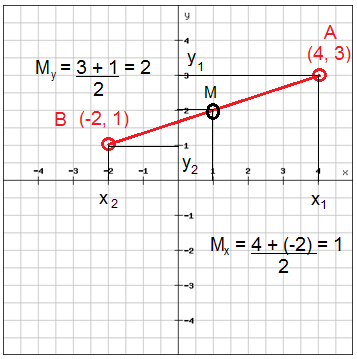
The midpoint of a line segment is the point that divides the segment into two equal parts.
Formula:
[
M = \left(\frac{x_1+x_2}{2}, \frac{y_1+y_2}{2}\right)
]
Example of Midpoint
Points:
[
(2,4) \quad and \quad (6,8)
]
Midpoint:
[
M = (4,6)
]
Slope of a Line
The slope measures how steep a line is.
Formula:
[
m = \frac{y_2 – y_1}{x_2 – x_1}
]
Slope represents the rate of change between two points.
Types of Slopes
Lines can have different types of slopes.
Positive Slope
Line rises from left to right.
Example:
(m > 0)
Negative Slope
Line falls from left to right.
Example:
(m < 0)
Zero Slope
Horizontal line.
Example:
(m = 0)
Undefined Slope
Vertical line.
Division by zero occurs.
Equation of a Line
Lines in coordinate geometry are represented by equations.
Slope-Intercept Form
[
y = mx + c
]
Where:
- (m) = slope
- (c) = y-intercept
Example
[
y = 2x + 3
]
Slope = 2
Y-intercept = 3
Point-Slope Form
[
y – y_1 = m(x – x_1)
]
Used when slope and one point are known.
Two-Point Form
Used when two points are known.
[
y-y_1 = \frac{y_2-y_1}{x_2-x_1}(x-x_1)
]
Intercept Form
[
\frac{x}{a} + \frac{y}{b} = 1
]
Where:
- (a) = x-intercept
- (b) = y-intercept
Parallel Lines
Two lines are parallel if they have the same slope.
Example:
[
y = 3x + 1
]
[
y = 3x – 4
]
Both have slope 3.
Perpendicular Lines
Two lines are perpendicular if the product of their slopes equals -1.
Example:
If:
[
m_1 = 2
]
Then:
[
m_2 = -\frac{1}{2}
]
Area of Triangle in Coordinate Geometry
Area formula using coordinates:
[
A = \frac{1}{2} |x_1(y_2-y_3)+x_2(y_3-y_1)+x_3(y_1-y_2)|
]
Equation of a Circle
Circle equation in coordinate geometry:
[
(x-h)^2 + (y-k)^2 = r^2
]
Where:
- (h,k) = center
- r = radius
Graphs of Functions
Coordinate geometry allows functions to be represented graphically.
Example:
[
y = x^2
]
This produces a parabola.
Transformations in Coordinate Geometry
Graphs can be transformed by shifting, stretching, or reflecting.
Example:
[
y = (x-2)^2
]
Shifted right by 2 units.
Applications of Coordinate Geometry
Coordinate geometry has many practical applications.
Engineering
Used in structural design and mechanical systems.
Physics
Used to analyze motion and forces.
Computer Graphics
Digital images and animations rely heavily on coordinate geometry.
Navigation
GPS systems use coordinates to determine location.
Robotics
Robot movements are calculated using coordinate systems.
Architecture
Building layouts are designed using coordinate-based plans.
Coordinate Geometry in Calculus
In calculus, coordinate geometry helps analyze curves.
Concepts include:
- derivatives
- integrals
- limits
Curves are described using equations in the coordinate plane.
Three-Dimensional Coordinate Geometry
Beyond two dimensions, coordinate systems extend into 3D space.
Coordinates are written as:
[
(x,y,z)
]
Axes include:
- x-axis
- y-axis
- z-axis
Used in physics, engineering, and computer graphics.
Importance of Coordinate Geometry
Coordinate geometry is important because it:
- connects algebra and geometry
- simplifies geometric calculations
- allows precise representation of shapes
- supports advanced mathematics
It forms the basis for many modern technologies.
Conclusion
Coordinate geometry is a powerful branch of mathematics that combines algebraic techniques with geometric concepts to study shapes and relationships in a coordinate plane. By representing points as ordered pairs and using equations to describe lines and curves, coordinate geometry allows mathematicians and scientists to analyze spatial relationships with precision.
From calculating distances and slopes to graphing equations and studying geometric figures, coordinate geometry provides essential tools for solving mathematical problems. Its applications extend far beyond mathematics into fields such as physics, engineering, computer graphics, navigation, and robotics.
Understanding coordinate geometry lays the foundation for advanced mathematical topics such as calculus, linear algebra, and analytical geometry, making it one of the most important areas of mathematical study.