Tag Archives: algebra basics

Linear Equations in Mathematics

Image
Image
Image
Image

Tags:


Linear Equations in Mathematics

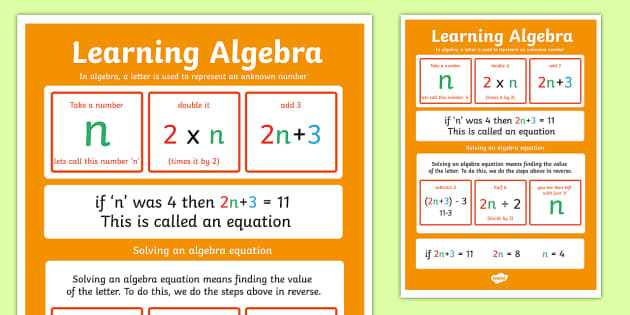
Linear equations are one of the most fundamental topics in algebra and mathematics. They represent relationships between variables that form straight-line graphs when plotted on a coordinate plane. Linear equations are widely used in mathematics, physics, economics, engineering, computer science, and many other scientific disciplines.

A linear equation is an equation in which the highest power of the variable is one. This means the variables are not squared, cubed, or raised to higher powers. Linear equations describe relationships that change at a constant rate.

For example:

2x + 3 = 7

This equation contains a variable x, constants 2, 3, and 7, and the equation shows a relationship that can be solved to find the value of x.

Linear equations are essential because they form the basis for understanding more advanced mathematical concepts such as systems of equations, matrices, calculus, and mathematical modeling.


1. Definition of a Linear Equation

A linear equation is an algebraic equation in which each variable has an exponent of one, and the equation forms a straight line when graphed.

General form:

ax + b = 0

Where:

  • a and b are constants
  • x is a variable

Example:

3x + 5 = 11

Here:

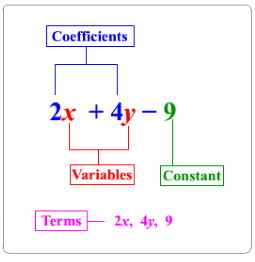
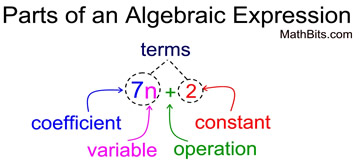
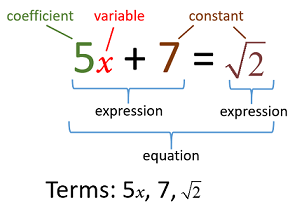
  • 3 is the coefficient
  • 5 is the constant term
  • x is the variable

Linear equations are called “linear” because they produce linear graphs (straight lines).


2. Components of a Linear Equation

Image
Image
Image
Image

Linear equations contain several key components.


Variables

Variables represent unknown values.

Example:

x, y, z

Example equation:

2x + 4 = 10

Here x is the variable.


Constants

Constants are fixed numbers.

Example:

In the equation:

3x + 7 = 16

The numbers 7 and 16 are constants.


Coefficients

A coefficient is a number multiplied by a variable.

Example:

5x

Here 5 is the coefficient.


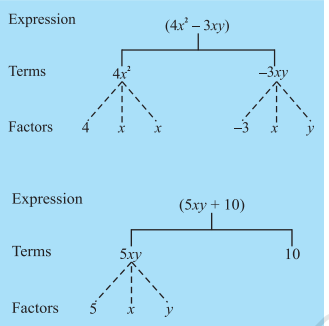
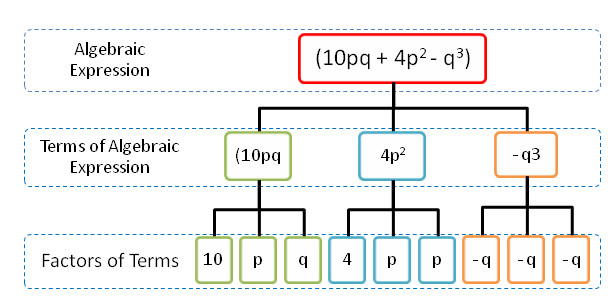
Terms

Terms are parts of an equation separated by addition or subtraction.

Example:

4x + 6

Terms:

4x and 6


3. Types of Linear Equations

Linear equations can appear in several different forms.


Linear Equation in One Variable

These equations contain only one variable.

Example:

5x + 3 = 13

Solution:

5x = 10

x = 2


Linear Equation in Two Variables

These equations contain two variables.

Example:

2x + y = 6

Solutions include pairs of numbers that satisfy the equation.

Example:

x = 2, y = 2


Linear Equation in Three Variables

Example:

x + y + z = 6

These equations are used in advanced algebra and linear systems.


4. Standard Form of Linear Equation

The standard form of a linear equation in two variables is:

Ax + By + C = 0

Where:

  • A, B, and C are constants
  • A and B are not both zero

Example:

2x + 3y − 6 = 0

This form is useful in coordinate geometry.


5. Slope-Intercept Form

Image
Image
Image
Image

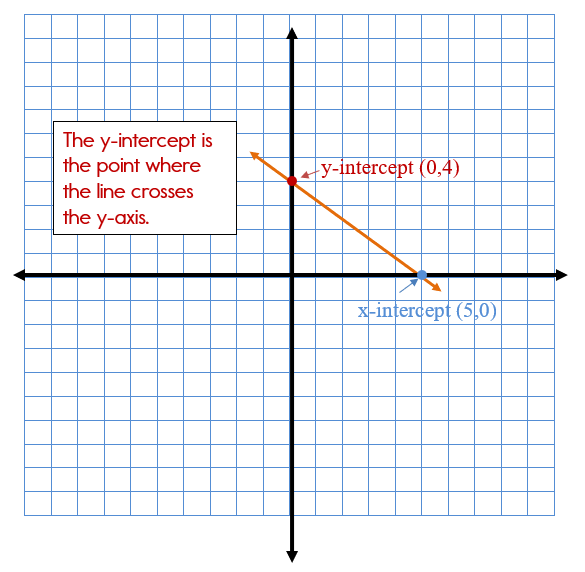
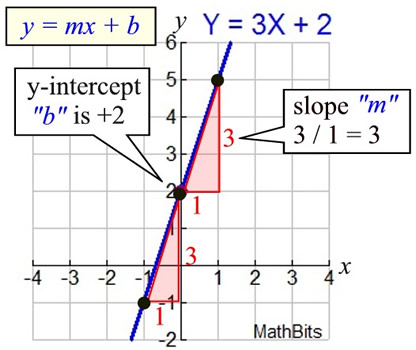
Another important form is:

y = mx + b

Where:

  • m is the slope
  • b is the y-intercept

Example:

y = 2x + 3

Slope = 2
Intercept = 3

This means the line crosses the y-axis at 3.


6. Graph of Linear Equations

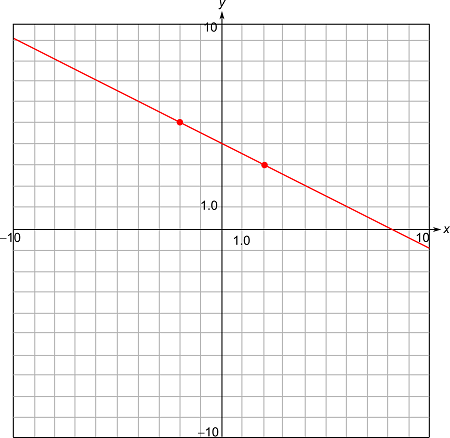
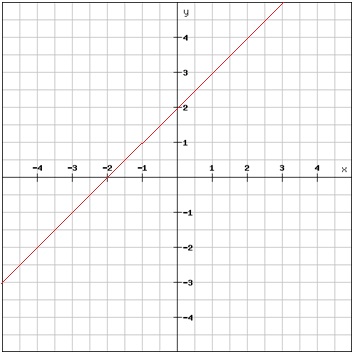
A linear equation in two variables represents a straight line on a coordinate plane.

Steps to graph a linear equation:

  1. Convert equation into slope-intercept form.
  2. Identify slope and intercept.
  3. Plot the intercept.
  4. Use the slope to find additional points.
  5. Draw a straight line through the points.

Example:

y = x + 2

Points:

(0,2)

(1,3)

(2,4)

These points form a straight line.


7. Solving Linear Equations
Image
Image
Image
Image

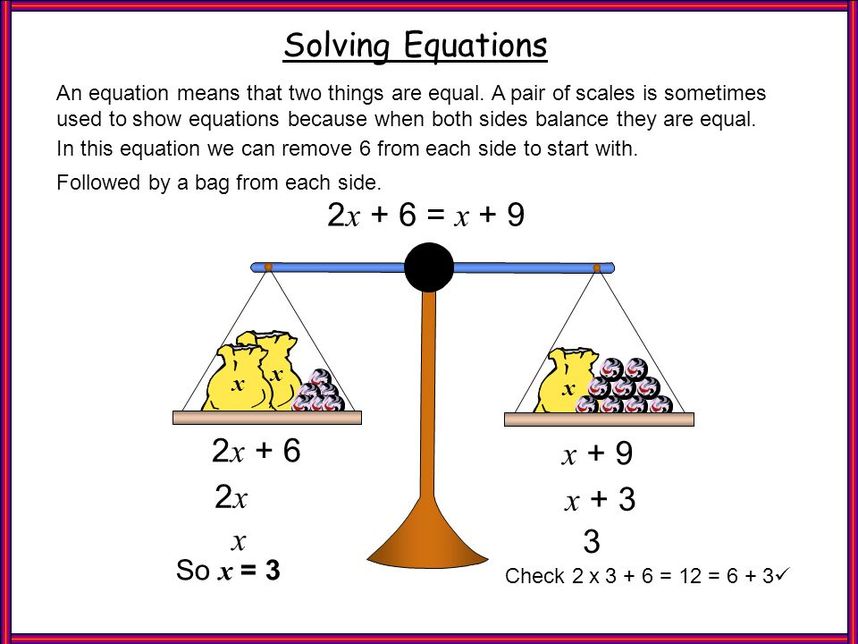
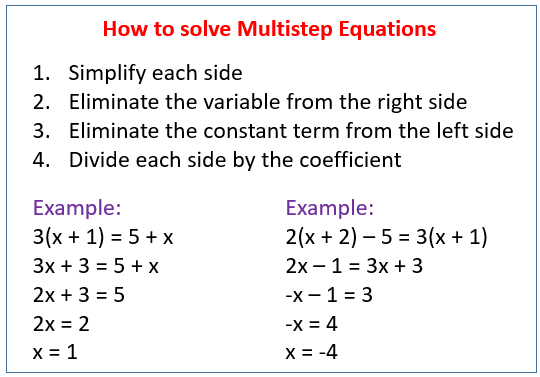
Solving a linear equation means finding the value of the variable.


Example 1

3x + 5 = 11

Step 1:

Subtract 5

3x = 6

Step 2:

Divide by 3

x = 2


Example 2

5x − 4 = 16

Add 4:

5x = 20

Divide by 5:

x = 4


8. Linear Equations with Variables on Both Sides

Example:

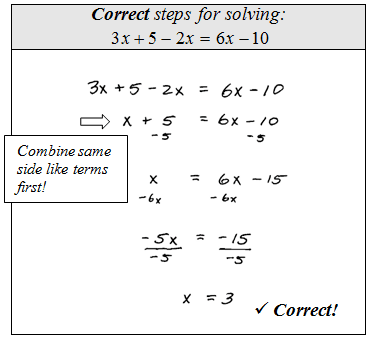
2x + 5 = x + 9

Step 1:

Subtract x from both sides

x + 5 = 9

Step 2:

Subtract 5

x = 4


9. Systems of Linear Equations

Image
Image
Image
Image

A system of linear equations contains two or more equations with the same variables.

Example:

x + y = 5
x − y = 1

The solution is the point where both equations are satisfied.


10. Methods for Solving Systems


Substitution Method

Solve one equation for a variable and substitute into the other.

Example:

x = 5 − y

Substitute into the second equation.


Elimination Method

Add or subtract equations to eliminate a variable.

Example:

x + y = 5
x − y = 1

Add equations:

2x = 6

x = 3

Substitute:

y = 2


Graphical Method

Plot both equations on a graph.

The intersection point is the solution.


11. Special Cases of Linear Systems

Systems may have:


One Solution

Lines intersect at one point.


Infinite Solutions

Lines overlap completely.


No Solution

Lines are parallel.


12. Linear Equations in Real-Life Applications

Linear equations appear in many practical situations.


Economics

Profit equations:

Profit = Revenue − Cost


Physics

Motion equation:

distance = speed × time


Business

Cost calculations:

Total cost = fixed cost + variable cost


Engineering

Linear models describe relationships between variables.


13. Linear Functions

A linear function describes a relationship between variables.

Example:

f(x) = 3x + 2

This function produces a straight line graph.

Linear functions describe constant rates of change.


14. Linear Equations in Coordinate Geometry

Linear equations represent lines on a coordinate plane.

Key concepts include:

  • slope
  • intercepts
  • parallel lines
  • perpendicular lines

Parallel Lines

Parallel lines have the same slope.

Example:

y = 2x + 3
y = 2x − 4


Perpendicular Lines

Perpendicular lines have slopes that are negative reciprocals.

Example:

Slope = 2

Perpendicular slope = −1/2


15. Linear Equations in Matrices

In higher mathematics, systems of linear equations can be represented using matrices.

Example:

AX = B

Matrix methods help solve large systems efficiently.


16. Importance of Linear Equations

Linear equations are essential because they:

  • describe relationships between variables
  • model real-world problems
  • provide a foundation for algebra

They are used extensively in science and technology.


17. Linear Equations in Computer Science

In computing, linear equations appear in:

  • machine learning
  • optimization algorithms
  • graphics transformations

Many algorithms rely on solving systems of linear equations.


18. Historical Development of Linear Algebra

The study of linear equations dates back to ancient civilizations.

Chinese mathematicians used methods similar to modern matrix techniques to solve systems of equations.

These ideas later developed into modern algebra and linear algebra.


19. Advanced Concepts Related to Linear Equations

Advanced topics include:

  • linear programming
  • vector spaces
  • matrix algebra
  • numerical methods

These topics extend the study of linear relationships.


20. Summary

Linear equations are fundamental mathematical expressions that represent relationships between variables where the highest exponent is one. These equations form straight lines when graphed and describe constant rates of change.

They are essential tools in algebra and are widely used in science, economics, engineering, and computer science. Understanding linear equations involves learning their forms, solving methods, graphical interpretation, and real-world applications.

Mastery of linear equations provides a strong foundation for advanced mathematics and problem-solving in many fields.
Algebraic Expressions in Mathematics

Image
Image
Image
Image

Tags:


Algebraic Expressions in Mathematics

Algebraic expressions are one of the central concepts in algebra, a branch of mathematics that deals with symbols and the rules for manipulating those symbols. Algebraic expressions combine numbers, variables, and mathematical operations to represent mathematical relationships.

In simple terms, an algebraic expression is a mathematical phrase that may contain variables, constants, and arithmetic operations such as addition, subtraction, multiplication, and division. These expressions allow mathematicians and scientists to describe patterns, relationships, and general formulas.

For example:

3x + 5

This expression contains a variable x, a constant 5, and a coefficient 3.

Algebraic expressions are used in various fields such as physics, engineering, economics, and computer science to represent unknown values and perform calculations.

Understanding algebraic expressions is essential for learning more advanced mathematical topics like equations, functions, calculus, and mathematical modeling.


1. What is an Algebraic Expression?

An algebraic expression is a mathematical expression formed using:

  • numbers
  • variables
  • arithmetic operations

Example:

2x + 7

This expression represents a quantity that depends on the value of x.

Unlike equations, algebraic expressions do not contain an equals sign.

Example of an equation:

2x + 7 = 15

Example of an expression:

2x + 7

Expressions describe mathematical relationships but do not state equality.


2. Components of Algebraic Expressions

Image
Image
Image
Image

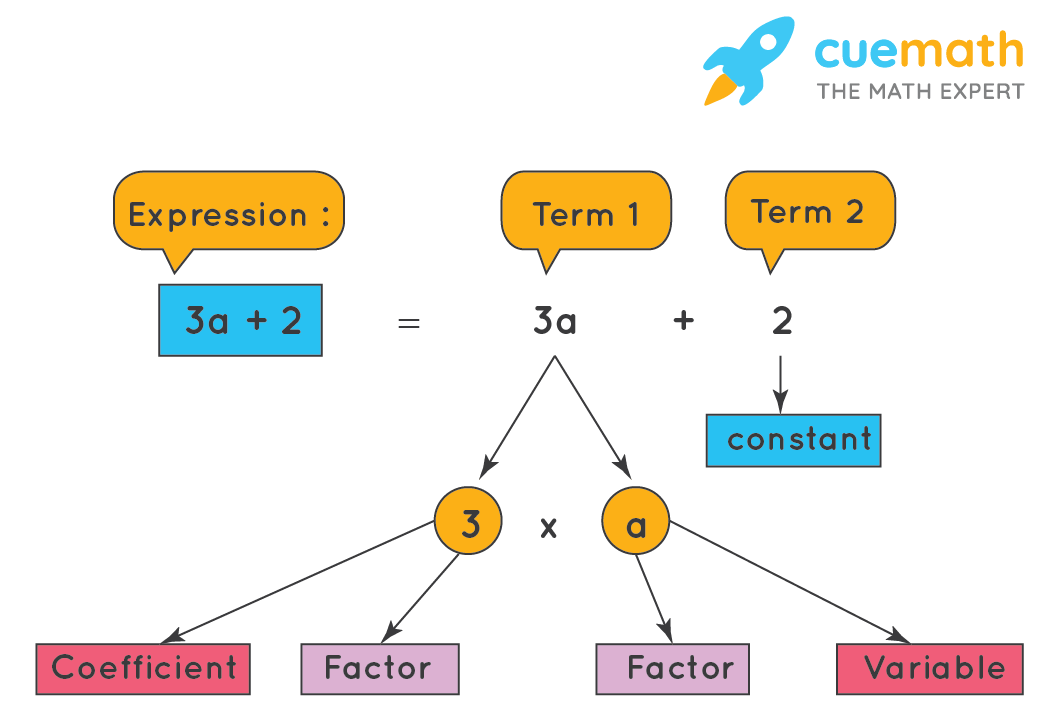
Algebraic expressions are made up of several key components.


Variables

A variable is a symbol that represents an unknown value.

Common variables include:

x, y, z, a, b

Example:

5x + 2

Here x is the variable.

Variables allow expressions to represent many possible values.


Constants

A constant is a fixed numerical value.

Example:

In the expression:

3x + 8

The number 8 is a constant.

Constants do not change.


Coefficients

A coefficient is the numerical factor multiplied by a variable.

Example:

4x

Here 4 is the coefficient.

Coefficients determine how much of a variable is present.


Terms

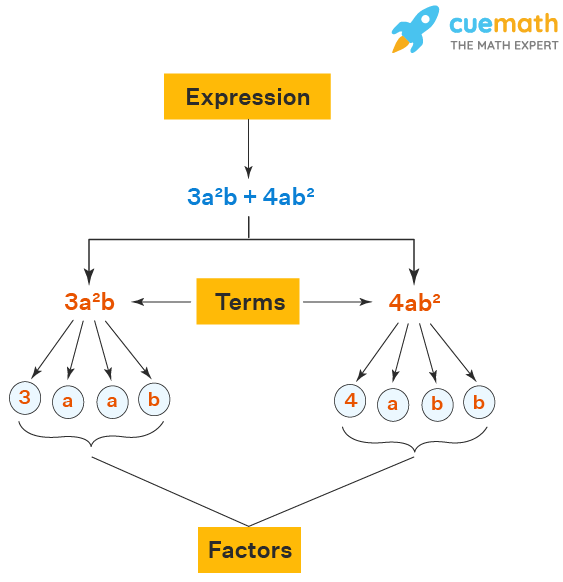
A term is a part of an expression separated by addition or subtraction.

Example:

5x + 3y − 2

Terms are:

5x, 3y, −2


3. Types of Algebraic Expressions

Expressions can be classified according to the number of terms.


Monomial

A monomial contains one term.

Example:

7x

4y²


Binomial

A binomial contains two terms.

Example:

x + 5

3a − 2b


Trinomial

A trinomial contains three terms.

Example:

x² + 4x + 7


Polynomial

A polynomial contains one or more terms.

Example:

2x³ + 3x² − 5x + 6

Polynomials are widely studied in algebra.


4. Degree of an Algebraic Expression

The degree of an algebraic expression is determined by the highest exponent of the variable.

Example:

3x² + 2x + 5

The highest exponent is 2.

Degree = 2


Examples:

x³ + 2x² + 7 → degree 3
5x + 3 → degree 1

The degree helps classify polynomial expressions.


5. Algebraic Operations

Image
Image
Image
Image

Algebraic expressions can be manipulated using basic arithmetic operations.


Addition of Algebraic Expressions

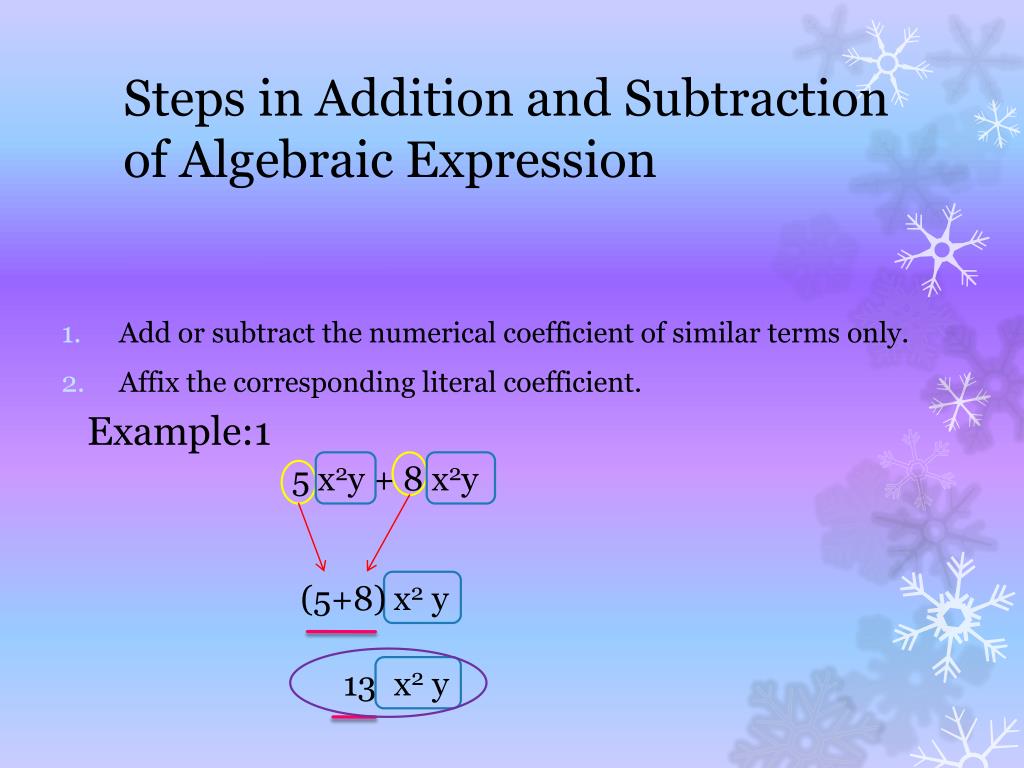
Add like terms together.

Example:

3x + 2x

Result:

5x

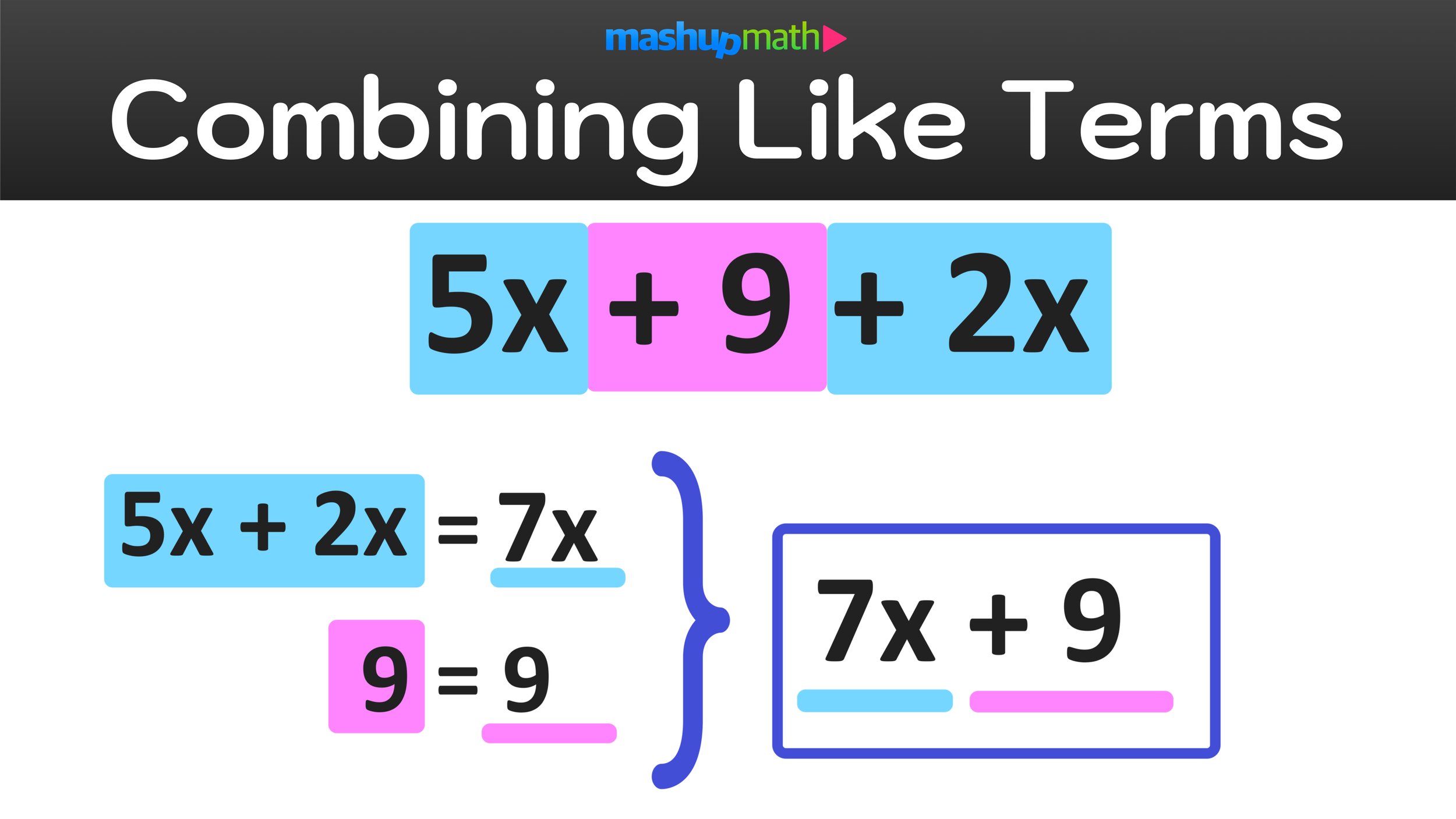
Another example:

2x + 3 + 4x + 5

Combine like terms:

6x + 8


Subtraction of Algebraic Expressions

Example:

7x − 3x

Result:

4x

Example:

(5x + 8) − (2x + 3)

Result:

3x + 5


Multiplication of Algebraic Expressions

Example:

2x × 3x

Result:

6x²

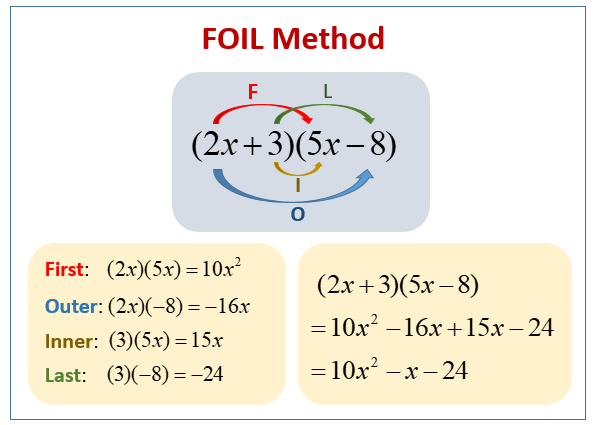
Example:

(x + 2)(x + 3)

Using distributive property:

x² + 5x + 6


Division of Algebraic Expressions

Example:

6x² ÷ 3x

Result:

2x

Division simplifies expressions.


6. Like Terms and Unlike Terms

Understanding like terms is essential for simplifying expressions.


Like Terms

Terms with the same variable and exponent.

Example:

3x and 5x

2y² and 7y²

These terms can be combined.

Example:

3x + 5x = 8x


Unlike Terms

Terms with different variables or exponents.

Example:

3x and 3y

2x² and 2x

These terms cannot be combined.


7. Simplifying Algebraic Expressions

Image
Image
Image
Image

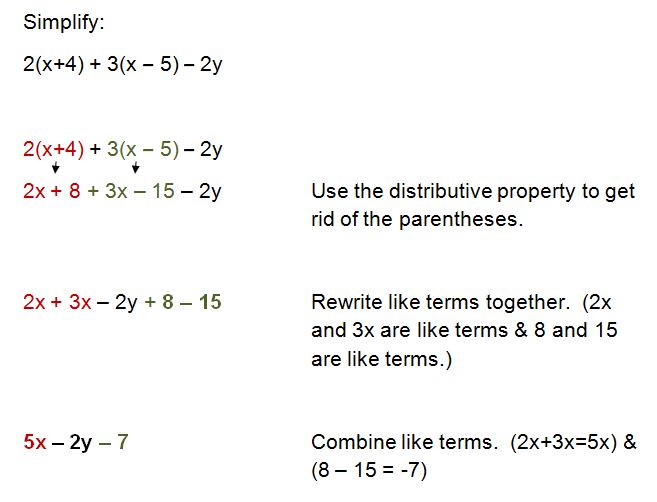
Simplifying means rewriting expressions in their simplest form.

Steps:

  1. Identify like terms
  2. Combine like terms
  3. Arrange in standard form

Example:

3x + 2x + 4 − 1

Combine:

5x + 3


Example:

7y + 5 − 3y + 2

Result:

4y + 7


8. Evaluating Algebraic Expressions

Evaluating means finding the value of an expression when variables are replaced with numbers.

Example:

Expression:

2x + 5

If x = 3:

2(3) + 5

Result:

11


Example:

3a² − 4

If a = 2:

3(2²) − 4

Result:

8


9. Algebraic Expressions in Geometry

Algebraic expressions are used to represent geometric formulas.

Example:

Area of rectangle:

A = l × w

If length is:

x + 2

And width is:

x

Area expression:

x(x + 2)


Example:

Perimeter of square:

4x


10. Algebraic Expressions and Real-Life Applications

Algebraic expressions are used in many practical situations.


Economics

Profit calculations:

Profit = revenue − cost


Physics

Distance formula:

d = vt


Engineering

Design calculations involve algebraic expressions.


Computer Science

Algorithms often use algebraic formulas.


11. Algebraic Identities

Important identities simplify algebraic expressions.

Examples include:

(a + b)² = a² + 2ab + b²

(a − b)² = a² − 2ab + b²

(a + b)(a − b) = a² − b²

These identities help expand or factor expressions.


12. Factorization

Image
Image
Image
Image

Factorization is the process of writing an expression as a product of factors.

Example:

x² + 5x + 6

Factors:

(x + 2)(x + 3)


Example:

x² − 9

Result:

(x − 3)(x + 3)


13. Importance of Algebraic Expressions

Algebraic expressions are important because they:

  • represent mathematical relationships
  • describe patterns
  • simplify calculations
  • help solve equations

They also form the basis of advanced mathematics.


14. Role in Higher Mathematics

Algebraic expressions are used in:

  • calculus
  • linear algebra
  • statistics
  • differential equations

They provide a symbolic way to represent mathematical models.


15. Algebraic Expressions and Functions

Functions often use algebraic expressions.

Example:

f(x) = 2x + 3

This function describes how outputs depend on inputs.


16. Historical Development of Algebra

The word algebra comes from the Arabic term “al-jabr.”

Early mathematicians developed symbolic methods to represent unknown quantities.

These ideas evolved into modern algebraic notation used today.


17. Algebraic Expressions in Scientific Models

Scientists use algebraic expressions to represent relationships between physical quantities.

Examples include:

  • motion equations
  • energy formulas
  • electrical circuits

These models help predict and analyze real-world phenomena.


18. Common Mistakes in Algebraic Expressions

Students often make mistakes such as:

  • combining unlike terms
  • forgetting negative signs
  • incorrect distribution

Example:

Incorrect:

3x + 2y = 5xy

Correct:

They cannot be combined.


19. Importance in Education

Learning algebraic expressions develops:

  • logical thinking
  • problem-solving skills
  • mathematical reasoning

These skills are valuable in many academic disciplines.


20. Summary

Algebraic expressions are mathematical expressions consisting of variables, constants, and operations. They provide a powerful way to represent mathematical relationships and unknown quantities.

Understanding algebraic expressions involves recognizing their components, performing operations, simplifying expressions, and applying them to real-world problems.

These expressions are fundamental to algebra and serve as the foundation for advanced mathematical concepts used in science, engineering, economics, and technology.