Tag Archives: atomic theory

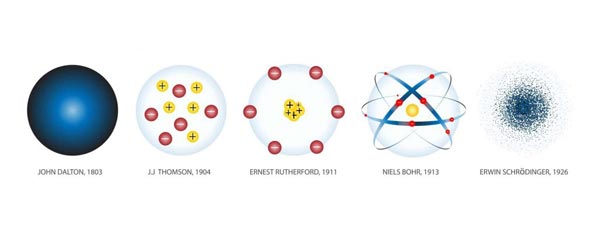
Atomic Models

Image
Image
Image
Image

1. Introduction to Atomic Models

Atomic models are conceptual representations used to explain the structure and behavior of atoms. Because atoms are extremely small and cannot be observed directly with the naked eye, scientists use models to describe their internal structure and explain experimental observations.

Over the centuries, scientific understanding of atoms has evolved through a series of discoveries and experiments. Each new model improved upon earlier ones by explaining additional experimental evidence. Atomic models help scientists understand:

  • The arrangement of subatomic particles
  • Chemical bonding and reactions
  • The periodic table of elements
  • Spectral lines of atoms
  • The behavior of matter at microscopic levels

The development of atomic models represents one of the most important progressions in the history of science. From early philosophical ideas to the modern quantum mechanical model, each step has contributed to a deeper understanding of matter.

Atomic models are not exact pictures of atoms but rather scientific frameworks that approximate atomic structure based on available evidence.


2. Early Philosophical Concepts of Atoms

Image
Image
Image
Image

The earliest ideas about atoms originated in ancient Greece around 400 BCE. Philosophers such as Democritus and Leucippus proposed that matter consisted of tiny indivisible particles called atoms, derived from the Greek word meaning “uncuttable.”

According to their theory:

  • Matter is composed of extremely small particles.
  • These particles cannot be divided further.
  • Different substances are formed by different arrangements of atoms.

Although this concept was remarkably insightful, it was based on philosophical reasoning rather than experimental evidence. Therefore, it did not gain widespread acceptance in scientific circles at the time.

For many centuries afterward, the dominant view of matter was based on the four classical elements proposed by Aristotle:

  • Earth
  • Water
  • Air
  • Fire

It was not until the development of modern experimental science in the eighteenth and nineteenth centuries that atomic theory began to gain scientific support.


3. Dalton’s Atomic Model (Solid Sphere Model)

Image
Image
Image
Image

The first scientific atomic model was proposed by John Dalton in the early nineteenth century.

Dalton’s model was based on experimental observations related to chemical reactions and the laws of chemical combination.

Dalton’s Atomic Theory

Dalton proposed several fundamental principles:

  1. Matter is composed of tiny indivisible particles called atoms.
  2. Atoms of a given element are identical in mass and properties.
  3. Atoms of different elements differ in mass and properties.
  4. Compounds form when atoms combine in fixed whole-number ratios.
  5. Chemical reactions involve the rearrangement of atoms.

Characteristics of Dalton’s Model

Dalton imagined atoms as solid, indivisible spheres, similar to tiny billiard balls.

This model successfully explained several chemical laws, including:

  • Law of conservation of mass
  • Law of definite proportions
  • Law of multiple proportions

Limitations of Dalton’s Model

Although Dalton’s theory was revolutionary, later discoveries revealed several limitations:

  • Atoms are divisible and contain subatomic particles.
  • Atoms of the same element can have different masses (isotopes).
  • Atoms can undergo nuclear reactions.

Despite these limitations, Dalton’s model laid the foundation for modern atomic theory.


4. Thomson’s Atomic Model (Plum Pudding Model)

Image
Image
Image
Image

The discovery of the electron in 1897 by J. J. Thomson led to a new atomic model.

Through experiments with cathode ray tubes, Thomson demonstrated that atoms contain negatively charged particles.

Thomson’s Model Description

Thomson proposed the plum pudding model of the atom.

In this model:

  • The atom is a positively charged sphere.
  • Electrons are embedded throughout the sphere like raisins in a pudding.

This arrangement ensured that the atom remained electrically neutral.

Contributions of Thomson’s Model

The model introduced the concept of subatomic particles, proving that atoms were not indivisible.

It also explained the electrical properties of atoms.

Limitations

Thomson’s model could not explain:

  • The existence of a dense nucleus
  • The scattering of alpha particles observed in later experiments

These limitations led to the development of a new atomic model.


5. Rutherford’s Nuclear Model

Image
Image
Image
Image

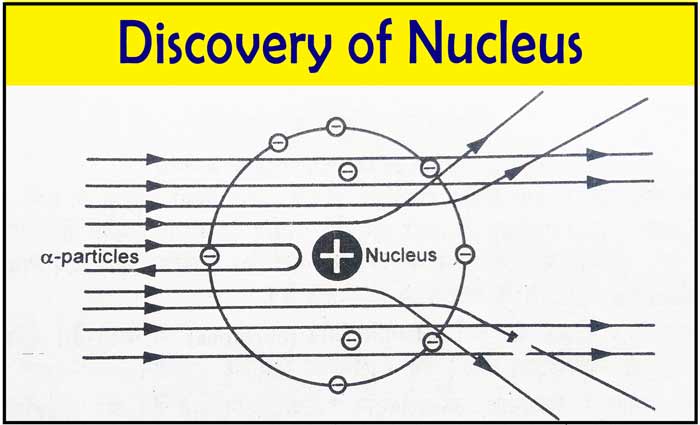
In 1911, Ernest Rutherford conducted the famous gold foil experiment, which revolutionized the understanding of atomic structure.

Gold Foil Experiment

Rutherford and his colleagues directed a beam of alpha particles at a thin sheet of gold foil.

Observations:

  • Most alpha particles passed straight through the foil.
  • Some particles were deflected slightly.
  • A few particles bounced back at large angles.

Conclusions

From these observations, Rutherford concluded that:

  1. Atoms are mostly empty space.
  2. Positive charge is concentrated in a tiny central nucleus.
  3. Electrons move around the nucleus.

Rutherford’s Atomic Model

The atom consists of:

  • A small, dense, positively charged nucleus
  • Electrons orbiting the nucleus
  • Large empty space between the nucleus and electrons

Limitations

Rutherford’s model could not explain:

  • Why electrons do not spiral into the nucleus
  • The discrete spectral lines observed in atomic emission spectra

These problems led to the development of the Bohr model.


6. Bohr’s Atomic Model

Image
Image
Image
Image

In 1913, Niels Bohr proposed an improved atomic model that incorporated ideas from quantum theory.

Main Features of Bohr’s Model

  1. Electrons move in fixed circular orbits around the nucleus.
  2. Each orbit corresponds to a specific energy level.
  3. Electrons can jump between energy levels by absorbing or emitting energy.
  4. Energy is quantized and exists in discrete units.

Explanation of Atomic Spectra

Bohr’s model successfully explained the spectral lines of hydrogen.

When electrons jump from higher energy levels to lower levels, they emit light of specific wavelengths.

Advantages

Bohr’s model explained:

  • Atomic emission spectra
  • Stability of atoms
  • Quantized energy levels

Limitations

Bohr’s model works well only for hydrogen and hydrogen-like atoms.

It cannot accurately describe atoms with multiple electrons.


7. Quantum Mechanical Model of the Atom

Image
Image
Image
Image

The modern understanding of atomic structure is based on quantum mechanics.

This model was developed through the work of scientists such as:

  • Erwin Schrödinger
  • Werner Heisenberg
  • Louis de Broglie

Key Principles

Wave-Particle Duality

Electrons behave both as particles and waves.

Uncertainty Principle

The exact position and momentum of an electron cannot be known simultaneously.

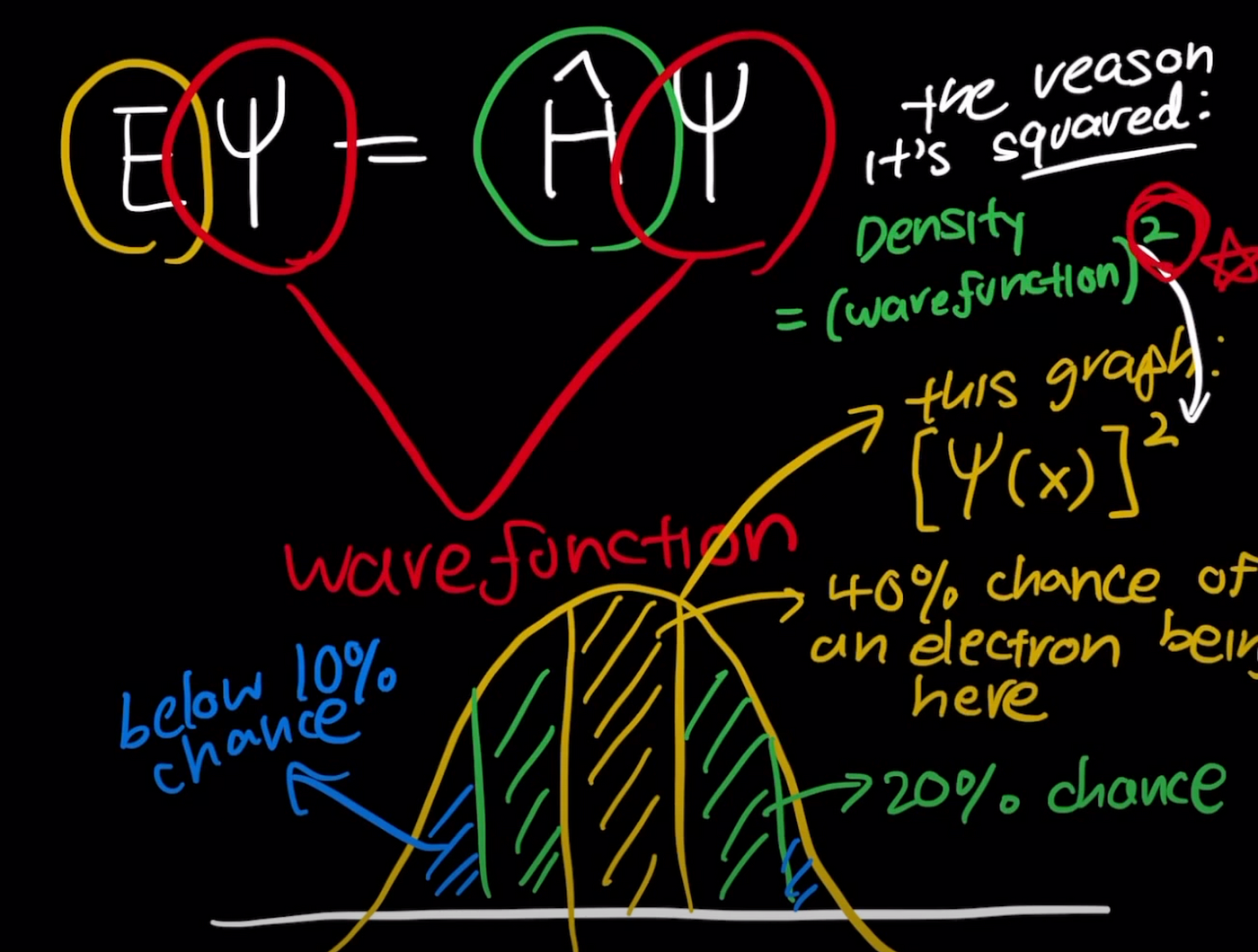
Schrödinger Wave Equation

This equation describes the probability distribution of electrons in atoms.

Orbitals

Instead of fixed orbits, electrons occupy orbitals, which are regions where electrons are most likely to be found.

Types of orbitals include:

  • s orbitals (spherical)
  • p orbitals (dumbbell-shaped)
  • d orbitals (clover-shaped)
  • f orbitals (complex shapes)

This model accurately explains atomic structure and chemical bonding.


8. Comparison of Atomic Models

Each atomic model improved upon the previous one.

Dalton Model

Atoms are indivisible solid spheres.

Thomson Model

Atoms contain electrons embedded in positive charge.

Rutherford Model

Atoms contain a dense central nucleus.

Bohr Model

Electrons occupy quantized energy levels.

Quantum Mechanical Model

Electrons exist in probability clouds called orbitals.

This progression reflects the advancement of experimental techniques and scientific understanding.


9. Importance of Atomic Models

Atomic models are essential for understanding many aspects of chemistry and physics.

Chemical Bonding

Models explain how atoms combine to form molecules.

Periodic Table

Atomic structure determines periodic trends.

Spectroscopy

Atomic models explain emission and absorption spectra.

Material Science

Understanding electron behavior helps design new materials.

Nanotechnology

Atomic-level understanding enables manipulation of matter at extremely small scales.


10. Applications in Modern Science

Atomic models play a crucial role in many technological fields.

Electronics

Semiconductors rely on understanding electron energy levels.

Nuclear Energy

Nuclear models explain fission and fusion reactions.

Medical Technology

Radiation therapy and imaging technologies rely on atomic principles.

Astronomy

Spectral analysis helps identify elements in stars and galaxies.


11. Conclusion

The development of atomic models represents a remarkable journey in scientific discovery. Starting from philosophical ideas about indivisible particles, scientists gradually uncovered the complex internal structure of atoms.

Dalton’s model introduced the concept of atoms as fundamental building blocks of matter. Thomson’s discovery of electrons revealed that atoms contain subatomic particles. Rutherford’s experiments demonstrated the existence of a dense nucleus. Bohr introduced quantized electron energy levels, and the quantum mechanical model provided a sophisticated description of electron behavior.

Today, the quantum mechanical model remains the most accurate representation of atomic structure. It continues to guide research in chemistry, physics, materials science, and nanotechnology.

The evolution of atomic models highlights the importance of experimentation, theoretical insight, and technological advancement in expanding our understanding of the natural world.


Tags

Atomic Structure

Image
Image
Image
Image

1. Introduction to Atomic Structure

Atomic structure is one of the most fundamental concepts in chemistry and physics. It describes the internal composition of atoms and explains how subatomic particles are arranged and interact within an atom. Understanding atomic structure is essential for explaining the chemical behavior of elements, the formation of molecules, and the nature of chemical reactions.

An atom is the smallest unit of an element that retains the chemical properties of that element. All matter in the universe—whether solid, liquid, gas, or plasma—is made up of atoms. These atoms combine in various ways to form molecules and compounds.

The idea that matter is composed of tiny indivisible particles dates back to ancient philosophers. However, modern atomic theory developed through centuries of scientific investigation and experimentation.

The study of atomic structure provides insight into several important topics, including:

  • Chemical bonding
  • Periodic table organization
  • Spectroscopy
  • Quantum mechanics
  • Nuclear reactions
  • Material properties

Atoms are incredibly small. The typical diameter of an atom is about 10⁻¹⁰ meters (0.1 nanometers). Despite their tiny size, atoms consist of smaller components known as subatomic particles.

The three main subatomic particles are:

  • Protons
  • Neutrons
  • Electrons

These particles determine the mass, charge, and behavior of atoms.


2. Historical Development of Atomic Theory

Image
Image
Image
Image

The concept of atoms has evolved through many scientific discoveries.

Early Philosophical Ideas

The earliest ideas about atoms were proposed by ancient Greek philosophers such as Democritus around 400 BCE. He suggested that matter is composed of indivisible particles called atoms, derived from the Greek word meaning “uncuttable.”

However, these ideas were philosophical rather than scientific because they were not supported by experiments.


Dalton’s Atomic Theory (1803)

The first modern scientific atomic theory was proposed by John Dalton in the early 19th century.

Dalton’s atomic theory included several key ideas:

  1. Matter is composed of tiny indivisible atoms.
  2. Atoms of the same element are identical in mass and properties.
  3. Atoms of different elements differ in mass and properties.
  4. Atoms combine in simple whole-number ratios to form compounds.
  5. Chemical reactions involve the rearrangement of atoms.

Dalton’s model represented atoms as solid spheres.


Thomson’s Model (1897)

In 1897, J. J. Thomson discovered the electron through experiments with cathode rays.

He proposed the plum pudding model, in which:

  • The atom is a positively charged sphere
  • Electrons are embedded within it

Although this model explained the presence of electrons, it did not accurately represent atomic structure.


Rutherford’s Nuclear Model (1911)

Ernest Rutherford conducted the famous gold foil experiment.

In this experiment, alpha particles were directed toward a thin sheet of gold foil. Most particles passed straight through, but some were deflected at large angles.

This led to several conclusions:

  • Atoms are mostly empty space.
  • The positive charge is concentrated in a tiny central nucleus.
  • Electrons move around the nucleus.

This discovery introduced the concept of the atomic nucleus.


Bohr’s Atomic Model (1913)

Niels Bohr improved Rutherford’s model by introducing quantized energy levels.

According to Bohr:

  • Electrons move in fixed circular orbits around the nucleus.
  • Each orbit corresponds to a specific energy level.
  • Electrons can jump between levels by absorbing or emitting energy.

Bohr’s model explained the spectral lines of hydrogen but could not fully explain more complex atoms.


Quantum Mechanical Model (Modern Theory)

The modern understanding of atomic structure is based on quantum mechanics.

Instead of fixed orbits, electrons exist in orbitals, which are regions of probability where electrons are most likely to be found.

This model was developed through the work of scientists such as:

  • Erwin Schrödinger
  • Werner Heisenberg
  • Louis de Broglie

The quantum mechanical model remains the most accurate description of atomic structure.


3. Subatomic Particles

Image
Image
Image
Image

Atoms contain three primary subatomic particles.

Protons

Protons are positively charged particles located in the nucleus of an atom.

Characteristics of protons:

  • Positive electric charge (+1)
  • Mass approximately 1 atomic mass unit (amu)
  • Located in the nucleus

The number of protons in an atom determines the atomic number, which identifies the element.


Neutrons

Neutrons are electrically neutral particles located in the nucleus.

Characteristics of neutrons:

  • No electric charge
  • Mass approximately 1 atomic mass unit
  • Located in the nucleus

Neutrons contribute to the overall mass of the atom and help stabilize the nucleus.


Electrons

Electrons are negatively charged particles that move around the nucleus in orbitals.

Characteristics of electrons:

  • Negative electric charge (−1)
  • Very small mass (about 1/1836 of a proton)
  • Located outside the nucleus

Electrons determine the chemical properties and bonding behavior of atoms.


4. Atomic Number and Mass Number

Every atom has specific numerical characteristics that define it.

Atomic Number

The atomic number (Z) is the number of protons in the nucleus.

It uniquely identifies an element.

For example:

Hydrogen → 1 proton
Carbon → 6 protons
Oxygen → 8 protons

Atoms of the same element always have the same atomic number.


Mass Number

The mass number (A) is the total number of protons and neutrons in the nucleus.

Mass Number = Protons + Neutrons

Mass number determines the approximate mass of the atom.


5. Isotopes

Image
Image
Image
Image

Isotopes are atoms of the same element that have the same number of protons but different numbers of neutrons.

Because they have different numbers of neutrons, isotopes have different mass numbers.

Example: Hydrogen isotopes

Protium → 1 proton, 0 neutrons
Deuterium → 1 proton, 1 neutron
Tritium → 1 proton, 2 neutrons

Although isotopes have similar chemical properties, their physical properties may differ.

Isotopes are important in many applications:

  • Medical imaging
  • Radiotherapy
  • Carbon dating
  • Nuclear energy

6. Electronic Structure of Atoms

Image
Image
Image
Image

Electrons occupy specific energy levels around the nucleus.

These energy levels are called electron shells or principal energy levels.

Each shell can hold a maximum number of electrons determined by the formula:

Maximum electrons = 2n²

Where n is the energy level.

Example:

n = 1 → 2 electrons
n = 2 → 8 electrons
n = 3 → 18 electrons


Subshells and Orbitals

Each energy level contains subshells.

The main types of subshells are:

  • s
  • p
  • d
  • f

Each subshell contains orbitals where electrons are most likely to be found.

Orbital shapes include:

  • s orbital → spherical
  • p orbital → dumbbell-shaped
  • d orbital → complex shapes
  • f orbital → highly complex shapes

7. Quantum Numbers

Quantum numbers describe the location and energy of electrons in atoms.

There are four quantum numbers.

Principal Quantum Number (n)

Determines the main energy level of the electron.

Angular Momentum Quantum Number (l)

Determines the shape of the orbital.

Magnetic Quantum Number (m)

Determines the orientation of the orbital.

Spin Quantum Number (s)

Represents the spin direction of the electron.

Quantum numbers provide a mathematical description of electron behavior.


8. Electron Configuration

Electron configuration describes how electrons are distributed among atomic orbitals.

Electrons follow three important principles when filling orbitals.

Aufbau Principle

Electrons occupy the lowest energy orbitals first.

Pauli Exclusion Principle

No two electrons in an atom can have the same set of quantum numbers.

Hund’s Rule

Electrons occupy orbitals singly before pairing up.

Example electron configuration:

Oxygen (8 electrons):

1s² 2s² 2p⁴


9. Atomic Orbitals and Electron Clouds

The modern quantum model describes electrons as existing in probability clouds rather than fixed orbits.

An orbital represents a region in space where the probability of finding an electron is highest.

This model explains many phenomena that earlier atomic models could not explain.

Electron clouds create the shapes and sizes of atoms and influence chemical bonding.


10. Atomic Spectra

When electrons move between energy levels, they absorb or emit energy in the form of light.

This produces atomic spectra, which appear as specific lines of color.

Each element has a unique spectral pattern that acts like a fingerprint.

Spectroscopy uses these spectra to identify elements in:

  • stars
  • distant galaxies
  • chemical samples

11. Nuclear Stability and Radioactivity

The stability of an atom depends on the balance between protons and neutrons in the nucleus.

When nuclei become unstable, they may undergo radioactive decay.

Common types of radioactive decay include:

  • Alpha decay
  • Beta decay
  • Gamma radiation

Radioactivity plays important roles in:

  • nuclear medicine
  • radiometric dating
  • nuclear power generation

12. Importance of Atomic Structure

Understanding atomic structure is crucial for many scientific fields.

Chemistry

Explains chemical bonding and reactions.

Physics

Helps understand quantum mechanics and nuclear physics.

Material Science

Determines properties of metals, semiconductors, and polymers.

Medicine

Radioisotopes are used in medical imaging and cancer treatment.

Astronomy

Atomic spectra help scientists identify elements in stars and galaxies.


13. Conclusion

Atomic structure forms the foundation of modern chemistry and physics. The discovery that atoms consist of protons, neutrons, and electrons revolutionized our understanding of matter.

Over time, atomic models evolved from simple solid spheres to the sophisticated quantum mechanical model that describes electron behavior using probability distributions.

Knowledge of atomic structure allows scientists to understand chemical bonding, predict the properties of elements, and develop new technologies in medicine, energy, and materials science.

As scientific research continues, deeper exploration of atomic and subatomic particles continues to reveal new insights into the fundamental nature of matter and the universe.


Tags

Atomic Models

Image
Image
Image
Image

Introduction

Atomic models are theoretical representations that describe the structure, composition, and behavior of atoms. The development of atomic models has been one of the most significant achievements in the history of science, helping scientists understand the nature of matter and the fundamental particles that compose it.

The idea that matter is composed of tiny indivisible particles dates back to ancient philosophical traditions, but it was only during the nineteenth and twentieth centuries that scientific experiments began to provide concrete evidence supporting atomic theory. Over time, several models of the atom were proposed to explain experimental observations. Each new model refined or replaced previous ones as scientific knowledge advanced.

Major atomic models include:

  • The Dalton atomic model
  • The Thomson plum pudding model
  • The Rutherford nuclear model
  • The Bohr planetary model
  • The Quantum mechanical model

These models were proposed by scientists such as John Dalton, J. J. Thomson, Ernest Rutherford, Niels Bohr, and Erwin Schrödinger.

The evolution of atomic models reflects the progress of scientific understanding and experimental techniques.


Early Ideas About the Atom

Ancient Greek Atomism

The earliest known concept of atoms was proposed by the Greek philosophers Democritus and Leucippus around 400 BCE.

They proposed that:

  • Matter is composed of tiny indivisible particles called atoms.
  • Atoms move in empty space.
  • Different materials consist of different types of atoms.

However, these ideas were philosophical rather than experimental and lacked scientific verification.


Dalton’s Atomic Model (1803)

Image
Image
Image
Image

The first modern atomic theory was proposed in 1803 by John Dalton.

Dalton’s model described atoms as solid, indivisible spheres, similar to billiard balls.

Main Postulates of Dalton’s Atomic Theory

  1. All matter is made of tiny indivisible particles called atoms.
  2. Atoms of the same element are identical in mass and properties.
  3. Atoms of different elements have different masses and properties.
  4. Atoms combine in simple whole-number ratios to form compounds.
  5. Chemical reactions involve rearrangement of atoms.

Importance of Dalton’s Model

Dalton’s theory explained several fundamental chemical laws:

  • Law of conservation of mass
  • Law of definite proportions
  • Law of multiple proportions

Although Dalton’s model treated atoms as indivisible particles, later discoveries showed that atoms contain subatomic particles.


Limitations of Dalton’s Model

Dalton’s theory could not explain:

  • The existence of electrons
  • Radioactivity
  • The internal structure of atoms
  • Isotopes of elements

These limitations led to the development of more advanced atomic models.


Thomson’s Atomic Model (1904)

Image
Image
Image
Image

The discovery of the electron by J. J. Thomson in 1897 led to the development of a new atomic model.

Thomson proposed the plum pudding model.

Description of the Model

In this model:

  • The atom is a positively charged sphere.
  • Negatively charged electrons are embedded within it.
  • The structure resembles plums embedded in pudding.

This model suggested that positive and negative charges balance to make the atom electrically neutral.


Cathode Ray Experiment

Thomson discovered electrons using a cathode ray tube experiment.

The experiment showed that:

  • Cathode rays consist of negatively charged particles.
  • These particles are smaller than atoms.

This discovery proved that atoms are divisible.


Limitations of Thomson’s Model

The plum pudding model failed to explain:

  • The results of Rutherford’s gold foil experiment
  • The presence of a concentrated atomic nucleus
  • The arrangement of electrons around the nucleus

Rutherford’s Nuclear Model (1911)

Image
Image
Image
Image

A major breakthrough in atomic theory came from experiments conducted by Ernest Rutherford.

His famous experiment is known as the Rutherford gold foil experiment.


Gold Foil Experiment

In this experiment:

  • Alpha particles were directed at a thin gold foil.
  • A detector recorded how particles scattered.

Observations

Most particles:

  • Passed straight through the foil.

Some particles:

  • Deflected at small angles.

Very few particles:

  • Bounced back.

Conclusions

Rutherford concluded that:

  1. Most of the atom is empty space.
  2. Positive charge is concentrated in a tiny nucleus.
  3. Electrons move around the nucleus.

This led to the nuclear model of the atom.


Limitations of Rutherford’s Model

The model had a major problem.

According to classical physics:

  • Accelerating electrons should emit radiation.
  • Electrons orbiting the nucleus should lose energy.
  • Eventually, electrons should collapse into the nucleus.

But atoms are stable, so this model was incomplete.


Bohr’s Atomic Model (1913)

Image
Image
Image
Image

To solve the problems of Rutherford’s model, Niels Bohr proposed a new model in 1913.

Bohr introduced the concept of quantized electron orbits.


Bohr’s Postulates

  1. Electrons move in fixed circular orbits around the nucleus.
  2. Each orbit has a specific energy level.
  3. Electrons do not radiate energy while in a stable orbit.
  4. Energy is emitted or absorbed when electrons jump between orbits.

Energy Levels

Bohr proposed that electron energies are quantized:

[
E_n = -\frac{13.6}{n^2} \text{ eV}
]

Where:

  • (n) = principal quantum number.

Explanation of Hydrogen Spectrum

Bohr’s model successfully explained the spectral lines of hydrogen.

When electrons jump between energy levels, photons are emitted with energy:

[
E = hf
]

Where (h) is Planck’s constant.


Limitations of Bohr Model

Bohr’s model works well for hydrogen but fails for:

  • Multi-electron atoms
  • Fine spectral structures
  • Zeeman effect
  • Stark effect

These problems led to the development of quantum mechanics.


Quantum Mechanical Model

Image
Image
Image
Image

The most accurate description of atoms is provided by the quantum mechanical model.

It was developed by scientists such as:

  • Erwin Schrödinger
  • Werner Heisenberg
  • Louis de Broglie

Wave Nature of Electrons

De Broglie proposed that particles have wave properties.

The wavelength is:

[
\lambda = \frac{h}{p}
]

This idea introduced wave–particle duality.


Schrödinger Equation

The motion of electrons is described using the Schrödinger equation:

[
H\psi = E\psi
]

The solution gives wave functions, which describe the probability of finding an electron in a certain region.


Atomic Orbitals

Electrons occupy orbitals, which represent probability distributions.

Types of orbitals include:

  • s orbitals (spherical)
  • p orbitals (dumbbell-shaped)
  • d orbitals
  • f orbitals

Heisenberg Uncertainty Principle

The uncertainty principle states:

[
\Delta x \Delta p \geq \frac{h}{4\pi}
]

This means it is impossible to know both the exact position and momentum of an electron simultaneously.


Modern Understanding of Atomic Structure

The modern atomic model includes:

Nucleus

Contains:

  • Protons
  • Neutrons

The proton was discovered by Ernest Rutherford.

The neutron was discovered by James Chadwick.


Electron Cloud

Electrons exist in probability distributions around the nucleus.

These regions form the electron cloud.


Comparison of Atomic Models

ModelKey IdeaLimitation
DaltonAtoms are solid spheresNo subatomic particles
ThomsonElectrons embedded in positive sphereNo nucleus
RutherfordNuclear atom with electrons orbitingAtomic instability
BohrQuantized electron orbitsOnly works for hydrogen
QuantumElectron probability cloudsComplex mathematics

Importance of Atomic Models

Atomic models are fundamental to understanding:

  • Chemistry
  • Materials science
  • Nuclear physics
  • Spectroscopy
  • Quantum mechanics

They explain:

  • Chemical bonding
  • Periodic table structure
  • Atomic spectra
  • Reaction mechanisms

Applications of Atomic Theory

Atomic models have many applications.

Chemistry

Understanding molecular bonding.

Electronics

Semiconductors and transistors.

Nuclear Energy

Energy from nuclear reactions.

Medicine

Radiation therapy and imaging.

Nanotechnology

Design of atomic-scale devices.


Conclusion

The development of atomic models represents a progressive refinement of scientific understanding about the nature of matter. Beginning with the simple solid sphere model proposed by Dalton and evolving through the discoveries of electrons, nuclei, and quantum mechanics, scientists have gradually built a more accurate and detailed picture of atomic structure.

Modern atomic theory, based on quantum mechanics, describes atoms as complex systems where electrons exist in probability clouds around a dense nucleus composed of protons and neutrons. This model successfully explains a wide range of physical and chemical phenomena and forms the foundation of modern physics and chemistry.

The evolution of atomic models highlights the importance of experimentation, theoretical development, and scientific collaboration in advancing knowledge about the fundamental structure of matter.


Tags