


Introduction to Circles
A circle is one of the most fundamental and widely studied shapes in geometry. It appears frequently in mathematics, science, engineering, architecture, astronomy, and everyday life. From wheels and coins to planetary orbits and waves, circles play a crucial role in understanding shapes and motion.
In geometry, a circle represents a perfectly symmetrical figure where every point on its boundary is at the same distance from a central point. This constant distance defines the size of the circle and is known as the radius.
Circles have fascinated mathematicians for thousands of years. Ancient civilizations studied circles to understand astronomical movements, construct buildings, and measure land. Today, circles are used extensively in modern technology, computer graphics, physics, and engineering.
The study of circles includes many important concepts such as radius, diameter, chords, arcs, sectors, tangents, and angles. These concepts help us understand the geometric properties of circular shapes and their applications in both theoretical and practical contexts.
Definition of a Circle
A circle is defined as the set of all points in a plane that are at a fixed distance from a given point.
The fixed point is called the center of the circle.
The fixed distance is called the radius.
Mathematically:
A circle with center (O) and radius (r) consists of all points (P) such that:
[
OP = r
]
This means every point on the circle lies exactly the same distance from the center.
Basic Components of a Circle
A circle contains several important elements that help describe its geometry.
Center
The center of a circle is the point located exactly in the middle of the circle.
It is usually represented by the letter O.
All points on the circumference of the circle are equidistant from the center.
Radius
The radius is the distance from the center of the circle to any point on its boundary.
Symbol:
[
r
]
Example:
If the radius of a circle is 5 cm, every point on the circle is exactly 5 cm away from the center.
Diameter
The diameter is the longest chord of the circle and passes through the center.
It connects two points on the circle and passes directly through the center.
Formula:
[
d = 2r
]
Where:
- (d) = diameter
- (r) = radius
Circumference
The circumference is the distance around the circle.
Formula:
[
C = 2\pi r
]
Or
[
C = \pi d
]
Where:
(\pi) is approximately 3.14159.
Area of a Circle
The area of a circle represents the space enclosed inside the circle.
Formula:
[
A = \pi r^2
]
Example:
If radius = 7 cm
[
A = \pi \times 7^2
]
[
A = 49\pi
]
Chord
A chord is a line segment that connects two points on the circle.
The diameter is the longest chord in a circle.
Properties:
- Every diameter is a chord.
- Not every chord is a diameter.
Arc
An arc is a part of the circumference of the circle.
There are two types of arcs:
Minor Arc
The smaller arc between two points.
Major Arc
The larger arc between two points.
Sector
A sector is a region bounded by two radii and an arc.
Example:
A slice of pizza is an example of a sector.
Area formula:
[
A = \frac{\theta}{360} \times \pi r^2
]
Where (\theta) is the central angle.
Segment
A segment is the region between a chord and the arc.
Segments can be minor or major depending on the size.
Tangent
A tangent is a line that touches the circle at exactly one point.
Properties:
- Tangent touches circle at one point.
- Tangent is perpendicular to the radius at the point of contact.
Secant
A secant is a line that intersects a circle at two points.
Unlike a tangent, it passes through the circle.
Concentric Circles
Two or more circles with the same center but different radii are called concentric circles.
Example:
Ripples formed when a stone drops in water.
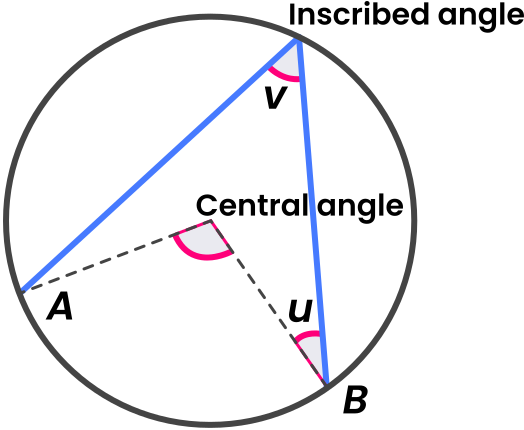
Central Angle
A central angle is an angle formed by two radii of the circle.
The vertex of the angle is at the center.
The measure of the arc equals the central angle.
Example:
If central angle = 60°
Arc measure = 60°.
Inscribed Angle
An inscribed angle is an angle whose vertex lies on the circle and whose sides contain chords.
The measure of an inscribed angle equals half the measure of the intercepted arc.
Formula:
[
\angle = \frac{1}{2} arc
]
Theorems Related to Circles
Many important theorems describe relationships between parts of circles.
Angle in a Semicircle
The angle formed in a semicircle is always a right angle.
This theorem is widely used in geometry.
Tangent Radius Theorem
A tangent is perpendicular to the radius at the point of contact.
Equal Chords Theorem
Equal chords are equidistant from the center of the circle.
Perpendicular Bisector of a Chord
The perpendicular bisector of a chord passes through the center.
Intersecting Chords Theorem
If two chords intersect inside a circle:
[
a \times b = c \times d
]
Tangent-Secant Theorem
If a tangent and a secant are drawn from a point outside the circle:
[
t^2 = external \times whole
]
Equations of Circles in Coordinate Geometry
In coordinate geometry, circles are represented by equations.
Standard form:
[
(x-h)^2 + (y-k)^2 = r^2
]
Where:
- (h,k) = center
- (r) = radius
Example:
[
(x-2)^2 + (y-3)^2 = 25
]
Center = (2,3)
Radius = 5
General Equation of a Circle
General form:
[
x^2 + y^2 + Dx + Ey + F = 0
]
This equation can be converted to standard form.
Length of an Arc
Arc length formula:
[
L = \frac{\theta}{360} \times 2\pi r
]
Where:
(\theta) = central angle.
Area of a Sector
[
A = \frac{\theta}{360} \times \pi r^2
]
Circles in Trigonometry
The unit circle is important in trigonometry.
It has radius = 1.
Used to define:
- sine
- cosine
- tangent
Circles in Real Life
Circles appear everywhere in everyday life.
Examples include:
- wheels
- coins
- clocks
- plates
- gears
- planets
- lenses
Circles in Engineering
Engineers use circular designs for:
- rotating machinery
- wheels
- gears
- turbines
Circular shapes distribute forces evenly.
Circles in Astronomy
Planetary orbits are often studied using circular and elliptical models.
Circular motion is important in physics and astronomy.
Circles in Architecture
Architectural structures such as domes and arches often use circular shapes.
Examples:
- stadium roofs
- bridges
- arches
Historical Development of Circle Geometry
The study of circles dates back to ancient civilizations.
Egyptians and Babylonians studied circular measurements.
Greek mathematicians developed systematic geometry of circles.
One of the most famous discoveries related to circles is the constant π (pi).
Pi represents the ratio between circumference and diameter.
Importance of Circles in Mathematics
Circles are essential because they:
- represent symmetry
- connect geometry with trigonometry
- appear in calculus
- model circular motion
- describe waves and rotations
They provide a bridge between algebra, geometry, and physics.
Circles in Calculus
Circles appear in calculus when studying curves and motion.
Example:
Parametric equations of a circle:
[
x = r\cos\theta
]
[
y = r\sin\theta
]
These equations describe circular motion.
Advanced Concepts Related to Circles
Advanced mathematics studies concepts such as:
- cyclic quadrilaterals
- circle inversion
- complex numbers and the unit circle
- circular functions
These topics extend the study of circles into higher mathematics.
Conclusion
Circles are one of the most important and elegant shapes in mathematics. Defined as the set of all points equidistant from a central point, circles possess unique properties that make them essential in geometry, trigonometry, and many scientific disciplines.
The study of circles includes various components such as radius, diameter, chords, arcs, sectors, tangents, and angles. These elements help mathematicians understand relationships within circular shapes and solve geometric problems.
Beyond theoretical mathematics, circles appear extensively in real-world applications, including engineering designs, architectural structures, astronomy, and mechanical systems. Their symmetry and efficiency make them fundamental in both natural phenomena and human-made technologies.
Understanding circles provides a foundation for advanced mathematical concepts and highlights the deep connections between geometry, algebra, and science.