Tag Archives: energy transfer

First Law of Thermodynamics

Image
Image
Image
Image

Introduction

The First Law of Thermodynamics is one of the fundamental principles of physics and thermodynamics that describes the conservation of energy in thermodynamic systems. It states that energy cannot be created or destroyed; instead, it can only be transferred or transformed from one form to another.

This law provides the foundation for understanding how energy moves between systems and their surroundings in the form of heat and work. It explains many natural phenomena such as heating, cooling, mechanical work, engine operation, and chemical reactions.

Thermodynamics studies the relationship between heat, work, temperature, and energy. The first law specifically deals with the energy balance of a system and shows how energy changes during physical and chemical processes.

Historically, the concept evolved during the 19th century when scientists such as James Prescott Joule, Julius Robert Mayer, and Hermann von Helmholtz demonstrated experimentally that mechanical work and heat are interchangeable forms of energy.

The First Law of Thermodynamics is widely used in many fields, including:

  • Physics
  • Chemistry
  • Mechanical engineering
  • Chemical engineering
  • Environmental science
  • Aerospace engineering
  • Energy systems

Understanding this law allows scientists and engineers to design machines, engines, refrigerators, and power plants.


Basic Concepts of Thermodynamics
Image
Image
Image
Image

Before understanding the first law, several important thermodynamic concepts must be understood.

System

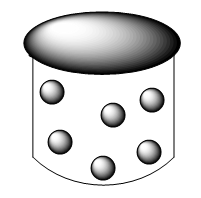
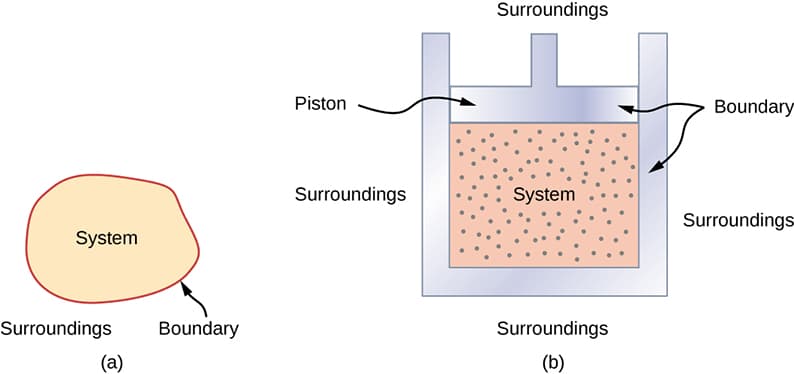
A thermodynamic system is a specific portion of the universe chosen for study.

Examples include:

  • Gas inside a cylinder
  • Water inside a boiler
  • A chemical reaction mixture
  • The Earth’s atmosphere

Everything outside the system is called the surroundings.

Types of Systems

Open System

An open system exchanges both energy and matter with the surroundings.

Examples:

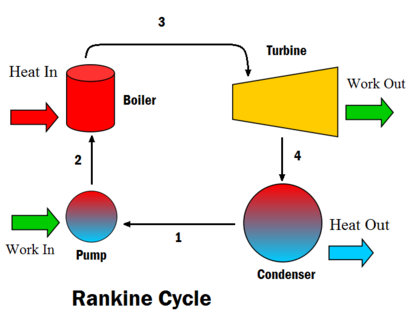
  • Steam turbine
  • Human body
  • Flowing river

Closed System

A closed system exchanges energy but not matter with surroundings.

Example:

  • Gas inside a sealed piston-cylinder device.

Isolated System

An isolated system exchanges neither energy nor matter.

Example:

  • The universe (considered an isolated system).

Boundary

The boundary separates the system from the surroundings. It may be real or imaginary.


Energy in Thermodynamics

Image
Image
Image
Image

Energy is the capacity to do work.

In thermodynamics, energy appears in different forms:

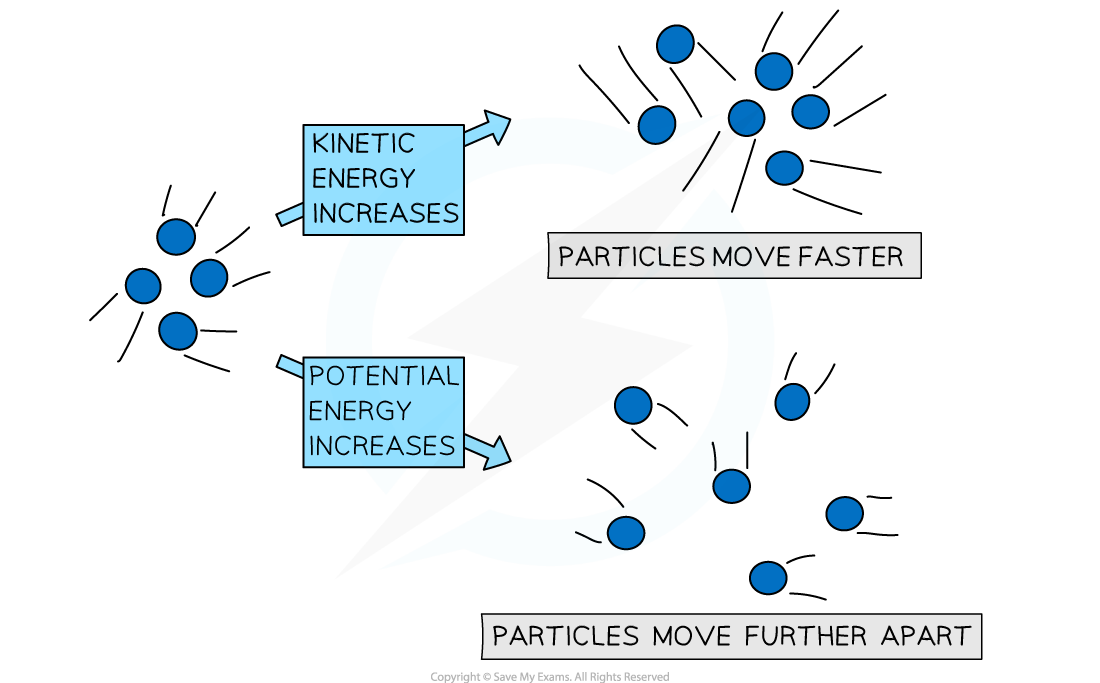
Kinetic Energy

Energy due to motion.

Example:

Moving gas molecules.

Potential Energy

Energy stored due to position or configuration.

Example:

Water stored in a dam.

Thermal Energy

Energy associated with temperature.

Chemical Energy

Energy stored in chemical bonds.

Electrical Energy

Energy due to electric charges.

Nuclear Energy

Energy stored in atomic nuclei.

All these forms of energy can transform into each other.


Internal Energy

Image
Image
Image
Image

Internal energy (U) is the total microscopic energy contained within a system.

It includes:

  • Kinetic energy of molecules
  • Potential energy between molecules
  • Rotational and vibrational energies

Internal energy depends mainly on temperature and state of the system.

Important points:

  • Internal energy is a state function.
  • It depends only on the current state of the system, not on the path taken to reach that state.

Heat and Work
Image
Image
Image
Image

Energy can cross the system boundary in two ways:

Heat (Q)

Heat is energy transferred due to temperature difference between system and surroundings.

Examples:

  • Heating water on a stove
  • Sun warming the Earth
  • Heat transfer in engines

Characteristics of Heat

  • Flows from high temperature to low temperature
  • Measured in joules (J) or calories

Work (W)

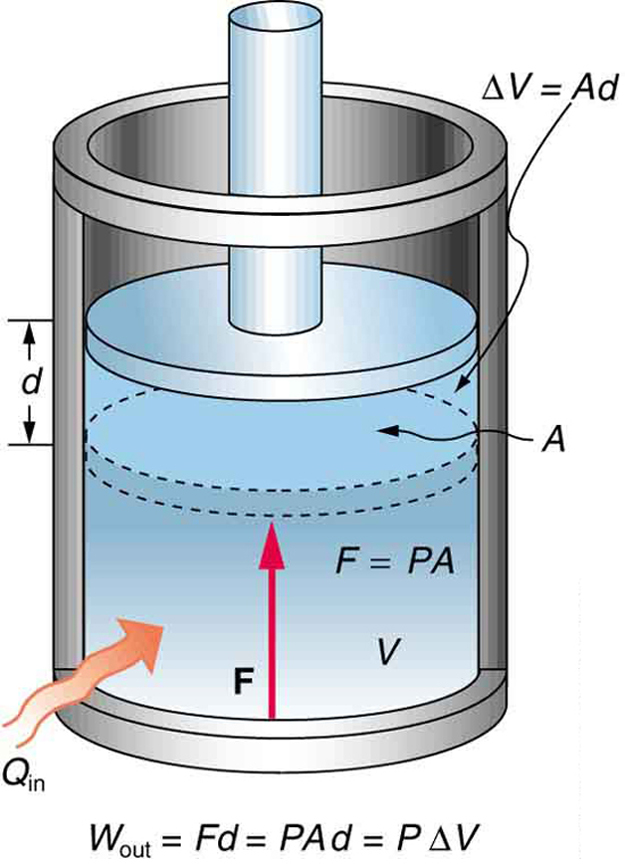
Work is energy transferred when a force causes displacement.

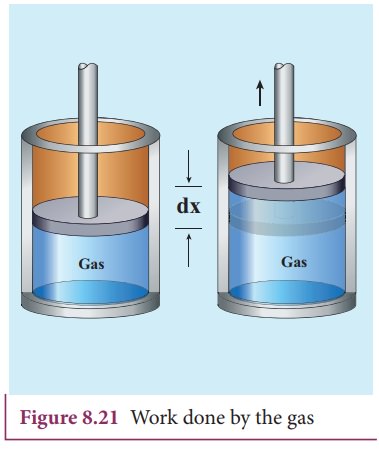
In thermodynamics, work commonly occurs when gas expands or compresses inside a piston.

Examples:

  • Steam pushing a piston
  • Air expanding in engines

Statement of the First Law of Thermodynamics

Image
Image
Image
Image

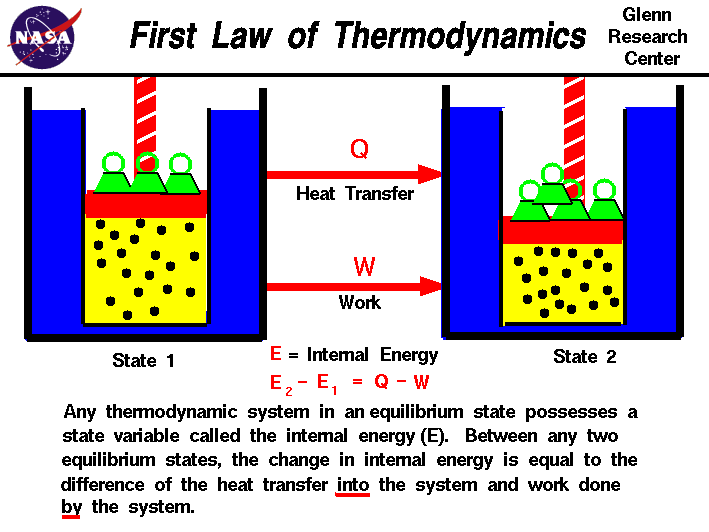
The First Law of Thermodynamics states:

The change in internal energy of a system equals the heat added to the system minus the work done by the system.

Mathematical Form

[
\Delta U = Q – W
]

Where:

  • ( \Delta U ) = Change in internal energy
  • ( Q ) = Heat supplied to the system
  • ( W ) = Work done by the system

Interpretation

  • If heat enters the system → internal energy increases
  • If the system performs work → internal energy decreases

Sign Conventions

Understanding sign conventions is important in thermodynamics.

QuantitySignMeaning
Heat added to systemPositiveEnergy enters system
Heat removedNegativeEnergy leaves system
Work done by systemPositiveSystem uses energy
Work done on systemNegativeEnergy added to system

First Law for Different Thermodynamic Processes

Isothermal Process
Image
Image
Image
Image

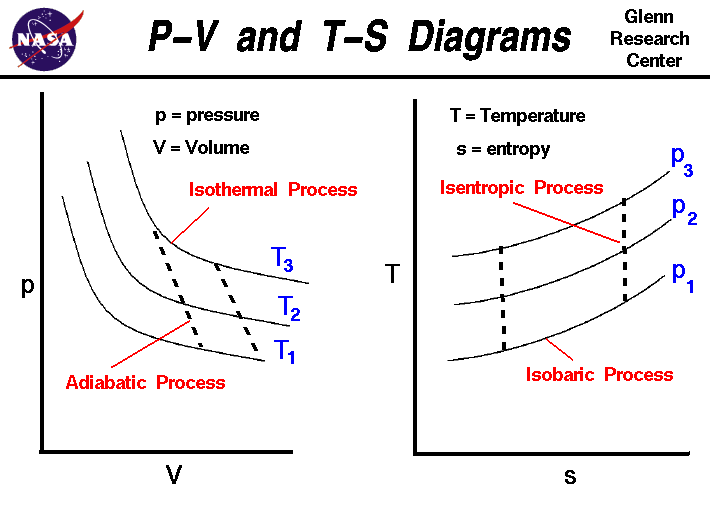
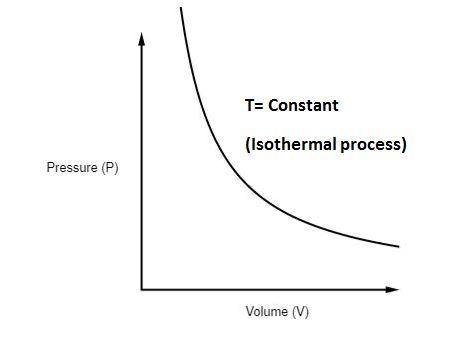
An isothermal process occurs at constant temperature.

Since internal energy depends on temperature:

[
\Delta U = 0
]

Thus,

[
Q = W
]

Meaning heat added to the system is completely converted into work.

Example:

Slow expansion of gas in a piston while temperature remains constant.


Adiabatic Process
Image
Image
Image
Image

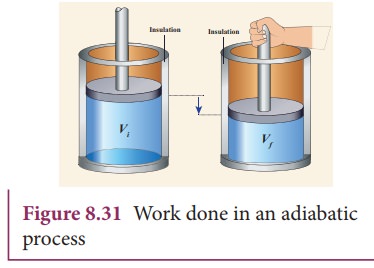
In an adiabatic process, no heat is exchanged with surroundings.

[
Q = 0
]

Thus:

[
\Delta U = -W
]

Internal energy changes due to work done.

Examples:

  • Rapid compression of gas
  • Atmospheric processes
  • Diesel engine compression

Isochoric Process

Image
Image
Image
Image

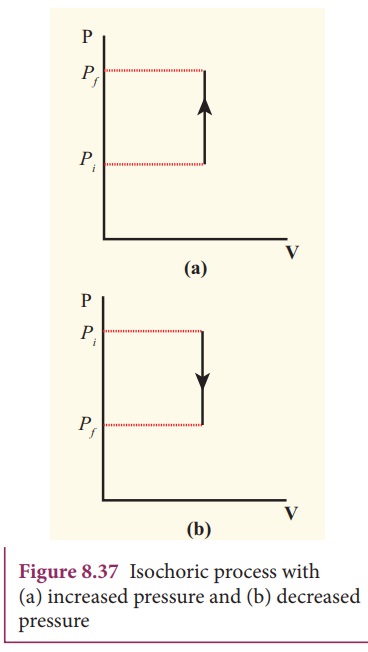
In an isochoric process, volume remains constant.

[
W = 0
]

Therefore:

[
\Delta U = Q
]

Heat added directly changes internal energy.

Example:

Heating gas in a rigid container.


Isobaric Process

Image
Image
Image
Image

In an isobaric process, pressure remains constant.

Work done:

[
W = P(V_2 – V_1)
]

The heat added is partly used for:

  • Increasing internal energy
  • Doing work

Applications of the First Law of Thermodynamics

Image
Image
Image
Image

The First Law has many practical applications.

Heat Engines

Heat engines convert thermal energy into mechanical work.

Examples:

  • Steam engines
  • Car engines
  • Gas turbines

Refrigerators

Refrigerators use work to transfer heat from cold regions to warm surroundings.

Power Plants

Thermal power plants convert heat from fuel into electricity.

Biological Systems

Human metabolism follows energy conservation principles.


Limitations of the First Law

The First Law has some limitations.

It does not explain:

  • Direction of heat flow
  • Why heat flows from hot to cold
  • Efficiency limits of engines

These questions are addressed by the Second Law of Thermodynamics.


Importance of the First Law

The First Law is one of the most important scientific principles because it:

  • Establishes energy conservation
  • Connects mechanical and thermal energy
  • Forms the basis of thermodynamic analysis
  • Helps design engines, turbines, and refrigerators
  • Explains chemical energy transformations

Conclusion

The First Law of Thermodynamics expresses the fundamental principle of energy conservation in thermodynamic systems. It states that energy can neither be created nor destroyed but can only be transformed between different forms such as heat, work, and internal energy.

The law provides a mathematical relationship that allows scientists and engineers to analyze energy changes in physical and chemical processes. By understanding how heat and work influence internal energy, we can design machines, engines, power plants, and refrigeration systems that operate efficiently.

Although the First Law does not explain the direction of energy flow or the efficiency limits of energy conversion, it remains the foundation of thermodynamics and energy science.


Tags

Heat Transfer: Conduction, Convection, and Radiation

Image
Image
Image
Image

1. Introduction to Heat Transfer

Heat transfer is a fundamental process in physics and thermodynamics that explains how thermal energy moves from one object or region to another. Whenever there is a temperature difference between two bodies or areas, heat energy flows from the hotter region to the colder region until thermal equilibrium is reached.

Heat transfer plays a vital role in both natural processes and technological systems. It influences weather patterns, ocean currents, climate systems, biological processes, industrial manufacturing, and household appliances. For example, heat transfer occurs when water boils in a pot, when the Sun warms the Earth, when an engine converts heat into mechanical energy, and when a refrigerator removes heat from food to keep it cold.

There are three primary mechanisms through which heat transfer occurs:

  1. Conduction
  2. Convection
  3. Radiation

Each of these processes operates under different physical principles and occurs in different environments. Conduction involves heat transfer through direct contact between particles. Convection involves heat transfer through the movement of fluids such as liquids or gases. Radiation involves the transfer of heat through electromagnetic waves and does not require a medium.

Understanding heat transfer is essential in many areas of science and engineering, including mechanical engineering, environmental science, architecture, electronics, and energy systems.


2. Concept of Heat Transfer

Heat transfer occurs whenever there is a difference in temperature between two systems.

According to thermodynamics:

Heat always flows from a region of higher temperature to a region of lower temperature.

This flow continues until both systems reach the same temperature, a condition known as thermal equilibrium.

The rate and efficiency of heat transfer depend on several factors such as:

  • Temperature difference
  • Material properties
  • Surface area
  • Distance between objects
  • Nature of the medium

Heat transfer mechanisms explain how energy moves within solids, liquids, gases, and even empty space.


3. Conduction

Image
Image
Image
Image

3.1 Definition of Conduction

Conduction is the transfer of heat through a material without the movement of the material as a whole.

In conduction, heat energy is transferred through microscopic collisions between atoms, molecules, or electrons.

This process occurs primarily in solids, where particles are closely packed.


3.2 Mechanism of Conduction

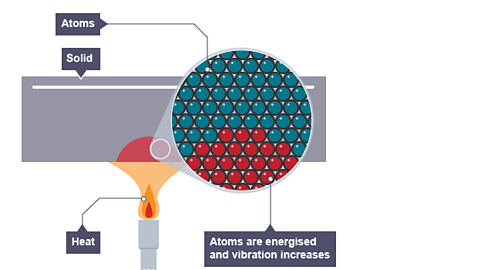
When one part of a solid is heated:

  1. The particles in that region gain kinetic energy.
  2. These particles vibrate more vigorously.
  3. They collide with neighboring particles.
  4. Energy is transferred through the material.

Thus heat gradually spreads from the hot region to the cooler region.

In metals, conduction occurs very efficiently because free electrons carry energy quickly through the material.


3.3 Thermal Conductivity

The ability of a material to conduct heat is called thermal conductivity.

Materials with high thermal conductivity transfer heat rapidly.

Examples of good conductors include:

  • Copper
  • Aluminum
  • Silver
  • Iron

Materials with low thermal conductivity are called insulators.

Examples include:

  • Wood
  • Plastic
  • Rubber
  • Air

These materials resist the flow of heat and are used in thermal insulation.


3.4 Mathematical Description of Conduction

Heat conduction is described by Fourier’s Law.

Heat transfer rate:

Q/t = kA (ΔT / L)

Where:

Q = heat transferred
t = time
k = thermal conductivity
A = cross-sectional area
ΔT = temperature difference
L = length of material

This equation shows that heat transfer increases with larger temperature difference and larger surface area.


3.5 Examples of Conduction

Common examples include:

  • A metal spoon becoming hot in a cup of tea.
  • Iron rods heating when placed in a fire.
  • Cooking utensils transferring heat from stove to food.
  • Heat traveling through walls of buildings.

Conduction is very important in engineering applications such as heat exchangers and thermal insulation.


4. Convection

Image
Image
Image
Image

4.1 Definition of Convection

Convection is the transfer of heat through the movement of fluids such as liquids and gases.

Unlike conduction, convection involves the bulk motion of matter.

When a fluid is heated, its density decreases and it rises. Cooler fluid then moves in to replace it, creating a continuous circulation pattern called convection currents.


4.2 Mechanism of Convection

The process of convection occurs in several steps:

  1. A fluid near a heat source becomes warmer.
  2. Warm fluid expands and becomes less dense.
  3. The warm fluid rises upward.
  4. Cooler fluid moves downward to replace it.
  5. This circulation continues, transferring heat through the fluid.

4.3 Types of Convection

Natural Convection

Natural convection occurs due to density differences caused by temperature variations.

Examples include:

  • Warm air rising above heaters
  • Ocean currents
  • Atmospheric circulation

Forced Convection

Forced convection occurs when an external force moves the fluid.

Examples include:

  • Fans cooling electronic devices
  • Pumps circulating coolant in engines
  • Air conditioning systems

Forced convection increases the rate of heat transfer.


4.4 Examples of Convection

Convection occurs in many everyday situations.

Examples include:

  • Boiling water in a pot
  • Warm air rising from heaters
  • Sea breezes and land breezes
  • Circulation of air in rooms

Convection is also responsible for large-scale phenomena such as weather systems and ocean currents.


5. Radiation

Image
Image
Image
Image

5.1 Definition of Radiation

Radiation is the transfer of heat through electromagnetic waves.

Unlike conduction and convection, radiation does not require a medium.

Heat can travel through empty space via radiation.


5.2 Mechanism of Radiation

All objects emit electromagnetic radiation due to the thermal motion of their particles.

The amount of radiation depends on:

  • Temperature of the object
  • Surface properties
  • Area of the object

Hotter objects emit more radiation.


5.3 Thermal Radiation

Thermal radiation includes infrared radiation emitted by objects.

Examples include:

  • Heat from the Sun reaching Earth
  • Heat felt from a fire
  • Warmth from a heater

Even human bodies emit infrared radiation.


5.4 Stefan–Boltzmann Law

Radiated energy depends on temperature.

The Stefan–Boltzmann law states:

E = σT⁴

Where:

E = energy emitted
σ = Stefan–Boltzmann constant
T = absolute temperature

This law shows that radiation increases rapidly with temperature.


6. Comparison of Conduction, Convection, and Radiation

These three heat transfer mechanisms differ in several ways.

Conduction occurs mainly in solids through particle collisions.

Convection occurs in liquids and gases through fluid motion.

Radiation occurs through electromagnetic waves and can occur even in vacuum.

Conduction and convection require a medium, while radiation does not.

Each method plays a role in different physical situations.


7. Heat Transfer in Everyday Life

Heat transfer affects many daily activities.

Examples include:

  • Cooking food on a stove
  • Heating rooms with radiators
  • Sunlight warming the Earth
  • Cooling systems in vehicles
  • Refrigeration systems

Engineers use knowledge of heat transfer to design efficient appliances and energy systems.


8. Heat Transfer in Nature

Heat transfer processes drive many natural phenomena.

Examples include:

  • Ocean currents distributing heat around the planet
  • Atmospheric circulation causing winds
  • Formation of clouds and storms
  • Solar radiation heating Earth’s surface

Without heat transfer, life on Earth would not be possible.


9. Applications of Heat Transfer

Understanding heat transfer is essential in many technological fields.

Applications include:

  • Power plants generating electricity
  • Cooling systems for computers
  • Thermal insulation in buildings
  • Aerospace engineering
  • Solar energy systems

Efficient heat transfer management improves energy efficiency and safety.


Conclusion

Heat transfer is a fundamental concept in physics that describes how thermal energy moves from one place to another due to temperature differences. The three primary mechanisms of heat transfer are conduction, convection, and radiation.

Conduction transfers heat through direct particle interactions in solids. Convection transfers heat through the movement of fluids such as liquids and gases. Radiation transfers heat through electromagnetic waves and can occur even in a vacuum.

These processes are essential for understanding natural phenomena, industrial processes, and everyday activities. From climate systems to cooking, from power generation to space technology, heat transfer plays a critical role in shaping the physical world.

By studying heat transfer, scientists and engineers develop technologies that improve energy efficiency, environmental sustainability, and technological innovation.


Tags: