
Trigonometry
1. Introduction to Trigonometry


Trigonometry is a branch of mathematics that studies the relationships between the angles and sides of triangles, especially right-angled triangles.
The word trigonometry comes from the Greek words:
- “trigonon” – meaning triangle
- “metron” – meaning measure
Thus, trigonometry literally means “measurement of triangles.”
Trigonometry helps us determine unknown sides and angles of triangles using special ratios called trigonometric functions. These functions are fundamental in mathematics, physics, engineering, astronomy, architecture, navigation, and many other scientific fields.
The basic trigonometric functions are:
- Sine (sin)
- Cosine (cos)
- Tangent (tan)
- Cosecant (csc)
- Secant (sec)
- Cotangent (cot)
Trigonometry is essential for studying waves, oscillations, circular motion, and distances that cannot be measured directly.
2. History of Trigonometry



Trigonometry developed gradually over thousands of years through the work of mathematicians from different civilizations.
Ancient Civilizations
Early concepts related to trigonometry existed in:
- Egypt
- Babylon
- China
- India
Egyptians used geometric ratios to calculate pyramid slopes.
Greek Contributions
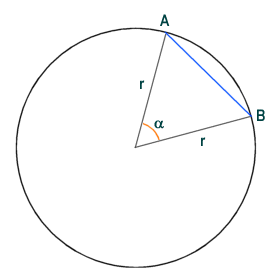
The Greek astronomer Hipparchus (190–120 BCE) is often called the father of trigonometry. He created the first known trigonometric tables based on chord lengths in circles.
Later, Ptolemy expanded these ideas and created more accurate mathematical tables.
Indian Contributions
Indian mathematicians such as Aryabhata developed early forms of sine and cosine functions, which later influenced Arabic and European mathematics.
Islamic Scholars
Islamic mathematicians expanded trigonometry by introducing:
- Secant
- Cosecant
- Tangent tables
European Development
During the 16th and 17th centuries, mathematicians formalized trigonometry and developed the modern notation sin, cos, tan.
Today, trigonometry is a fundamental part of modern mathematics and science.
3. Right-Angled Triangle Basics

A right-angled triangle contains one 90° angle.
The three sides of a right triangle are:
- Hypotenuse
- Longest side
- Opposite the right angle
- Opposite side
- Opposite the given angle
- Adjacent side
- Next to the given angle
These sides form the basis of trigonometric ratios.
4. Trigonometric Ratios
The six trigonometric ratios are defined as:
1. Sine (sin)
[
sin(\theta) = \frac{Opposite}{Hypotenuse}
]
2. Cosine (cos)
[
cos(\theta) = \frac{Adjacent}{Hypotenuse}
]
3. Tangent (tan)
[
tan(\theta) = \frac{Opposite}{Adjacent}
]
These ratios relate the sides of a triangle to an angle.
The other three functions are reciprocals:
- Cosecant
[
csc(\theta)=\frac{1}{sin(\theta)}
]
- Secant
[
sec(\theta)=\frac{1}{cos(\theta)}
]
- Cotangent
[
cot(\theta)=\frac{1}{tan(\theta)}
]
5. Unit Circle in Trigonometry


The unit circle is a circle with radius = 1 centered at the origin.
It is used to extend trigonometric functions beyond right triangles.
Key concepts:
- Coordinates on the circle represent cosine and sine values
- Any point on the circle is written as:
[
(x,y)=(cos\theta,sin\theta)
]
Important angles include:
| Angle | sin | cos |
|---|---|---|
| 0° | 0 | 1 |
| 30° | 1/2 | √3/2 |
| 45° | √2/2 | √2/2 |
| 60° | √3/2 | 1/2 |
| 90° | 1 | 0 |
6. Important Trigonometric Identities
Trigonometric identities are equations that are always true.
1. Pythagorean Identity
[
sin^2\theta + cos^2\theta = 1
]
2. Tangent Identity
[
1 + tan^2\theta = sec^2\theta
]
3. Cotangent Identity
[
1 + cot^2\theta = csc^2\theta
]
Reciprocal Identities
[
sin\theta = \frac{1}{csc\theta}
]
[
cos\theta = \frac{1}{sec\theta}
]
[
tan\theta = \frac{1}{cot\theta}
]
These identities help simplify trigonometric equations and solve complex problems.
7. Laws of Trigonometry
Law of Sines
[
\frac{a}{sinA} = \frac{b}{sinB} = \frac{c}{sinC}
]
Used when:
- Two angles and one side are known.
Law of Cosines
[
c^2 = a^2 + b^2 – 2ab cosC
]
Used when:
- Two sides and included angle are known.
These laws help solve any triangle, not just right triangles.
8. Trigonometry Graphs


Trigonometric functions produce periodic graphs.
Sine Graph
- Smooth wave
- Period = 360° or (2\pi)
Cosine Graph
- Similar to sine
- Starts at maximum value
Tangent Graph
- Repeating pattern
- Vertical asymptotes
These graphs are used in studying waves, oscillations, and signal processing.
9. Example Problems
Example 1: Find sin θ
If:
Opposite = 4
Hypotenuse = 5
[
sin\theta = \frac{4}{5}
]
Example 2: Find the Height of a Tower
A ladder makes an angle 30° with the ground and reaches a wall.
Length of ladder = 10 m
Using sine:
[
sin30° = \frac{height}{10}
]
[
\frac{1}{2} = \frac{height}{10}
]
Height = 5 m
Example 3: Using Tangent
If:
Angle = 45°
Adjacent = 6
[
tan45° = \frac{Opposite}{6}
]
[
1 = \frac{Opposite}{6}
]
Opposite = 6
10. Applications of Trigonometry

Trigonometry has many real-life applications.
1. Architecture
Used to design:
- Bridges
- Buildings
- Towers
2. Astronomy
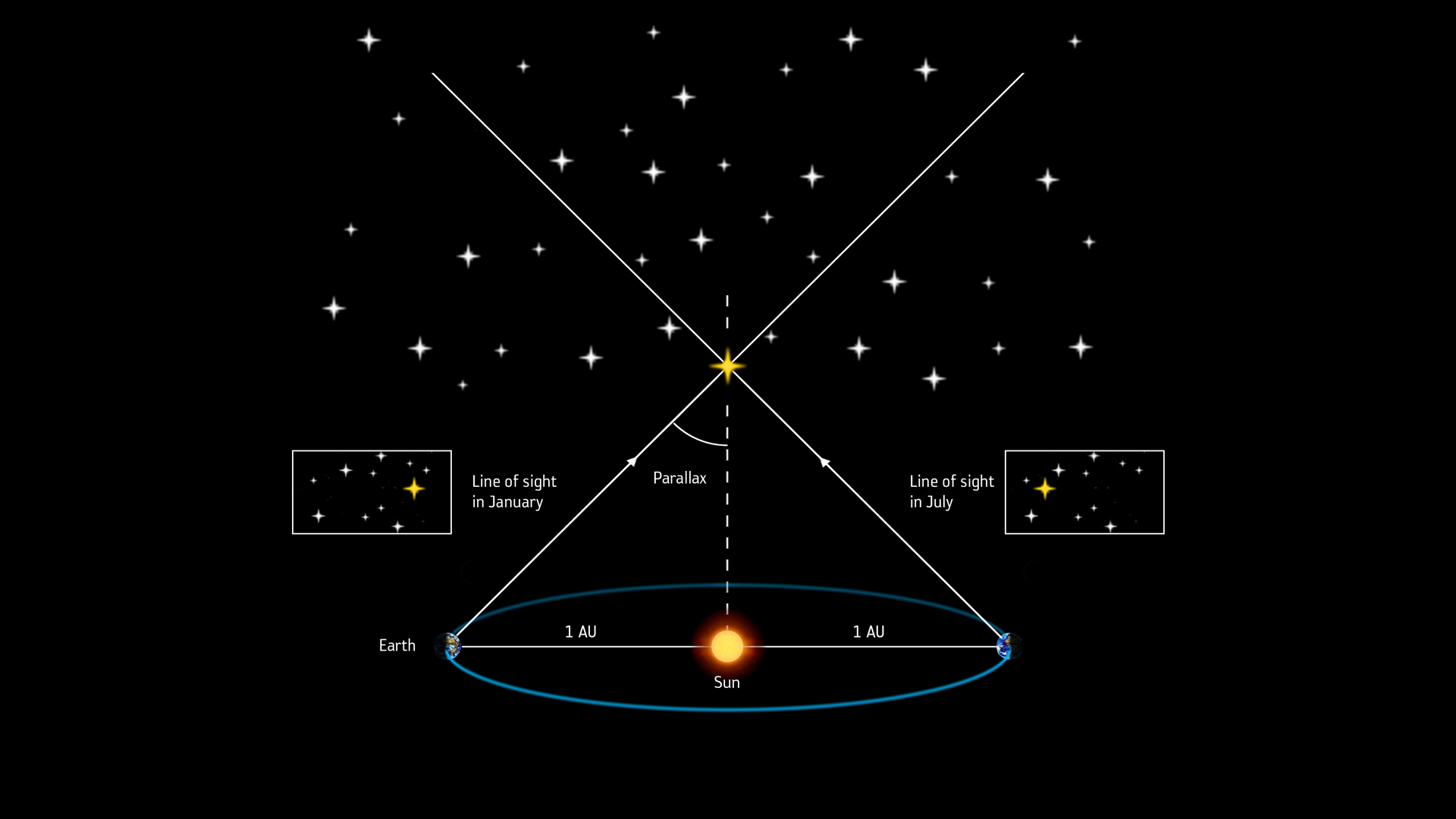
Used to calculate distances between stars and planets.
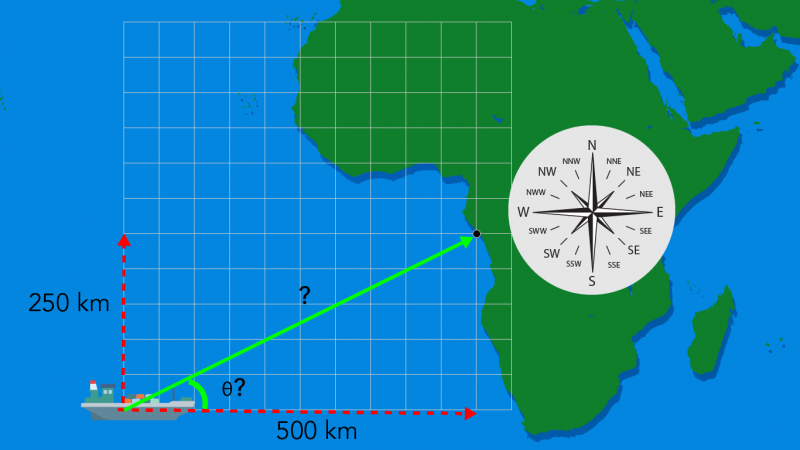
3. Navigation
Used in:
- Ships
- Airplanes
- GPS systems
4. Physics
Used to analyze:
- Waves
- Sound
- Light
5. Engineering
Engineers use trigonometry to design:
- Machines
- Roads
- Electronics
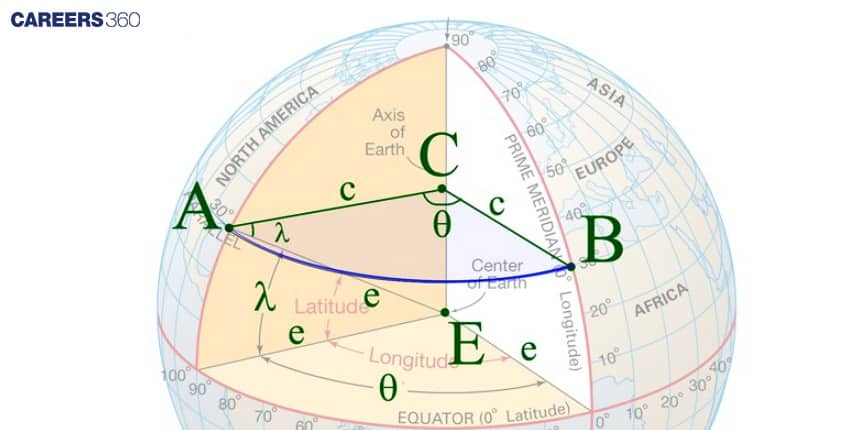
6. Geography and Surveying
Used to calculate heights and distances without measuring directly.
11. Importance of Trigonometry
Trigonometry is important because it helps:
- Solve real-world measurement problems
- Understand circular motion
- Study waves and oscillations
- Analyze periodic phenomena
- Develop advanced mathematics such as calculus
Many modern technologies rely on trigonometric principles.
12. Conclusion
Trigonometry is a fundamental branch of mathematics that deals with the relationships between angles and sides of triangles. From ancient civilizations to modern science, it has played an essential role in solving problems involving distance, height, and angles.
By understanding trigonometric ratios, identities, graphs, and laws, students and researchers can solve complex mathematical and real-world problems.
Today, trigonometry is widely used in engineering, astronomy, architecture, navigation, and physics, making it one of the most practical areas of mathematics.