

Tags:
Percentages in Mathematics
Percentages are one of the most widely used mathematical concepts in everyday life. The term percentage means “per hundred,” and it expresses a quantity as a fraction of 100. Percentages allow us to compare values, represent proportions, and interpret data in an easy and standardized form.
Percentages are used in various fields such as finance, economics, statistics, business, science, and education. From calculating discounts in stores to determining interest rates in banks, percentages play a critical role in real-world applications.
Understanding percentages also helps people interpret statistical information, analyze changes in quantities, and make informed decisions based on numerical data.
In mathematics, percentages are closely related to fractions and decimals, and they can easily be converted between these different numerical forms.
1. Definition of Percentage
A percentage is a number expressed as a fraction of 100.
The word percentage comes from the Latin phrase “per centum,” which means “out of one hundred.”
The symbol used for percentage is:
%
For example:
25% means 25 out of 100.
Mathematically:
25% = 25/100
This can also be written as:
0.25
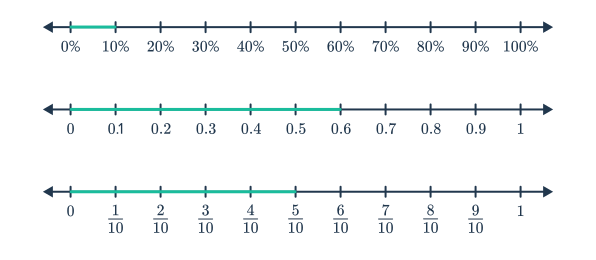
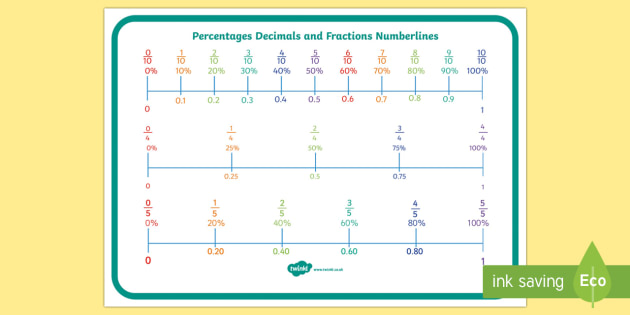
Thus, percentages can be represented in three forms:
- fraction
- decimal
- percent
2. Understanding Percentages
Percentages represent parts of a whole where the whole equals 100.
Example:
If 60 out of 100 students passed an exam, the percentage of students who passed is:
60%
This means 60 parts out of 100.
Visual Interpretation
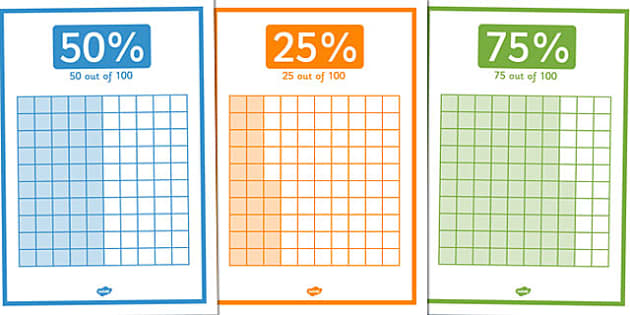
Percentages are often illustrated using diagrams such as:
- pie charts
- bar charts
- grids with 100 squares
For example:
50% of a pie chart represents half of the circle.
75% represents three quarters of the circle.
These visual models help people easily understand proportions.
3. Converting Between Fractions, Decimals, and Percentages
Percentages can easily be converted into fractions and decimals.
Percentage to Fraction
To convert a percentage to a fraction:
Write the percentage over 100 and simplify.
Example:
40%
40/100
Simplified:
2/5
Percentage to Decimal
To convert a percentage to a decimal:
Divide by 100.
Example:
75%
75 ÷ 100 = 0.75
Fraction to Percentage
Multiply the fraction by 100.
Example:
1/4
1/4 × 100 = 25%
Decimal to Percentage
Multiply the decimal by 100.
Example:
0.6
0.6 × 100 = 60%
4. Common Percentage Values
Some percentages are commonly used and easily recognized.
| Percentage | Fraction | Decimal |
|---|---|---|
| 50% | 1/2 | 0.5 |
| 25% | 1/4 | 0.25 |
| 75% | 3/4 | 0.75 |
| 10% | 1/10 | 0.1 |
| 20% | 1/5 | 0.2 |
These values frequently appear in everyday calculations.
5. Calculating Percentages


The basic formula for calculating a percentage is:
Percentage = (Part / Whole) × 100
Example
Suppose a class has 40 students, and 30 passed the exam.
Part = 30
Whole = 40
Percentage = (30/40) × 100
Percentage = 75%
Thus, 75% of students passed the exam.
6. Finding a Percentage of a Number
To find a percentage of a number:
Convert the percentage to decimal and multiply.
Example:
Find 20% of 150.
Step 1:
20% = 0.20
Step 2:
0.20 × 150 = 30
Answer:
30
Example:
Find 15% of 200.
15% = 0.15
0.15 × 200 = 30
7. Percentage Increase


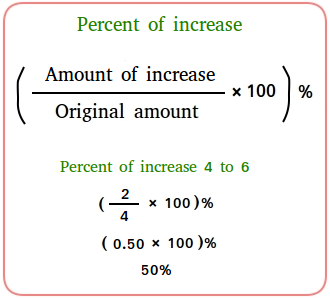
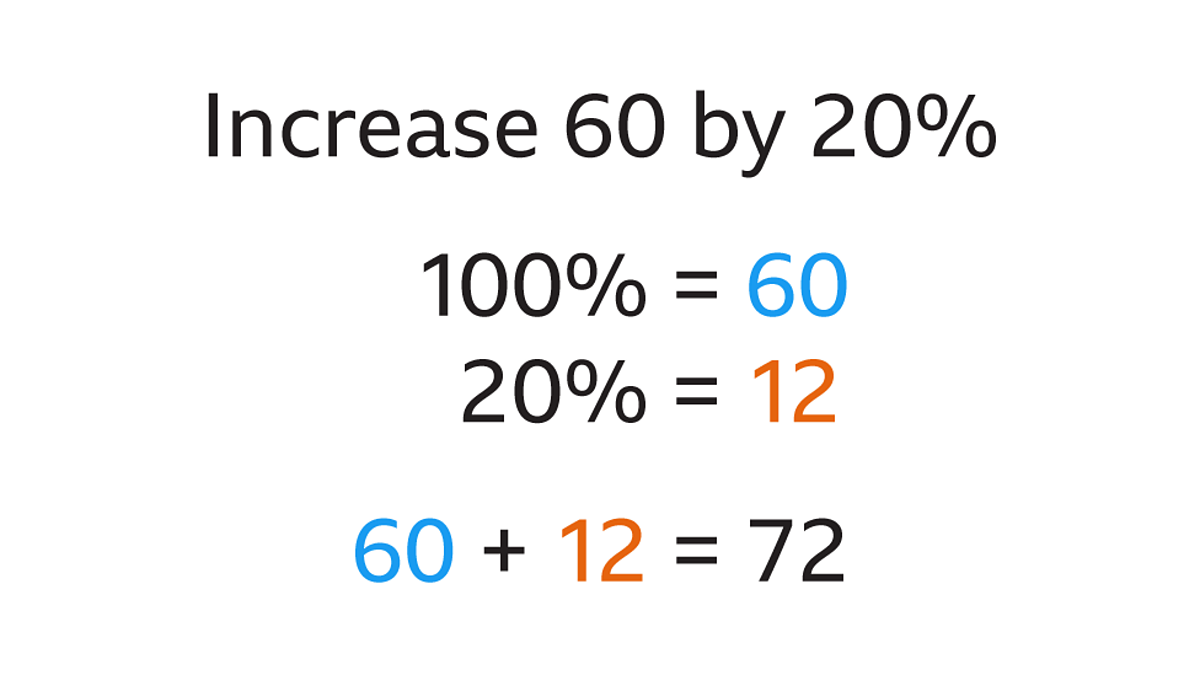
Percentage increase measures how much a quantity grows compared to its original value.
Formula:
Percentage Increase = (Increase / Original Value) × 100
Example
Original price = $50
New price = $65
Increase:
65 − 50 = 15
Percentage increase:
(15/50) × 100 = 30%
Thus, the price increased by 30%.
8. Percentage Decrease


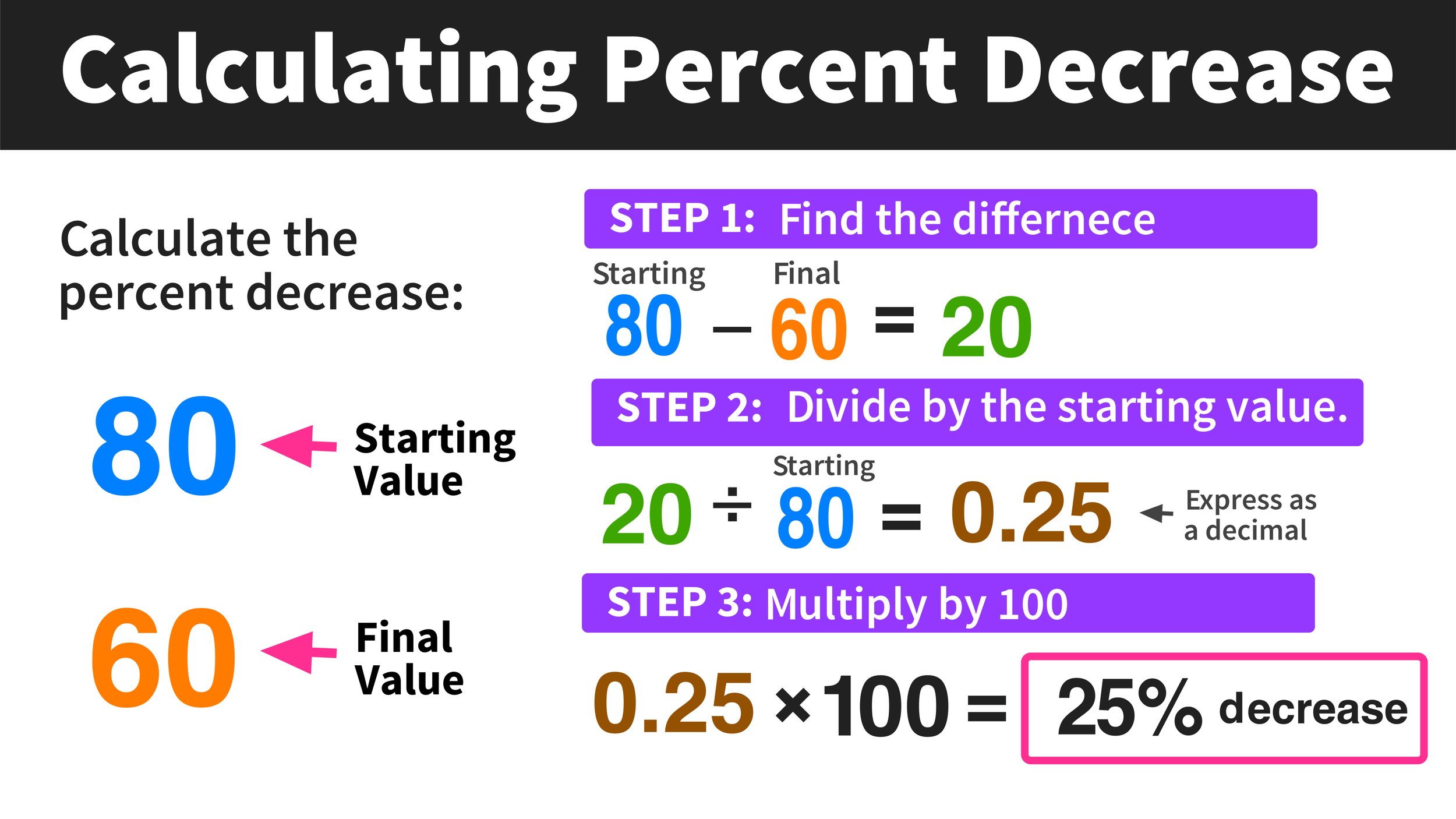
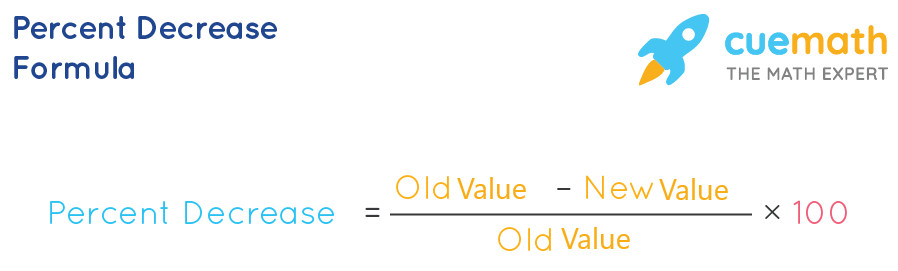
Percentage decrease measures how much a quantity decreases relative to the original value.
Formula:
Percentage Decrease = (Decrease / Original Value) × 100
Example
Original value = 80
New value = 60
Decrease:
80 − 60 = 20
Percentage decrease:
(20/80) × 100 = 25%
Thus, the value decreased by 25%.
9. Percentage Change
Percentage change describes the overall change between two values.
Formula:
Percentage Change = (New Value − Original Value / Original Value) × 100
This value may be positive (increase) or negative (decrease).
10. Applications of Percentages
Percentages are widely used in real-world situations.
Discounts in Shopping
Stores often offer discounts using percentages.
Example:
20% discount on a $100 item.
Discount amount:
20% of 100 = 20
New price:
100 − 20 = 80
Banking and Interest
Banks use percentages to calculate interest rates.
Example:
5% annual interest on savings.
Taxes
Governments use percentage rates to calculate taxes.
Example:
10% sales tax.
Statistics
Percentages help interpret data.
Example:
Population growth rates.
Education
Grades are often expressed as percentages.
Example:
85% score on an exam.
11. Percentage in Data Representation


Percentages are commonly used in data visualization.
Common charts include:
- pie charts
- bar graphs
- percentage grids
Example:
If 40% of people prefer tea and 60% prefer coffee, a pie chart clearly shows the difference.
These visualizations help communicate information effectively.
12. Percentages in Business
Businesses rely heavily on percentage calculations.
Examples include:
- profit percentage
- loss percentage
- growth rate
- market share
Profit Percentage
Profit percentage formula:
Profit % = (Profit / Cost Price) × 100
Loss Percentage
Loss % = (Loss / Cost Price) × 100
13. Percentages in Science
In science, percentages are used to express concentrations.
Examples:
- chemical solutions
- humidity
- probability
Example:
A solution may contain 10% salt.
14. Percentages in Probability
Probability is often expressed as a percentage.
Example:
If the probability of rain is 0.3:
0.3 × 100 = 30%
Thus, there is a 30% chance of rain.
15. Percentages in Economics
Economists use percentages to analyze financial trends.
Examples include:
- inflation rates
- unemployment rates
- economic growth rates
These percentages help governments make economic decisions.
16. Importance of Percentages in Mathematics
Percentages are important because they:
- simplify comparisons
- express proportions clearly
- help analyze data
- support decision making
They also form the basis for advanced topics such as statistics and finance.
17. Historical Background of Percentages
The concept of percentages developed through trade and commerce.
Merchants needed a standardized way to express:
- profit margins
- interest rates
- tax calculations
Over time, percentages became a universal mathematical tool used worldwide.
18. Relationship with Ratios and Proportions
Percentages are closely related to ratios and proportions.
Example:
25%
This represents the ratio:
25 : 100
Which simplifies to:
1 : 4
Thus, percentages can be viewed as ratios with denominator 100.
19. Percentage Errors
Percentage error measures how close a measured value is to the true value.
Formula:
Percentage Error = (|Measured − True| / True) × 100
Example:
True value = 100
Measured value = 95
Error:
5
Percentage error:
5%
This concept is widely used in scientific experiments.
20. Summary
Percentages are a fundamental mathematical concept used to represent proportions out of one hundred. They provide a convenient and universal way to compare quantities, analyze data, and express numerical relationships.
Percentages can easily be converted into fractions and decimals, making them flexible tools in mathematics. They are used extensively in everyday activities such as shopping, banking, education, and statistics.
In mathematics and science, percentages help interpret information, measure changes, and communicate data clearly. Their widespread applications make them one of the most practical and essential concepts in both academic study and real-world problem solving.