

Tag Archives: Prime Numbers

Number Theory

Image
Image
Image
Image

1. Introduction to Number Theory

Number theory is a branch of mathematics that studies the properties and relationships of integers. It focuses on understanding the behavior of numbers, particularly whole numbers, and exploring patterns, structures, and relationships among them.

Number theory is often referred to as the “Queen of Mathematics” because of its deep theoretical significance and its connections to many other areas of mathematics.

Historically, number theory was studied for purely theoretical purposes, but today it has many practical applications in fields such as:

  • Cryptography
  • Computer science
  • Coding theory
  • Digital security
  • Data encryption
  • Computer algorithms

Number theory deals with concepts such as:

  • Prime numbers
  • Divisibility
  • Greatest common divisors
  • Modular arithmetic
  • Diophantine equations

These topics allow mathematicians to explore fundamental questions about numbers and their relationships.


2. Integers and Their Properties

The integers are the set of whole numbers, including negative numbers, zero, and positive numbers.

Notation:

ℤ = {…, −3, −2, −1, 0, 1, 2, 3, …}

Integers are the foundation of number theory.

Basic operations on integers include:

  • Addition
  • Subtraction
  • Multiplication
  • Division

However, division is not always possible within integers unless the result is also an integer.


3. Divisibility

Divisibility is one of the most important concepts in number theory.

An integer a divides another integer b if there exists an integer k such that:

b = a × k

Notation:

a | b

Example:

3 | 12

Because:

12 = 3 × 4

If a does not divide b, we write:

a ∤ b


4. Divisibility Rules

Certain rules help determine divisibility.

Examples:

Divisible by 2 → last digit even
Divisible by 3 → sum of digits divisible by 3
Divisible by 5 → last digit 0 or 5
Divisible by 9 → sum of digits divisible by 9

Example:

123

1 + 2 + 3 = 6

6 divisible by 3 → number divisible by 3.


5. Prime Numbers

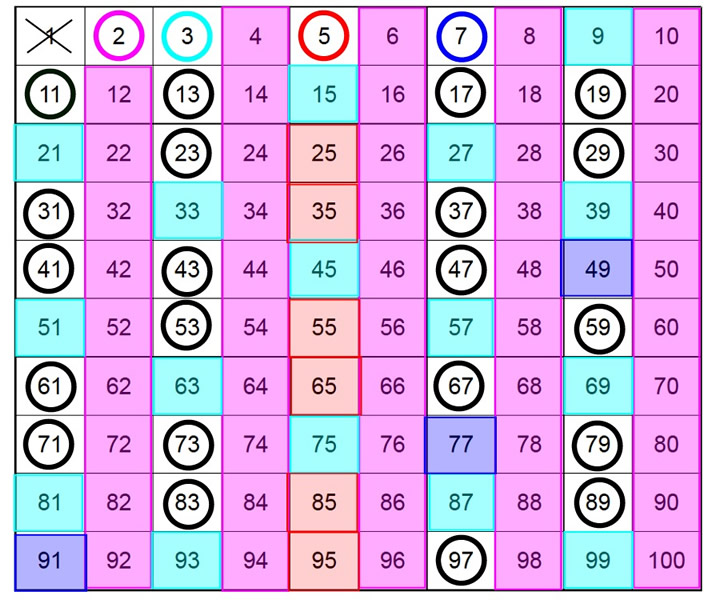
A prime number is a natural number greater than 1 that has exactly two divisors:

1 and itself.

Examples:

2, 3, 5, 7, 11, 13

Prime numbers are the building blocks of integers.


Composite Numbers

Numbers with more than two factors.

Example:

12 = 2 × 2 × 3

Composite numbers can be expressed as products of primes.


6. Fundamental Theorem of Arithmetic

Every integer greater than 1 can be uniquely expressed as a product of prime numbers.

Example:

60 = 2² × 3 × 5

This factorization is unique.

This theorem is fundamental in number theory.


7. Greatest Common Divisor (GCD)

The greatest common divisor of two integers is the largest integer that divides both numbers.

Example:

GCD(12,18)

Factors of 12:

1,2,3,4,6,12

Factors of 18:

1,2,3,6,9,18

GCD = 6


Euclidean Algorithm

An efficient method for finding GCD.

Example:

GCD(48,18)

48 = 18×2 + 12
18 = 12×1 + 6
12 = 6×2 + 0

GCD = 6


8. Least Common Multiple (LCM)

The least common multiple is the smallest number divisible by both numbers.

Example:

LCM(6,8)

Multiples:

6 → 6,12,18,24
8 → 8,16,24

LCM = 24


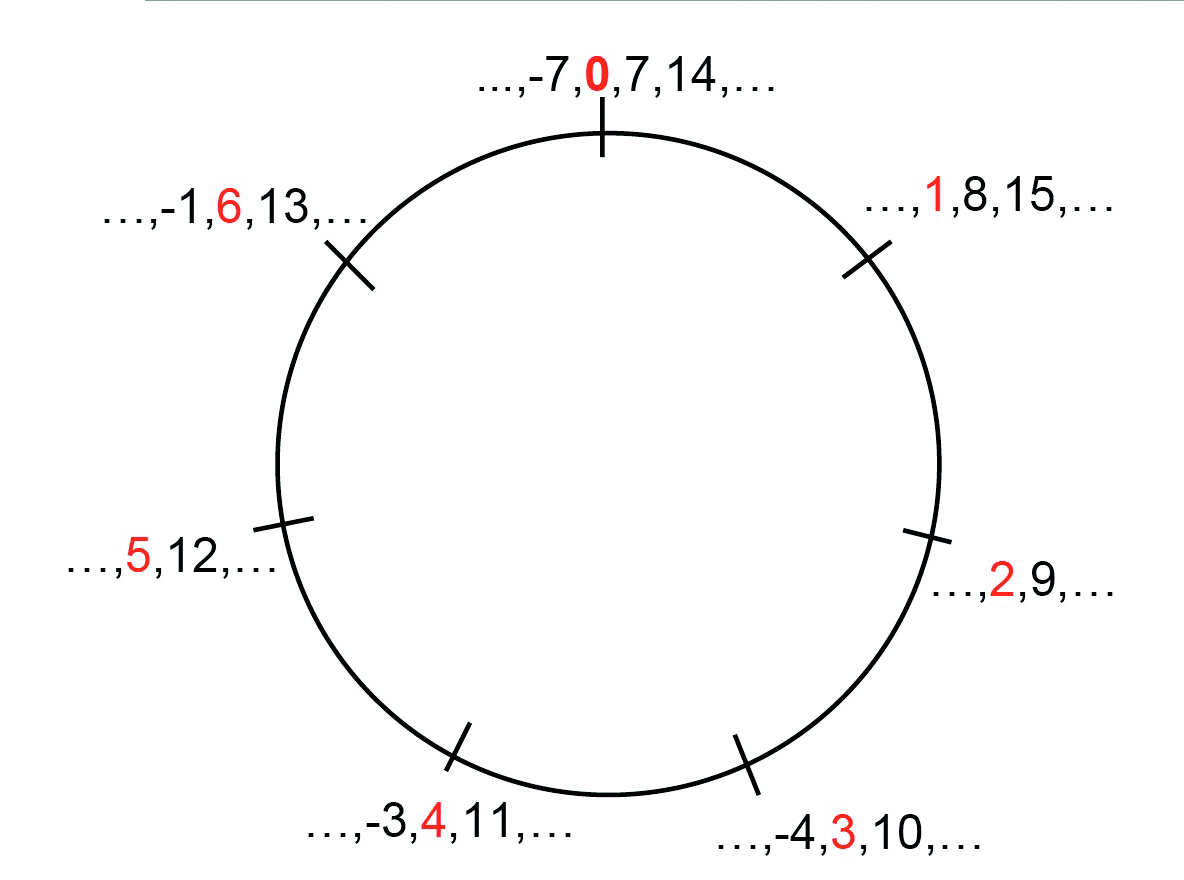
9. Modular Arithmetic

Modular arithmetic deals with remainders.

Example:

17 mod 5 = 2

Because:

17 = 5×3 + 2

Modular arithmetic is similar to clock arithmetic.


Congruence

Two numbers are congruent if they have the same remainder.

Notation:

a ≡ b (mod n)

Example:

17 ≡ 2 (mod 5)


10. Applications of Modular Arithmetic

Modular arithmetic is widely used in:

  • cryptography
  • hashing algorithms
  • computer science
  • error detection

11. Euler’s Totient Function

Euler’s function counts numbers less than n that are relatively prime to n.

Notation:

φ(n)

Example:

φ(10)

Numbers less than 10 relatively prime to 10:

1,3,7,9

φ(10) = 4


12. Fermat’s Little Theorem

If p is prime and a is not divisible by p:

a^(p−1) ≡ 1 (mod p)

Example:

2⁴ ≡ 1 (mod 5)

This theorem is widely used in cryptography.


13. Diophantine Equations

Diophantine equations involve integer solutions.

Example:

2x + 3y = 7

Solutions must be integers.

These equations appear in many number theory problems.


14. Perfect Numbers

A perfect number equals the sum of its proper divisors.

Example:

6

Divisors:

1,2,3

Sum:

1 + 2 + 3 = 6


15. Fibonacci Numbers

The Fibonacci sequence appears in number theory.

Sequence:

1,1,2,3,5,8,13…

Each number equals the sum of the previous two.


16. Cryptography and Number Theory

Modern cryptography relies heavily on number theory.

Example:

RSA encryption.

It uses large prime numbers and modular arithmetic.


17. Number Theory in Computer Science

Number theory is used in:

  • hashing algorithms
  • encryption
  • coding theory
  • data security

18. Number Theory in Coding Theory

Coding theory uses number theory for error detection.

Examples:

  • QR codes
  • digital communication systems

19. Advanced Topics in Number Theory

Some advanced topics include:

  • algebraic number theory
  • analytic number theory
  • transcendental numbers
  • prime distribution

These areas explore deeper properties of numbers.


20. Importance of Number Theory

Number theory provides insight into the fundamental nature of numbers.

It has applications in mathematics, cryptography, and computer science.

The study of primes and divisibility has led to important discoveries in modern technology.


Conclusion

Number theory is one of the oldest and most fascinating branches of mathematics, focusing on the study of integers and their properties. From basic concepts such as divisibility and prime numbers to advanced topics like modular arithmetic and Diophantine equations, number theory provides powerful tools for understanding the structure of numbers.

Although number theory was originally developed as a purely theoretical discipline, it now plays a crucial role in modern technology, particularly in cryptography and digital security. The use of prime numbers and modular arithmetic forms the backbone of many encryption systems that protect sensitive information in the digital age.

As mathematical research continues to advance, number theory remains a central area of study, offering deep insights into the patterns and relationships that govern numbers and contributing to developments in computer science, data security, and computational mathematics.


Tags

Arithmetic in Mathematics: A Comprehensive Guide

Introduction to Arithmetic

Arithmetic is one of the oldest and most fundamental branches of mathematics. It deals with numbers and the basic operations performed on them. From counting objects in ancient civilizations to performing complex financial calculations in modern economies, arithmetic forms the foundation upon which all higher mathematics is built. Every mathematical discipline—whether algebra, geometry, calculus, statistics, or number theory—relies on arithmetic principles.

The word “arithmetic” originates from the Greek word arithmos, meaning “number.” Historically, arithmetic developed alongside trade, astronomy, architecture, and engineering. Ancient civilizations such as the Egyptians, Babylonians, Greeks, Indians, and Chinese made significant contributions to arithmetic systems and methods. Today, arithmetic is introduced at an early age because it is essential not only for academic study but also for daily life activities like budgeting, measuring, shopping, and planning.

Arithmetic primarily focuses on understanding numbers, their properties, relationships, and operations. These operations include addition, subtraction, multiplication, and division. Over time, arithmetic has expanded to include fractions, decimals, percentages, ratios, proportions, exponents, roots, and more.


Types of Numbers in Arithmetic

Arithmetic works with different types of numbers. Understanding these categories is essential for mastering arithmetic.

1. Natural Numbers

Natural numbers are counting numbers:
1, 2, 3, 4, 5, and so on.
They are used for counting objects.

2. Whole Numbers

Whole numbers include all natural numbers and zero:
0, 1, 2, 3, 4, …

3. Integers

Integers include positive numbers, negative numbers, and zero:
…, -3, -2, -1, 0, 1, 2, 3, …

4. Rational Numbers

Rational numbers can be expressed as a fraction of two integers, where the denominator is not zero.
Examples: 1/2, -3/4, 5, 0.75

5. Real Numbers

Real numbers include rational and irrational numbers (like √2 and π). While arithmetic mainly focuses on rational numbers, real numbers extend arithmetic concepts further.


Fundamental Operations of Arithmetic

Arithmetic is built around four basic operations.

1. Addition

Addition combines two or more numbers to produce a sum.
Example: 5 + 3 = 8

Properties of Addition:

  • Commutative Property: a + b = b + a
  • Associative Property: (a + b) + c = a + (b + c)
  • Identity Property: a + 0 = a

Addition is used in counting totals, calculating expenses, and combining quantities.


2. Subtraction

Subtraction finds the difference between numbers.
Example: 9 − 4 = 5

Subtraction is not commutative:
5 − 3 ≠ 3 − 5

Subtraction is used to determine remaining quantities, differences in values, and financial balances.


3. Multiplication

Multiplication represents repeated addition.
Example: 4 × 3 = 12 (4 + 4 + 4)

Properties of Multiplication:

  • Commutative Property: a × b = b × a
  • Associative Property: (a × b) × c = a × (b × c)
  • Identity Property: a × 1 = a
  • Zero Property: a × 0 = 0

Multiplication is essential in scaling, area calculations, and financial growth.


4. Division

Division is the process of distributing a number into equal parts.
Example: 12 ÷ 3 = 4

Division is the inverse of multiplication.
Division by zero is undefined.


Order of Operations

When solving expressions with multiple operations, arithmetic follows the order of operations:

PEMDAS:

  • Parentheses
  • Exponents
  • Multiplication and Division (left to right)
  • Addition and Subtraction (left to right)

Example:
5 + 3 × 2 = 5 + 6 = 11


Fractions

Fractions represent parts of a whole.

Example: 3/4

Components:

  • Numerator (top number)
  • Denominator (bottom number)

Types of Fractions:

  • Proper fractions (3/5)
  • Improper fractions (7/4)
  • Mixed numbers (1 3/4)

Operations with fractions require common denominators for addition and subtraction.


Decimals

Decimals represent fractions in base-10 form.

Example:
1/2 = 0.5
3/4 = 0.75

Decimals are widely used in measurements, finance, and scientific calculations.


Percentages

A percentage represents a number out of 100.

Example:
50% = 50/100 = 0.5

Used in:

  • Discounts
  • Interest rates
  • Statistics
  • Grades

Ratios and Proportions

A ratio compares two quantities.
Example: 2:3

A proportion states that two ratios are equal.
Example:
2/3 = 4/6

Ratios and proportions are important in scaling recipes, maps, and models.


Exponents and Powers

An exponent indicates repeated multiplication.

Example:
2³ = 2 × 2 × 2 = 8

Laws of Exponents:

  • a^m × a^n = a^(m+n)
  • (a^m)^n = a^(mn)
  • a^0 = 1

Roots

Roots are the inverse of exponents.

Square root:
√16 = 4

Cube root:
∛27 = 3

Roots are used in geometry and scientific calculations.


Factors and Multiples

A factor divides a number evenly.
Example: Factors of 12 → 1, 2, 3, 4, 6, 12

A multiple is the product of a number and an integer.
Multiples of 5 → 5, 10, 15, 20…


Prime Numbers

A prime number has exactly two factors: 1 and itself.
Examples: 2, 3, 5, 7, 11

Composite numbers have more than two factors.

Prime factorization expresses a number as a product of prime numbers.

Example:
24 = 2 × 2 × 2 × 3


Greatest Common Divisor (GCD)

The largest number that divides two numbers.

Example:
GCD(12, 18) = 6


Least Common Multiple (LCM)

The smallest multiple common to two numbers.

Example:
LCM(4, 6) = 12


Arithmetic Sequences

An arithmetic sequence has a constant difference between terms.

Example:
2, 5, 8, 11…

Formula:
aₙ = a₁ + (n − 1)d


Applications of Arithmetic

Arithmetic is applied in:

  1. Finance (banking, interest, budgeting)
  2. Business (profit, loss, taxation)
  3. Science (measurements)
  4. Engineering (calculations)
  5. Education (foundational math)
  6. Daily life (shopping, cooking)

Mental Arithmetic

Mental arithmetic improves cognitive ability and speed.

Techniques include:

  • Breaking numbers into parts
  • Using rounding
  • Memorizing multiplication tables

History of Arithmetic

  • Ancient Egyptians used hieroglyphic numerals.
  • Babylonians developed base-60 systems.
  • Indians introduced the decimal system and zero.
  • Arabs transmitted the Hindu-Arabic numeral system to Europe.
  • Medieval scholars expanded arithmetic methods.

Arithmetic in Modern Education

Arithmetic is taught in stages:

  • Basic counting
  • Operations
  • Fractions and decimals
  • Word problems
  • Applied arithmetic

It builds logical reasoning and problem-solving skills.


Importance of Arithmetic

Arithmetic:

  • Forms the base of mathematics.
  • Develops logical thinking.
  • Enhances financial literacy.
  • Is essential for scientific understanding.
  • Is necessary for technological development.

Common Arithmetic Errors

  1. Ignoring order of operations.
  2. Misplacing decimal points.
  3. Division by zero.
  4. Calculation mistakes in multi-step problems.

Conclusion

Arithmetic is the cornerstone of mathematics. It is both ancient and modern, simple yet powerful. From basic counting to advanced scientific computation, arithmetic principles guide numerical reasoning. Mastery of arithmetic enables success in academics, business, science, and everyday life. It is not merely about numbers—it is about logical thinking, structured reasoning, and precise calculation.

Arithmetic continues to evolve with technology, but its core principles remain unchanged. Whether using a calculator or performing mental calculations, the foundation always lies in arithmetic.


Tags

Arithmetic, Mathematics, Basic Mathematics, Number System, Addition, Subtraction, Multiplication, Division, Fractions, Decimals, Percentages, Ratios, Proportions, Exponents, Roots, Prime Numbers, Factors, Multiples, GCD, LCM, Arithmetic Sequence, Mental Math, Mathematical Operations, Elementary Math, Numerical Calculations