


Introduction to Probability
Probability is a fundamental branch of mathematics that deals with uncertainty and randomness. It helps us measure the likelihood that a particular event will occur. In everyday life, we constantly deal with uncertain situations, whether predicting weather, playing games, investing money, or analyzing data. Probability provides the mathematical framework to quantify such uncertainties.
The concept of probability allows mathematicians, statisticians, scientists, and engineers to make predictions about events whose outcomes cannot be determined with absolute certainty. Instead of saying something will definitely happen or will never happen, probability assigns a value between 0 and 1 to describe the likelihood of an event.
- Probability = 0 → The event will never occur
- Probability = 1 → The event will definitely occur
- Probability between 0 and 1 → The event may occur with varying likelihood
For example, when flipping a fair coin, the probability of getting heads is 0.5, meaning there is a 50% chance that heads will appear.
Probability plays a crucial role in many fields such as:
- Statistics
- Artificial Intelligence
- Machine Learning
- Economics
- Engineering
- Data Science
- Finance
- Insurance
- Medicine
- Computer Science
Understanding probability allows individuals and organizations to make informed decisions when dealing with uncertain outcomes.
Basic Concepts of Probability
To understand probability properly, several fundamental concepts must be introduced.
Experiment
An experiment is any process that produces a result or outcome.
Examples include:
- Tossing a coin
- Rolling a dice
- Drawing a card from a deck
- Selecting a student randomly from a class
Each experiment produces an outcome that cannot be predicted with certainty before performing it.
Outcome
An outcome is the result of a single trial of an experiment.
Examples:
When rolling a six-sided die, the possible outcomes are:
1
2
3
4
5
6
Each of these numbers is considered an outcome.
Sample Space
The sample space represents the set of all possible outcomes of an experiment.
It is usually represented by the symbol S.
Example:
Rolling a die
S = {1, 2, 3, 4, 5, 6}
Coin toss
S = {Heads, Tails}
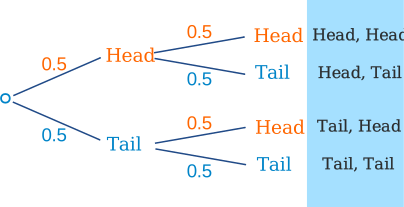
If two coins are tossed, the sample space becomes:
S = {HH, HT, TH, TT}
Event
An event is a subset of the sample space.
An event occurs when the outcome of an experiment belongs to a particular subset of outcomes.
Example:
Rolling a die
Event A = getting an even number
A = {2, 4, 6}
Event B = getting a number greater than 3
B = {4, 5, 6}
Classical Definition of Probability
The classical definition of probability states that if an experiment has n equally likely outcomes, and an event A has m favorable outcomes, then the probability of event A occurring is:
P(A) = m / n
Where:
- P(A) = Probability of event A
- m = Number of favorable outcomes
- n = Total number of possible outcomes
Example 1
Rolling a die
What is the probability of getting a 3?
Total outcomes = 6
Favorable outcomes = 1
P(3) = 1/6
Example 2
Probability of getting an even number
Favorable outcomes = {2, 4, 6}
Total outcomes = 6
P(Even) = 3/6 = 1/2
Types of Events in Probability
Simple Event
A simple event contains only one outcome.
Example:
Rolling a die and getting the number 5.
Compound Event
A compound event contains more than one outcome.
Example:
Getting an even number when rolling a die
{2,4,6}
Impossible Event
An impossible event cannot occur.
Probability = 0
Example:
Rolling a 7 with a six-sided die.
Certain Event
A certain event is guaranteed to occur.
Probability = 1
Example:
Rolling a number less than 7 on a six-sided die.
Complementary Events
Two events are complementary if one occurs when the other does not.
If event A occurs with probability P(A), then its complement A’ has probability:
P(A’) = 1 − P(A)
Example:
If probability of rain is 0.3
Probability of no rain = 1 − 0.3 = 0.7
Addition Rule of Probability
The addition rule helps calculate the probability that at least one of two events occurs.
For two events A and B:
P(A ∪ B) = P(A) + P(B) − P(A ∩ B)
Where:
- P(A ∪ B) = Probability of A or B occurring
- P(A ∩ B) = Probability of both A and B occurring
Example
Drawing a card from a deck.
Event A = drawing a king
Event B = drawing a heart
P(King) = 4/52
P(Heart) = 13/52
P(King of hearts) = 1/52
Using formula:
P(A ∪ B)
= 4/52 + 13/52 − 1/52
= 16/52
= 4/13
Multiplication Rule of Probability
The multiplication rule calculates the probability of two events happening together.
For independent events:
P(A ∩ B) = P(A) × P(B)
Example
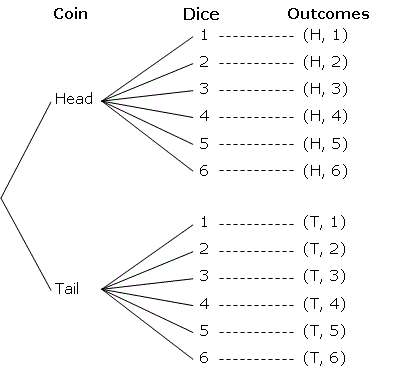
Flip a coin and roll a die.
Probability of heads = 1/2
Probability of rolling a 3 = 1/6
P(Heads and 3)
= 1/2 × 1/6
= 1/12
Independent and Dependent Events
Independent Events
Two events are independent if the occurrence of one does not affect the probability of the other.
Examples:
- Tossing two coins
- Rolling a die and tossing a coin
Example:
P(Heads and Tails)
= 1/2 × 1/2
= 1/4
Dependent Events
Two events are dependent if the outcome of one affects the probability of the other.
Example:
Drawing two cards from a deck without replacement.
Probability of first card being a king
= 4/52
After drawing one king:
Probability of second king
= 3/51
So
P(King and King)
= (4/52) × (3/51)
Conditional Probability
Conditional probability measures the probability of an event occurring given that another event has already occurred.
Formula:
P(A|B) = P(A ∩ B) / P(B)
Where:
P(A|B) = Probability of A given B.
Example
A card is drawn from a deck.
Event A = card is a king
Event B = card is a face card
Face cards = 12
Kings = 4
P(A|B)
= 4/12
= 1/3
Random Variables
A random variable assigns numerical values to outcomes of a random experiment.
Two types exist:
- Discrete random variables
- Continuous random variables
Discrete Random Variables
Discrete variables take countable values.
Examples:
- Number of heads in coin toss
- Number of students in class
- Number of defective products
Example:
Number of heads when tossing two coins
Values = 0, 1, 2
Continuous Random Variables
Continuous variables take values within a continuous range.
Examples:
- Height
- Weight
- Temperature
- Time
They can take infinite values within an interval.
Probability Distribution
A probability distribution describes how probabilities are assigned to values of a random variable.
Example:
Distribution for number of heads when tossing two coins:
| Heads | Probability |
|---|---|
| 0 | 1/4 |
| 1 | 1/2 |
| 2 | 1/4 |
Important Probability Distributions
Binomial Distribution
The binomial distribution describes the number of successes in repeated independent trials.
Conditions:
- Fixed number of trials
- Only two outcomes (success or failure)
- Probability remains constant
Formula:
P(X = k) = nCk p^k (1-p)^(n-k)
Example:
Flipping a coin 5 times.
Normal Distribution


The normal distribution, also called the Gaussian distribution, is one of the most important probability distributions in statistics.
It forms a bell-shaped curve.
Characteristics:
- Mean = Median = Mode
- Symmetrical distribution
- Defined by mean and standard deviation
Many natural phenomena follow normal distribution:
- Human heights
- IQ scores
- Measurement errors
- Exam scores
Law of Large Numbers
The law of large numbers states that as the number of trials increases, the experimental probability approaches the theoretical probability.
Example:
If a coin is flipped many times, the proportion of heads approaches 0.5.
Bayes’ Theorem
Bayes’ theorem describes how probabilities change when new information becomes available.
Formula:
P(A|B) = (P(B|A) × P(A)) / P(B)
Applications:
- Medical diagnosis
- Machine learning
- Spam filtering
- Risk assessment
Example:
Updating probability of disease after test results.
Applications of Probability
Probability is widely used across various domains.
Gambling and Games
Probability determines fairness and outcomes in games such as:
- Poker
- Roulette
- Dice games
- Lottery
Game strategies often rely on probability calculations.
Weather Forecasting
Meteorologists use probability models to estimate chances of rain, storms, or other weather events.
Example:
70% chance of rain means rain is expected in 70% of similar weather conditions.
Insurance Industry
Insurance companies rely heavily on probability.
They calculate:
- Risk of accidents
- Life expectancy
- Probability of illness
Premiums are based on probability analysis.
Artificial Intelligence
AI and machine learning use probability in:
- Predictive models
- Bayesian networks
- Decision-making algorithms
Probability helps machines deal with uncertain information.
Finance and Investments
Investors use probability models to evaluate:
- Risk
- Market trends
- Portfolio performance
Probability helps estimate expected returns and potential losses.
Medicine
Doctors use probability in:
- Disease diagnosis
- Clinical trials
- Treatment success rates
Medical tests often involve conditional probabilities.
Probability in Data Science
Probability is a core component of data science.
Applications include:
- Predictive modeling
- Hypothesis testing
- Statistical inference
- Machine learning algorithms
Algorithms such as Naive Bayes directly rely on probability theory.
Probability in Computer Science
Probability helps solve problems such as:
- Randomized algorithms
- Cryptography
- Network reliability
- AI search algorithms
Example:
Monte Carlo simulations use probability to approximate solutions.
Misinterpretations of Probability
People often misunderstand probability.
Common mistakes include:
Gambler’s Fallacy
Belief that past outcomes affect future independent events.
Example:
Thinking that a coin must land heads after several tails.
In reality, each flip is independent.
Misunderstanding Risk
Low probability events may still occur.
Example:
Winning lottery is extremely unlikely but still possible.
Importance of Probability Education
Studying probability improves:
- Decision making
- Risk management
- Critical thinking
- Statistical literacy
It helps individuals understand uncertainty in real-world situations.
Future of Probability
Probability continues to play a major role in modern technology.
Important areas include:
- Artificial Intelligence
- Big Data Analytics
- Quantum Computing
- Financial Engineering
- Climate Modeling
As technology advances, probability theory will become even more important for analyzing complex systems and uncertain environments.
Conclusion
Probability is a powerful mathematical concept that helps quantify uncertainty and analyze random events. From simple experiments like tossing a coin to complex machine learning algorithms, probability forms the backbone of decision-making under uncertainty.
It provides tools to measure likelihood, analyze risks, and make predictions about future events. The study of probability includes concepts such as sample space, events, conditional probability, distributions, and statistical inference.
Its applications extend across numerous fields including science, engineering, finance, medicine, artificial intelligence, and everyday life.
By understanding probability, individuals gain the ability to interpret data, make informed decisions, and navigate uncertainty with mathematical confidence.